PC 308 From Pillar to Post

I could image this English saying to mean unconnected items to scribble about, as a pillar is not the same as a post, but the reality is different! It actually originates from the game of ‘real tennis’ (Note 1) and was first used in 1420 when it was ‘from post to pillar’! Its modern meaning describes someone who is being driven, hounded or chased from one place to another, is being harassed. Certainly not harassed about writing this week’s post, but don’t you just love how some sayings get hijacked to mean something completely different from their origin?

There is a tenuous theme to today’s post and it’s sand, as in the mixture of small grains of rock and granular materials, finer than gravel and coarser than silt, generally found at the seaside.
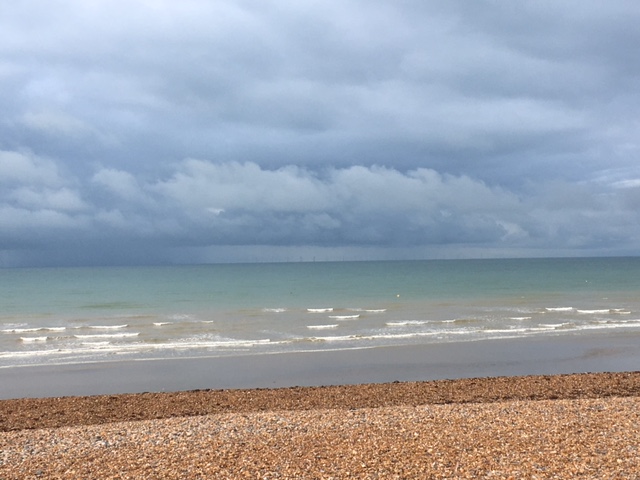
Our beach at low tide

Here on the Sussex coast at Hove the yellow stuff is only visible at low water. Normally the beach consists of small to medium pebbles, which make walking down to the water’s edge a slightly tricky operation and sitting on it without padding uncomfortable, unless you have your own built-in upholstery. The upside is that you don’t get sand inside your swimming costume or in your sandwiches!

When I first sailed offshore I started taking more of an interest in weather forecasting, as it played a hugely important part in any voyage. The ‘Shipping Forecast’ became de rigueur before any trip and I can recite the various sea areas around the UK, in their order, in my sleep: “…… Dogger, German Bight, Humber, Thames, Dover, Wight etc etc”. Paul Simons writes a column in The Times called Weather Eye and he’s good at researching for instance, comparisons with current weather, quoting weather folk lore and its accuracy or informing me that the earthy smell after it’s rained is called petrichor. I hope he won’t mind me quoting verbatim his recent piece about Red Crabs and their march across the sand, as it’s nature at its best and I couldn’t write it better:
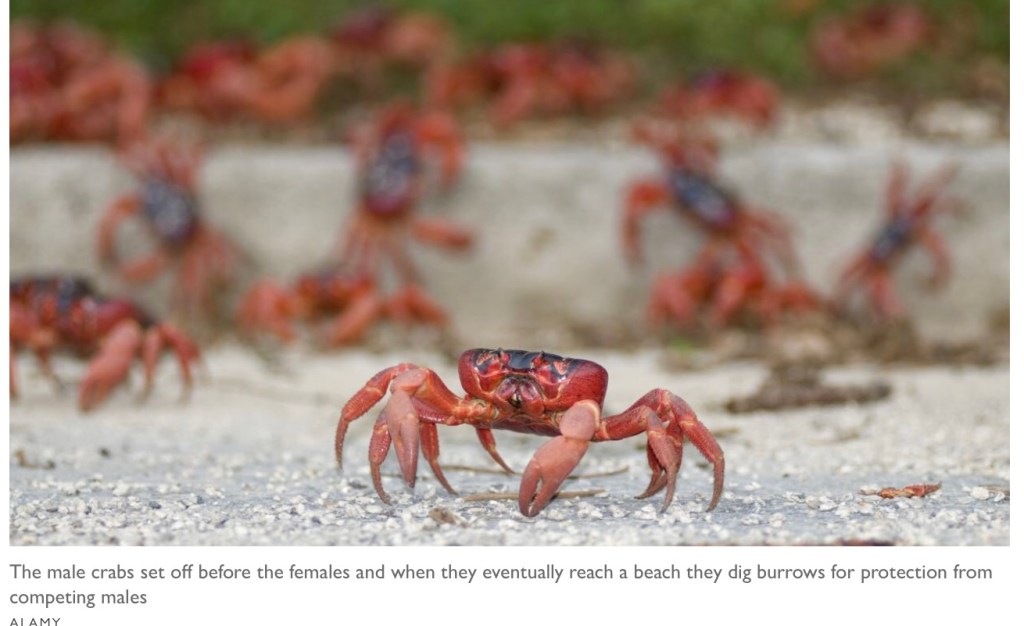
(Photo from Alamy)

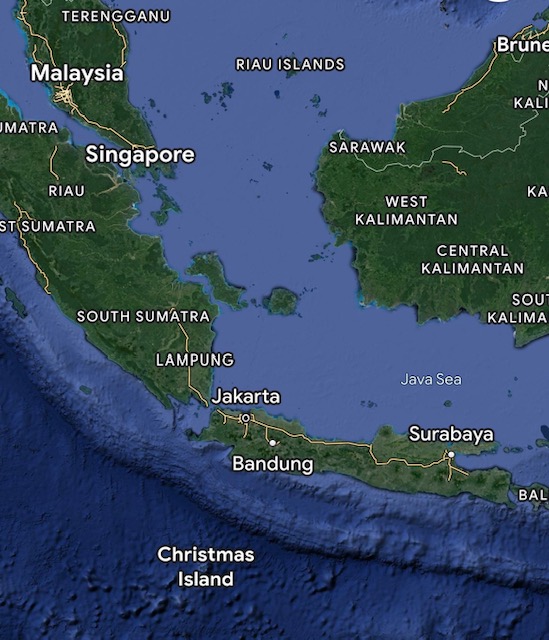
“Swarms of brilliant red land crabs are on the march across Christmas Island in the Indian Ocean (see photo). Up to 50 million crabs are swarming in a crimson carpet towards the sea in one of the natural world’s most epic migrations. The signal for this mass movement is the arrival of the first rains of the wet season at about this time and this year the migration kicked off when heavy rains fell on October 22; the speed of the migration then depends on the timing of the rains.
Most of their lives the red crabs live in forests, where they shelter from the sun as well as performing valuable forestry services, digging and fertilising the soil and keeping weeds in check. But the start of the wet season is the signal for all of them to scuttle off to the coast to spawn.

The male crabs set off before the females and when they eventually reach a beach they dig burrows for protection from competing males. When the females arrive, they mate before the males return to the forest, leaving the females to incubate the eggs. Then, with uncanny accuracy, the females wait until the moon reaches its last quarter and the high tide starts to turn before dawn. The females all leave their burrows laden with their eggs, mass along the shoreline, move into the sea and release the eggs. The eggs hatch as they touch the salt water and the crab larvae begin their initial growth stage in the ocean. As for the female crabs, once they have released their eggs, they turn around and return to the forest.”

Absolutely amazing!!

My brother announced some weeks ago he and his wife were off to Slapton in Devon, just to the South West of Dartmouth, for a Memorial Lunch. The name meant nothing to me so I went onto Google Maps:
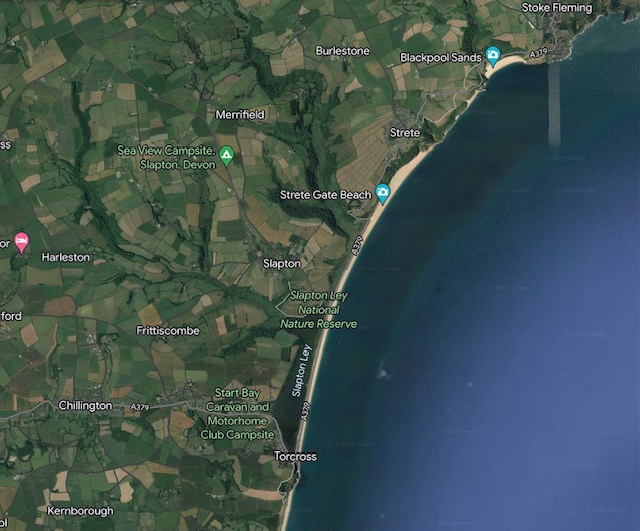
…….. and found this from local guide John Cummings-Lee-Hynes (Note 2): “Slapton Sands is an outstanding piece of tranquillity and beauty; the beach is well kept by all who visit with deep shingle sands and clear clean water. To the left of the toilet is the nudist section and to the right miles of beach for families with paid parking facilities and a coffee cart.”

Dig in the sand a little deeper and you find that, seventy eight years ago, it was the scene of carnage and mayhem. For the stretch of sand and its inshore shallow lagoon were similar to Utah beach in Normandy, one of the beaches to be used for the invasion of France in June 1944. (Note  3) On 27th April a rehearsal for the beach assault resulted in some 300 men being killed as a live firing bombardment from battleships didn’t lift as planned. As if this wasn’t tragic enough, the next day nine German E-boats attacked the next wave of ships with torpedoes. The Battle of Lyme Bay cost the Americans over six hundred lives.

If you visit Slapton Sands today and, while you sit with your toes in the sand, someone tells you this awful story, you would find it difficult to reconcile the two. Those men who survived Slapton arrived on the sands at Utah Beach two months later. In the United Kingdom, today is Remembrance Day, remembering all those who gave their lives for our freedom.

Richard Remembrance Day 2022

www.postcardscribbles.co.uk

PS Yesterday in his column Paul mentioned today is the start of St Martin’s Summer, a few days of mild weather to thank Martin, a C4th Roman Officer, for giving half his cloak to a cold beggar.

Note 1 Real Tennis originated in France in the C12th and was popularised (actually this means probably 0.001% of the population!) in the UK by Henry V (1413-1422).
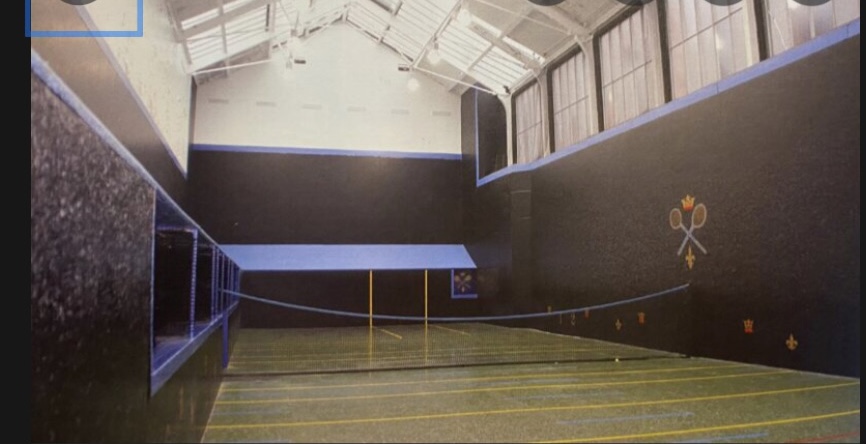
 It’s still played in a number of countries today and the word ‘tennis’ probably comes from ‘tenez’ – the French for ‘take heed’ ….. although these days the word heed is somewhat old-fashioned and we’d probably say ‘look out!’. The player serving the ball is known as a pillar; the post is part of the ‘gallery’ ……

Note 2 Does anyone know of someone with four hyphenated surnames?

Note 3 The American invasion beaches were called Omaha and Utah, the British Gold, Juno and Sword.
PC 307 I Am …..

Some weeks ago we went to a lovely supper party with local friends. Another couple were already there and one more arrived shortly after us. Introductions were made and, unless I repeat the person’s first name, I forget it in the blink of an eye. I am then of course embarrassed and spend time trying to think ‘do they look like a Robin or a Robert, or a Sara or a Serena’! The trick is to repeat their name when the introduction is made: “Hello Robin I’m Richard.” At least that’s what I am told works: I am still learning!

This particular evening remains in my memory as one of the guests wanted to immediately say who he was, as in: “I am a retired trade union official”. He could have said he was/had been a teacher/chemist/footballer/writer/artist or one of the hundred and one other descriptions of what people do for work or for love. I wanted to ask him more about it but my thoughts were more about why he felt the need to quickly identify himself to others, to label himself.

There’s a word from the Zulu language Ubuntu meaning ‘I am, because we are’; the longer phrase means a person is a person through other people, their community, their team – ‘umuntu ngumuntu ngabantu’. This suggests a belief an individual only has her or his existence through their interaction with others.

The actor William Hurt died in March. His obituary started “In the zoo of monstrous egos that is Hollywood, William Hurt took an almost Zen-like attitude to his profession. “I am not an actor. I am a nobody. I don’t exist.” he insisted. “But the work exists. The work is more than the actor.” This from a man who had three consecutive Oscar nominations for Best Actor!

Well, I know I exist (!) and I have a sense of my ‘self’ – “a person’s essential being that distinguishes them from others.” I am also aware I have an ego – “a person’s sense of self-esteem or self-importance.’

I practise yoga which is “a Hindu spiritual and ascetic discipline, part of which includes breath control, simple meditation and the adoption of specific bodily postures, widely practised for health and relaxation.” Many years ago, before I started practising yoga, I attended the London School of Economic Sciences for a weekly session in Philosophy. Fascinating – Year One at least! Year Two had an element of ‘meditation’ …… to which I recoiled. It was ‘an essential part of this course’ I was told …… so sadly I left. Blinkered? Maybe; that typical British attitude of not wanting to ‘give of oneself’ completely ….. and an inherent mistrust of those who are fervently preaching ‘their way is the only way’!! I think differently about meditation now.

I read recently that Buddhist teaching encourages one to distance oneself from ‘self’ and from self-concern, that the concept of ‘self’ is an illusion (!). I am a simple soul; I sense I live in my head, seeing the world, hearing the world and being aware through my other senses of the world around me. Am I an illusion? To whom? I don’t live in my big toe or in my arse, although some might challenge the latter! The sense I have of myself, confident and sure, or anxious and sensitive, starts within all those chemical goings-on inside my skull. If I try and explain it, explain that process, I run out of words and ideas.

After my Army career, I got into the habit of jogging wherever I was. Not a natural runner, it was a simple way of keeping fit, even though I found it hard. I felt ‘better’ afterwards (self-esteem up?). Then I turned to ordinary Hatha Yoga in 2002 as a way of gaining some more body flexibility – I could put up with the odd ‘omm’ I thought! I understood the physical benefits and progressed to hot yoga in 2009, and the particular sequence promoted by Bikram Choudray. Here, in addition to the physical demands of attempting the postures, the body, and one’s mind, has the challenge of the heat, which at times is suffocating!! Completion of the 90 minutes session was a real achievement. Tick in the box. Wow! I did it …….. and naturally I gave myself (that word ‘self’ again) a pat on the back and my self-esteem went up.
I understand how pure it could be to not focus on ‘myself’, able to live within and demand nothing of others. But life as I know it wouldn’t progress much if I spend my days sitting atop a pole, trying to plug into the ‘enlightenment’. Do I want to go and closet myself within some monastery, talking to no one, reading the ‘teachings’ of some guru, father, priest or even saint? It’s not for me; I actually think those that do are disengaging in real life, in the workings and struggles that beset us, the fulfilment of the hopes, dreams and aspirations within us. Does their way of life assist mine? I think not, unless we communicate on some subconscious level that I am not aware of. Give each human a good solid grounding, a teaching of values that mean something, and here each ‘religion’ contributes their own take on how to behave, how to grow, how to develop and we are good to go. 

Over ten years of doing yoga I still get that lift (endorphins?) when I complete a session; I feel good. If at that point some person doing a survey had asked me whether I felt better – absolutely!! I have started classes with a 60 second meditation; I have started with a 5 minute meditation. I understand a little of the ancient beliefs about yoga and meditation but I live in an age of enlightenment, of knowledge , of depth, so does my yoga give me more meaning to my life, does it enrich my soul?
Sure does ……. and I hope Buddha is smiling because of it.

Richard 4th November 2022

www.postcardscribbles.co.uk

PC 306 Murder at the Fete

You might think that after 300 one-thousand-word postcards I would be scrabbling around for things to write about? That maybe I should stop my scribbling and become a little more serious, focus on writing a novel? One postcard in draft concerns some of the books I have enjoyed, some which continue to stay fresh in my memory years after I have read them and others I have been unable to finish. Often novels develop from short stories, expanding the characters, their backstories and the tale itself.  I scribbled what follows three years ago; hope it makes you smile.

“I suppose that, after so many years of being a detective, nothing should surprise me. But life has a habit of doing exactly that and last weekend’s events are a case in point. I was the on-call duty officer, expecting a quiet couple of days and the weather forecast suggested a family BBQ was a possibility. As I wrestled with weighty matters like charcoal and underdone steaks, my mobile rang. My wife Jill looked up as I took the call and immediately saw from my face that duty called.

Sorry darling! There’s been a death at the summer fete in Folding-under-Sheet and the local chap wants some assistance. I’ll give you a call when I have established just what’s happened. Shouldn’t  be too long!”

Nestling deep in the Derbyshire Peak District, Folding-under-Sheet is a quintessential English village where time and customs turn slowly. Driving into the village I recalled its history, how the family in the manor had owned most of it until the beginning of the 1900s when Death Duties forced them to sell large tracts of land. Today Mrs Grace Girdlestone, (Note 1) the widow who lives in the mansion with her two daughters and son, would be in her eighties. Her daughters, headstrong and arrogant, were known to ride both horses and roughshod over the villagers but their mother would have been presenting prizes at the fete, as was her right!

 As I parked my car I saw PC Benson, a local policeman whom I had met previously, walking over.

Hello Sir! Good to see you. It’s Mrs Girdlestone I’m afraid; she was found about an hour ago outside the refreshment tent with her skull smashed in.”

“Good God! Forensics on their way?”

“Actually they got here about 5 minutes ago; they are over there now. There are lots of witnesses, Guv! People in the Refreshment Tent heard Grace having a fearful row with her younger daughter Sophia; George was standing meekly by.”

“George?”

“Her son-in- law.”

“What was the row about?”

“In summary Grace said she’d heard Sophia was pregnant by Matt, who runs the riding stables, and that she was disinheriting her. She used a few choice words apparently, quite shocking some of the older people! George was speechless and ran out of the tent.”

“So we’ll need to speak to Matt: what’s his surname?”

“Weaver Sir.”

“OK! So Grace follows George out of the tent and she’s found with her skull smashed in moments later?” 

“Seems that way. The doctor’s doing the preliminaries right now; come on ……”

I walk over to see the duty forensics officer bending over the body.

“Hi! Mark! What have we got?”

“Looks like someone cracked her skull open with a wooden instrument. That somewhat new wooden-handled fork, the one with the maker’s name stencilled in blue, could be the murder weapon; it’s got a certain amount of blood on it. We’ll take it back to the lab for testing. No sign of a struggle, just this blue stain on her right middle finger.”

“Let me know what forensics say. Seems we have the suspect, motive and weapon. Wish they were all so easy. I’ll go up to the manor and look around.”

The manor house lies only a mile outside of the village so within 15 minutes I ‘m looking around Grace’s study. On her desk I find a handwritten note to her solicitors telling them of the changes she needs to her will. A quick scan confirms what witnesses had said the row was about. Sophia was to receive nothing from her mother’s estate, save for a string of pearls and one particular oil painting of a horse. An old Sheaffer pen, very worn and well-loved, lies on the paper. Returning to the fete I arrest George for murdering his mother-in-law.

The following morning I am enjoying a first coffee at my desk, with an appointment at 1100 with the Super to bring her up-to-date, when I’m called down to the front desk, where Mr Wallace and his teenage daughter Tanya are waiting. We find an empty interview room.

“OK Mr Wallace. Tell me what you told the desk sergeant.”

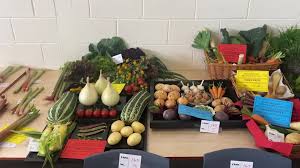
“I hate gardening but my missus has a real passion for growing vegetables. Do you like gardening Detective Inspector? Well, anyway, Doris had two huge Celeriacs in the Largest Vegetable Competition. Such a tragic thing to happen, Mrs Girdlestone and all and …..” 

“Why are you here?”

“Well, Stan won the largest carrot competition……”

“Please Mr Wallace, get to the point!”

“Doris got a prize and Tanya filmed her. We didn’t look at the footage until this morning ……. you had better see for yourself.”

They pass me Tanya’s phone; there’s Doris clutching her large Celeriacs  ……. and in the background is the outside of the refreshment tent. I pinch out the view …… and see Grace come running out ……. she must have tripped on a guy rope, put her foot out, caught that garden rake that had been left against the tent and got smacked very forcibly by the handle. She went down like a stone, her skull cracked like a breakfast boiled egg. No sign of George or anyone.

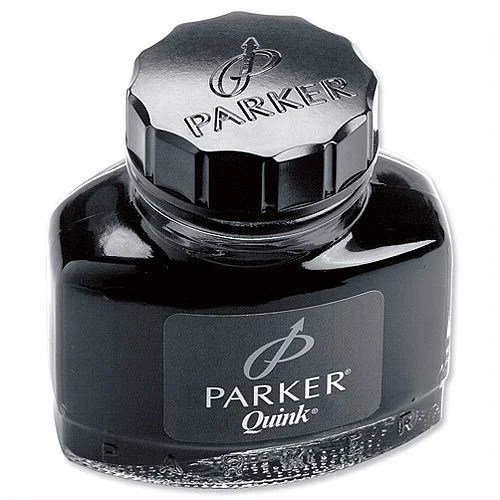
Back at my desk, I find a note. ‘Forensics just called. That blue stain on Mrs Girdlestone’s fingers? Quink Blue.’ (Note 2)

Richard 28th October 2022

www.postcardscribbles.co.uk

Note 1 Obviously known behind her back as GG

Note 2 Quink, a portmanteau from ‘quick’ and ‘ink’ is a fountain pen ink developed by the Parker pen Company in 1931 and remains in production.

PC 305 Alternative Beliefs

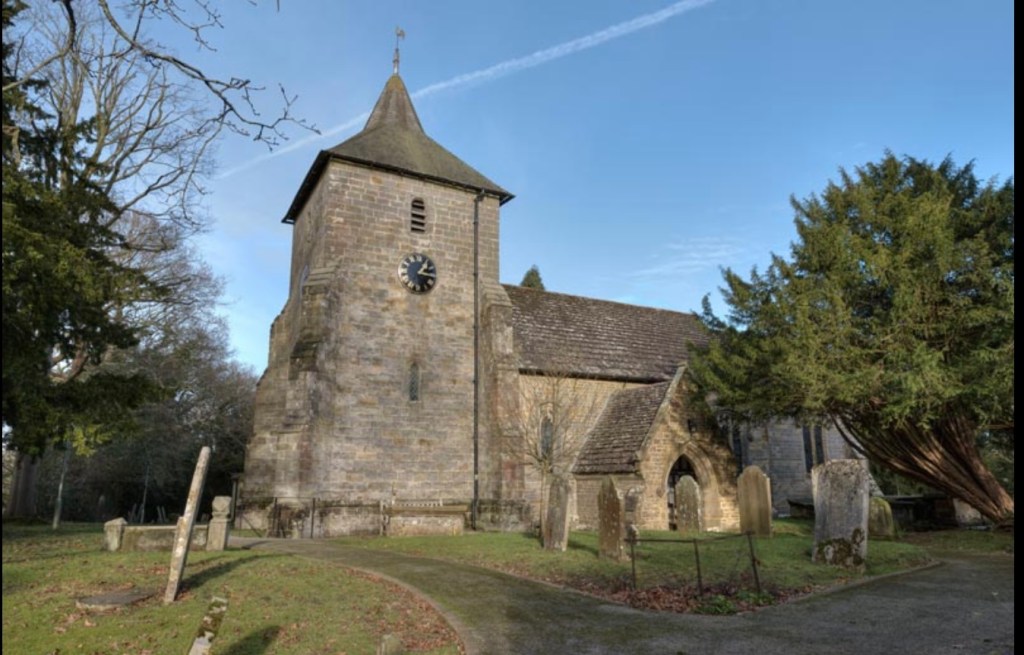
The Church of England is the established Protestant church of the United Kingdom and during my education attendance at Sunday morning church services was mandatory. In the holidays we walked the mile or so to an evening service in Balcombe’s little C15th St Mary’s Church.

 It wasn’t until a new vicar forbade my parents from taking communion as they belonged to the Church of Scotland that I realised the huge variations and schisms that exist in our global belief systems.

Setting aside the major religions of Christianity (31%), Islam (24%), Hinduism (15%), and Buddhism (7%), and acknowledging that some 16% of the world’s population could be described as irreligious, the remainder follow minor religions such as Shinto, Taoism, Confucianism, Jainism and Judaism (0.2%). I have put a percentage against Judaism as in Western culture it must be one of the most identifiable ‘minor religions’ and its source the centre of continuing bloodshed and division over two centuries. 

These scribbles are prompted by a recommendation to watch a four-part Netflix mini-series called Unorthodox. It concerns a young Hasidic Jewish woman called Esty Shapiro who flees Brooklyn and an arranged marriage and is taken in by a group of classical musicians in Berlin. It was fascinating and I realised I had little or no understanding of Ultra-Orthodox Jewish beliefs.  

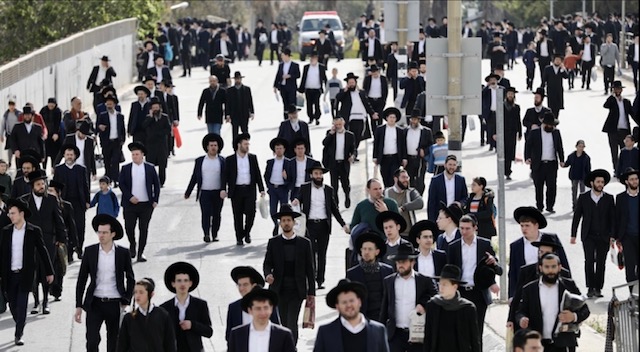
Ultra-Orthodox Jews strictly observe Jewish religious laws and separate themselves from Gentile society, as well as from Jews who do not follow the religious laws as strictly as they do. They live in closed communities, marriages are arranged and dress codes strictly observed. The men wear black or navy suits and a white shirt, and skull caps, Fedoras or Homburg hats; there are rules about the length of the hair down the side of their face. Women wear modest dresses. Stroll around Stamford Hill in London and you’ll be surrounded by some of the 30,000 Ultra-Orthodox Jews who have settled here, particularly as pre-war refugees and post-Holocaust survivors. Walk around Williamsburg in New York, where Netflix’s ‘Unorthodox’ series is set, and you could be forgiven for believing you were not in America.

For those of us who do not regularly interact with minority groups the film Witness (1985), with Harrison Ford and Kelly McGillis about an Amish boy who witnesses a murder, gave us an insight, albeit through the eyes of a producer intent on making an interesting and dramatic thriller, into the Amish community of Pennsylvania.

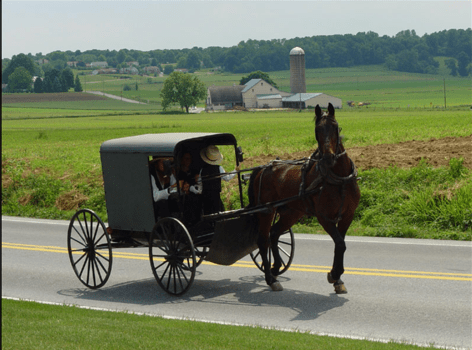
Amish transport

The history of the Amish church began with a break between the Swiss and Alsatian Mennonite Anabaptists in 1693. Today the Old Order Amish, traditionalist Anabaptist Christians, of whom the Mennonite Church is another denomination, are known for their simple living, plain dress, Christian pacifism and slowness to adopt many of the modern conveniences that non-Amish take for granted. Some 350,000 live in the USA and a further 6000 in Canada. The Amish communities operate their own schools and a great emphasis is placed on church and family relationships.

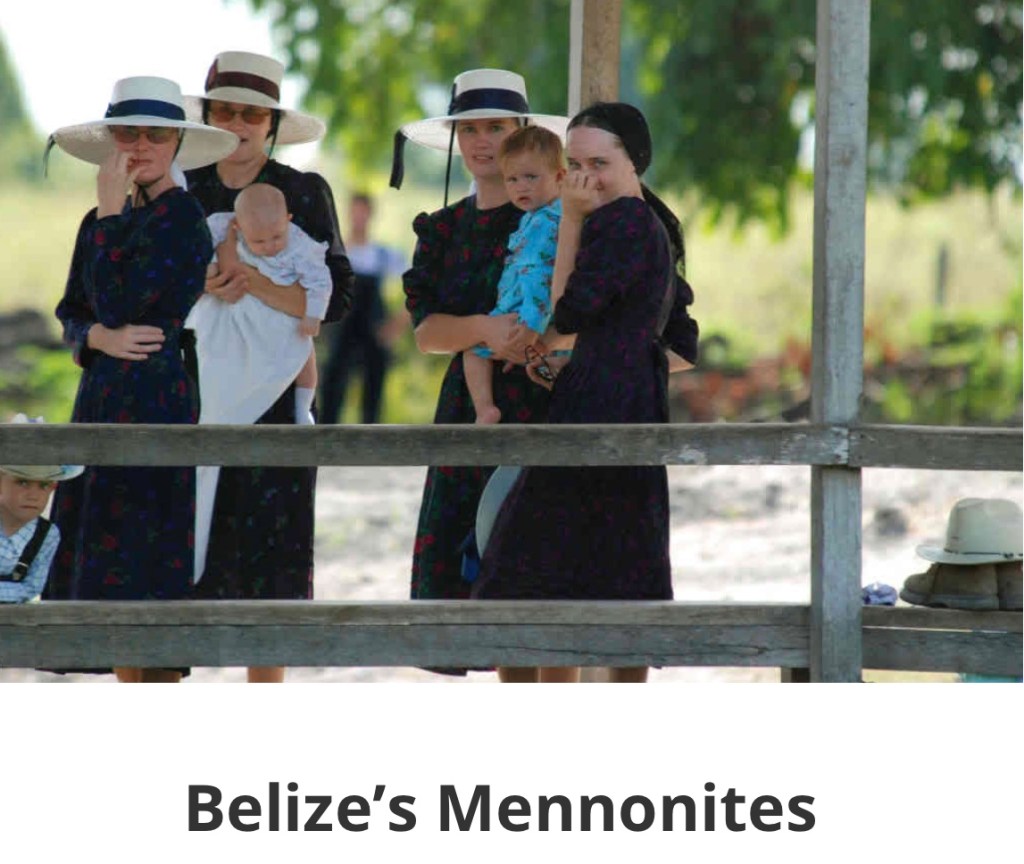
Mennonites can be split into roughly three groups, Old Order ones who eschew modern technology,  Conservative who use modern conveniences like cars and telephones but hold firmly to traditional theologies and wear plain clothes, and mainline Mennonites who are virtually indistinguishable from the general population. Mennonites have settled in 87 countries spread across the planet but I first became aware of them in Belize, when I went there in 1983.

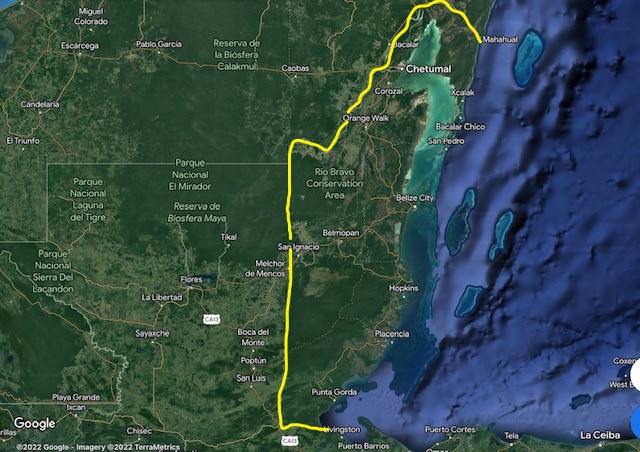
Belize, in Central America, outlined in yellow

They had settled here in 1957 when it was a British Colony, British Honduras, and in particular in Orange Walk, Cayo and Toledo Districts. The communities have established hugely successful organic farms that now provide some 85% of the nation’s milk, cheese and other dairy products.

Another minority group, The Plymouth Brethren, was founded in 1848 in Plymouth, England by John Darby, who believed the Anglican Church was too close to the Catholic Church in doctrine and ritual. Today some 50,000 members are spread over 17 countries. Traditional marriage and family life see women subservient to men and children expected to marry within the fellowship.  

The men are clean shaven, keep their hair short and don’t wear ties while the women should not cut their hair but wear scarves. Everyone starts the day with communion at 0600 and its members will not use the internet or watch television. The Brethren reserve all social activities for those with whom they celebrate the Lord’s Supper, excluding family members who are not members of the church. A client of mine didn’t agree with his parents’ devotion to the Plymouth Brethren diktats and hasn’t seen, been allowed to see them, in decades.

Francisquinha (PC 172 March 2020) pops her head around the door. “But you haven’t even mentioned The Church of Jesus Christ of Latter-day Saints aka The Mormon Church, Jehovah’s Witnesses or The Church of Scientology, to name a few omissions!”

“Ah! Mention Scientology and I think of Tom Cruise and my stepfather.”

Your Stepfather? Was he a member?”

“No, but a favourite Godson Tony Freeland became a member and shunned his friends, family and twin brother John. His parents were distraught!”

“And isn’t The Mormon Church concentrated in the west of the USA?”

“Of course! Its early leaders founded the state of Utah and one third of all six million American Mormons live there, mainly in Salt Lake City.” (Note 1)

These alternative beliefs create a way of life for their adherents, often one which is all-embracing, encompassing. The common theme to all these groups, and maybe with any ‘religion’, is a suspicion of outsiders, a belief that their way is the right way, in fact the only way ….. and ‘if you are not with us you are against us’. A worrying thought when the population of the planet cries out for more understanding and less polarisation.

Confident groups should not only welcome new arrivals but happily say farewell to those who wish to leave. Those trying to ensure continuing obedience often through coercion don’t get my vote.

Richard 21st October 2022

http://www.postcardscribbles.co.uk

Note 1 The church has some 16 million members

PC 304 Foot Fetishes

Where would we be without our feet? You can’t even say ‘on all fours’ as we need something at the end of our arms and legs! I assume that over the course of our evolution hands and feet developed into very different physical shapes, for very different purposes. Most of us take some care over our hands, maybe using a hand cream if they get dry and ensuring the nails are of a reasonable length. Nail polish of all sorts of colours is often applied but more normally by the female gender. But our feet?  “The lower extremity of the leg below the ankle, on which a person stands or walks”

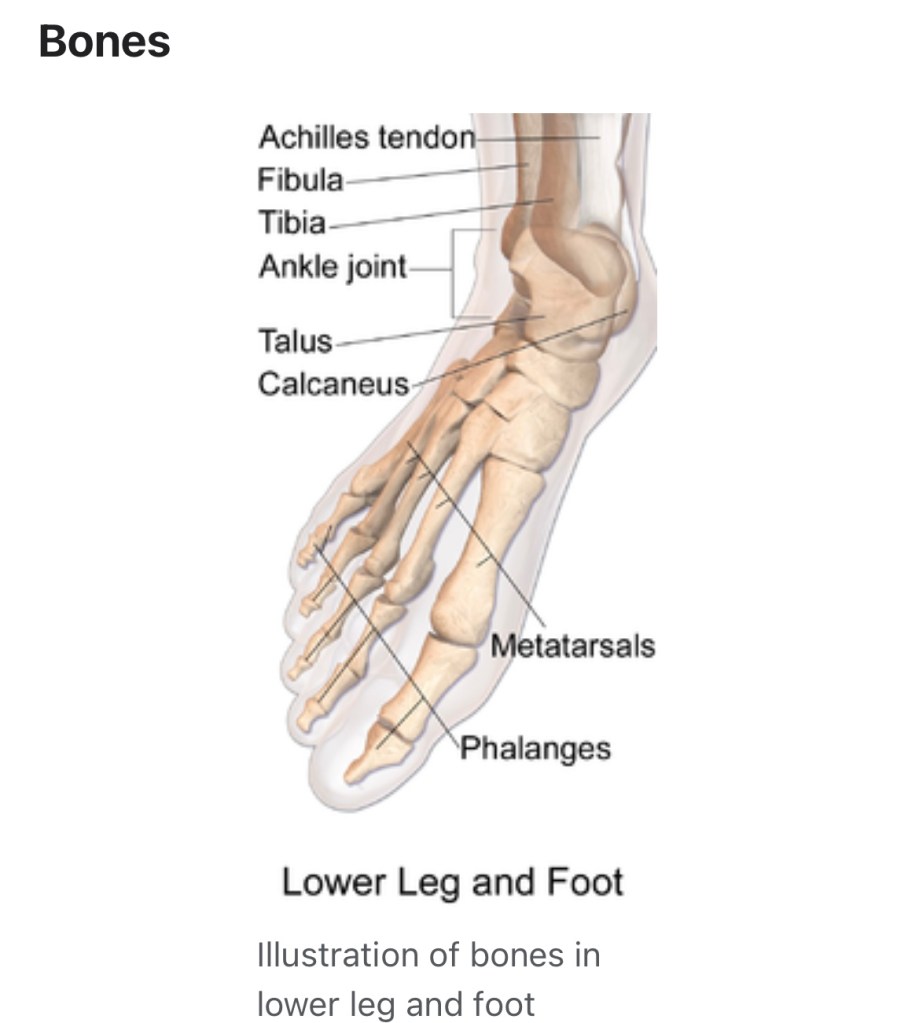
Each foot is made up of 26 bones, 33 individual joints and more than 100 muscles, tendons and ligaments, all of which work together to provide support, balance and mobility. In addition to the bones and their support systems, there are 7000 nerve endings in each foot and 250,000 sweat glands. The bones are grouped into three; the Tarsals making up the rear section, the five Metatarsal bones in the middle of the foot and the Phalanges, the bones of the toes; the second to fifth toes each contain three phalanges. I sincerely hope this is clear?

And if you recognise any of these conditions it’s possible you have been/are effected by them. Big toe arthritis, bunions, Gout, hammer toes, heel spurs, plantar fasciitis and stress fractures!! Then there are issues like chilblains, ‘Covid’ toes, in-growing toenails, verrucas, Morten’s neuroma and Athlete’s Foot.

Tinea pedis is afungal infection that is quite contagious and the haunt of swimming pools and gym changing rooms. Some years ago after suffering a bout and finding it resistant to most remedies, I remembered Potassium Permanganate from childhood. I was surprised to be able to buy it over-the-counter at a chemist’s. Followed the instructions and applied it for a few weeks. It did nothing for the Athlete’s Foot but did give me a delightful display of purple toenails!

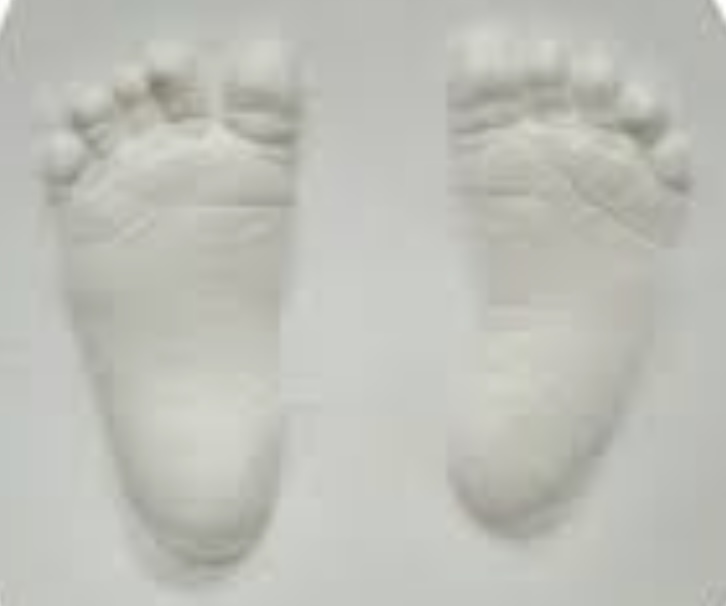
A plaster cast of a baby’s feet

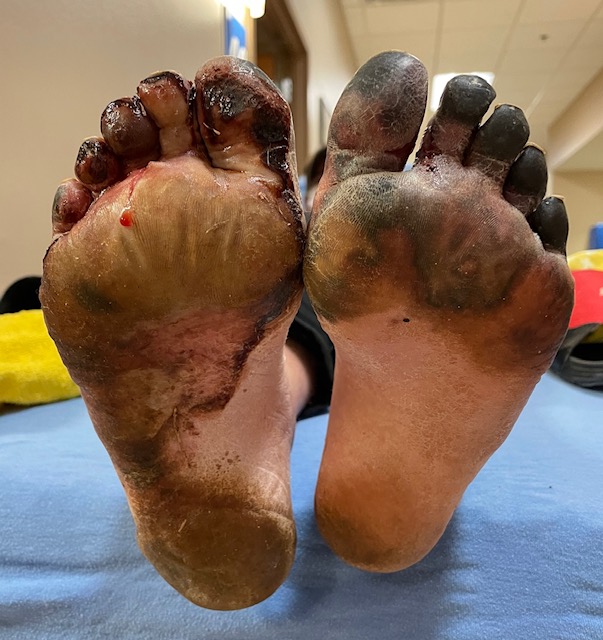
If your feet are constantly encased in cold, wet boots and socks, the chances are you will develop Trench Foot. Soldiers lived in awful conditions in the trenches in the First World War and some developed blisters, blotchy skin and tissue falling off on their feet; the condition became known as Trench Foot; 75,000 British soldiers actually died of it! The military were reminded of it during the Falklands War in 1982, as the wet, freezing conditions soldiers endured on the islands brought on some cases.

Frost bite is as bad as trench foot and something that those who wish to climb to the tops of mountains risk.

A nasty case of frost bite

During some routine exercise at Sandhurst called Battle PT, on the run I managed to put my booted right foot into a rabbit hole but continued forward. The resulting sprain swelled the ankle up like a Puffer Fish and for two years or more it felt vulnerable. No bone had been broken but the muscles managed to twist a bone out of kilter to the point I now have a bony tip where a bony tip shouldn’t be!! 

My mother-in-law remembers going to a recommended podiatrist in Rio de Janeiro back in the late 1980s. He was good but she sensed he was gay and as HIV Aids was creating misery and heartache in the gay community, she wasn’t sure that having someone picking and scraping her feet was such a good idea!!

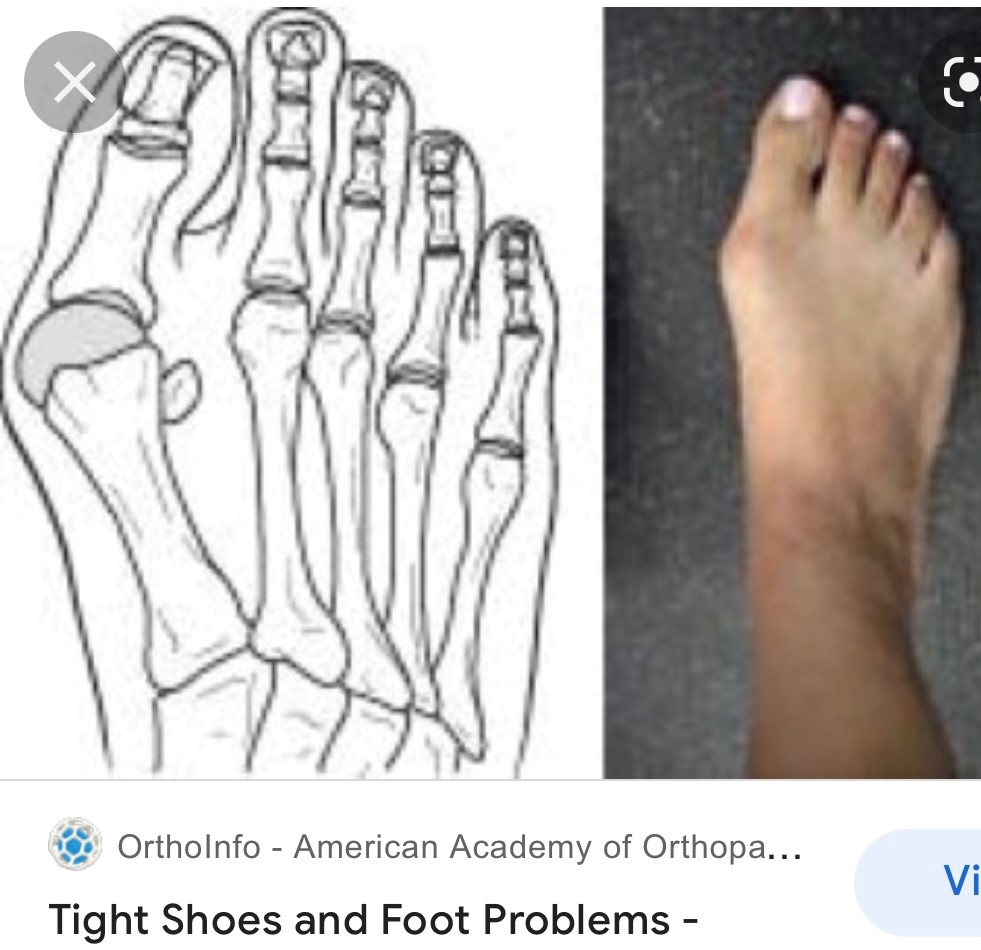
The shape and design of some ladies shoes can cause severe problems later in life. Squeezing your foot into narrow-fronted shoes can permanently distort the foot bones, in addition to producing bunions and the like.

However nothing in the west can compare with the ancient Chinese tradition of binding a child’s feet. The small feet were physically broken and then bound.

The resulting distorted foot was known as a lotus foot and the shoes Lotus shoes. Almost 100% of upper-class Han Chinese women had bound feet in the C19th. If this is news to you, read a most fascinating book on the subject, Pang-Mei Natasha Chang’s 1996 book “Chinese bound feet and Western Dress”.

Swedish men statistically have larger feet than most nationalities. During the late 1800s many migrated to the North West of the United States but found it impossible to get shoes big enough. John Nordstrom teamed up with Seattle shoemaker Carl Wallin, opening their first shop catering for bigger shoe sizes in 1901. Now Nordstrom is one of the largest department stores in the United States; revenue in 2021 was US$ 14.8 billion!

It seems natural to have a unit of measurement based on the length of a physical human foot, about twelve inches (big feet huh!). Since the International Yard and Pound Agreement of 1959 one foot, equal to twelve inches in the British Imperial and US Customary Systems of Measurement, is 30.48 centimetres; a ‘yard’ is three feet. It is useful to calibrate your own pace as you never know when that knowledge might come in useful. Simply measure out say 50 or 100 metres, then walk the distance ‘with a measured pace’!! Most individual’s pace is less than a metre. On my ‘Young Officers’ course at the Royal School of Artillery I  had to calibrate my ‘pace’ as it was useful in setting out a gun position.

Apart from the physical foot, it’s the projecting part on which a piece of furniture, or each of its legs, stands, the bottom or end of a space or object or “at the foot of the cliffs.”

There are of course lots of sayings and phrases that include ‘the foot’:

‘Foot the bill’ – pay for something typically when the amount is considered large or unreasonable; ‘Best foot forward’ – take your first step to begin anything; “They were taken out feet first, the body covered on the gurney by a flimsy blanket and wheeled into the waiting hearse.” – direction of travel for the body!; informally, to cover a long distance on foot for example “The rider was left to foot it ten or twelve miles back to camp” – my preferred term would be hoof it!; and ‘Footnotes’, so beloved of researchers.

Richard 14th October 2022

www.postcardscribbles.co.uk

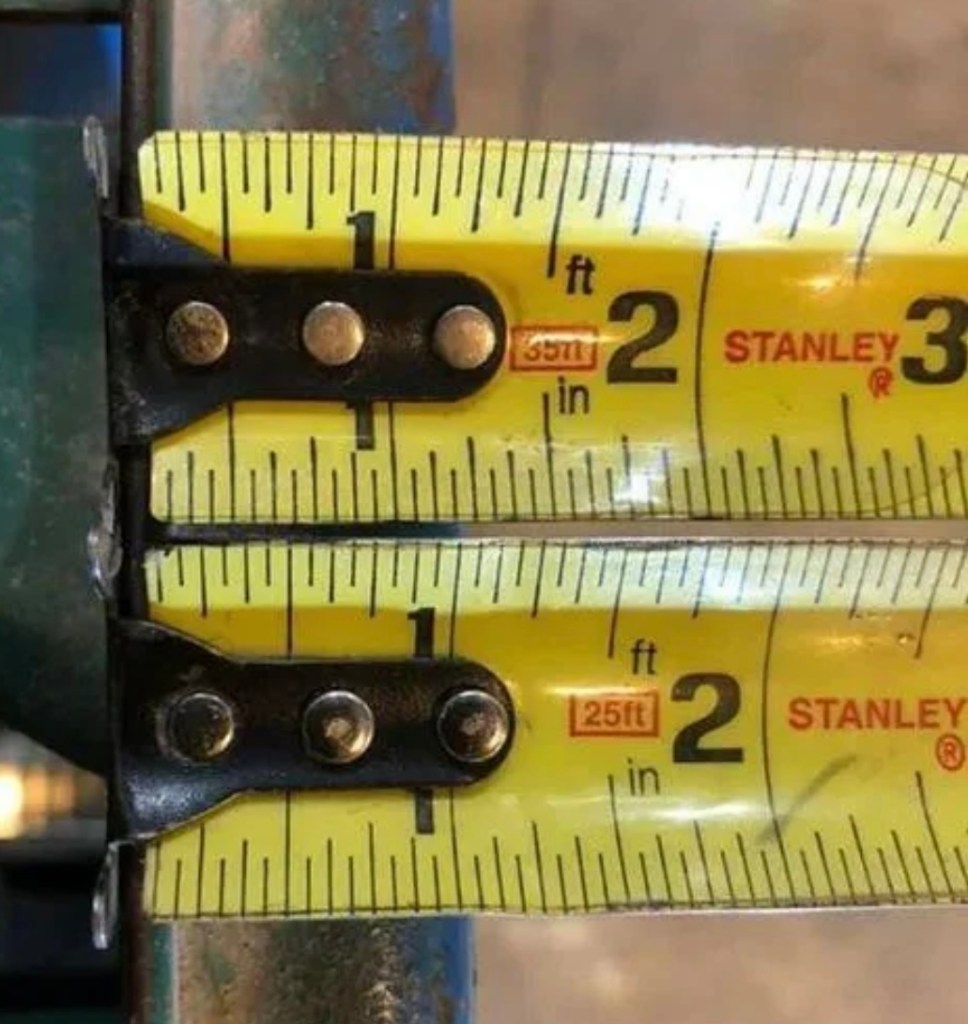
PS If you measure ‘stuff’ regularly, be aware that some metal measuring tapes don’t start at zero!! Always worth starting at 1 inch or 10 centimetres!!

PC 303 The Hope Café Survives

The earth rotates inexorably forwards, eastwards, turning on its axis, irrespective of how one feels and despite the oft-felt cry: “Stop The World! I want to Get Off” (Note 1). Last Sunday London held the 42nd running of its marathon, from the start in the east at Greenwich to the finish on The Mall between Buckingham Palace and Trafalgar Square. The Men’s winner was a Kenyan called Amos Kipruto in just under 2 hours 5 minutes and the Women’s by Yalemzerf Yehualaw, an Ethiopian, in a time of 2 hours 17 minutes.  Paula who, with her husband Hugh, owns Apartment 10 here in Amber House, ticked off one of the goals on her bucket list as she crossed the line on The Mall after just over four hours.

Thirteen days previously the same streets witnessing the runners finishing rang not to the sound of rubber-soled running shoes and physical exertion, but to the pageantry and military splendour of the State Funeral of the late Queen. Chalk and Cheese! The world turns.

I have missed the smell and the atmosphere of the Hope Café, cleverly created with lighting, carefully chosen artwork, and the buzz from contented customers. This week was the first time I have managed to have a few hours there since mid-July and I am pleased I did. You may recall that Edith died and Sami had left for India since I was last here so, as it wasn’t very busy, I caught up with Susie. I thought Susie had left for some ‘Overseas Experience’ (See PC 155 OE June 2019) but she admitted finances were too tight and at that moment Teresa walked in carrying some Brigadeiros and pāo doce from her delicatessen next door (see PC 267 from February 2022).

pāo doce

Susie introduced us and made us some coffee.

“We’ve been trading nine months, Richard, and I have to say it’s been tough! It seems we chose a very uncertain time to open and now, in the era of a European War and the fallout from your Brexit deal, customers are having to restrict their spending to essentials! We promised ourselves a year but last week someone came along and offered two of my staff more money to work for them. You have no idea how difficult it is to get staff and then have some shit comes along and poaches them. So we’re only going to open Wednesday to Sunday and hope we can survive.”

She passed me a couple of Brigadeiros, imagining I love them. Actually I find them extremely sweet but couldn’t let Teresa know that! She finished her coffee and with a ‘Ciao! Até amanhā!’ left for next door.

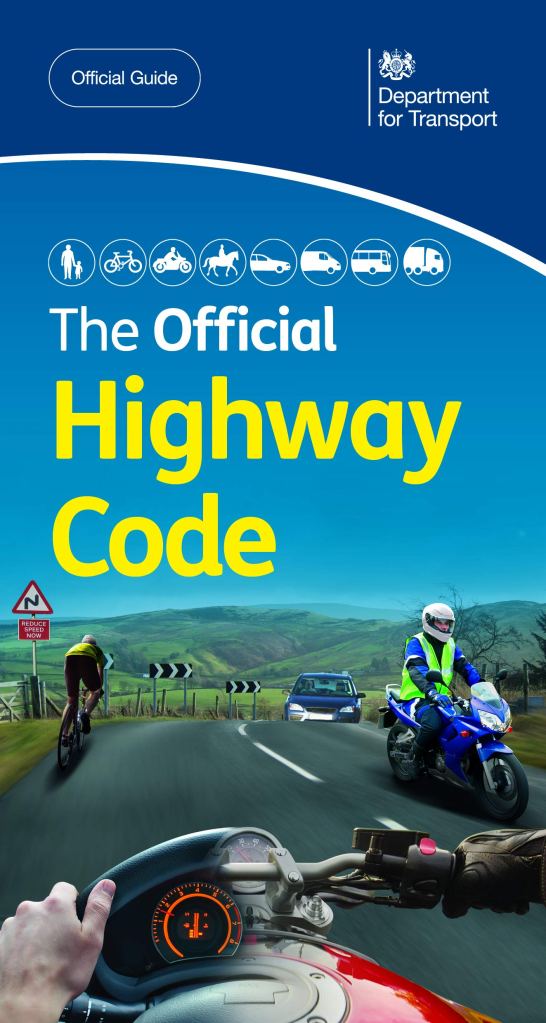
Unusually, on the counter are a few pamphlets; Susie’s busy so I walk over to take a look. It’s the latest UK’s Highway Code and I guess Josh thinks that the changes introduced in January are not well known; a little ‘light’ reading might encourage his customers to be more aware of them.

Our Highway Code sets out the rules and regulations for those using our streets and roads, be they pedestrians, runners, cyclists, motorcyclists, riders of horses, drivers of mobility scooters, users of wheelchairs or electric scooters. It’s the sort booklet that’s full of useful information that will help you pass your practical and theoretical driving test …. and then you don’t keep up to date as various changes are introduced to reflect today’s driving conditions! In January this year a significant change was made to the priority individuals have at street/road junctions and the rallying cry is ‘Shared Space’! Now cyclist and pedestrians have precedence – but not many drivers have read it or if they did they didn’t think it really applied to them.

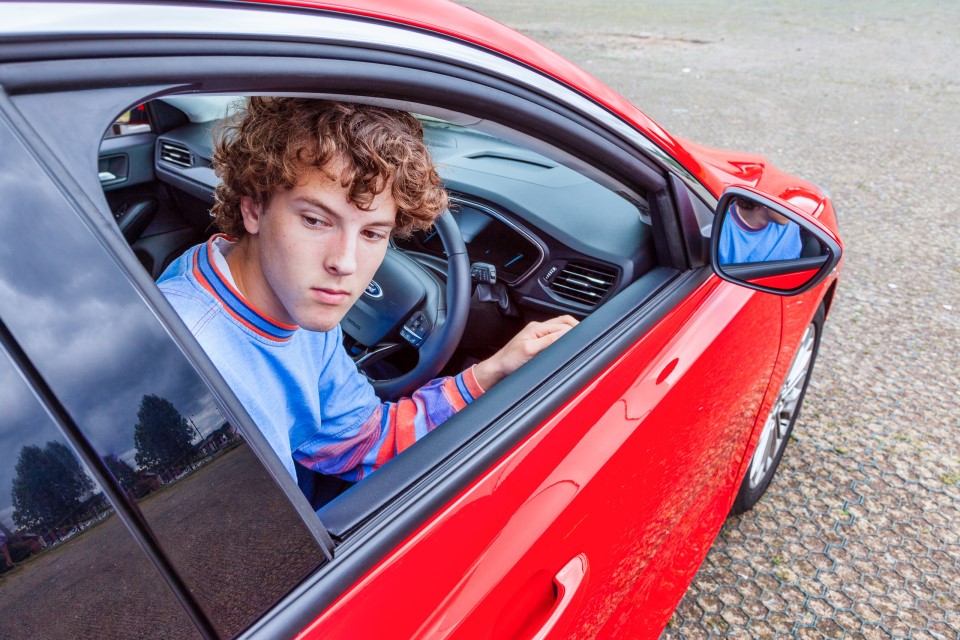
Personally if as a car driver you are exiting a main road and you have to wait in that road while a pedestrian crosses the minor road, potentially you could be in danger from other road users. But hey, that’s the new law! Amongst other changes is the advice to use the Dutch Reach (Note 2) when opening your car door, ie use the hand further from the door.

This manoeuvre turns your head, so giving you a better view of the road. You could probably sum up the changes as ‘consideration for others’.

The news coverage of the research into the science of queues was well flagged during the Lying in State of the late Queen. (See PC 301) The real nugget to take on board is ‘communication’. When we are told what’s happening, or even what’s not happening, what to expect and what not, we are happy. If there is no communication we get unhappy, believing we are being ignored, not respected.  

Josh comes over and tells me Duncan predicts The Hope Café will struggle, as energy costs rise, mortgage costs rise, food costs rise, and the squeeze on household budgets means that even a coffee and a pastry will be considered a luxury. We were getting back to some form of normality after the Covid pandemic (Should we bill China for the lost lives, lost businesses, lost loves?) then we left the European Union in a badly-handled manner, leaving the Northern Ireland situation incomprehensible to normal folk. How can anyone have agreed that part of the sovereign country of the United Kingdom should have different rules and regulations? Or is it a nod to the fact that the Catholic population of Northern Ireland are now in a majority, that it could within twenty years become part of a united Ireland? So we’ll just leave the trade in place and one less thing to worry about?

And all because of Putin the Pigheaded (Note 3) who has reinforced the observation that life can sometime just come and kick you in the butt.

Richard 7th October 2022

www.postcardscribbles.co.uk

Note 1 The title of this 1961 musical was apparently derived from graffiti

Note 2 Then there’s Double Dutch (as Dutch is not easily understood anything completely incomprehensible would be twice as hard as Dutch), Dutch Auction (goods offered at gradually reducing prices), Dutch Agreement (one made while intoxicated, Dutch Courage (liquid courage provided by alcohol) and some 25 other sayings starting with ‘Dutch’. 

Note 3 The Tsars had nicknames – Ivan the Terrible (Or more correctly translated to be The Strong or The Menacing (C16th), Alexis the Humblest 1629 – 1676, Peter The Great 1672-1725, Catherine The Great 1729-1796, Alexander I the Blessed 1777-1825 (victory over Napoleon), Alexander  II The Liberator (of the Balkans), Alexander The Peacemaker 1845-1894 and Nicholas II The Bloodstained 1868-1918 (for his cruelty) and the last tsar.

PC 302 Update from Sami in India

My regular readers will know that I frequent The Hope Café here in Hove, looking for inspiration, ideas for ‘copy’, a good coffee and some chat with the staff and regulars. One of the individuals I have taken a shine to is Sami, an ex-Post Office Manager who was wrongly charged with fraud and eventually made bankrupt (see PC 235 June 2021). Sami had taken to having a coffee and reading a good book in the friendly atmosphere. His story has appalled me but now, many years on from his financial ruin, there is an indication that the inquiry will recommend compensation to the over seven hundred individuals who were the victims of what is being called Britain’s greatest miscarriage of justice.

Maybe as a result of telling him about my own research into my family background Sami, whilst waiting for the enquiry to conclude, has taken off to Gujarat in India to look for his own Indian roots; he knew precious little – rather like the scant knowledge of my own! My mother wasn’t really interested and it was only after her death that I met a cousin of hers, who had a very sketchy family tree. Four years later there was a gathering of dozens of relatives in Auckland New Zealand!

Sami knew that his mother Fiona had worked in the English colonial civil service in Gujarat and had married Aadit Gupta in1946. They had moved to UK after the infamous partition of the Indian sub-continent into India, East Pakistan and West Pakistan. Euro-Asians found they didn’t really fit well into either nation and Sami’s parents settled in Southall in west London, an area known locally as the Little Punjab; Sami was born in 1956.

I received this email early last month:

“Grand Mercure, Gandhinagar, 3rd August

Dear Richard

I knew my father Aadit had been born in 1926 in a little town in Gujarat, so last month I flew direct from Heathrow on Air India to Gandhinagar, the state capital; the business capital Ahmedabad lies to the south. I have never been to India before; when I grew up international travel was for the rich and for us Indians life is either work or family. The idea of walking in the Lake District for instance would never be on our wish list! When I stepped off the plane I was enveloped by India’s heat, by its dust, by its noise, by its busy inhabitants. It’s well known that the Indians learned bureaucracy from the Victorian British and they’ve become even more succinct and pernickety about record keeping, so it wasn’t surprising I was able to find some details of my father’s family in the Records’ Office. Delightfully I have found an aunt who was twelve years younger than my father and will visit her soon.

Give my best wishes to Josh and Susie.

Take care! Sami

Gujarat State in western India

Then another email, dated 11th August, a week later:

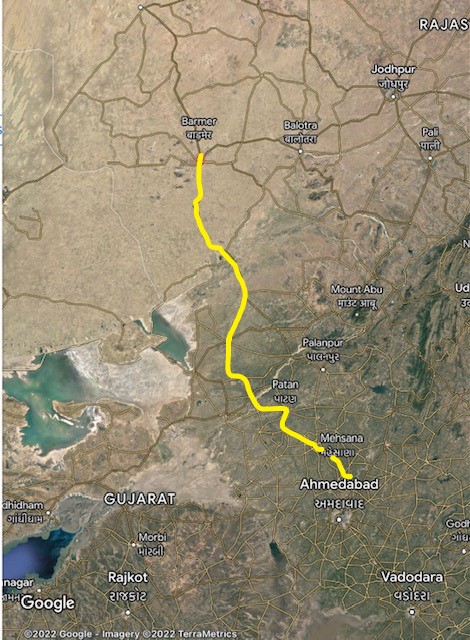
“Saw Indira yesterday; she lives with her daughter and family in the foothills to the north west, into Rajasthan, in a city called Barmer, so I took a very crowded, smelly and overloaded bus with loads of luggage on its roof. It took six hours so I stayed for a couple of nights! She’s 84 and rather frail but her mind is razor sharp. She has told me much about the family, those alive today and those past, some of whom fought in what you call The Indian Mutiny and what was also referred to as the First War of Independence or Indian Rebellion of 1857. I met a couple of her children. Children? They must be in their late 50s!

My bus trip to Barmer

My knowledge of the Indian Rebellion is non-existent and I find all this stuff fascinating, so have signed up for a tour of what’s often talked about as the triangle – Delhi and Meerut, where the uprising started, then down to Agra, on to Kanpur/Cawnpore then Lucknow. Maybe I can persuade one of my cousins to come too?

The local papers are full of the current Prime Minister Narendra Modi’s idealistic desire to make India a Hindu State and is talking of removing the rights to Indian citizenship from the Muslim population. Like you I imagine, I don’t know the details of the political history in India that well but I have learned Modi was Chief Minister of Gujarat in 2002 when there were anti-Muslim riots. It started with a fire on a train carrying hundreds of Hindu pilgrims home and 60 people died. Modi claimed it was a terrorist attack, blamed local Muslims and fanned the flames that encouraged the Hindus to act. Quick to anger, the locals rioted; the result was 790 Muslims and 254 Hindus killed and 150,000 driven into refugee camps.

Modi became Prime Minister of India in 2014 and is in the process, the press claim, of marginalising Muslims. You can hear the echo of the violence that accompanied the partition of the Indian sub-continent into India and Pakistan in 1947 and I wonder when this end, where it will go. (Note 1)

Probably be back in Hove in a month or so, depends how the ‘tour’ goes! That and Indira’s idea for a family reunion! Best wishes Sami.”

I haven’t been in The Hope Café since mid-July, so it was sad to receive a text from Josh saying that Edith has passed away (See PC 224). Apparently she hadn’t been in for a fortnight and Duncan found out she’d died. In keeping with her Jewish faith her funeral was the next day. These survivors of the Holocaust and of the Kinder transport, of whom Edith was one, are thinning out; a page of global history turning. 

Email 9th September 2022. “Sad to hear of our monarch’s death. God Save the King. Sami.”

Richard 30th September 2022

www.postcardscribbles.co.uk

Note 1. The partition of the Indian sub-continent into predominately Muslim Pakistan and predominately Hindu India required that Muslims living in what would become India moved to Pakistan and Hindus living in what would become Pakistan moved to India. Within six months of the August 1947 partition, 15 million people had been uprooted and between one and two million were dead, many in the most violent manner. As the nation responsible for the plan to divide the sub-continent, we should be ashamed it happened in such a horrific manner.

PC 301 And Still They Came

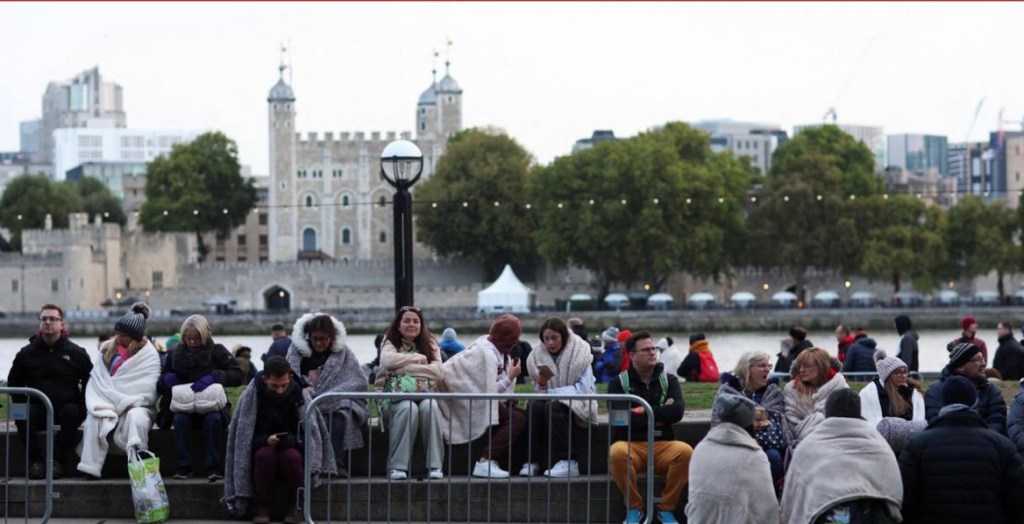
And still they came and the drums sounded the slow beat and the bell of the Elizabeth Tower, Big Ben, tolled …. one ring for every year of the late Queen’s life.

I opened the newspaper on Sunday and found that Christina Lamb, a well-known reporter and commentator, had started her column: “And still they come. From morning till night, tens of thousands of people of all ages, backgrounds and places across the land defy warnings of 24 hour waits and swarm to pay their last respects to their monarch – and to be part of the greatest queue on earth. ‘The Queue’ has its own Twitter feed, Instagram account and YouTube channel.”

We arrived back in the UK on Thursday of last week but were following the ramifications of the Queen’s death on the BBC News. Back home and the sense of loss is palpable. Should I join the queue to see her lying in State? Four hundred thousand did, including our Yoga Studio’s co-owner Simon and David, Mimi’s husband, both pulled inexorably to be part of this moment in history.

The remarkable success of The Queue was down to a Professor Keith Still who advises on the science of crowds. He suggests The Queue became an animated object, with a life of its own! “The crowd itself is looking after people within it. People need to know what is happening in advance, to have their expectations met and to be kept constantly informed and updated and, in The Queue, they have had that. So long as people know what’s happening, what’s expected of them, how long it’s going to take, they no longer face the uncertainty.” (Note 1)

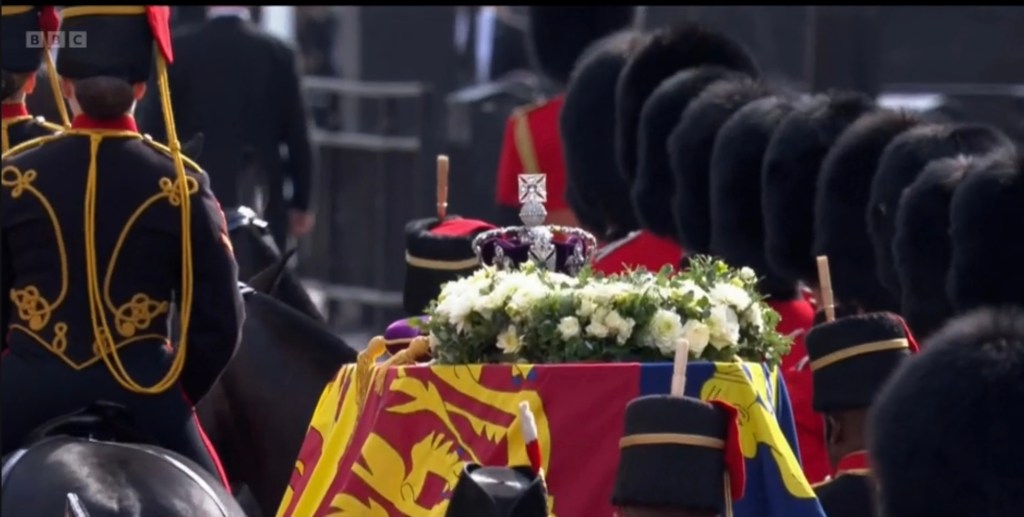
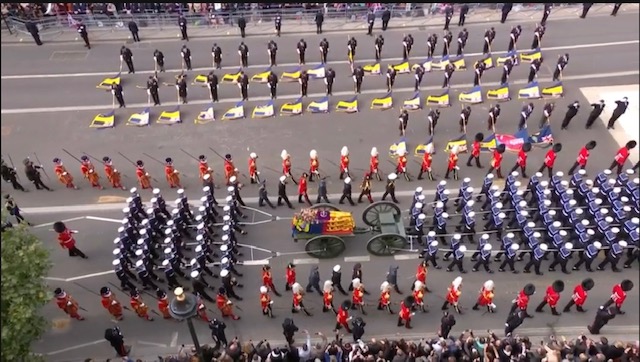
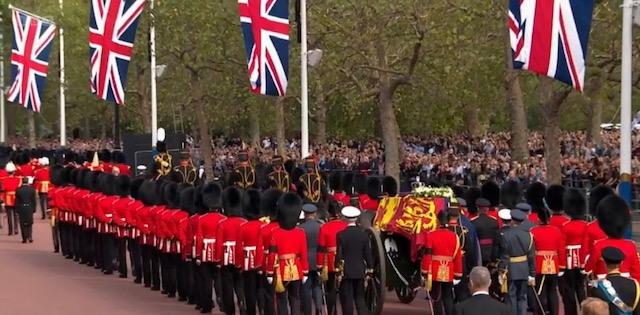
On Wednesday 14th September the late Queen’s coffin was taken from Buckingham Palace to The Palace of Westminster, the enormous hall built in 1096 where it was to ‘Lie in State’. As a muffled Big Ben tolled, the solemn procession made its way down The Mall that only recently had been the site of the Platinum Jubilee party. There was something very hypnotic about this spectacle; bands playing dirges from Beethoven or Mendelssohn, flags flying and leather reins creaking, the Gun Carriage with its precious cargo draped in the Royal Standard pulled by horses from Kings Troop Royal Horse Artillery, escorted by men of Her Household Cavalry, all marching at a slow 76 paces per minute.

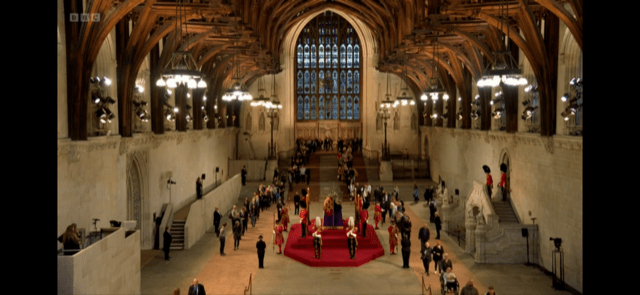
Her ‘Lying in State’, surrounded by officers, by family members, by Beefeaters, was televised live by the BBC. “And still they came ……” The old, the young, the curious, those the Queen had touched, families and those in wheelchairs, Chelsea Pensioners and retired military personnel, those who felt it their duty, their obligation ….. and to hell with the potential problems of queuing. Over five days 400, 000 people filed past her coffin, including Michael Tropp from Atlanta, who spent nine hours on an aeroplane to spend a further 8 hours in The Queue! “For 70 years she’s been the mother of this country. There will never be anything like this again in my lifetime.” I sense this echoes in ever heart here in the United Kingdom.

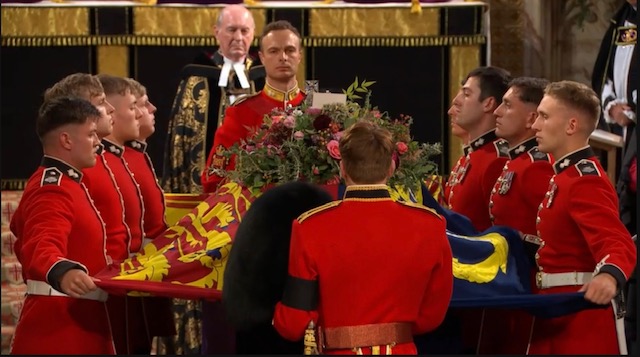
Monday 19th September 2022 – Her Majesty Queen Elizabeth II’s funeral. The coffin was carried by eight bearers from 1st Battalion The Grenadier Guards (Note 2) from the hall and placed on the Victorian Gun Carriage. The Gun Carriage was then pulled by 96 Royal Navy ratings to Westminster Abbey; a further 44 were used at the rear as a brake! (Note 3) Historically the State Funeral Service took place in St George’s Chapel in Windsor but, in a break with this tradition, The Queen had wished it to be held in Westminster Abbey. Plans for this mammoth state occasion were first drawn up on 2006 and updated regularly.

My heart had gone out to a dear friend and retired Gunner officer Mark Corbett-Burcher, who has a responsibility within the Ministry of Defence for the protocol of ‘Inward Visits’; he would get involved in the planning for VIP visits to the UK. This week has seen close to 500 ‘VIPs’, foreign Heads of Government, Presidents and Royalty, coming to the Capital; can’t imagine he had much sleep before Tuesday!! 

Following the service the funeral procession made its way back to Buckingham Palace and on to Hyde Park Corner, where the coffin was transferred to a hearse for the drive to Windsor Castle. There, after a Committal Service, the coffin was placed in the Royal Vault.

Old enough to have watched the State Funeral of the United States President JF Kennedy, I saw for the first time the age-old tradition of a Commander-in-Chief’s coffin being followed by his horse, with his riding boots fixed in the stirrups facing backwards. As Her Majesty’s coffin approached the final few hundred metres before the walls of Windsor Castle, there was her favourite Fell pony Emma. Given her life-long love of horses, I half-expected to see her riding boots in the stirrups …… facing backwards. 

Somewhere in one of the services William Wordsworth’s poem The Extinction of the Venetian Republic was quoted. The ‘she’ in the poem is Venice so substituting HM The Queen seems a bit odd – but I wasn’t asked!!

“ ……….. She was a maiden City, bright and free; …….. She must espouse the everlasting Sea. ….. Men are we, and must grieve when even the Shade of that which once was great is passed away.”

Everyone’s mother dies; one’s father too! When you get into your mid-90s the chances are sooner rather than later. In a monarchy the people have no say in who is the king or queen; it’s just luck as to whether they are good, bad or indifferent!

In Elizabeth II we were extremely lucky!

Richard 23rd September 2022

www.postcardscribbles.co.uk

PS Today is the Autumnal Equinox, when there’s an equal amount of daylight and darkness everywhere in the world and the sun rises exactly east and sets exactly west!

Note 1 And of course the converse is true: “As soon as that information flow stops that you get a degree of uncertainty and people start behaving as individuals rather than as a collective.” he says.

Note 2 One, Fletcher Cox is 19, reflecting the youth of the Bearer Party

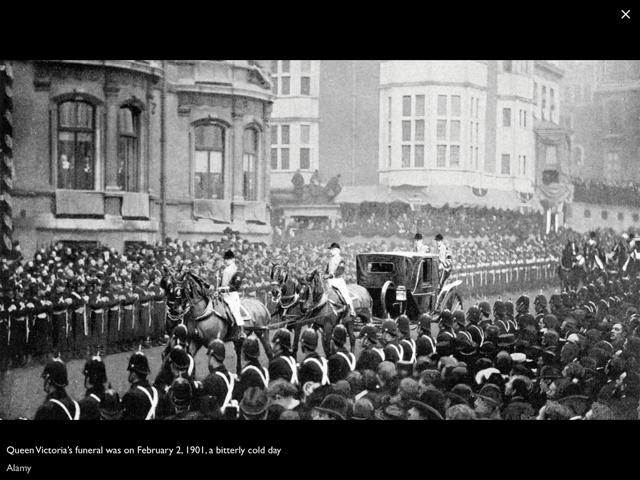
Note 3 During Queen Victoria’s funeral in February 1901, the icy cobbles around Windsor Castle caused the horses pulling the hearse to slip and shy, so much so that at one point it seemed the coffin would fall off its carriage! Quick thinking officials entrusted the pulling to chaps in uniform and that’s what happens now.

PC 300 Three Hundred Postcards!

I started writing the obligatory postcards, as one did before the days of texts/instagram/facebook etc, to ‘friends & family’ during my first visit to Rio de Janeiro, Brazil in April 2012. It wasn’t until my third visit in late December 2013 that I started sending what I might have written on a postcard, electronically. Abbreviated to PCs, the titles of the first seven sounded like something from a travel digest of Brazil: Rio de Janeiro (3&4), Sāo Paulo & Caneneia (5), Petropolis (6), Carnival (in Rio) (7), Beach Life in Brazil (8&9), Paraty (10) and Sāo Conrado (11). Wasn’t I a lucky chap?

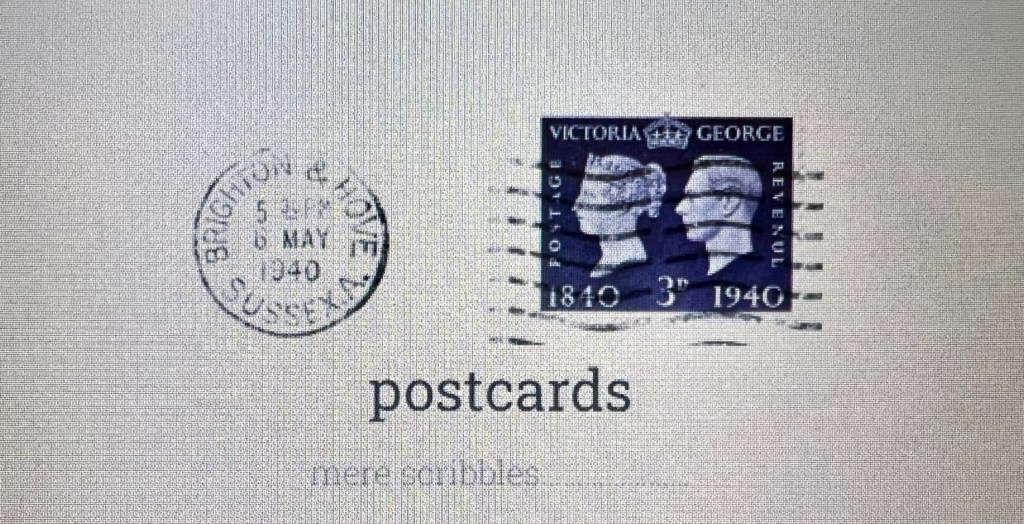
Along came my lovely techie son-in-law Sam and he set up my page on WordPress, www.postcardscribbles.co.uk. ……..

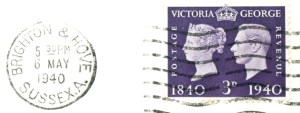
….. and he also found a post office franking for Brighton & Hove dated May 1940. (Note 1)

Seems a long time ago now and it is! Over eight years in fact. During the first UK Lockdown for the Covid pandemic, March 2020, I increased the frequency from two a month to one a week so this is my three hundredth, each about 1000 words. It’s not easy to group them into any sort of categories but I will try to, as it might make the back catalogue less daunting for my newer readers.

Places we’ve been to in Brazil

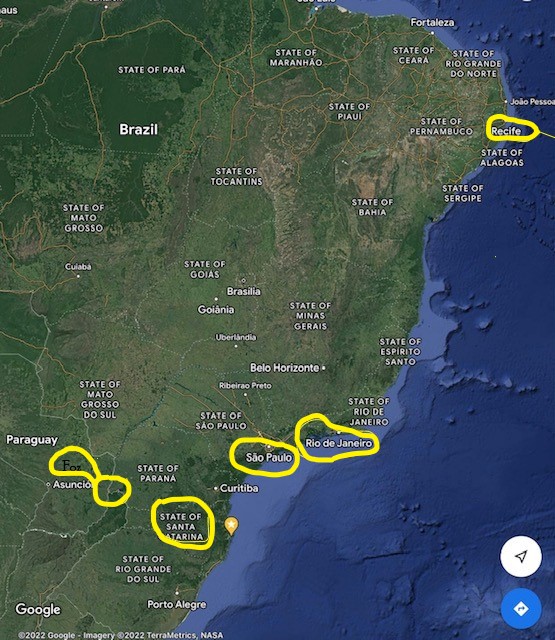
The series of postcard scribbles started in Rio de Janeiro in Brazil, Celina’s home city and that of her family. Brazil is enormous, some 4300 kms both north to south and east to west at its widest part. We have travelled north to Recife where my great grandfather Richard Sidney Corbett was born in 1850 (34) and south to Brazil’s Santa Catarina, one state away from the border with Uruguay (63). We visited the waterfalls at Foz that puts Niagara in the US to shame and gives Victoria Falls a good run for its money (51) and we spent some time in the world’s biggest flattest wetlands, some 800kms north to south and 500kms east to west, Pantanal (17 and 20).

Our Alaska journey in 2015

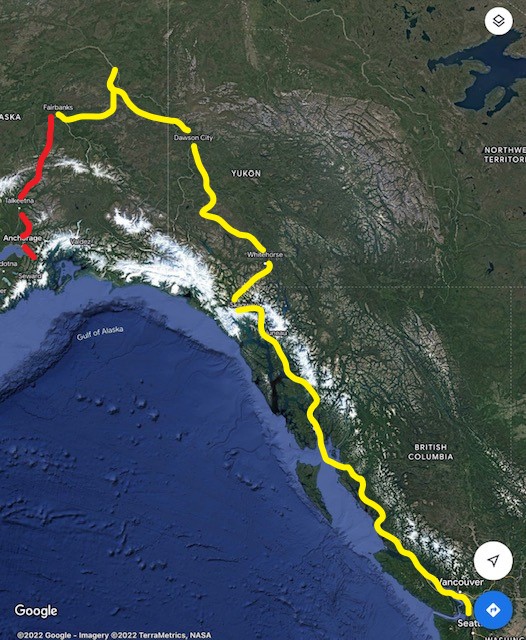
 In 2015 we followed in the footsteps of another of my great-grandfathers, George Nation, and his route up from Seattle into Alaska, to Dawson City and eventually Eagle, population 52, in 1900, 1901 and 1902. Postcards 44 & 45 covered this plus PC 46 included a few days in San Francisco.

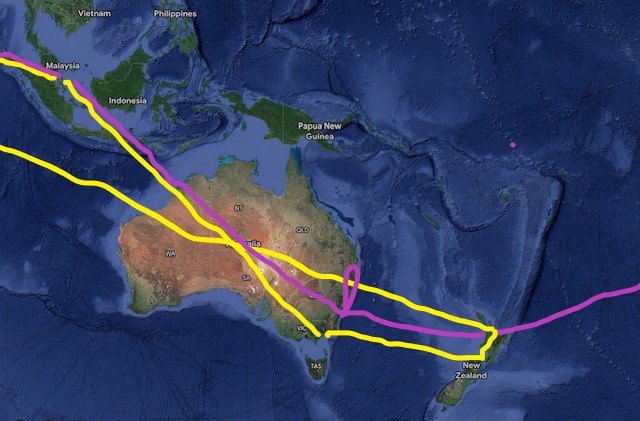
One year we flew eastwards, visiting Australia, Auckland, and The Coromandel Peninsula in New Zealand, before crossing the Pacific to Santiago in Chile (88 & 89).  We returned to South East Asia and The Antipodes in 2019, just before Covid locked down the globe! (168, 169 and 170)

There and back or straight through!!

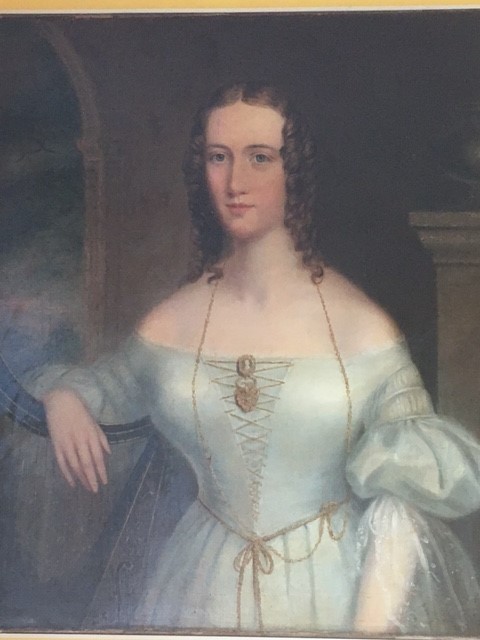
In PC 37, I described visiting the Rocha Miranda family home in Friburgo, Brazil. Closer to home in Hove, in PC 58, I scribbled about returning to my late parents’ home in Balcombe, 20 miles north of Brighton. The search for family connections saw us fly to Limerick, to look for the home of Sarah Fosbery, a great-great-grandmother (127 from June 2018).

Sarah Fosbery

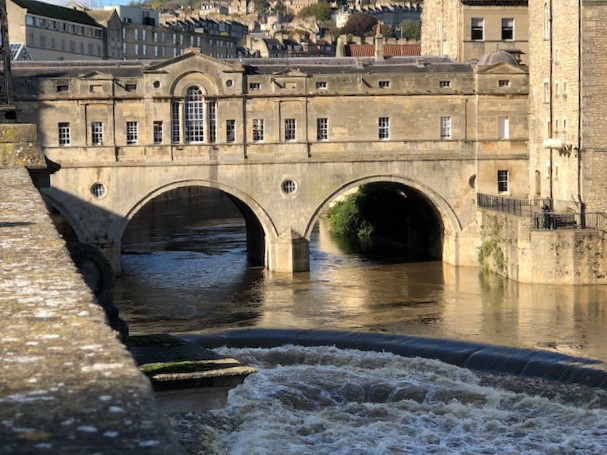
In 2019 we spent a couple of nights in the city of my birth, Bath (164 & 165).

Portugal has featured a great deal, ever since our first short break in April 2016, visiting Celina’s brother and family who were looking for somewhere to live (87). Subsequent postcards, 107, 112, 130, 245 for example, have covered Estoril and the Lisbon littoral. In 2018 we took the ferry from Portsmouth to Santander on the north Spanish coast and drove west and then south into Portugal. Sicily featured in PC 134 entitled ‘The Largest Mediterranean Island’.

My love of offshore sailing is reflected in a number of reminisces; Sailing in The Baltic (106), racing across The Atlantic (116) and Kiel to Oslo (229).

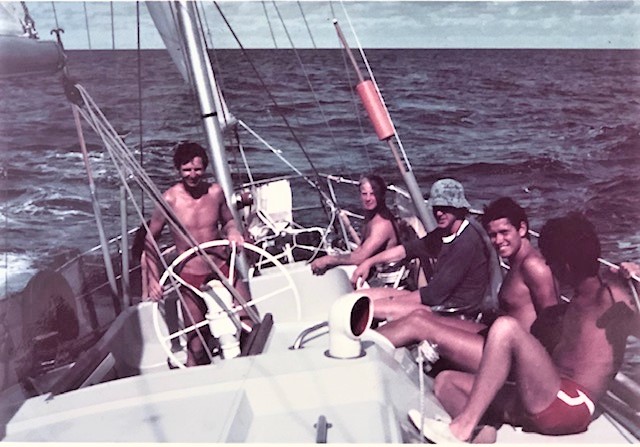
Somewhere in the middle of the North Atlantic 1976

Times when it’s been a little hairy are covered in Off Arromanches (209/211), Almost a Disaster (215) and Knockdown (249), supplemented by Ropes, Warps & Sheets (231).

The current focus on health and fitness has featured quite a lot in these three hundred postcards. Some have been specific like My Thumb (52), Molars & Wisdom (64 & 66), Sight & Eyes (94), Up My Nose (190, One’s Heart (280) and Hot Yoga Thoughts (84 & 93). More general ones have covered Bacteria & Bloating (28), Loo Paper (47) and The Loo (54), Male Waistlines (55) and Am I Obese? (233), The Common Cold (148) and Montefiore (my back operation) (99).

Some have had a very serious element, like What’s Going On (21) which looked at the ugly war against ISIS. That was eight years ago and now we have the Ukrainian War to be extremely concerned about: my PC 276 was about their cultural side of life – ‘Picture at an Exhibition’ with the overtones from Tchaikovsky’s 1812 Overture and Napoleon’s retreat from the gates of Moscow. Collectively PCs 263, 269 and 278 raise the issues of refugees, of migrants, of freedom and of hope.  In February 2018 I wrote about ‘Ancient and Modern Slavery’ in PC 117.

I looked at ‘Alcohol and Other Drugs’ in PC 15 in 2014, and followed it with ‘Alcohol and The British Issue’ in PC 257 seven years later. Earlier this month I scribbled ‘Judge Not’ (298) about the “the most socially acceptable drug”. The issue of what people do with their cigarette butts is the subject of PC 234 ‘No Buts ….. No Butts’. Surrounded by the ‘Carwash’ corruption investigation in Brazil at the time, I looked at the UK’s record of being squeaky clean, or not, in Money & Corruption PC 36. Two incidents, the Grenfell Tower fire when 72 people died and the Post Office scandal when over 700 were wrongly convicted, were the focus of ‘Generosity in Government’, PC 235 of June 2021.

And finally there are over two hundred and thirty others, covering topics as diverse as our language, English and others, the written word and spelling, Christmas, Boxing Day and Easter, manners and etiquette, guns in America, health, safety and customer services, chickens, pigs, cars and driving, pockets, the Truth, bread and toast, modern complexity and so on and so forth.

The late Queen’s coffin moved from Buckingham Palace to Westminster Hall on 14th September 2022

The penultimate one of these 300 postcards was written the day after Queen Elizabeth II died. It feels today as though a page has been turned, a chapter finished, the book closed. Satisfaction! Next week, after her funeral on Monday, the start of a new book, a new chapter and the first of another hundred postcards!

Richard 16th September 2022

www.postcardscribbles.co.uk

Note 1 Interesting stamp and frank. Celebrating 100 years 1840-1940 with portraits of Victoria and George VI, a postcard (maybe!) posted in Brighton & Hove on 6th May 1940 at 5:30. We were at war with Nazi Germany and within twenty days started the evacuation of the BEF from the beaches of Dunkirk.

PC 299 Our Nation Pauses

It’s Friday and today I post my weekly efforts, my scribbles about this and that, some topical, some simple observations or commentary about the life we live, the life we’ve had and the potential life to come. I don’t think there’s anything very intellectual about these posts but I hope that some part of them will encourage my readers to spend five minutes every week, pausing and being still.

This week’s post had been written, edited and proof-read and this afternoon I would have pressed the ‘send’ button. It was an update from Sami, my friend from The Hope Café, who’s gone to India to check out his family roots whilst awaiting the conclusion of the Post Office enquiry and subsequent allocation of compensation. Then yesterday late afternoon, news that our Queen had died pinged onto our news apps. Long gone are the days when the transmission of news relied on wind or horse power.

My step-father’s birthday was on June 1st and he always reminded those who would listen that the date was known as ‘The Glorious First of June’. Why? Well in the C18th the West Indies were key to the strategic aims of France. In answer to appeals from the French planters, British forces occupied the ports of Haiti in1794, and soon held all the French islands except Guadeloupe.

A French convoy on its way to the West Indies was engaged by Admiral Howe 300 miles west of Brest and a quarter of its fighting strength was destroyed; his signal to the Admiralty started: ‘On this glorious first of June, …..’. The signal was entrusted to a midshipman on a fast frigate that made landfall at Plymouth and then conveyed over the 220 miles to The Admiralty in London by horseback; even with fresh horses maybe some days.

Today news is instant; sometimes it seems to be transmitted before it’s happened. This morning the press is replete with commentary about Queen Elizabeth II; professional journalists and social observers compete with personal outpourings on television, in the newspapers, on Facebook and on other social media sites.

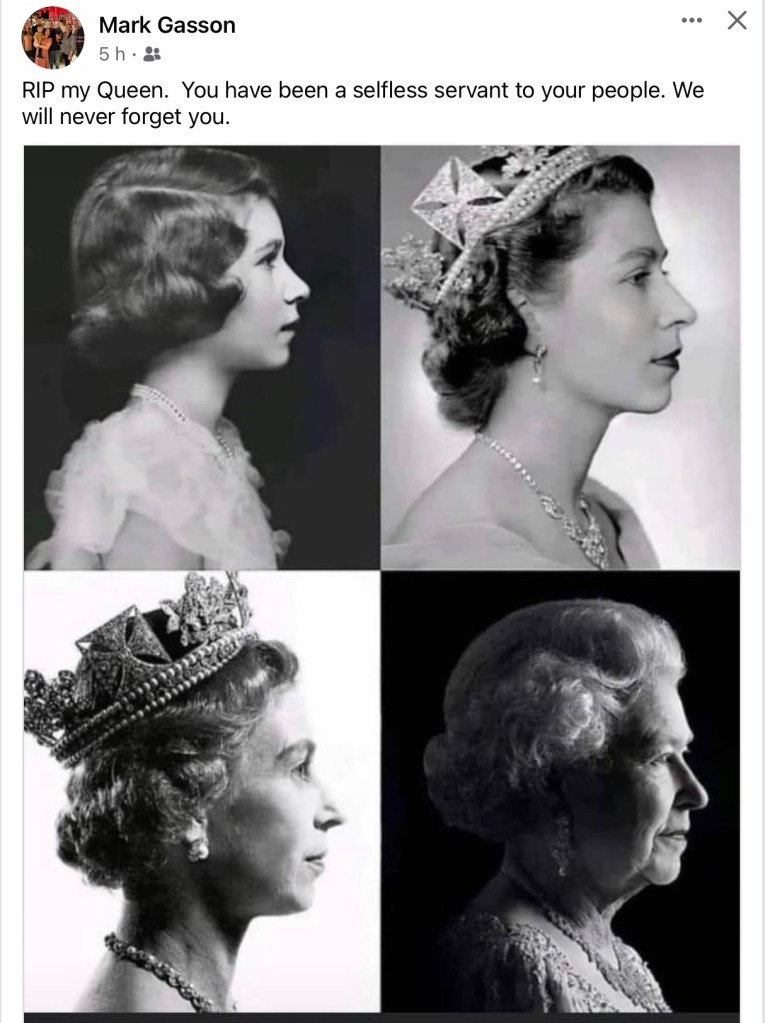
A ex-client turned friend, Mark Gasson, posted this on Facebook this morning

Max Hastings, writing in today’s Times, summed up his column of reflections so: “She conferred a grace, charm, and stature on her reign that caught the imagination even of tens of millions of republicans. Our debt to her is beyond any power of payment, save by doing justice to her memory. We shall soon join in saying ‘Long Live The King’. But first we may allow ourselves precious moments to bid farewell and give thanks for Elizabeth II. For seven decades, God indeed saved the Queen.”

Gerald Baker, again from The Times: “It will rank as one of the larger ironies of the era of Elizabeth II that even as the English Queen reigned over a dominion of ever-diminishing significance, she became a figure of ever increasing global reverence. Immediate reaction of her death attested to her status as the best-known and probably most respected woman in the world. ‘I remember her as a friend of France’ says President Macron, ‘Her wisdom was truly unique’ says Micheál Martin the Irish Taoiseach, ‘An irreparable loss’ says President Zelensky, ‘Pained by her demise’ says Narendra Modi the Indian Prime Minister. 

There is a lovely story doing the rounds on various radio stations and social media which, although not verbatim, I recount here, as it sums up the way this human being lived her life. One summer The Queen was enjoying a picnic somewhere in the grounds of Balmoral, her 50,000 acre Scottish estate, when a couple of American tourists on a walking holiday saw her and her equerry Dick. They didn’t recognise the Queen but asked: “Where do you live?” “Oh! I live in London but I have a holiday home over that hill.” She said, pointing in the general direction of the huge stately home behind some woods. “How often to you get up here?” “Well” she said, “I have been coming here since I was a child so over 80 years.” “So you must have met the Queen of England?” “Well, I haven’t but Dick here has!” So they asked Dick what the Queen was like. “She can be very cantankerous at times but has a great sense of humour.” And before you could say boo to a goose, they had got either side of Dick, given the camera to the Queen and asked her to take a photograph. Then they swapped places so the Americans left with some photographs to show their family back in the States. As they left, the Queen smiled and said: “I’d love to be a fly on the wall when they show the photographs!”

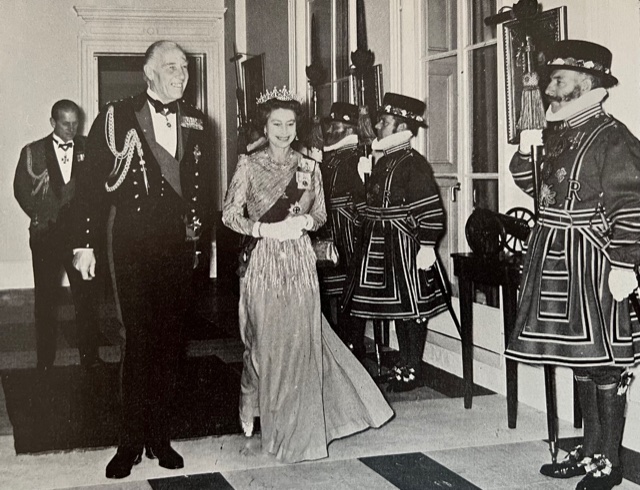
I have been lucky enough to have met the Queen informally, to ‘have a chat’ and scribbled about that experience in ‘I had Dinner with Her Majesty’ in PC 289 of July this year, the month of her Platinum Jubilee. Those in the last few days of their life often have a sense of quickening events. One of our Prime Ministers, Harold MacMillan, is reported to have had his normal evening whisky, put the glass on the table and murmured: “I think that’s enough” … and died. Knowing the late Queen’s impish sense of humour, I wonder whether she had simply waited to say goodbye to Boris, welcomed the new Prime Minister, Liz Truss and then, duty done, decided it was time to go?

In 2016 Celina’s father died. I had only known him for four years but come to love him deeply. In PC 60, ‘Goodbye … but never forgotten’ I summed up my thoughts about him. “The man I grieve in this piece was an enormously loved, talented individual who used his intellect to further our understanding of our brains and how they function. He was a simple man of faith or maybe a man of simple, deeply held faith, and if anyone was prepared for what might follow this earthy life, he was.

I sense this last sentence could apply equally well to Elizabeth II (with some pronoun adjustments!).

Richard 9th September 2022

http://www.postcardscribbles.co.uk