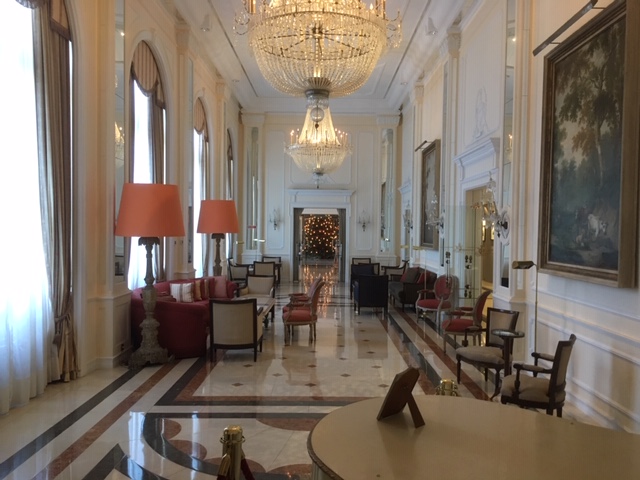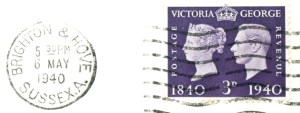
PC 353 …. Of Cabbages and Kings

The time has come’ the Walrus said ‘to talk of many things, of shoes …. and ships …. and sealing wax, … of cabbages … and Kings.’ (Note 1)

I love museums but often find that after an hour or so my initial enthusiasm and interest has waned, especially if you can see through to another exhibition hall …. leading on to another exhibition hall ….. leading on to …… and then the inevitable shop!

At some stage during my current stay in Estoril it was suggested that we visit the Jerónimos Monastery in the Lisbon suburb of Belém, after an admission that I hadn’t yet wandered the hallowed corridors where the monks had first created the little custard tarts know as Pastel de Nata or Pastel de Belém (Note 2). We could also see the Torres de Belém.

Having booked online for a 1030 admission, we parked the car, saw a huge queue and thought it was a good thing we booked! We walked over to the head of the queue to show our tickets and were pointed to the back of the queue, some 200m long! Something was seriously wrong with the way this is organised! It as a warm, sunny day but the queue was stationary so we decided to see the Tower of Belém first.  

The tower, which used to stand on an island in the Tagus River before some land reclamation, had a similar length of queue so we asked a ticket seller whether we could get a refund and why there was a problem. Apparently the authorities has decided to reduce the visitor capacity of the monastery from 200 to 60 but hadn’t altered the online booking system!

Near to the tower stands a very powerful stone projection of the reach and influence of Portugal in the C15th and C16th. Today in the C21st it’s hard to remember just how powerful this little country of 10.5 million people (Note 3) had been.

The first figure on the ‘prow’ of the Monument to the Discoverers is Prince Henry The Navigator (1394-1460), tasked by King Manuel I to explore!!


Third on the eastern flank is Vasco de Gama who discovered India in 1498 and next Pedro Alvares Cabral (see PC 349) the first European to reach Brazil in 1502. Further exploration saw Portuguese influence stretching across southern Africa, to Australia, Goa (Note 4), Macao and East Timor.

In 1788 Governor Phillip claimed the continent of Australia for Britain, but only as far west as the 135° east longitude, not wanting to upset the Portuguese who, under the Treaty of Tordesillas, still had a presence in the area, particularly in Macau and East Timor.  By 1825, however, Britain was powerful enough and found it convenient to adopt the original line of 129° east, which today demarcates Western Australia from the Northern Territories.

So we planned to return, just Toni and me, to see the Maritime Museum; plenty of ships there, one might think.

The charts are fascinating, given the age when they were drawn …..

…. and this glorious globe dated around 1645 by the Dutchman Willem Jansz Blaeu, amazing in its details …….

….. and some models and oil paintings.

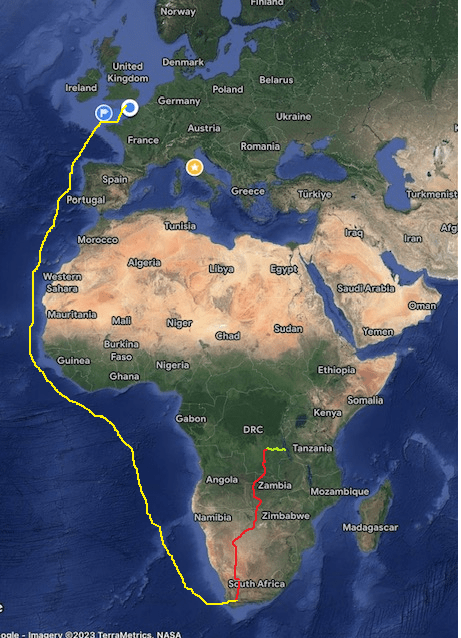
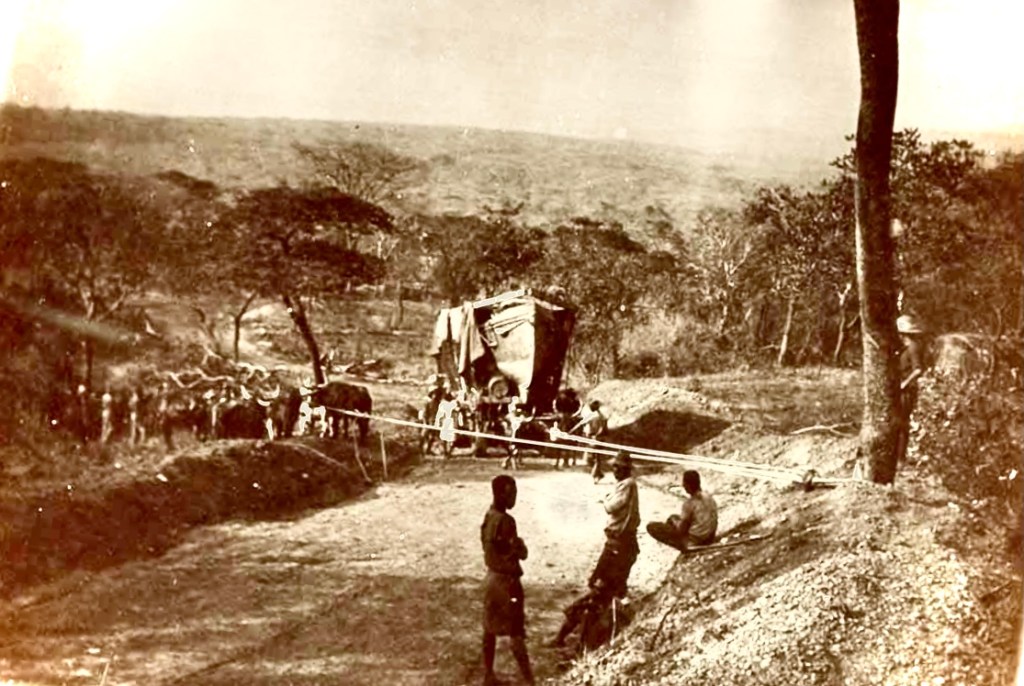
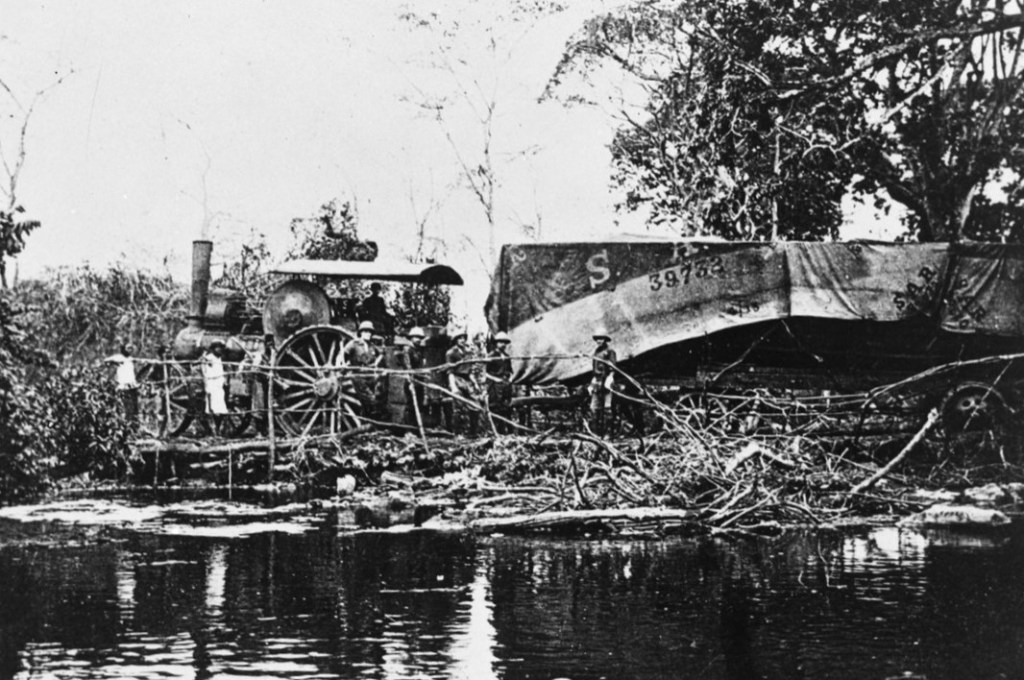
In the third exhibition hall, or was it the fourth (?), we came across ‘The British Ultimatum’ of 1890. The British required Portugal to give up the land between her African colonies, Angola on the west coast and Mozambique on the east; Britain would use force if necessary. So Portugal acquiesced and the land became the British colonies of Malawi and Rhodesia, now Zimbabwe, Malawi and Zambia. Portugal was extremely embarrassed by its inability to resist the British demands, and one can see here the seeds of dissent that would flower in revolution at the beginning of the C20th.

Angola on the west coast and Mozambique on the east

In some ways the large hanger-like building that houses a collection of boats, yachts and state barges is a metaphor for Portugal today.

Fascinating but rather dusty, reflecting a more glorious age. The Royal Barge was constructed in 1784 and was powered by 78 oarsmen using 40 oars.

It was last used when the late Queen Elizabeth II came on a State visit in 1957. Today it’s dusty!

So, onto Lewis Carroll’s ‘… and Kings’!

In my postcard about Mafra (PC 130 from 2018) I mentioned that when the republic was declared on 5th October 1910 the King, Dom Manuel II, one of whose nicknames was The Unfortunate, left the country rather quickly by sea. He eventually settled in Fulwell Park in Twickenham, London. His rapid departure was probably prompted by the memory of his father King Carlos I and his elder brother Crown Prince Luis Filipe’s assassination in Lisbon in 1908. Manuel died young in 1932 aged 42 and conspiracy theorists did not rule out foul play! His body was returned to Portugal by a Royal Navy Cruiser (HMS Concord) and, after a State Funeral, interred in the Royal Pantheon of the House of Braganza.

So no cabbages but ships, shoes on our feet, sealing wax on an ultimatum and now, no kings!

Richard 22nd September 2023

Estoril

www.postcardscribbles.co.uk

PS Next year on the 25th April Portugal will mark the 50th Anniversary of the 1974 Carnation Revolution which saw the return to democracy after the dictatorship of Salazar (1928 – 1968)

Note 1 Lewis Carroll, best known for his ‘Alice’s Adventures in Wonderland’, also wrote a poem called ‘The Walrus and the Carpenter’. It’s about entitlement and encroachment; it’s lovely nonsense but please ….. read it in full?

Note 2 Traditionally large quantities of egg whites were used to stiffen the clothes of the monks and nuns. The surplus egg yolks were used to make pastries and custard tarts. After the Liberal Revolution in 1820 and under increasing likelihood of closure, the monastery monks started selling Pastéis de Nata to the nearby sugar refinery. The monastery closed in 1834 and the recipe was sold to the refinery.

Note 3 Of these 10.5 million, 94% are Portuguese, 1.5% Brazilians, 1.5% Black, 1.5% mixed race and 1.5% other Europeans – but ask another reference and you get a different make up!

Note 4 Goa on the western seaboard was invaded by India in 1961 and after a mere 36 hours became an Indian state. (See PC 330)

PC 352 About Men (with ‘More About Men’ in Part 2)

Being a regular reader of ‘The Times’, whether in its paper copy or digitally via the internet, I often read Caitlin Moran’s column in Times 2 or in the Saturday Magazine. She’s insightful about a wide range of topics with a wicked sense of humour and the ability to bring out the verbal ‘hat pin’ ready to prick pomposity! As a feminist, she’s written a number of non-fiction books such as ‘How to be a Woman’ and ‘Moranthology’ and it was during a speaking tour in 2014 promoting the first that, in the Q&A session after her talk, a woman asked: “What advice would you give to the mothers of teenage boys?”  At the time, she was rather dismissive, telling the mother that other men, their father perhaps, should be the ones giving advice, being an ardent feminist and all.

Wind the clock forward five years and her teenage daughters need advice! In her book ‘What About Men?’ she recalls a Zoom call with three teenage girls and four teenage boys. “It’s harder to be a boy than a girl now. Everything is stacked against boys.” says Milo. “The girls talk about how scared they are of sexual violence – but the boys are much more likely to be attacked. It’s a fact; everyday I’m scared I’m going to be stabbed!”

George: “Girls don’t have to worry about getting into a fight or being stabbed. But there’s a lot of ‘she said/he said stuff’; in school rumours will suggest that such-and-such a boy has raped a girl, then it turns out they did have sex but she changed her mind, afterwards – or wanted to get back at him. A lot of boys are too scared to even talk to girls now!”

Moran found there was no good guide (Note 1) to help teenagers become happy contented men. So she wrote ‘What About Men?’ but was no way prepared for the backlash. One group were all: “How dare you suggest men have problems communicating their emotions?” and the other: “How dare you suggest that men should communicate their emotions? We are not biologically designed to be emotional!” During one of her Q&As, one woman’s response was to address these angry men: “If you don’t see yourselves reflected in this book, I suspect a lot of the girlfriends, mothers and colleagues do!”

Why, you might ask, am I writing a postcard about this? Curiosity for one thing; secondly as I have three grandsons all currently under twelve, I feel I need to understand, to use a nautical metaphor, the waters in which they swim and will swim and whether they will be able to go with the flow or have to fight against the tide; and thirdly because my daughter teaches in a secondary school, is currently Head of Year 11, and has to understand the issues her male students are presented with. My curiosity was highlighted in a column in The Times, whose headline was ‘A Question: why are men so rubbish at asking them?’ by Decca Aitkenhead, the paper’s Chief Interviewer. “Men”, says Nihal Arthanayake in his book  ‘Let’s Talk; How to have better Conversations’ “ are not curious – a conversation with a typical straight man is like playing tennis with someone who only serves at you.” Recalling her days at university, Decca wrote: “A fellow undergraduate seduced almost all the females on the course, despite him being not particularly handsome. I asked him his secret.” “It’s so unbelievably easy, I don’t get why every bloke doesn’t do it.” “What?” “I ask questions and am prepared to listen to the answers.”

I am not sure whether I fell into the ‘not curious’ group in my early life, but soon needed to be ultra-curious when I started my third 16 year-career as an executive coach. Getting inside someone’s head to understand them so that I could suggest alternatives/change required curiosity and the ability to ask the important question, like: “How do you feel?” And I remain curious about people today. In the men’s changing rooms at the yoga studio I can’t help myself in engaging with the others, impulsively wanting to know who there are/what they do/why they came to yoga – now naturally curious!

Men generally do not talk about sex, apart from in some meaningless banter. I mentioned Caitlin’s book to our masseuse the other day and said I could personally reinforce the idea that men don’t talk to each other about sex and its pluses and minuses! She immediately volunteered that she, her thirty-something daughter and a friend had sat on the beach the other evening and her daughter had looked for guidance on how to address the infrequency of her own sex life with her busy boyfriend. I can’t imagine men doing this.

I’ll scribble about pornography in the second part of this postcard as, according to Moran, some 65% of men admit to watching it. Apparently the addiction starts early.

But one of the issues that seems to have been overlooked, or dismissed as being in the ‘too difficult’ corner, is the fact that girls’ cerebellums reach physical maturity at 11 years old, whereas for boys it’s 15. What if we changed the way we educate our future generations to reflect this difference somehow in the structure of the syllabus, the ‘what, when & where’? I wonder whether other developed countries try and address this issue? I thought I was a fan of mixed sex schools, have suffered from being in a male-only environment from my early years until when I left the Armed Forces aged 39 (Note 2), but now, understanding this difference, I am not sure!

More in Part 2 …….

Richard 15th September 2023

Estoril

www.postcardscribbles.co.uk

Note 1 There are guides to masculinity but most promote a rather skewed view, unbalanced and biased. Not ‘good’ guides.

Note 2 Not completely true as gradually female soldiers became more integrated. But for instance in my last job in 32 Guided Weapons Regiment, the only woman among 450 men was the Assistant Adjutant, Rebecca Adams, but it was 1985!

PC 351 The Hope Closes – temporarily

Duncan, the manager of The Hope Café, emailed me, as I hadn’t been in for three weeks or more:

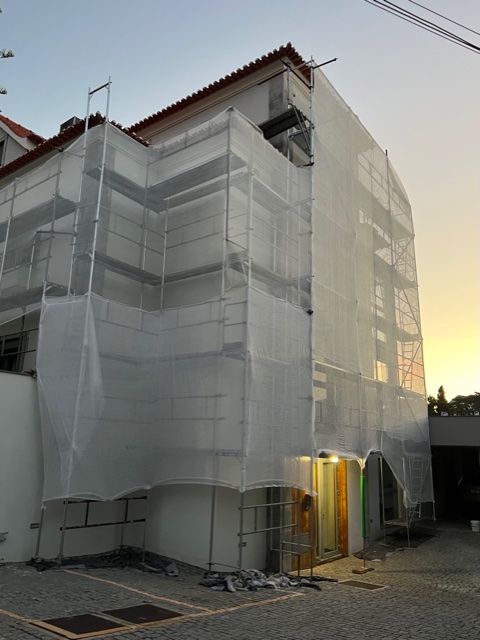
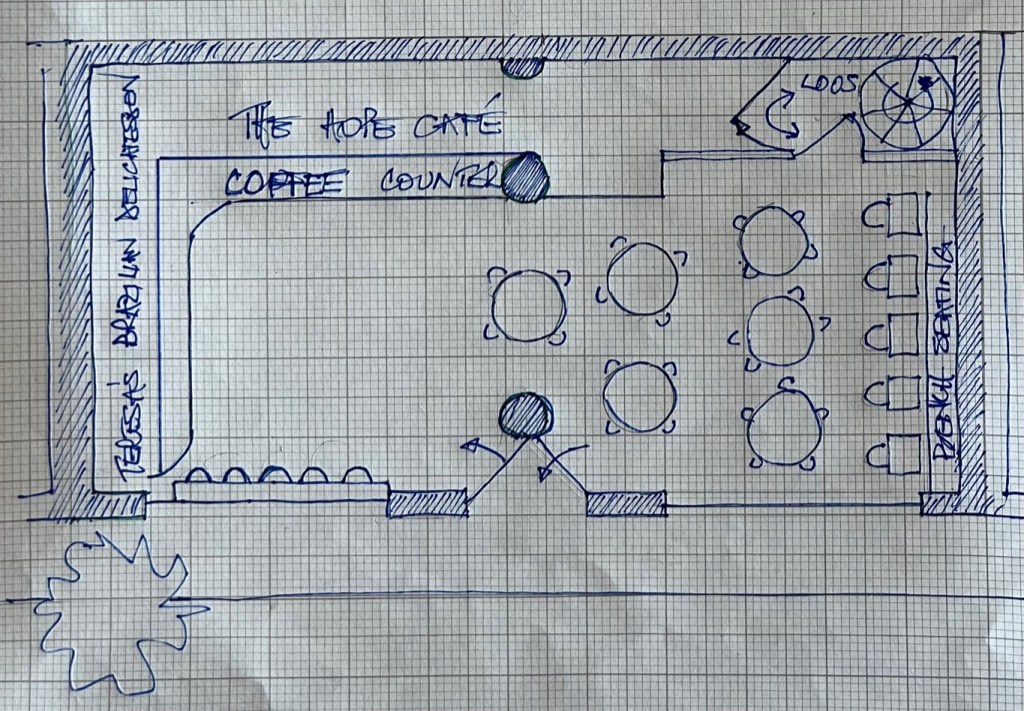
“Hi! Richard. Hope you and Celina are enjoying Portugal and we look forward to seeing you back here soon. This is just to let you know that we closed as planned a fortnight ago, Friday 25th August, for our renovations, initiated with the generosity of the legacy of dear Edith (PC 278 April 2022). We do miss her! Some of our regular customers who have the skills we need are working for free and often in the evening, so I am hoping we will reopen on Friday 22nd September. I have put up in the window two sketches, one of how we were and one showing how it should look! I have attached a photo:

We’ve already got the steel columns in place and the RSJ (Note 1) is now supporting the first floor. I am happy with the progress we’re making and the wonderful support and time my regulars have been giving. I am sure you would have been here if you hadn’t been in Portugal!

Before we closed we cleared out all the perishable items and took them to the local food bank. Libby took a couple of week’s holidays but she and Josh will between them manage the Coffee Cart that we have hired from Brad Stevens (@cups_coffeevan) for the period. The council gave us permission to station it to the left of the café; it’s open from 0730 to 1630 and so far has proved a God-send to our regulars. We all know that generally people are fickle about stuff and if we’re closed for too long will find somewhere else for their coffee and then may not return, so I am hoping this will keep them loyal.

A photo of Brad’s Coffee Cart in a park somewhere!

Brad gave Josh some useful instruction and he’s using it like a pro! How are you doing? Best wishes Duncan”

“Dear Duncan

Thanks for this; I have been kept vaguely up-to-date by others but now have an even better idea of how it’s going. I guess we’ve all got stories of builders and those who call themselves professionals – just the other day we recommended a good plumber, Henry Rodrigues, to a friend who had an insistent leak in her shower-room, despite the landlord providing someone to fix it. Henry reckoned the guy had no clue whatsoever!! I was reminded that when we first moved into our new apartment; we couldn’t understand why there was a constant smell of drains, until a good plumber looked under the kitchen sink and found the U-bend had been attached incorrectly! So I am delighted to read everyone’s putting their own professional expertise to good use.

Can you ask Libby to email any news she has of Susie as I don’t have her email address? Good luck! Richard”

A couple of days later I got an email from Libby:

“Hi! Richard. Not sure how much you’ve seen of New Zealand (Note 2) but after her stint as a chalet girl in the snow fields of Queenstown, I had expected Susie to travel up the west coast of South Island before crossing the Cook Strait. I was there many decades ago and think the Haast River valley one of the most beautiful in the whole country, so imagined her going there, on to see the Franz Joseph glacier and then Hokitika etc. But she decided to hitch up the East coast ….

…….. past the Moeraki Boulders Beach

….. then up through Christchurch, over the Waimakariri River

….. across to Wellington and up the middle of North Island

Kapiti Island on the west coast at sunset – far away to the left is the northern tip of South Island

….. and through Rotarua to Auckland. She was planning to find some work there but, on a weekend up in the Bay of Islands, Margie, a niece of mine who lives in Hobart, Tasmania, got in touch via WhatsApp saying she had an opening in her catering business for a couple of months, starting at the beginning of September. So, as far as I can tell, she got a seat on one of the twice-a-week direct flights with Jetstar and is now working for Margie in Hobart, hopefully until the end of October. She asked me to pass on her thanks, via you (!), to Michael in Auckland who had offered help in extremis but all good.

Alright for some, huh! Although between you and me she deserves this: needs to sort out her head and come back to Hove and The Hope. She might, of course, decide not to come back, or maybe bring someone with her! Who knows? Life huh!

Duncan says we’ll reopen on the 22nd September. I’ve been to see the progress and think he’s optimistic; I peeped inside and took this photograph:

but we’ll see. Fingers crossed! Take Care Richard and enjoy the sun. Libby

Without The Hope Café and its customers to provide me with ideas for my postcards, I have fallen back on my file with cuttings from this and notes about that. Some months ago there was some correspondence about Ovaltine.

It’s probable only my older readers who will have drunk a cup of Ovaltine, the malted milk drink believed to make you sleep better, but maybe I’m wrong? Personally the best drink to ensure a good night’s sleep was, I thought, a tumbler filled 50:50 with whiskey and hot milk! What I hadn’t appreciated was Ovaltine’s aphrodisiac qualities and this little ditty should be sung to the tune of the Christmas carol ‘Hark! The Herald Angels Sing’:

“Uncle George and Auntie Mabel fainted at the breakfast table. Let this be an awful warning, not to do it in the morning.

But Ovaltine has put them right, now they do it morn and night.

Uncle George is hoping soon, to do it in the afternoon.

Hark! The Herald Angels Sing, Ovaltine’s a damn good thing.”

Roll on the reopening of The Hope Café!

Richard 8th September 2023

Estoril

www.postcardscribbles.co.uk

Note 1 Rolled Steel Joist – often in an ‘I’ shape.

Note 2 Libby doesn’t know of my fairly extensive knowledge of New Zealand.

PC 350 Another Fifty PCs, Another Year

If it was a jubilee, 50 would be golden; nice thought?

There was no plan, no target, no goal, just an initial desire back in 2014 to send the sort of ‘Wish You Were Here’ postcard from Brazil. Quite easy to develop habits and here we are, nine years later, producing a postcard every week about my observations and take on living in the C21st. Reaching the 350th immediately tells you, if you’re numerate, that another year has gone by, well, less two weeks, since the 300th.

Our major travel adventure this year was five days in the Atacama Desert in northern Chile (PCs 319 and 320), book-ended by time in Rio de Janeiro. We stayed in a wonderful hotel in San Pedro de Atacama, Noi Casa de Atacama, and from there travelled out to various places such as the Atacama Salt Lakes,  

The Atacama Salt Lake, about 165kms by 50kms

… up to 4150m in the foothills of The Andes to the twin lakes of Miscanti and Miniques

The Miscanti Lake with a rain shower

and to Lunar Valley with its unbelievable rock formations.

What a strange and wonderful place, one that prompted me to paint a couple of triptychs, which I hung together.

We also made friends with Andreas and Andrea from Berlin and tried to visit in June, but EasyJet cancelled our plans, for now!

Continental travel was reflected in some memories of driving to Greece with five others in 1965 (PC346 Puds to Greece), an appropriate memory at this time of year as, on our return, we faced our A Level examination results on which our future depended. We have also stayed in Lisbon for a night (PC 349) and PC 339 ‘With a Connecting Door’ had a travelling theme. In the United Kingdom a couple of nights in the City of Bath with my mother-in-law and Toni were covered by ‘An American in Bath’ PC 337

and a rather wet week with my daughter and my three grandchildren in Devon by PC 347 Frogmore, Devon.

Dartmouth from the castle

Our Gaggia machine with some Illy grounds produce our breakfast coffees but, always looking for ‘copy’ for my scribbles, I started going for a coffee in The Hope Café here in Hove in October 2021, almost two years ago. Since then I have got to love this place, its staff, its customers and the ambience. I think fourteen of my posts in this batch of 50 concern goings on in The Hope Café and key has been my relationships with Sami & Lisa, with Mo, with the late Edith and with Josh and Susie behind the counter. Susie has of course gone off with on her much delayed ‘Gap Year’ so I rely on her aunt Libby to keep me up to date; I think she’s still in New Zealand – should have an update next week.

It’s hard to believe that after another year, the final settlements that should mark the end of the Post Office scandal and the subsequent initiation of criminal charges against those responsible remain as unattainable as ever. Because of my relationship with Sami I have remained interested in this dreadful miscarriage of justice; otherwise the story would have faded back into the general ‘news’ pot. Sami, who had gone to India to find his roots, signed up for a tour of the historical sites of the Indian Mutiny (PC 302) while he was there and found Lisa Wallace, a journalist. Sami introduced Lisa to his friends in The Hope Café and subsequently I have learned of Lisa’s awful experiences at the hands of her controlling ex-partner Andrew (See PC 335). Rightly the issue of controlling, coercive, belittling behaviour has been seen for what it is, personal abuse, and HM Government has legislated against it.

In addition to writing about the serious subject of coercive behaviour and its prevalence, one of my postcards concerned a single subject, Sepsis. (PC 334). The more people are aware of this lethal condition the more likelihood less people will die from it.    

Relationships are always part of my life and part of your lives but it was only this year I learned about IRL – meaning ‘in real life’. There is obviously a genuine need to distinguish between a fantasy world and one’s real life, but when an individual can’t see or understand the difference the potential for danger to themselves and to others is apparent.

There are more and more docudramas that have an alternative belief as their framework, religious or otherwise, the top of the list being the beliefs of Ultra-Orthodox Jews. I touched in this in PC 305 exploring in brief the main ideas that run through these groups.

My postcard entitled Tradition (PC 341), prompted by the coronation of the new king, got the prize for the most comments.

‘From Pillar to Post’ (PC 308 ), ‘Bits & Bobs’ (PC 310) and ‘Jottings’ (PC 323) pulled together thoughts and observations about this and that; bits & bobs even!!

In PC 348 I recounted how Mo had asked me why I remembered Bastille Day; I explained of my more recent memory that the storming of the Bastille in 1789. Jonathan commented:

“National myths can run wild, as with Quatorze Juillet. Thus, The Bastille was a rather unimpressive fortification with low walls, not as in the paintings. It contained only 7 prisoners: 4 forgers, ‘an Irish lunatic’, an energetic adept of the Marquis de Sade, and a man who had plotted to kill the King. However, it is generally advisable to leave other people’s national myths well alone – only ours are true.”

Communication, either good or bad, is key to a better understanding of where we are, what we’re at. After reading PC 349 about Facebook’s ability to predict what one’s doing/interested in, you’ll be pleased to know that it’s the iCloud that’s listening, for I have observed it!

… or should it be the ‘ear cloud’?

I wonder what sort of summary I’ll be writing about in PC 400, before I post it on Friday 16th August 2024?

Richard 1st September 2023

http://www.postcardscribbles.co.uk

PC 349 Coincidence? Nah! Big Brother!

I am really not sure what to make of a recent experience of mine? I can smile and yet am concerned in equal measure. But let me explain so that you can offer your own interpretations, if you wish. These scribbles are focused on one particular issue but I have wrapped it with a few layers to make it more interesting!

We drove into Lisbon last Wednesday for a night in a hotel. It was only when we were a few kilometres from our destination that we realised we had left Francisquinha behind. (See PCs 172, 217 and 331). Anyone who has had a young child in the rear seat suddenly burst into tears and exclaim that they had left their favourite stuffed animal at home will recognise the situation; worried looks between mother and father and thoughts about how they will soothe the situation without driving home to collect the animal. So it was with Francisquinha, although I think we were more worried about what she might get up to, left alone for 24 hours!

In central Lisbon there is a lovely shaded square called Jardim das Amoreiras, a place where local inhabitants can sit under the Mulberry trees, collect a snack or a drink from the little café and if they’re lucky listen to music from an itinerant guitarist.

The south west side of the square is bounded by part of the magnificent Aqueduto das Aguas Livres, an 18km aqueduct

which opened in 1748, survived the 1755 earthquake that destroyed much of the city, and remained the major supplier of the city’s drinking water until 1973. (Note 1)  

at ground level

The leaf of the Mulberry tree is essential food for the larvae of the Mulberry silk worm. I read that they will spend about a month chomping their way through lots of leaves before resting in a pupa stage. After some 10 days they emerge as the silk worm moth – for a rather short life of some 5 to 10 days. The Hotel das Amoreiras obviously chose the Mulberry Silk Moth as its motif.

By now you’re probably thinking he better start taking about this coincidence – ‘a remarkable concurrence of events or circumstances without apparent causal connection’ (see PC 328 March 2023) – that isn’t or I’ll stop reading. Patience dear reader!

My mother-in-law had stayed in the Hotel das Amoreiras before, liked it and its friendly staff, and wanted to stay here for the night before her birthday. The booking was made and around 1600hrs on Wednesday afternoon we checked in, without Francisquinha! The reception is at the end of a gloriously furnished room with an open bar at the other; ‘clubby’ was the atmosphere created but definitely not stuffy clubby!

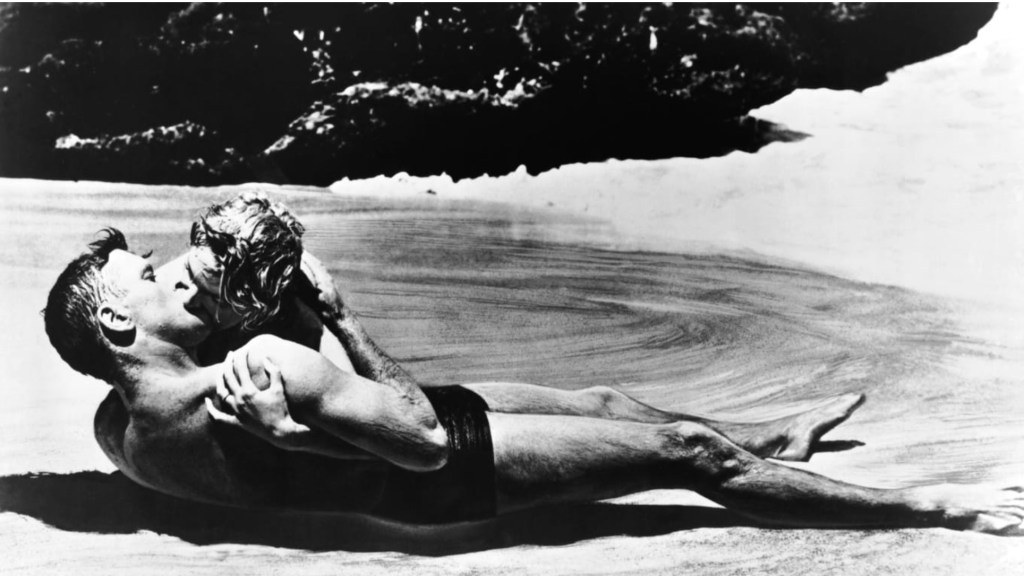
We all went up to my mother-in-law and Toni’s room on the first floor before Celina and I went up to ours. At the end of the corridor was a floor-to-ceiling mirror and in the middle a framed black & white photograph of Sean Connery and Ursula Andress.

(Note my feet at the edges!)

Those of us of a certain age will instantly recognise the two actors who played starring roles in Dr No, the first cinematic adaption of Ian Fleming’s 1958 book of the same name; Connery as 007 and Andress as Honey Ryder. It was 1962 and this still photograph from some downtime on set has proved an enduring memory. When I saw it I mentioned it to Toni: “Isn’t that great! Good film, Dr No, great actors obviously having some fun!” Toni agreed! At the other end of the corridor was a black & white photograph of Charlie Chaplin so I imagined Pedro & Alicia, the hotel owners, are film aficionados.

We had agreed to meet outside around 1640 and I walked out into the square and sat, listening to a delightful guitar solo from the chap. Still within the internet coverage of the hotel, I checked my emails and clicked on Facebook. We get used to buying something in a store or online and then being inundated with advertisements from the same company, offering more of what you’ve just bought. For example last month I bought an Osprey backpack in the Cotswold shop in Brighton and was then inundated with offers for more backpacks. Why would I want to buy another one right now? In a year or three maybe, but right now?

However the second item that lit up on my Facebook screen was this:

Could someone explain it? My only thought was that my mobile listened to my conversation with Toni in the corridor outside their room, looking at the picture and someone/something thought I/it will make him smile and posted this on my Facebook account. Big brother? Whatever happened I think it’s scary!

Near to the hotel was Avenida Álvares Cabral with Cabral’s statue sitting at the southern end, at the entrance to Jardim da Estrela (The Garden of the Stars). Pedro Álvares Cabral, 1467 – 1520, was a ‘Portuguese nobleman, military commander, navigator and explorer regarded as the European discoverer of Brazil’. Note the use of the adjective European; to those who already lived there, it didn’t need discovering! Brazil is of course the only country in South America to speak Portuguese.

At first glimpse, against the bright sky, I may be forgiven for thinking the statue is of a hooded witch with a staff, bending forward. On closer inspection it’s Cabral with a flag blowing in the wind – well, frozen in bronze wind.

In six days from now, on 31st August the earth will see a bluish tint to the moon. Blue moons occur every two to three years; in 2018 we had two but will have to wait until 2037 for that to reoccur. In the bar after supper we tried to think, as you do, who had sung the Rogers & Hart song ‘Blue Moon’?

Richard 25th August 2023

Estoril Portugal

www.postcardscribbles.co.uk

PS Francisquinha looked somewhat space-out on our return.

Note 1 At the bottom of the square is a large dominant building that was the cistern for the aqueduct (reservatório da Mãe d’Água das Amoreiras) but now houses a museum and is an occasional venue for art exhibitions.

PC 348 Into The Hope

I managed to pop into The Hope Café last week and caught up with my friends. Josh handed me a double espresso and I made my way across to Mo, who was looking tanned and relaxed. It transpired she had just had a couple of weeks in Provence in France with one of her daughters.

“Oh!” I said. “My daughter and family are there now, in France I mean; Paris for a couple of nights, Beaulieu-sur-Dordogne and Royan (Note 1) for a week each and then up to the Channel coast near St Malo.” 

I read your last postcard reporting gossip from here (PC 343) and noticed you added, down at the date, that it was posted on Bastille Day. Why did you add that? You’re not French!”

“Well, that date always makes me think about a sailing adventure. I certainly don’t need to remind you how pivotal the storming of the Bastille Prison in Paris in July 1789 by ‘revolutionaries’ is in French, European and actually global history!”

“Absolutely not, as it led immediately to the revolution and the end of the monarchy.”

“My memory is more recent! In July 1973 I managed to secure a couple of weeks on the Sail Training Association (Note 2) TS Malcolm Miller, a three-masted Staysail Schooner, which offered an introduction to sailing, team work and all that stuff to some 36 young men from under-privileged backgrounds. I was one of three Watch Officers. Let me see, somewhere in my thousands of photos I might have one of the schooner. Ah Yes!

We sailed from Gosport, opposite Portsmouth, and, via St Peter’s Port in Guernsey, arrived on the 13th July, the day before Bastille Day, in the French town of Douarnenez on the north west tip of France. Our visit was a major attraction for the local population, particularly the young women. I tried to persuade the captain we should stay for the town’s celebrations the following day, but he was unmoved so on Bastille Day we slipped our mooring lines and sailed north west to The Scilly Isles.

After a day or so there we went off to Lundy Island in the Bristol Channel …..

Where? Lundy? I’ve never heard of it!”

“It’s a very small island off the north Devon coast, northwest of Bideford. Popular with ornithologists, especially those interested in Puffins, and it attracts day trippers from Ilfracombe.

It was given to The Landmark Trust in 1969 by a British billionaire. Anyway, we met up with the Malcolm Miller’s sister ship the Sir Winston Churchill. Looking down from the cliff outside Lundy’s pub, it was a timeless scene, two three-masted ships at anchor. The trip finished in Newport in south Wales.”

The Malcolm Miller’s track

“Lovely memories Richard and I now understand about Bastille Day! Listen, I must dash as I have a dental appointment, but I see Sami’s over there with Lisa.”

“Good to see you. Hope the dentist is gentle!” and I got up and joined Sami and Lisa. She had succeeded in getting an ad hoc agreement with The Argos, the local Brighton & Hove paper, and has submitted a piece about the fire on 24th July that destroyed fifty per cent of the Royal Albion Hotel here in Brighton, opposite The Palace Pier.

The 208-room hotel was built in 1826 in the Regency Style, popular at the time, and had a 3 star rating. According to those who had stayed there recently, it had seen better days!

Note the sailing painting still in its frame, somewhat untouched!

“That’s great Lisa, I hope it’s the start of a good relationship with The Argus. Now Sami, I imagine you’re up to date about the Post Office scandal but I was moved to write to The Times the other day after Nick Wallis’ piece.

“Why was that?”

“I was mulling over the whole sorry saga again and I thought, have we all missed something? I know the figures are different for you, but to use you as an example, if you had been falsely accused of stealing £10k, ‘falsely’ as in there was no error in your accounts, and charged and ordered to pay the money back – the Post Office is suddenly £10,000 in credit. Multiply this by 736 and you can imagine a conversation between the CFO and the CEO: “We’ve got £7,360,000 in our account that is completely unaccounted for. What should we do?”

“Probably pay out bonuses and keep quiet! But it does beg the question Richard; was the Post Office never audited during this period? How did they explain the huge credits? We will probably never know! Anyway Richard, how are you?

“Actually very good! But I did get fed up a couple of weeks ago when a friend of over 50 years with whom I had lunch sneered at my addiction to the hot yoga series! Why do people do that? It’s obviously not his bailiwick but I don’t ask in a similarly critical way why he does ‘x’ or ‘y’! Maybe I should? Incidentally I realise it’s your 65th birthday in October. Are you planning to do anything special?

Lisa gives me a look as if to say ‘I am organising something but it’s a secret and we haven’t discussed it yet!’

“You know me Richard. Not a great party man so maybe a pizza somewhere.” Whereupon Lisa rolls her eyes to heaven!

“I think I’ll have a quiet word with Lisa and see what we can organise – it could of course be just a pizza!! Hey! I promised to pick up something from The Framing Workshop before they close; must dash! See you!”

Richard 18th August 2023

Estoril, Portugal

www.postcardscribbles.co.uk

Note 1 Royan is at the mouth of the Gironde River; at the river’s southern end is the city of Bordeaux. In early December 1942 six Royal Marine canoes were launched from a submarine off the estuary, for an attack on the Bordeaux docks.  Only two canoes survived to complete the 50 mile paddle but they managed to attach some limpet mines to six ships. Two out of the twelve marines made it back to England, although Operation Frankton was judged a success.

Note 2 Now the Tall Ships Youth Trust, based in Portsmouth

PC 347 Frogmore, Devon

Frogmore Creek at low water

My maternal ancestors, as far back as I have researched, came from villages astride the Devon-Somerset boundary. Matthew Nation, my great-great-great-great-grandfather died in Dulverton, some 25 miles west of Taunton in Somerset and some 75 miles north of Frogmore in Devon, in 1795 aged 47. The following year his eldest son Stephen, aged 16, joined the East India Company as a cadet and sailed for India. (Note 1) Whether Dulverton has changed much in the intervening two hundred years is anyone’s guess, as down here in the West Country life responds to different rhythms to the rest of England.

We had booked an AirBnB, The Granary, in the little hamlet of Frogmore (note 2), east of Kingsbridge, Devon for a week, to spend some time with my daughter and her three boys. Securing it months ago, I guess we all imagined sun-drenched days on sandy beaches, the warm after-glow of sun on skin; a period in late July when time would stand still. This year, however, autumn has come early to the United Kingdom and we managed one day on a small shingle and pebble beach, oddly named Blackpool Sands, just north of Slapton Sands. (see PC 308 From Pillar to Post November 2022)

Blackpool Sands

With a light rain forecast to last all of our first day, we took The Lady Mary, a little 50 pax ferry, from Kingsbridge down the estuary to Salcombe; a great way to both be on the water and also see something of the marine-scape.

What I hadn’t counted on was the cost. Three adults and three children cost £48 – one way! Clearly the wet-weather programme for families on holiday is extremely expensive. 

Salcombe caters for the tourists: lots of shops selling nautical clothing and nick-nacks with a nautical theme, local artists displaying their efforts and the inevitable pizzas, burgers, and pasta food options – oh! and ‘Cornish’ pasties in Devon! Later we took the ferry back to Kingsbridge …. in the rain!

I met The Pophams over 30 years ago and, knowing they had moved, many months ago, to Devon and settled in Buckfastleigh, we got ourselves invited for lunch. So good to be warmly-welcomed and bombarded with chat and chat and lunch ….. and then off to Hembry Wood for an afternoon walk with their two dogs along the River Dart.

moss grows generally on the north side of trees (in the Northern Hemisphere)

The Pophams are an artistic family, with daughter Ellie an aspiring opera singer and Karen a well-established oil painter and member of The South West Academy. The latter has an exhibition at West Brompton Cemetery Chapel, Fulham Road, London SW10 9UG 9th – 14th September 2023.

Chris, delightfully a regular reader of my PCs, is embarking on a new career in wood sculpting.

No wet-weather holiday programme would be complete without the visit to a cinema. Kingsbridge’s Kings Cinema has three extremely small and cute theatres and in one screened Pixar’s Elemental: “fire, water, land and air residents live together ….. two discover how much they have in common.” The age-old story – female meets male but they are of the wrong tribe, wrong side of the tracks, wrong social level, race, religion, sexual orientation – but love wins! And this aimed at children!

And with children there’s always a thrill in going to a castle, whether it’s Windsor, Cardiff, Corfe, Edinburgh or even Dartmouth.

Large guns faced seaward as it sits across the mouth of the River Dart, which we had encountered as a smaller river back in Hembry Wood.

I have been to Dartmouth before, when my brother was being commissioned from the Royal Naval College, so was aware that in this part of the world roads are often extremely narrow; everyone is tested in their knowledge of the width of their car but fortunately passing spaces are frequent. We live in the city of Brighton & Hove and adore being here. But cities and towns are not everyone’s cup of tea and I am reminded of the contrasts down here in Devon. Little concrete and glass, few high rise apartment blocks, less hard surfaces and grey; replaced by green in the trees and green in the fields and rolling hills, by cattle and wildlife.

Slapton Sands ahead in the murk!

In Torcross at the southern end of Slapton Sands we stopped for some afternoon tea and another chance for the boys to swim in the cool sea, under grey clouds!

A World War II American Sherman Tank

Parents used to use the expression ‘you’ll get square eyes if you look at television for too long’ before laptops, iPads and the plethora of screens which give us access to so much of modern life. My grandchildrens’ iPad use is normally extremely controlled but on a wet holiday they delighted in trying to alter the shape of their eyes! Aside from the odd card game and the completion of a 1000 word jigsaw, I tried to get one of my grandsons to contribute to this postcard. “Oh! It’s so hard! …… I can’t think! ….. Why can’t I …..? ….. So sorry, my mind’s a blank!”

We left a day early. On the day we should have returned it was again blowing a hooley; 40 – 50 mph winds and torrential rain. Lucy, a yoga chum currently not working because of the Writers Guild of America strike and its knock-on effect here, returned from Cornwall – “The worst drive of my life!”

Frogmore Creek at high water

A last view from the AirBnB across the Frogmore Creek reflecting that these rhythms are timeless: the tide goes out, the water recedes and comes back …… and we inhale and exhale, our breathe goes out. We breathe in ……..

Richard 11th August 2023

Hove

http://www.postcardscribbles.co.uk

Note 1 Stephen Nation, then a Brigadier, died of Cholera aged 48 in 1828

Note 2 Not Frogmore Cottage owned by The Crown Estates and recently occupied by Harry & Meghan. 
PC 346 Puds to Greece

Not sure why those who attended Dauntsey’s School in Wiltshire were nicknamed ‘Puds’ as it wasn’t in regular use in the school; maybe it was the school itself that earned the moniker? Maybe ‘Puds’ is a nod to puddings, a term for both sweet and savoury dishes, reflecting the nature of the children that passed through the school’s main entrance. Maybe someone will enlighten me?

In 1964 I had hitched with Nigel Bond from Ostend down through Belgium to Luxembourg, then back up the Rhine to Koln, Antwerp and home. Other than that I had never been further than Germany to visit an uncle serving with the British Army in Mönchengladbach, unless you call The Isle of Man overseas?

Few of us growing up in the 1960s thought of taking a Gap Year but the nub of an idea of some adventure after taking our A levels took hold. Eventually the plan to drive across Europe to Greece firmed up and in late July 1965 six of us climbed on board a hard-topped Land Rover, complete with tentage and stores, Gaz bottle and stove.

We were Ray Morrell, Andrew Hamilton, Ian Leigh, Jonathan Appleby, Doug Tester and me. Two of us in the front, four in the rear, with ‘stuff’ piled there and on the roof-rack. If you sat in the back, visibility was limited and this, together with the fact that not everyone drove, meant we soon realised we couldn’t simply drive all day, for hours on end. I think it was on our fourth day, the first of August, when we woke up in our Swiss alpine campsite to find it had snowed overnight.

Our route took us down the Adriatic coast of what was Yugoslavia, formed after World War Two as a federation of six republics, Bosnia & Herzegovina, Croatia, Macedonia, Montenegro, Serbia and Slovenia. Communist President Tito’s policies allowed some liberal development within a planned economy and he was remarkably successful. (Note 1) Leaving the coast to go around Albania, we drove into northern Greece.

Memories of campsites and putting up the tent and cooking and washing up and sleeping and taking down the tent and loading up the Land Rover and  ….. all tend to merge into a general ‘we drove down to Greece and back’. I had never heard the noise of a Cicada before but now of course the sound brings an instant recall of warm Mediterranean evenings, coastal towns like Split and Dubrovnik, driving inland from the Gulf of Kotor up and around isolated Albania, being delayed by a landslip and finally arriving in Greece.

We had taken much longer than we had imagined to get there so stayed only a few days in Thessaloniki before starting our return! There was another reason. Greece in August 1965 was a country of strife and protest. King Constantine had dismissed the Prime Minister Georgios Papandreou and appointed Georgios Athanasiadis-Novas, who was very unpopular. The streets of Greek cities filled with anti-riot police and student demonstrations and eventually he was voted out of office after 21 days. Not a time to be a tourist!
In amongst ‘we drove to Greece and back’ one particular event remains quite vivid for me, as I was driving! We were on our return journey, making our way around the north of Albania, driving through the suburbs of Pristina, now the capital city of Kosovo, when we realised we had taken a wrong turning. We had lots of road maps but the levels of detail varied enormously and mistakes were easy. The side street was potholed and dusty and, as I started to turn left across the street to execute a U-turn, an unseen motorcyclist on a rumpty-tumpty moped clipped the Landrover’s left wing. He skidded across the street and the bike toppled over. Struggling to his feet, he had the presence of mind to pick up the revolver that had fallen from his jacket, before giving us his opinion of my driving skills. Not being a linguist, I could only judge he was very cross! A small crowd gathered, suspicious and unused to foreigners. The local policeman on his pushbike arrived, my details were taken down, all our passports stuffed in his bag and we were told to appear before the judge at a certain place at 9 o’clock the following day.

Pristina didn’t do camp sites in 1965 so we headed out into the countryside, found a suitable sheltered spot to erect the tent, made a roaring fire and, over supper, contemplated what might happen, wondering what Yugoslavian prisons might be like etc. The following morning we appeared before Judge Kadriu. Contrite and full of apology, driving on the other side, confused, so sorry etc ….. and serendipity came to my aid! We had given a lift out of Greece to a South African girl hitch- hiker named Morgan (Note 2) and our judge had learned his English in South Africa. Chat! Chat! Chat! Fined some 2000 dinars (about £10 in 1965) (Note 3) and told to drive more carefully.

Three days later at Trieste we turned left and settled into a Venetian campsite for a couple of days before driving home. On the way back we had an amusing interlude with a Volkswagen Beetle on the motorway between Basle and Koln. We passed them, they passed us and waved, we passed them and waved and then, as they passed again, they passed us some chocolates and we shared some of our biscuits and then they turned off.

We caught the ferry and, once home, went our separate ways, our adult lives starting.

Richard 4th August 2023

Hove

http://www.postcardscribbles.co.uk

PS We are all still alive. Ray, whose father generously supplied the Land Rover, lives in Toronto, Canada: Andrew is in Surrey, Ian and Doug emigrated to Australia, the former living in Woongarrah, New South Wales, and Doug further down the coast in Sydney; Jonathan lives near Southampton.

Note 1. Typing these names brings back the horrors of the Balkan/Bosnian War that followed his death in 1980 and subsequent violent break-up of Yugoslavia.

Note 2 The only other Morgan I know, apart from the car, is a film titled “Morgan – A Suitable Case for Treatment”  (1966)

Note 3 £10 may seem a trifling amount but my first month’s pay when I joined the Royal Military Academy as an Officer Cadet in September 1965 was £65.

PC 345 Drifting

We drift in and out of consciousness following some surgical operation or physical assault, or overindulging with alcohol or drugs, drift off to sleep and sometimes feel our lives just …… drift!

Shopping, I know what I want and where I am going to buy it; quite focused and engaged. In the crowded North Laines of Brighton I get frustrated by those ambulating, strolling, drifting even. Occasionally I hear my inner voice: ‘Hey! Slow down! It’s probably quicker if you just go with the flow; you will certainly be less stressed, able to observe more!’ for there is much to see in these busy streets and quirky shops.

Got me thinking about drifting …….. and the first thought that came to my mind, well actually the second as the first was the chorus of the song Drift Away, was about Continental Drift. The continents we know today drifted from where they had first formed. One particularly well known aspect is that what we now know as the South American Continent fitted neatly into the African Continent; you can imagine Recife in Brazil nestling up to Lagos in Nigeria, before the latter drifted away. Another fact is that the Himalayan mountain range and Tibetan plateau have formed as a result of the collision between the Indian Plate and Eurasian Plate; the first impact started some 50 million years ago and that movement continues today.

My first offshore sailing trip was on the west coast of Scotland, on an engineless 30ft yacht called Jutta. There was very little wind over the week and we drifted …… although at some point tried to make progress towards the harbour of Tarbert Loch Fyne by either pulling the yacht with an inflatable or by getting a tow; the latter was more successful.

Many years later skippering a 42ft yacht from Kiel to Olso, on the return leg near Copenhagen we had no wind and drifted for an hour or two, before accepting a tow into the nearest marina. Always difficult judging when to let the tow rope go as you needed enough forward momentum to get to a berth! In the same part of the world, I remember Billy standing on the foredeck of a yacht in a race from Kiel to Eckernförde and lighting a cigarette to see if the smoke would indicate any puff of wind as we drifted!  Incidentally Eckernförde had some of the best smoked eels in the world.

Drifting is so often associated with danger in a sailing sense, drifting towards a lee shore or towards rocks, but Eva Fosbery, the seventeen year old who was to become my great grandmother, recalls something else. Following the grounding of the barque The Queen Bee in August 1877 on Farewell Spit in the north of South Island New Zealand (see PCs 152 & 154), she wrote: “I think the Captain wanted us and the others in the lifeboat to stay together, but no sooner had we got on board the crew cast off and we drifted away; we should have had the Chief Officer and some food and water with us! I could hear the Captain yelling for us to come back but the crew seemed resolute in their actions. I was told later that those left on board constructed a raft but we lost sight of the Queen Bee after about seven hours so at the time imagined we were on our own.”

‘…. drifted away;’ – but they were all saved from beaches in the Marlborough Sounds two days later.

Elmslie’s Beach

Dobbie Gray wrote about losing himself in the music in his Drift Away (1973) with its chorus:

“Oh! Give me the beat, boys, and free my soul

I wanna get lost in your rock and roll and drift away ….”

As I drifted off to sleep the other night, I had another memory, of The Drifters, an ‘American doo-wop (Note 1) and R&B/soul vocal group’, formed in 1953. ‘Who?’ you might cry! Well, surely you’ve heard the songs “Save The Last Dance For Me” (1962) and “Under The Boardwalk” (1964)? Maybe not!

Away from the world of lyrics this is a simple illustration of a drift net, used for catching, herrings, mackerel and pilchards:

Mona Storkaas, a Norwegian ceramicist, found fame attaching her pieces to driftwood she collected on the seashore. This one from 1986 :

In the mining of ore, a drift is a horizontal shaft that follows the vein. Phosphorus flares suspending by a little parachute will drift to earth. Clouds drift across the face of the moon, leaves from trees and shrubs drift into piles in the corner of your garden and snow drifts and makes driving extremely difficult if not impossible:

I have driven hundreds of thousands of miles in my lifetime but I don’t think I ever needed to, or felt inclined to ‘drift’. Drifting is a driving technique where the driver intentionally oversteers, with loss of traction, while maintaining control and driving the car through the entirety of a corner. James Hodges, a bit of a petrol-head, tried to teach me the technique but he’s no longer here so can’t comment on my ability!

There was a certain repetition to Army life in Germany in the 1970s; individual training kicked off in January, sub-unit training followed, then exercises at regimental and divisional level across on the North German plains in September and October. Repetition can be boring and after three years I felt my career was drifting, no longer driven, my life in neutral, so I found more excitement in sailing in The Baltic – although sometimes we drifted even there!  

If you catch my drift? (note 2)

Richard 28th July 2023

Frogmore, Devon

www.postcardscribbles.co.uk

PS If you read PC 342 about relationships and my new-found abbreviation IRL, I noticed that an R&B singer called Mahalia has named her latest album IRL

Note 1 Not sure I have come across this interesting description before – ‘doo-wop’!

Note 2 First used by Shakespeare in the C16th when drift meant a stream of thought or meaning.

PC 344 In support and under command for movement

Sufficient time has passed since Celina’s sister Ana Luiza died that I feel I can revisit my thoughts from seven months ago. It was on a wet Monday early in December last year I found myself ‘in support and under command for movement’ (Note 1) of my wife Celina. In short, the previous week Ana Luiza had gone into the local hospital’s ICU after suffering a blockage to her respiratory tract, which resulted in oxygen deprivation. She did not recover.

I find it hard to accept that the funeral was planned so quickly, brought up to believe the importance of a time interval, to come to terms with a death and to allow those at a distance to attend if possible. It feels unseemly to bury someone within a day or so, in haste almost, although this is very common in so many faiths across the world. The contra view: “Let’s get this over with, then we can grieve and reflect.”

The family gathered at the Centro Funerário de Cascais in the suburb of Alcabideche, Portugal, around 1000, to sit with her body and to accept the condolences of friends and those who had cared for her at Quintaessencia, (note 2) a day and residential home in Abrunheira that  “ …. promoted the greatest possible autonomy for the residents, stimulating their development and valuing their abilities, in a safe environment.

I recognised Miguel Mata Pereira who had been the Clinical Director but was now pursuing his PhD in Educational Psychology. I remember visiting before Ana Luiza had moved from Rio, being given a tour of their wonderful facilities. “You allow the residents to smoke?” I asked seeing a resident come out and light a cigarette. “Why not? We must treat them as adults with their own free will. And if they form romantic attachments with others, so be it!” It was a refreshing attitude of someone caring for vulnerable people; the easy answer was ‘control’!

A few years ago Celina’s brother had taken advantage of Portugal’s hugely successful ‘Investment Residency Visa’ policy. (Note 3) The international nature of his children’s school is reflected in some of the other parents who had come to pay their respects, a Brazilian/Swiss property developer and his Brazilian wife and a South African and his Mexican partner.

In keeping with the Catholic tradition, Celina’s sister’s body lay in an open casket, surrounded by flowers, a posy wrapped by her hands; she looked very peaceful. I am not a fan of this open display, preferring my memories to be of the living and not possibly replaced by that of the dead. But while I type this, the latter is all I see! Around midday a priest arrived to conduct a short service around the coffin. Naturally it was in Portuguese and I had no real idea what was said, although I recognised the Lord’s Prayer with its familiar lilt; others mumbled the automatic responses to the priest’s petitions. The family were offered a little communion wafer but oddly no wine. After the priest left I sensed the atmosphere was slightly lighter and memories surfaced; for example, how Ana Luiza had claimed to be married to her fitness instructor Leno and had two children! Everyone agreed she had had a very fertile imagination!

In another of the crematorium’s areas, the gathering was all over in three hours. I glanced through the huge glass entrance wall, envious at those leaving, but I was ‘in support’ so had to remain. Time has no meaning for those who grieve, for those whose heart has broken; the moment to say goodbye should never come but it does, just like a train departing, or the moment an examination ends, or when the curtains close after a stage show or the conductor’s baton is allowed its final flourish to bring the orchestra’s performance to a close.

The falling drizzle matched the human expressions of grief, completely natural and beneficial. Those who had looked after her in Quintaessencia had come to say goodbye, that bond between the carer and the cared-for very evident. Isabella, who did the midnight to midday shift because it suited her, says she was extremely popular; Andre, who was inconsolable at Ana’s death, was just that, inconsolable. I recognise the same issues we have in the Care Sector in the UK, lack of staff. The Spanish sector pays more and many Portuguese move across the border.

The coffin’s lid was finally placed gently over the base: a last look, a last heart-wrench and then the departed truly depart through doors to the crematorium. On the way home, there was silence in the car, everyone’s own immediate thoughts crowding out the external world, whose urgent nature would soon re-impose itself.  

That physical umbilical cord that started life is finally severed forever, although the emotional one has no end.

Her cousin commented: “Ana Luiza was in a way God’s gift – to help us be more loving and caring to others.”

Richard 21st July 2023

http://www.postcardscribbles.co.uk

Note 1 The Military has various states of command, for obvious reasons. ‘In Command’ and ‘Under Command’ are well understood but there are others. As a Gunner, we were often ‘In Support’ of some operation, the command element remaining in the Royal Artillery Chain of Command. In a complex operation we might have had to fit in with an overall movement strategy, so could have been ‘In Support and Under Command for Movement’.

Note 2 Translated as ‘the fifth element’

Note 3 There was another visa option for retired individuals, to settle in Portugal and pay no tax for ten years. It was so popular with Finnish pensioners that the Finnish Government complained it was putting the country at a financial disadvantage! (Pensions being sent to Portugal and spent there – as opposed to being spent in Finland)