PC 480 More Hope News

Mo and I sit down with our individual coffees for a catch up; it’s been a while and I feel sure there’s much to chat about.

“You know my mother’s in Southwick, Richard, in one of those retirement places which offers everything those of a certain age need, without taking away anyone’s individuality?

“Yes; She’s got her own flat, hasn’t she? Am I right, she has become obsessed with the Assisted Dying Bill?”

“I suppose it’s bound to be on everyone’s lips, with the worriers wondering whether their offspring will use it to hasten their departure and those more sanguine thinking it’s needed for those with life-limiting conditions. The ‘Terminally Ill Adults (End of Life) Bill’, as it’s officially called, is currently at the Committee stage in the House of Lords. (See PS) But we had a bit of a scare last month; her doctor found she’d developed an infection that had created more fluid than normal around her heart. It’s called Pericardial Effusion and the fluid squeezes the heart muscle, so it needs to be drained, slowly.”

“All good now?”

“Yes. Just needs to take some antibiotics for a couple of weeks to clear the infection.”

“Hearts seem to be on everyone’s lips. You’ll remember before Christmas, a yoga chum’s sister, aged 59, had gone to bed early and her husband had found her dead before midnight? Well, our masseuse had a very good friend who had a fatal heart attack last month at 62, then last week her nephew had a heart attack, went into a coma and was allowed to die; he was 39! Now news of your mother, although pleased her heart issue was easily dealt with.”

“God, that sounds awful. I guess the message is, if in doubt about any ache or pain around your heart, go and get it checked – NOW! And how’s your daughter, Richard?”

“Half term last week and I suspect that was a real relief; a hard first half. In addition to her full-on teaching role and head of year, personally she’d become somewhat deficient in iron, a vital chemical for our bodies to function at 100%. She had to have two iron infusions, a fortnight apart ….. and suffered a rather swollen tongue for a few hours afterwards. A little investigation says this is a common reaction.”

“If it had been me, I would have panicked!!”

“For me, it brought back a memory from a different era when, during the long summer holidays, my brother and I found ourselves playing cricket near home in Balcombe. My own cricket experience was from a preparatory school when, despite being hopeless at either batting, bowling or fielding, so every aspect of the game (!) I realised the team needed someone to keep score. And there was the added attraction of the after-match cream teas!
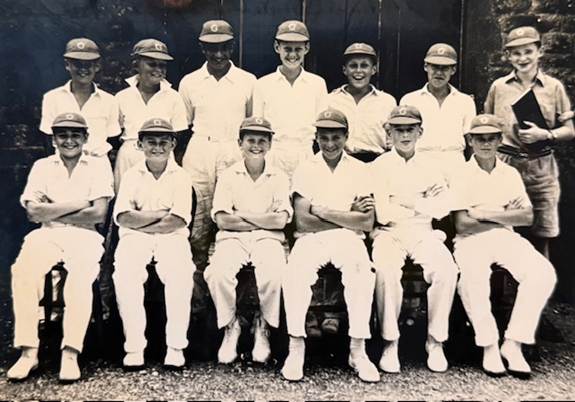
Two scratch teams came together using the pitch of a local school. Apart from the fact it was a glorious summer’s day, I remember little of the cricket. But during the tea, I hadn’t realised a bee had landed on the cream éclair I was about to stuff into my mouth. The last action of its short life was to sting my tongue. One’s body reacts to certain chemicals quickly and my tongue rapidly grew in size! Someone recognised this as a Medical Emergency and called an ambulance. I obviously survived …… but the memory of that jab of its barbed stinger into my tongue remains to this day.” 

“You wrote in your last postcard about The Hope Café (PC 475 New Year in The Hope 23 January) that you were curious the Waitrose produce-picker had chosen Pomegranate seeds as a substitute for an order of Red Currents. I read that the recent storms in Southern Europe and North Africa have created a potential dearth in the UK of soft fruit like raspberries (Note 1), strawberries, blackberries, and blue berries. We have got used to being able to buy them all the year around, haven’t we – even if we accept that the blueberries in winter come from Peru!”

“Whenever I hear about berries I remember the delightful story about the colour of the mulberry.”

“The colour of the mulberry?”

“I wrote about it in PC 242 ‘What is This Thing Called Love? (1)’ (August 2021). In summary Thisbe has found her lover Pyramus’ body next to a white Mulberry bush, covered in his blood. Her heart broken, Thisbe kills herself with the same sword that Pyramus had used. The gods are so moved that the colour of the Mulberry fruit is forever changed to blood red!”

“Ah! That’s such a nice story! I think, like you Richard, I generally have the radio station Classic FM murmuring on in the background at home. A commercial station, its revenue comes from advertising. Having read PC 478 Eating Habits (13 February 2026) I have become a little more aware of what I am eating! Recently Classic FM was broadcasting an advertisement for Nestle’s Shredded Wheat.

 The voiceover says: “I’ve been asked to read out the ingredients.” Of course, these days we are led to expect lots of ‘E’ numbers, flavourings and colourings, so it is a pleasant surprise when she continues: “Whole grain wheat.” Then there’s a pause and she comes on again: “That’s it, whole grain wheat. Nothing else.”

And that’s what the box shows ……. plus the disclaimer about nuts (!), although it this case Peanuts seem to be in a category of their own (?)”

“You mentioning Classic FM reminds me! A couple of weeks ago I was scanning The Times at breakfast. Having learned to play the trumpet at school I was attracted to the obituary of John Wallace CBE, whose career as a trumpeter took him all over the world with his renowned brass group The Wallace Collection, which he’d formed in 1986. In a lovely twist, as I was reading of his career, Classic FM was broadcasting Haydn’s famous Trumpet Concerto in E flat, the Andante movement of which I played for my audition for the National Youth Orchestra. (See PPS)”

“Need to rush, Richard. Lovely to chat ….. see yer!”

Richard 27th February 2026

Hove

www.postcardscribbles.co.uk

PS Yesterday the Government of Jersey passed its own ‘Assisted Dying Bill’ and that will need Royal Assent; probable within 18 months. The Isle of Man’s bill is still awaiting Royal Assent. It’s likely that England & Wales’s own Assisted Dying Bill will fail due to lack of time. It is a Private Member’s Bill so does not have the Government’s support.

PPS Wasn’t successful! I could play something I had practised but the sight-reading test was a nightmare.

Note 1 To make the point, in this morning’s Waitrose online order, Raspberries have been substituted by …… Strawberries!!

PC 479 Memories of Regimental Service (3)

Memories aren’t necessarily concentrated – my mind sees one, remembers other, hears a third, from the general collective memory of ‘my time in Germany’. We generalise our memories to make them manageable. For instance: I remember the funeral of Major Dick Jones, killed in a car accident whilst on exercise, and having to practise carrying his coffin with a weighted filing cabinet; the restaurant in the Lippstadt town square where the Pfeffersteak was to die for;

spending a long weekend at the regimental Ski Hut down in Southern Germany; my left-hand-drive blue Volkswagen Variant; taking the train to Turin to collect a new Lancia Fulvia from the factory; formal mess dinners once a month,

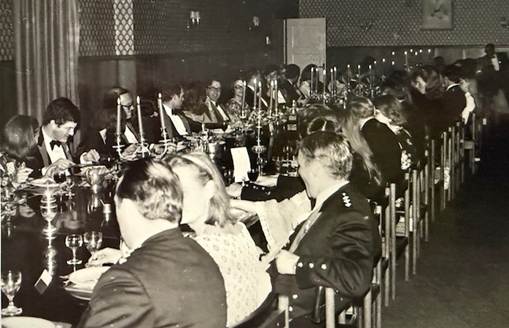
all booted and spurred – the meal followed by mess rugby; what was known as ‘the porcelain telephone’ in the gentleman’s in the Officers’ Mess in Lippstadt, essentially somewhere to vomit when you have drunk too much (!); pretending to be a private soldier and collecting the late Richard Clarke, a newly-joined officer at that time, at RAF Gutersloh in a little Ferret Scout Car;

Not a lot of room inside one of these!

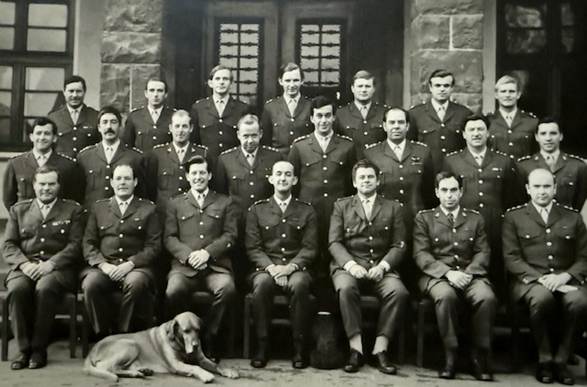
studying for academic exams for entry to the Army Staff College, a prerequisite to promotion beyond the rank of Major; learning that the wives of my soldiers could also be charged with offences under Military Law – a Sergeant’s wife lost her temper, smashed a bottle over someone’s head (nice huh!) and ended up in a Military Court; listening to the first ever moon walk – ‘One small step for man, one giant leap for mankind’ – by Neil Armstrong on 20th July 1969, on a small battery-powered radio in a tent in Trauen Camp; sitting for the annual Regimental Officers’ photograph, which often included a dog or two – this one of 27 Medium Regiment Royal Artillery in Lippstadt in 1972;

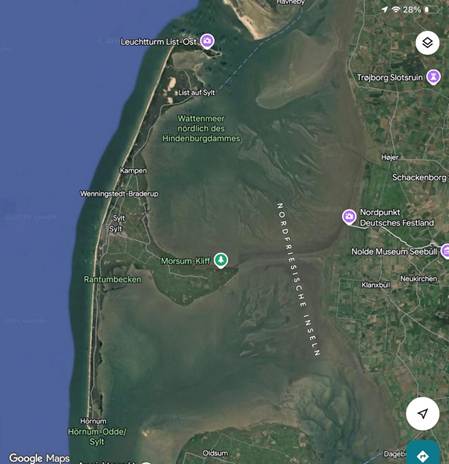
travelling to the German North Sea island of Sylt one Easter for a long weekend. Accessible by a man-made causeway …

….. an up-market place for Germans to be seen, to promenade, to eat cake; another memory is easy – the extension cable I used in my Officers’ Mess accommodation, to take power to a stereo system, is still in use (see PC 108 ‘I’m Long and Black’ October 2017): attending a ‘Colloquial German’ course in Mülheim, near Düsseldorf, and embarrassingly translating a message to the effect there was a tank (hiding) behind the large farmer – confusing bauer (farmer) for scheune (barn).

Travel to East Germany was almost impossible, although one could drive or fly to Berlin with the correct paperwork. In the British sector of West Germany, troops occasionally patrolled the border with the East, more for its Public Relations value than any suggestion it was a deterrent! I undertook one such week’s fascinating patrol with sixteen of my gunners and am glad I did. We stayed in farmers’ barns, although a young Guard’s Second Lieutenant, who was attached to us, and I shared a room in the main house. I remember our first morning; out of nowhere, in his rather plummy voice: ‘Drat! He didn’t pack my razor!’ ‘What’s the problem, Brian/Andrew/Toby/etc?’ ‘My man (ie batman) forgot my razor!’ I lent him a spare and hope he learned a little lesson; if you want to guarantee something, do it yourself!

I have mentioned that 39 Medium Regiment spent two Christmases (1972 and 1975) on operations in Northern Ireland (see appropriate postcards). Prior to my second tour, the commanding officer, Mike Hudson, decided we should get used to working well into the night, so shifted our working day from 0800 – 1630 to 1230 – 2200. Previously, we just accepted that training went on into the evening. Now we could have a nice relaxing morning and the ‘working day’ never went beyond 2300.

Twice in my Army career I organised an Officers’ Mess Summer Ball, the second time in Bulford north of Salisbury, the first time in the Lippstadt Officers’ Mess. In the latter I was assisted by Anna Clements, the wife of the resident dentist John. I saw a lot of both of them and their three young boys, but it was Anna whose artistic ability gelled with mine in designing the decorations. 

Memories of food outside the Officers Mess are of the wonderful German sausages and their extravagant cakes. Their little ‘Schnell Imbis’ (‘Fast Snack’ (Obviously!)) caravans were everywhere in die Parkplätze and the ‘Currywurst mit pommes frit’, served on a white cardboard tray with a little wooden two-pronged fork, became the easy answer to hunger pangs. Writing this, another memory surfaced! On big exercises in Germany, we tended to operate on Greenwich Mean Time, the time zone adopted by the Royal Air Force. In the summer months that meant we were two hours behind the locals. At the end of one gruelling day, the lieutenant colonel of the armoured regiment I was attached to suggested we had a snack in the local pub – the kitchen of which to our dismay had already closed!

Living on continental Europe had its advantages from a travel point of view. In 1976, a conversation over lunch in England led to an offer; ‘come out to Palau, Sardinia and help Merry Andrews, the old friend of a friend, crew his yacht’. Two weeks on and off sailing, ‘fed, watered and accommodated for free’; I jumped at the chance. Late one Friday afternoon, with some sandwiches for supper, I set off in my little Lancia Fulvia for Civitavecchia, the port city to the west of Rome, from where I could catch a ferry to Olbia on Sardinia.

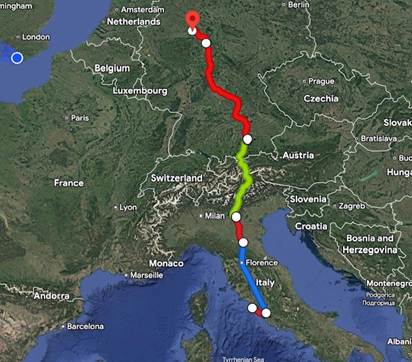
It’s just under 1500kms; Google Maps today tells me it would take around 18 hours. I drove until I felt the need to sleep, pulled into a layby, dropped the seat down, covered myself with a sleeping bag and slept. I reached Civitavecchia in time to book for the 2300 sailing; my car was hoisted onto the ferry deck by crane and I headed off in search of the bar. Two Gin & Tonics went down in quick succession! It was a very good fortnight.

And finally, our world was a diet of Alphabet soup. For example:

RA JDSC 2IC CO BC BAOR FOO TEWT NAAFI CPX GPO ADC AFV ADJ OP AG6 NSI SGT BDR GNR FP FUP GCM

Richard 20th February 2026

Hove

www.postcardscribbles.co.uk

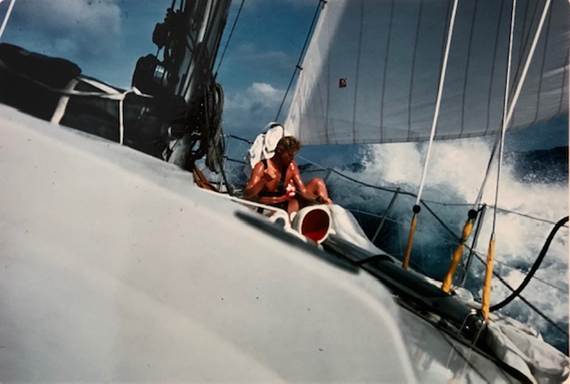
PS Oh! And I managed to find time to race from Tenerife to Bermuda in a 55ft ketch:

see PC 161 The Atlantic 1976 (Sep 2019)

PC 478 Eating Habits

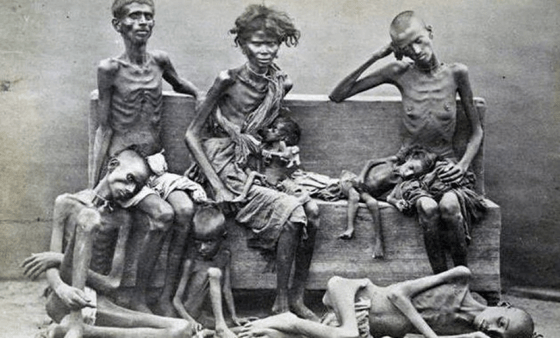
I have to assume that none of my readers have actually ever been starving, although they may have screamed something to that effect at some moment. Starving is a horrible situation to be in and for some parts of the world starvation stalks people too readily. You may remember Stalin confiscated Ukraine’s wheat harvest in 1932; in the year that followed some 3.9 million, 13% of the population, starved to death. (See PC 273 ‘Stories to Tell’ March 2022)

Extreme starvation in Ukraine in 1932

Malnutrition follows and, unless there’s a slow reintroduction to energy-giving food, the physical effects become irreversible. That is life limiting.

In developed countries we seem to get into fixed routines when it comes to eating. Breakfast starts the day, something in the middle, called lunch in the southern half of England but often ‘dinner’ in the North, then supper/tea/dinner after you’ve stopped working. Other opportunities to put food in your mouth might be mid-morning, traditionally called ‘elevenses’ in Britain or simply ‘coffee’. In my Army service, in barracks most things stopped for ‘coffee’; down to the various messes or canteen, a quick peruse of the morning papers, a chance to talk to others not in your sub-unit, and then back to work. Afternoon tea for the middle and upper classes would have been tea, sandwiches and maybe a slice of cook’s latest cake; for the workers it was their main meal of the day. Who can forget Shirley Valentine’s husband Joe, in the film of the same name, arriving back from work, expecting steak for his tea, only to find that she’s fed it to a friend’s Bloodhound; ‘But it’s Tuesday. I always have steak on Tuesday!’  

Fortunately you have a choice, to find some food and put it into your mouth …. and no one is forced-fed!

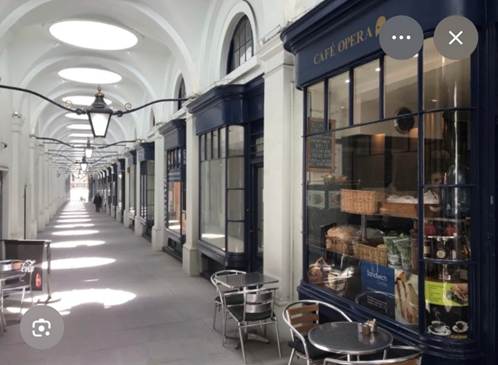
When I started my executive coaching career, I became a member of The Institute of Directors on Pall Mall in central London, so I could use the meeting rooms to engage with my clients. The huge oil paintings of the great and the good of the C19th that hung around the large rooms communicated a sense of ‘anything is possible’; that’s how I saw them, although I never asked a client their take! Sometimes for lunch I had a sandwich at my table, but more often-than-not I walked across Pall Mall and up the Royal Opera Arcade to an Italian-run Deli.

The arcade itself had a curious mix of tenants; today it lists an art gallery, a ‘Synergy Chinese Medical Centre’, a stationers and bookshop, a diamond merchant and the back door to the New Zealand High Commission, as well as the sandwich centre. This was a busy place at lunchtime, and the energised staff recognised their regulars with a big smile and wave: “The usual?” It was gloriously theatrical! Then my ‘usual’ was slices of rare roast beef in a granary bap with some horseradish sauce and masses of fresh black pepper; I can taste it now ….. to die for!

Another London lunchtime favourite was egg mayonnaise in a brown bap with masses of black pepper, and an apple, when I worked for Short Brothers in Glen House in Victoria. The usual? We do get into habits about food, don’t we.

My body screams ‘sugar please’ when I come back from hot yoga, where I’ve lost over a litre of sweat ….. so need liquid and sugar. I got into the habit of having a large bowl of cornflakes, with granulated sugar, full fat milk and an apple or banana; then some Cadbury’s Whole Nut! Over the months my weight gradually increased; not surprising! Then last year I got quite severe food poisoning on our TAP flight from Rio de Janeiro, took ten days to recover completely, lost weight and recognised here was an opportunity to change my habits. So now my ‘usual’ is a salad of crayfish tails, anchovies, tomatoes and cucumber.

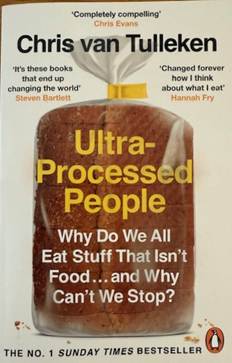
A yoga chum passed me Chris van Tulleken’s paperback ‘Ultra-Processed People – Why Do We All Eat Stuff That Isn’t Food …. And Why Can’t We stop?’, as he thought I might like to read it. He had absorbed its contents lying in his evening bath and the back cover had clearly had alternating periods of being wet and drying out. In some strange way it made me want to read it more!

If you think van Tulleken’s name’s familiar, it’s probably because his ideas were popular with the late Michael Mosely, whose television series about food, particularly about intermittent fasting, low-carbohydrate and the ketogenic diets, made him a household name. 

In 2017 British consumers spent just 8% of their household budget on food; this compares with only 6% in the USA, but 11-14% in Germany, Norway, France and Italy for example. Research by the Food Foundation shows that the poorest 50% of households would need to spend almost 30% of their disposable income if they wanted to eat a diet that adheres to national ‘healthy eating guidelines’; the poorest 10% would need to spend 75%. UPF is almost universally cheaper, quicker and supposedly just as nutritious than foods and meals that need home preparation. For some it’s a no brainer.

I haven’t read more than a third of the book yet, but already like the statement: “Fish oil is bad for you; oily fish is good for you.”, although I accept that for some, ‘cod liver oil tablets’, for instance, might be more available than a couple of mackerel fillets. Van Tulleken uses Palm Oil to illustrate his point: “When freshly pressed, it’s an almost luminous, crimson, highly aromatic, spicy and flavourful, full of antioxidants like palm tocotrienol.”

Not sure whether you’re a fan of Nutella but this spread uses oil, and that can’t be crimson and spicy! So, the palm oil is refined by heating, has phosphoric acid added to remove gums and waxes, is neutralised by caustic soda, bleached with bentonite clay (!) and finally deodorised using high-pressure steam. The process is known as RBD – refined, bleached and deodorised. And it’s this process which is used to make soybean, palm, canola (rapeseed) and sunflower oils.

I wonder what other nuggets I will uncover as I read more of the book. It might make me question further: “The usual?”

Richard 13th February 2026

Hove

http://www.postcardscribbles.co.uk

PC 477 Norway

Everyone seems to be going to Norway this year. Jon & Sally went to Lapland around the New Year, Ian, one of our yoga chums, went with his partner Mike last week to Bergen for a few days and David & Sally are exploring the fjords in the southwest when it’s warmer later in the year. I realised I already have some lovely memories of this fantastic Scandinavian country and I actually know a real Norwegian, Anders Schonberg, who currently lives in Cascais, Portugal and, with his wife Chloe, runs the AI company Plansom (www.plansom.com). (See PS)

Geographically, Norway is a northern European country of mountains, glaciers and deep coastal fjords. At around 100,000kms, its coastline is the second longest in the world, although this includes their 50,000 islands; the mainland coastline is 2,650kms. Its major land border is with Sweden, but it also borders Finland and Russia. A constitutional monarchy (Note 1), it currently has a population of 5.6 million (8% that of the UK) and enormous wealth due to its oil and gas industry. The country has the largest sovereign wealth fund in the world, valued last year at $1.4 trillion.  

Every year, in recognition of the UK’s support for Norway during WW2, Norway donates a huge Christmas tree that’s erected in Trafalgar Square. Part of that support was the development of tactics to take the war back to Occupied Europe. Operation Claymore, a British/Norwegian commando raid on the Lofoten Islands in March 1941, was the first of 12 commando raids directed against the Germans in Norway. One of the instructors at RMA Sandhurst when I was there was a Colonel Dennis O’Flaherty who, so the story went, had lost an eye during this raid; his eyepatch gave him a piratical look. We cadets didn’t get close enough to determine whether it was true!

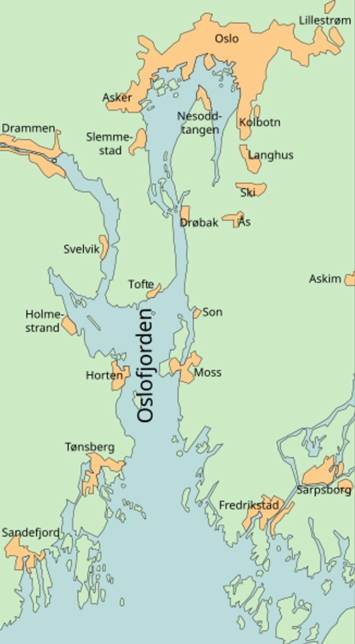
In August 1974 I sailed a 42ft yacht from the north coast of Germany to Oslo (see PC 229 ‘Kiel to Oslo’ May 2022). We stopped overnight at Horten on the west of the fjord to recharge the yacht’s batteries.

It was my first time in Oslo and thought it a delightful city, if not a little pricey. I’ve inserted a stock photograph of the grand Oslo fjord, one of the highlights of this 1000 kms trip, as I was using a cinecamera and have no ‘still’ photographs.

In 1976, after 4 years at Regimental duty in Germany, I was posted to UKLF HQ in Salisbury, to a ‘Staff Captain’s role. At the time the headquarters had a total of some 190 officers (this may be not be too accurate!) – a ‘gathering of generals’, a ‘clutch of colonels’, ‘masses of majors’ and about three captains; we felt quite special! I was to be responsible for some of the quartermaster aspects of the UK’s Ace Mobile Force (Land) (AMF(L) & Amphibious Forces– fortunately I didn’t need to complete the Royal Marine Commando course. The AMF(L) was, and probably still is, NATO’s fast reaction force, operating on its flanks.

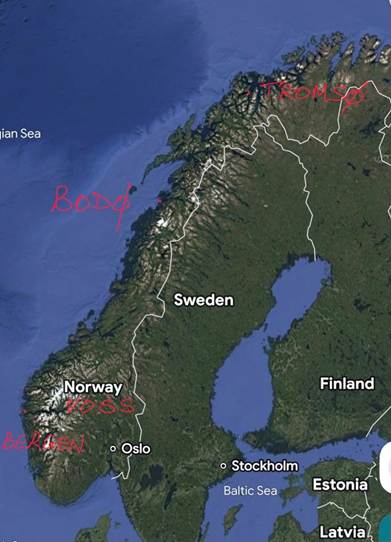
A couple of months before I joined on 1st January 1977, I had flown from Germany to Oslo, then on to Bergen and caught the train up to Voss, to meet the then current holder of the role, a Major Colin Constable. We stayed in the Fleischer’s hotel where I was introduced to the Norwegian breakfast buffet. If you liked fish or cheese, you would not go hungry. (Note 2) In Voss, some 100kms inland from Bergen, one of my responsibilities would be to find and book accommodation for troops undergoing ‘Winter Warfare Training’.

After a couple of days, we flew back to the UK on a RAF C130 Hercules. On Colin’s advice, I bought some enormous prawns from the fish market in Bergen and put them far up in the tail of the aeroplane, where they froze during the flight to RAF Lyneham.   

In April 1977 the AMF(L) held a three-day CPX (Command Post Exercise – no troops) in Bodø, a coastal city just north of the Arctic Circle. It’s always interesting to work with other NATO nationalities, but my memories are of little sun and some wonderful fish!

Captain John Odell, Major Jeff Pink and Norwegian Reserve Colonel Knut Strøm

The next month Major Jeff Pink, Captain John Odel and I joined Norwegian Reserve Colonel Knut Strøm in Voss and spent a week negotiating and securing the accommodation for the 1978 Winter Warfare Training.

Leaving The Army in 1985, I joined Short Brothers’ London Office and was given Scandinavia as my Area of Responsibility, pitching the company’s Javelin SAM system. Sweden made a competing one, so I visited Finland, Denmark and Norway to discuss possibilities. Our local Norwegian agent, an anglophile called Fleming Devor, bought himself a Mark 10 Jaguar to improve his image! We came close to achieving a sale in Denmark, but Norway stayed with its Swedish systems.

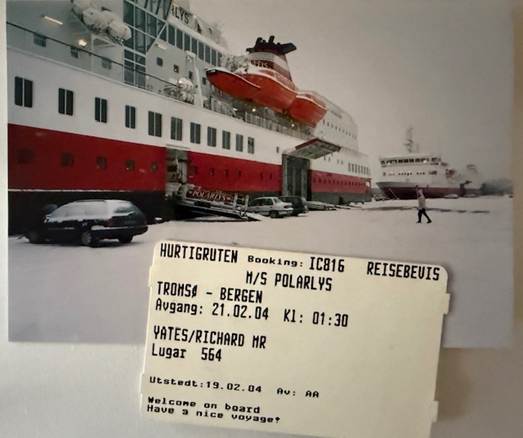
And then, in February 2004. I went in search of the Northern Lights, flying to Oslo and north to Tromsø, to join the M/S Polarlys.

The Norwegian company Hurtigruten run these ships rather like coastal buses; people got on and off whenever we stopped on our way to Bergen.

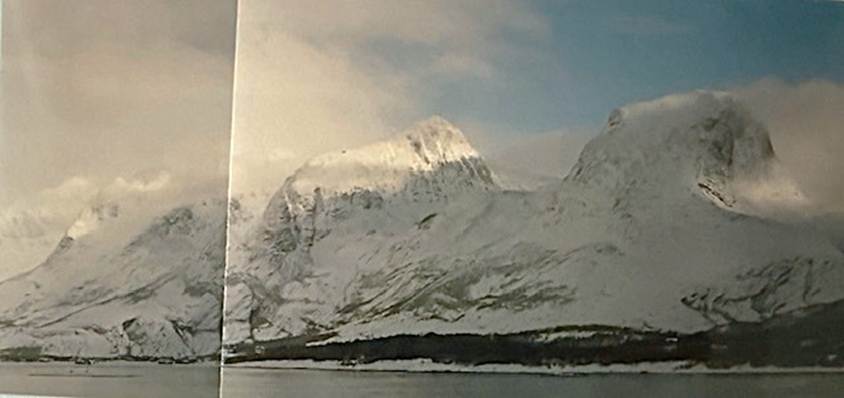
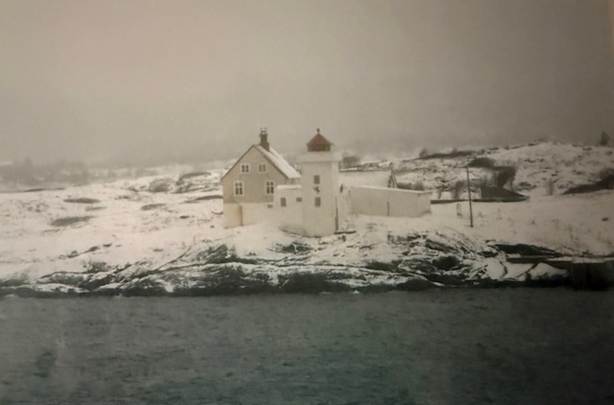
Sadly, the Northern Lights only made a mediocre appearance during our three-day trip and my memory is of cold, of the black & white coastal landscape and of a Force 10 storm as we left the more sheltered inshore waters and headed south towards Bergen.

The captain came around at breakfast asking how we had slept; ‘hanging on in our bunks, Captain’ was the general response – from those of us brave enough to eat anything.

Richard 6th February 2026

Hove

www.postcardscribbles.co.uk

PS We call someone from Sweden a Swede, someone from Denmark a Dane, someone from Finland a Finn, so should we call someone from Norway a Norge …..?

Note 1 King Haakon VII was exiled in London during the Nazi Occupation in WW2. The monarchy is in the news today as the oldest son of Mette-Marit, the Crown Princess, Marius Borg Hoiby, is on trial accuses of raping four women.

Note 2 It’s the same in India. If you like curry, either at breakfast, lunch or supper, or all three, you will not go hungry!