PC 476 Memories of Regimental Service in Germany (2)

….. continued from PC 474 …….

In PC 15 Alcohol and Other Drugs (June 2014) I wrote about my own journey from schoolboy to teetotaller, through a great deal of red and white wines, spirits and liqueurs, not to mention cigarettes and little cigars! As a single officer living in the Mess off-duty life revolved, as I’ve already admitted, around the bar; it was part of the life we led. Sometimes you need someone else to tell you some home truths. Paddy Surgeoner, the Battery Sergeant Major of 132 Medium Battery (The Bengal Rocket Troop) Royal Artillery, took me aside one day and said: “Hold out your arm, Captain Yates.” “Why?” (so argumentative!) “Just do it, Sir!” So, I held out my arm, as straight as I could. He looked at my hand. “Keep your hand still.” (It was shaking!) “I am, Sergeant Major!” “Think you should cut down on the booze, Sir!”

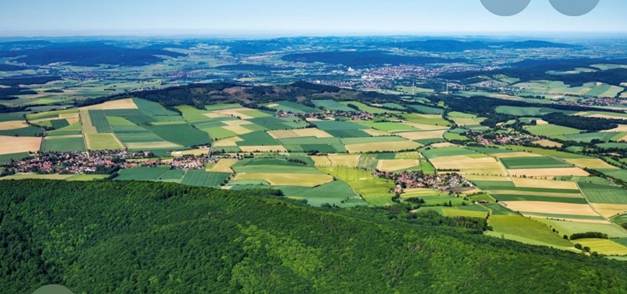
South of the German city of Hanover lies the town of Coppenbrügge; to its south-west lie what were the British Army bases of Bielefeld and Paderborn. Somewhere near the town the geography moulds and constricts any advancing enemy from the east into a narrow fold – forever known to those who exercised a fighting withdrawal as the Coppenbrügge Gap. I certainly spent a few days each year in a camouflaged vehicle or trench overlooking this ‘choke point’, waiting to bring down artillery fire on the ‘enemy’.
Recently we have become more aware of our changing global climate and an increase in the frequency of ‘once-in-a-lifetime’ events. In 1972, during a two-week live firing exercise on Hohne, the six self-propelled M109s of my battery (6 Medium Battery Royal Artillery) were deployed in a firing area which was surrounded by very tall pine trees. As the afternoon wore on, the wind strength increased to a point when it would have been unsafe to continue firing. Thirty minutes later a tornado ripped through the countryside. My observation later was: ‘It was as if a malevolent hand had brushed the surface of the land’, uprooting thousands of trees and lifting corrugated rooves off barns.

Often a mammoth ‘fuck up’ can led to glory! In 1973 my battery was on a non-live firing exercise on the Bergen-Hohne Training area, part of which would be a test of our ‘nuclear’ preparedness. As the GPO (Gun Position Officer) I was responsible for every aspect of the gun position. It went wrong from the beginning. I bummed a helicopter ride from a chum, Jim Longfield, to conduct a reconnaissance of the allocated training area to determine where best to set out the six guns; that was OK! But the first ‘recce’ Command Post AFV 432 caught fire on its way overland, causing delays and by the time the test started, we were behind. Our responses were slow because the firing tables hadn’t been amended and eventually the Directing Staff (DS) and AIGs (Assistant Instructor Gunnery) terminated our participation. We would be retested, a NATO requirement, after the DS and AIGs had crawled all over us, admonishing us for this and that; it was not a happy few weeks.

On the re-test, everything and everyone came together. The result was highlighted by the Master Gunner, a full-ranking general, who came by helicopter to visit the gun position. Initially he couldn’t find it, so good was the camouflage that my gunners had used to disguise the six large M109 guns. “Best gun position he’d ever seen.”

You can make out the self-propelled M109 barrel – but not much else.

Three Nine Regiment Royal Artillery in Paderborn had a tactical nuclear capability, that is the ability to fire a small yield nuclear shell. The US made the shells and their maintenance was controlled by a small American Army detachment led by a Captain Bob Anala. His team’s presence in the barracks ensured there was also a small PX (PX: Post Exchange – an American store), where I was introduced to the delights of Aunt Jemima pancakes, Bourbon, and King Edward cigars.
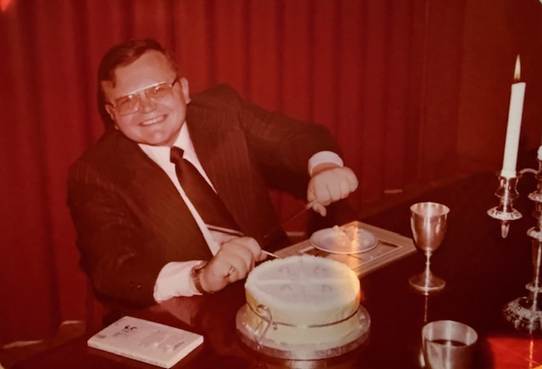
Bob celebrating his birthday

Other names surface from the murky depths; Ollerhead, Bailey, Corbett-Burcher, Ross, Longfield, Bromby, Watkins, Tar, Bazard, Faith, Sawrey-Cookson, Peters, Piper, Rooke, James, Clarke, Colley, Treseder, Myberg, Pender, Morley, Harman, Gwyn, Freeth, McNee, Quarelle and Scarlett …. and my soldiers like Sergeants Fitzpatrick and Williams or Bombardiers Batchelor or Elrick.

When I started Officer Training at RMA Sandhurst, we wore leather boots for drill and leather boots for training exercises – they got wet, they were uncomfortable. Fast forward to Germany some years later and it wasn’t much better. In the winter Germany was generally colder so I bought a pair of fur-lined tank boots. These, with white long-johns and insulating inner soles, became de rigour, especially when one was on a bare hill practising ‘Observation of Fire’ (ie correcting artillery fire to where you wanted it) and it was -10C. One spring for some reason the whole regiment was in a tented camp up at Bergen-Hohne; we had over a foot of snow!

I reflect that one got used to living outside, either down some hole, under or in a vehicle. So much so that on return to barracks after two or three weeks living in the elements, it was necessary to turn off the central heating and throw open the windows!

I have mentioned in another postcard that, on a day off from an exercise, I visited the Belsen concentration camp, or what was left of it ….. mounds and mounds of banked earth, with a simple sign at their base, something like: ‘Here are buried 2000 bodies’. If the atmosphere pervading the area wasn’t bad enough, sombre, tangibly evil, no birds, one only had to drive across to the Bergen-Hohne railway station, where those destined for the camp arrived. Looking down from an overbridge at the platforms, a light drizzle falling in the dusk, a breeze swinging the station lamps ….. imagining a train arriving and disgorging its human cargo for their final kilometre or so …… words fail but the visuals survive.

(To be continued …..)

Richard 30th January 2026

Hove

http://www.postcardscribbles.co.uk

PC 475 New Year in The Hope

I hadn’t been to The Hope Café in this new year, so popped in on Wednesday, in the off chance some of the regulars would be there. I had my iPad so wouldn’t be too disappointed if they weren’t, as we all need time alone. January is a funny month, notable for those who have decided to undertake some new hobby/new eating regime/become TT for the month/maybe not drink coffee etc, so I wasn’t too surprised that the café was fairly empty, just Josh behind the counter and a few tables occupied.

With my double espresso I opened my iPad and found a collection of news items I had been planning to discuss and share with either Sami, Mo, Lisa, Robert, Anna or even Duncan.

Don’t know about you, but Celina and I have a regular groceries delivery, topping up as necessary from our local shops, all within walking distance. At the beginning of January, I ordered a little tub of Pomegranate seeds, in the belief they have magical benefits and we should all be ingesting them daily.

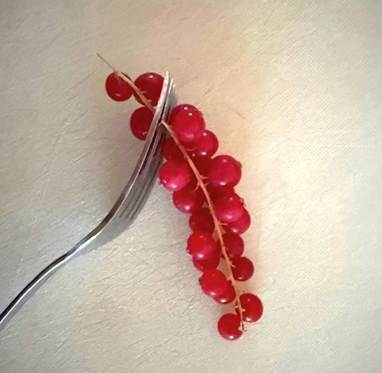
Unfortunately Waitrose had run out and, reminiscent of the early days of online shopping when substitutions bore little resemblance to what you had actually ordered, had delivered some Red currants instead. I like these little tangy balls so told Darren we’d keep them. “Never know what to do with them, too fiddly!” was his retort. I like teaching people new skills, so showed him how one can run the tines of a fork down the stalk and the individual currants fall off.

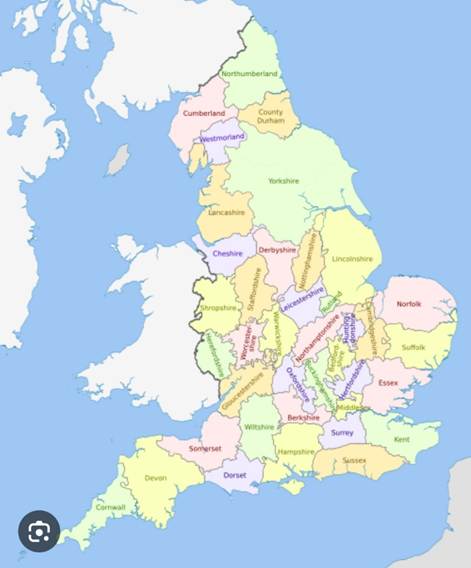
There was some discussion in The Times Feedback page about whether it’s correct to say one lives, in my case, in East Sussex or Sussex. A little research says there are 39 historic counties in England, of which Sussex is one.

But then many counties are sub-divided to create administrative areas, like Yorkshire, historically one but now comprising North Yorkshire, South Yorkshire, West Yorkshire, the East Riding of Yorkshire and the City of York as a unitary authority. The County of Sussex got divided into East and West, simple divisions for local government authorities, so I have reverted to ‘Sussex’; these things matter, don’t they? I mentioned this to Sam, my son-in-law, who found a fascinating piece of history.

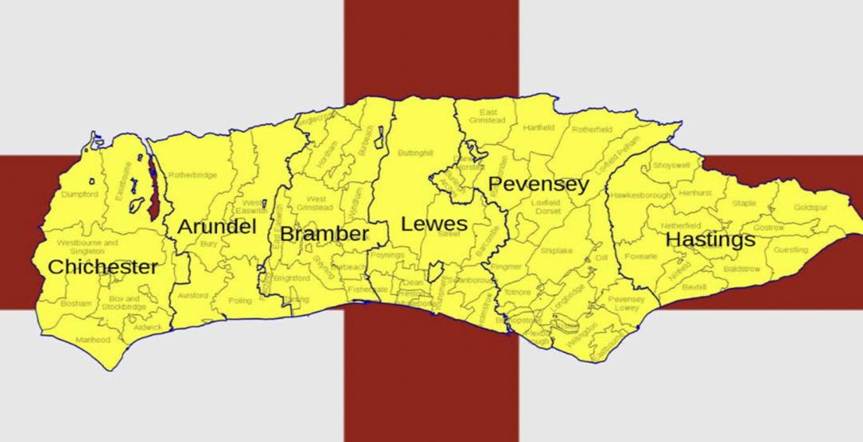
Sussex is the only county to have sub-divisions called Rapes. The six Rapes of Sussex were established by the Normans in 1066. Stretching in strips from the northern border to the coast, each rape was centred on a fortified castle and port to provide military defence and easy access to France. The six were Chichester, Arundel, Bramber, Lewes, Pevensey and Hastings. The name ‘rape’ likely stems for the old English word for rope, referring to the ancient practice of using rope (cord) to measure out land boundaries. You might have known, but I didn’t, that a ‘cord’ is a standard length, 8 feet; but did you know that a ‘full cord’ is a volume of stacked firewood (4ft x 4ft x 8ft – 128 cubic feet (3.62 m³))?

I picture this tidy stack of logs and my thoughts revert to a simpler world!

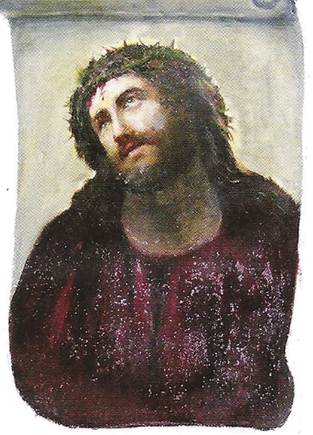
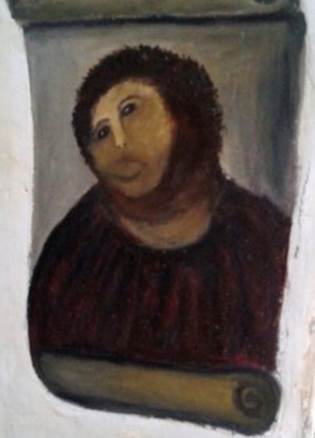
In The Times’ Obituary pages the other day, I was intrigued to read of Cecilia Giménez, an amateur artist who had lived in the northern Spanish town of Borja. In the town’s Sanctuary of Mercy church was a 1930’s painting, ‘Ecce Homo’, painted by Elías García Martínez.

The Original Ecce Homo

Over decades Cecilia had done her best to protect the painting from the ravages of the town’s humid air, a little bit here, a little bit there, but in 2012 had undertaken a comprehensive restoration ….. which didn’t turn out well.

News of the ‘monkey face’ painting travelled far and wide and, to the little town’s mayor’s surprise, in August 2012 a busload of tourist arrived in Borja to see it. They decided to charge €1; some 150,000 arrived over the following three years, giving the dying town a huge financial boost. Cecilia overcame the initial ridicule she had caused, personally benefitted from the merchandising and came to like the ‘monkey face’; she died in December aged 94.  

Another 94-year-old who checked out at the end of last year was my distant cousin Peter Russell. Regular readers will remember Celina and my trip from Auckland to Rotorua in late September to see the Russell family. I am so pleased we did; he had built a jewellery business in Christchurch (NZ) and was a great example of a good life well lived.

I am always saddened when someone dies well before their expected life span and Skye Gyngel is one. The daughter of a well-known Australian media tycoon, Bruce Gyngell, she had developed a passion for simple food and, after working under Anton Mosimann at The Dorchester, found a run-down glasshouse and plant nursery in the grounds of Petersham House in Richmond to demonstrate her ideas.

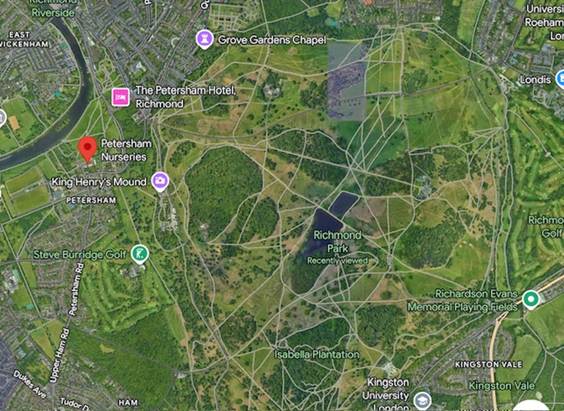
Petersham Nurseries Café at the red marker

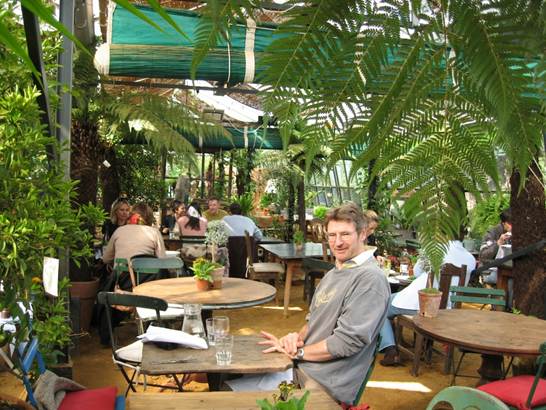
In 2004 she opened Petersham Nurseries Café; there were 15 tables and it only opened at weekends. Her kitchen was an old shed with a two-ring stove, the dining area mismatched tables and chairs and a beaten-earth floor. I went a few times, parking the car in Richmond Park and walking the two miles or so to the Petersham Gate. The whole experience was quirky and, with unfussy food, a delight.

In the rough and ready dining area in 2006

Within a year it had won the Time Out award for best al fresco dining and in 2011 a Michelin Star. The latter Skye regarded as a bit of a curse and she left the following year; within the next ten years she opened three London and Hampshire restaurants.

Skye Gyngell at Heckfield Place in Hampshire

You may be able to tell from her photograph she had freckles! Last year she was diagnosed with the rare skin cancer Merkel cell carcinoma and died in November at the young age of 62.

Ah! Mo’s arriving …….

“Hi! Mo ……. can I buy you a coffee?”

Richard 23rd January 2026

Hove

http://www.postcardscribbles.co.uk

PC 474 Memories of Regimental Service in Germany (1)

During my 20 years serving Her Majesty and her elected governments, I spent almost six years in Germany, when it was divided into West and East, and home to the British Army of The Rhine (BAOR). In the 1970s 1st (BR) Corps, which was headquartered in Bielefeld, had a strength of about 53,000. NATO forces faced the combined might of the USSR and Warsaw Pact armies. To quote a former commander of 7th Armoured Brigade: “These were huge armies that we were going to have to take on, and we were inevitably going to be overwhelmed by numbers. Therefore, it was the amount of damage that we could do …. to limit their advance before ‘nuclear release’, before we actually used tactical nuclear weapons.” I reflect that we never practised ‘advancing’, always refining the managed retreat!

I write these memories at a time of heightened tension across Europe, with Russia reinterpreting history to justify its own belligerent nature. Sad when you read its president talking about war with Europe. Why can’t he refocus, on, say, raising the living standards of his people?

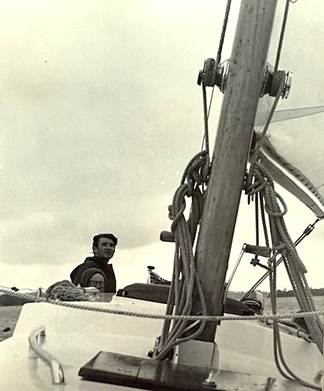
Sailing a 30ft engineless Danboat with the late Bill Pender

In my first year in Lippstadt, before going to university, I was often sailing in The Baltic, on yachts from the British Kiel Yacht Club on the western side of the Kieler Fjord (See PC 106 Sailing in The Baltic 2017, PC 229 Kiel to Oslo 2021 and PC 231 Ropes and Sheets 2021.) I continued to introduce soldiers to the rigours of offshore sailing when I returned to Lippstadt in 1972, before moving down the road to Paderborn the following year.

My absence from barracks was noticeable! So much so that when the Second-in-Command, Major John Harman, wanted to reinforce a point in his lecture to junior NCOs, he allegedly asked: “So where would you expect the FOO of 132 Battery (Note 1), Captain Yates, to be at this stage in the battle?”, a wag at the back shouted: “Sailing in The Baltic, Sir!” In my accommodation in the Officers’ Mess, I had a wall covered with charts of The Baltic, with coloured lines marking different expeditions. Good times!

In August 1969 I heard on the radio Prime Minister Jim Callaghan announce that British troops would be sent to Northern Ireland ‘to aid the police’. I was, naturally, on a yacht, this time near the little Danish village of Aerøskøbing and within three weeks of returning to England and starting university. I genuinely thought I might miss some action, with the prospect of three years studying Civil Engineering. Surely in that time ‘they’ could sort out what would become known as the Troubles? No one forecast the civil conflict would last for 30 years. My own ‘Tales of Northern Ireland’ can be found in PCs 196, 197 & 198 from 2020.

I was a single officer during my time in Germany and life revolved around training in and out of barracks, sport,

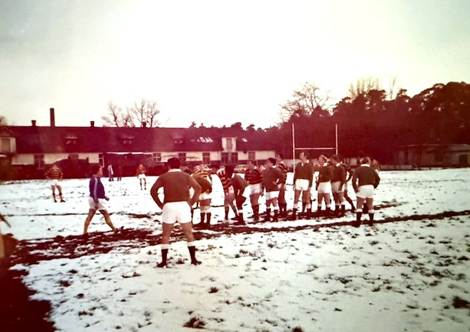
An inter-regimental rugby match in February 1973

and the Officers’ Mess. It was here we congregated for a mid-morning coffee, a drink in the bar before lunch, a drink or two in the bar before dinner and possibly a nightcap. I sensed we ‘worked hard and played hard’! There was no watchable television, the newspapers were at least a day old and the only telephone was a landline contained in a little kiosk in a corner of the Mess hallway. For international calls, you had to talk to the operator and book it! The Mess in Lippstadt was a grand building with a double-height dining room and a Minstrel’s gallery at one end. During morning coffee in one of the anterooms, Captains David Morley and the late Bill Pender would read, with appropriate accents, Punch magazine’s Idi Amin column. (Note 2) Somehow a wonderful memory, although the subject was evil! Idi Amin was the dictatorial President of Uganda (1971-1979) whose regime was responsible for the deaths of anywhere from 100,000 to 500,000 Ugandans and the expulsion of some 50,000 Ugandan Asians, who owned the vast majority of the country’s businesses; economic collapse followed.

We enjoyed a life of duty-free alcohol, cigarettes and other goods like cars. The British Forces were supported by the NAAFI (Naval, Army & Air Force Institute), which had a large supermarket near the barracks in Schloss Neuhaus. Living as a single chap in the Officers’ Mess, my victualing needs were met, and I rarely went to the NAAFI. On the odd occasion I did, I was disappointed. Looking for some ink cartridges for a fountain pen, I tried the NAAFI: “Sorry love; no, we don’t stock those ….. but you’re the third person this month who’s asked for them.” I left, thinking well why don’t you order some in if there is a demand.

Training for the four-month infantry-role deployment to Northern Ireland took a huge chunk out of our normal Artillery training schedule; I did it twice!

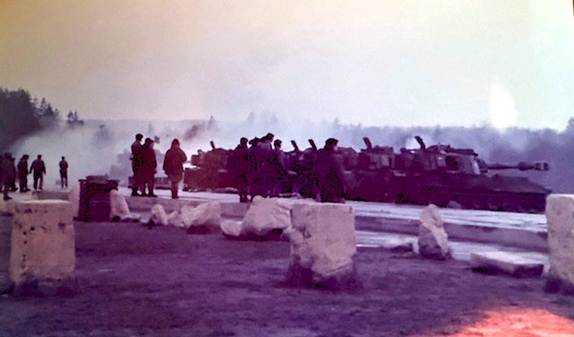
M109s in the direct as opposed to indirect fire role

The artillery training programmes at regimental level hadn’t changed for decades; individual/personal training advanced into sub-unit and regimental exercises, then in the autumn much larger Divisional formations practised over the north German plains. Farmers were paid compensation if dozens of tracked vehicles ripped through, for instance, their fields of Sugar Beet. These exercises naturally never used live ammunition; we practised that with 155mm shells on the Hohne-Bergen and Münsterlager Training areas.

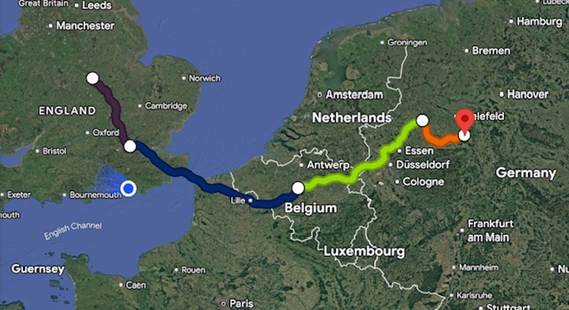
We did some mad things but then we were in our twenties, and everyone does mad things in their 20s, right? One Friday afternoon I got in the car after work, and drove to Calais, some 550kms. I then caught the 2300 ferry to Dover and drove to Leicester. On the Sunday afternoon, I drove back to Dover, caught the ferry to Ostend in Belgium and drove back into Germany, arriving for breakfast in the Officers Mess.

(To be Continued)

Richard 16th January 2026

Hove
www.postcardscribbles.co.uk

Note 1 An artillery Forward Observation Officer (FOO) would be attached to an infantry or tank regiment, to bring indirect fire support as necessary.

Note 2 Regular articles by Alan Coren appeared in Punch, “utilising phonetic spelling and current idiom to lampoon this odious dictator. Sadly, its success won the attention of the Politically Correct Commissars, who pompously halted the satire.”

PC 473 You had a What?

One Sunday last month, the day of the Winter Solstice, I walked down to the Fish Shack, a small kiosk on Hove’s beach, open three days a week to sell extraordinarily fresh fish – hence its name, I guess.

I love the little crayfish tails they sell, so buy a large tub and some anchovies in oil. It was two days after I had had the all clear from the nursing staff at The Montefiore about my post-operative Hernia wound. Jim recognises me and asks:

‘How are you, Richard?’

“On the mend after my hernia repair.”

There’s a tendency when we hear something, we automatically want to recount our own experiences, rather than ask a question to further the conversation; not really listening!! 

“Hernia huh! I had one of those, so you don’t need to tell me how painful it is. (Ed: Actually, I wasn’t going to!) It was about 5 years ago, and I was working in The Billingsgate Fish Market in Central London …….

One of the Billingsgate stalls

I was supervising the unloading of a lorry, a fork-lift taking the pallets off the back. One partially split and I instinctively went to hold it together ….. well, that was stupid wasn’t it …..  got a shooting pain down my arm and suffered a rupture, later diagnosed as a hernia.”

As I am listing to this tale of woe, I realise another customer, a woman, has arrived to buy some fish. I turned to her and apologised about the rather distressing medical story: “Don’t worry, I know all about Hernias …. my husband, my brother and my son have all suffered.”

We will all suffer something going wrong with our physical bodies during our lifetime, that much is guaranteed. What’s not is which particular ailments might come our way, maybe affected by lifestyle, our level of risk, eating habits, genetics and possibly bad luck – wrong place, wrong time. A Hernia? I had heard the name, knew that one of our yoga chums had had a bad one, whatever that meant, but my knowledge was minimal. Three weeks after mine and I apologise to the Waitrose delivery chap that I shouldn’t lift the green plastic crates containing our order (ie my wife Celina had told me not to!), as I am recovering from a hernia operation. “I’ve had one of those, know all about it!” He looked about 17 (actually he was 22!) and his had occurred when he was 18 – so age is no differentiator!

You can skip the next paragraph if you know all about hernias.

A hernia occurs when an organ or tissue pushes through a weak spot in the surrounding muscle or connective tissue. Common types of hernias include an Inguinal hernia, occurring in the groin area; an Umbilical hernia, occurring near the belly button; a Hiatal hernia, occurring when part of the stomach pushes through the diaphragm and lastly a Femoral hernia, occurring in the upper thigh near the groin. Symptoms may include a noticeable bulge, discomfort, or pain, especially when lifting or straining. Treatment often involves surgery.’

Then I found a diagram; I like diagrams, having a preference for pictural representation rather than a verbal description. I learned the other day that some 1-4% of people have a real phenomenon called Aphantasia; they are completely unable to imagine images in their head. For example, they can’t consciously create pictures in their head, like ‘seeing a red apple when you think of one.’ Thankfully I am not so afflicted, as I can’t imagine not being able to visualise, picture something.

Sorry, I digress!

Note the ‘weak point’ in the surrounding muscle. To confirm I had a hernia, I went off for an Ultrasound at The Nuffield Hospital, the other side of Brighton, on 12th August 2025. (Note 1) The Radiologist explained that, in men, the testes left the abdomen to drop down into the scrotum. OK, I understood this basic biology; they are there because they need to be kept at a cooler temperature than within the abdomen. What I hadn’t known was that where they exited the abdomen, they left a weak spot; that is often where inguinal hernias in men occur.

I was put on the NHS list in mid-August and attended the clinic on 7th November 2025 at The Montefiore. Given the delicate nature of a hernia repair, I was motivated to find out more about the consultant. These days, with LinkedIn and other online platforms, it’s easy to find out some basics, such as the fact he was born overseas, arriving in England as a child, and completing his medical training at Cambridge University. After our initial meeting he booked me in for late February 2026 and followed up with lots of information about the procedure, for me to digest. I was impressed – he ‘did what he said he would.’! We exchanged emails and I learned for instance his favourite composer is Bach. I warmed to him as a human being when he wrote: “I always say how lucky I am to have been accepted here and never cease to admire the tolerance and civility of this nation and its people. It is my duty to give back as much as I can.” Currently there’s often derogatory comment in our press about Britain and its place in the world. It was nice to read something positive and fundamental.

We managed to bring the operation forward to 5th December 2025. I checked in with Helen at the Reception Desk at 0655, got briefed by Abbi the Anaesthetist, felt confident everyone knew what they were about to do ……. zzzzzz ….. then into the recovery room!

I left around 1400 just as Helen, the receptionist, was finishing her shift. Seemed a fitting closure. Three weeks later I was back in the hot yoga studio, albeit being careful in some postures.

Richard 9th January 2026

Hove

http://www.postcardscribbles.co.uk

Note 1 Paying for medical treatment is, for some, an option, either through their Health Insurance or from their deep pocket. The cost of the scan was so exorbitant that I wrote to the CEO of The Nuffield, essentially asking him to justify it. I received a reply explaining this and that and the other – but no real justification for the cost.

PC 472 Shorts

The title might have given the impression I was going to scribble about shorts, ie short trousers ….. maybe I should, given that I wore shorts at school until I was 18 …….

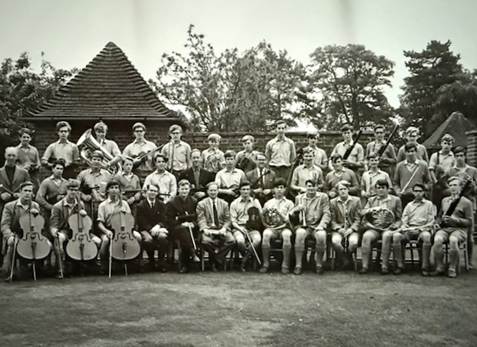
Dauntsey’s School First Orchestra circa 1964

…. but I’m not! Those who practise hot yoga in the Middle Street studio are an interesting group, from diverse backgrounds and professions, the young and those slightly older. Some of the regulars have become good friends, others prefer to drop in, practise, and leave, without any interaction; each to their own!

Sophie is an ‘award-winning actor, writer and film producer who works professionally under the name Cerys Knighton’. (See PC 342 Relationships IRL July 2023). She’s a graduate of the National Film and Television School and recently her short film ‘I’m Not Brilliant’ was shown as part of Brighton’s Film Festival in The Trinity Chapel on Duke Street in the centre of the city.

The chapel was built in 1817 by Thomas Kemp for his Nonconformist congregation, underwent several alterations during the C19th, and closed in 1984 due to declining numbers. In keeping with a lot of non-conformist places of worship, around three sides it has a large gallery on its first floor. The Fabrica Art Gallery made the chapel its home in 1996 and it was Fabrica which laid on the ‘Short Film Festival’.

I wouldn’t regard myself as a ‘Film Buff’, enjoy mainstream films as much as anyone, but sense our attendance at the local Odeon cinema has declined over the years. Supporting friends in their professional careers is important to me, so we went along to the early-evening screening of Sophie’s and other ‘short’ films; anything under 40 minutes is considered ‘short’. Hers was sixth on the list. The first was more like a dirge; atmospheric cliff-top images of Guernsey for 17 minutes, interspersed with a red-bearded individual who wandered around with a tattered old book. I have a habit of falling asleep in dark, warm places, so maybe I missed the whole point!

The next film was about a surprise birthday party, the subject entering a doorway and confronted by ‘friends and family’, whom you heard but didn’t see. She kept protesting that she didn’t do birthday parties and then seemed to get sprayed with blood ……! Again, the point was completely lost on me; the audience gave it desultory applause for some 4 seconds, so maybe I wasn’t alone. There was a short film, almost a documentary, about individuals who volunteered on a hospital radio. It had ‘real’ people not actors but again its point was lost – on me! One interesting film showed a series of cartoons about a boy going to Boarding School, the voice-over suggesting he felt abandoned and unloved. The choice of dull colours, browns and greys, added to the sense of despair. A clever way of portraying a difficult and possibly traumatic subject.

At the beginning of my commissioned Army service, I won a prize for being the best/worst/punctual/late/immaculate/scruffy – interested/ disinterested/capable/incapable young officer – it was a long time ago!! The award came with a cheque for £50 (about a month’s pay!) – to be spent on ‘sports equipment’.  Did I need another Squash racket? I didn’t play cricket so no need for a new bat, I played Rugby but didn’t need to buy a ball: I was at a loss! Eventually I persuaded the committee that I would seriously benefit from buying a Super 8 Cine Camera and projector; it was a stretch but ultimately successful. I used it for almost ten years before buying a Ftb Canon 50mm still camera.

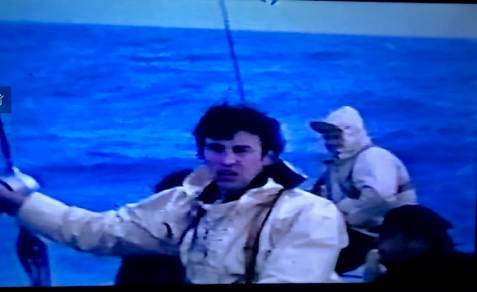
A still from one of the many hours of ‘sailing trips’ Super 8 Cine film; the late James Hodges skippering a yacht returning from the Channel Islands.

Given that two aspects of my life then, offshore sailing and my Royal Artillery service, were full of photogenic opportunities, it was inevitable I ended up with hours of 8mm cine film, spliced together when necessary. Life moved on; I transferred the films I wanted to keep to VHS video tape …… then onto CDs. Now I don’t have a dedicated CD player …….

I was reminded of my library of Super 8 film by the fifth ‘short’ showing, a mishmash of family cine film reels spliced together in some incoherent way. I am sure the more critical members of the audience would have gained something by watching all 9 minutes, but I didn’t include myself in that group.

And then we got to our ‘Main Event’, Sophie’s film ‘I’m Not Brilliant’, written by her and directed by Julian Kerridge.

Sophie plays Donna, an overly keen carer of Elsie, an elderly woman wanting to end her life. Little flashes of very dark humour, like Elsie going up the stairs with an electrical toaster saying: ‘Think I’ll go and have a bath’ made me smile, as did the confusion about the location of Dignitas as one of the options – Sweden? Elsie is determined to spend any extra cash she has and not let her ungrateful daughter get her hands on it, so they depart for the local pub. There they bump into a Hen Night, to which Donna thought she should have been invited. And there was a delightful twist at the end to make you smile with relief. This short film got the loudest round of applause of the evening, not because Sophie had packed the audience with friends and supporters but because it was a rounded, sensible and watchable film.

After an interval, another collection of ‘shorts’ and another audience. We drifted out of the old chapel, into the cool evening air and made our way home. These viewings are the bedrock of the cinematic industry and the development of its creatives, without whom we couldn’t sit back in Screen 4 with the tub of popcorn and escape into a different world. No doubt we will read about some of the makers of and participants in these short films in the years to come, as they grow, experience and are recognised for their art.

Richard 2nd January 2026

Hove

http://www.postcardscribbles.co.uk