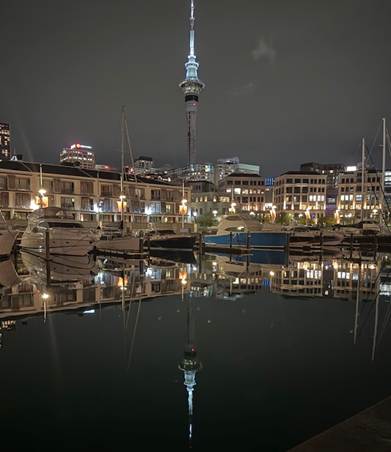
Other highlights from our time in Auckland were attending a hot yoga session in the Hiyoga studio on Queens Street, experiencing the local rail network when we went out to Des & Gleneth’s in Meadowbank for supper, seeing Cornwall Park where we met Michael & Angela and Des & Gleneth for lunch in The Bistro, and being lucky enough to stay in the Sofitel Viaduct Hotel, which was very central and comfortable. During our time in Auckland, England’s Women’s team The Lionesses played Canada in the Rugby World Cup final on Saturday 27th September. Cousin Michael in Victoria on Vancouver Island found a pub at 0800 local time to watch the match; in Auckland the time for the kick-off was at 0400 local on the Sunday, so I watched the highlights!
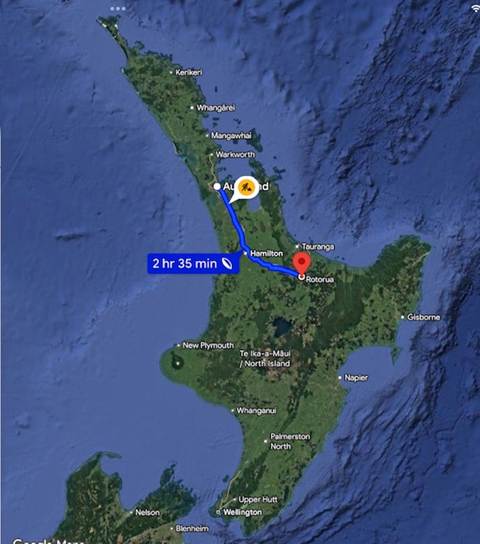
After checking out of our hotel, we picked up a hire car and drove down to Rotorua. Known for its lively geothermal activity, it’s an area of New Zealand I wanted Celina to see. Of course, there is so much of New Zealand that’s gorgeous; another two hours’ drive further south we could have seen Mount Ruapehu, one of the country’s largest volcanos and Lake Taupo.
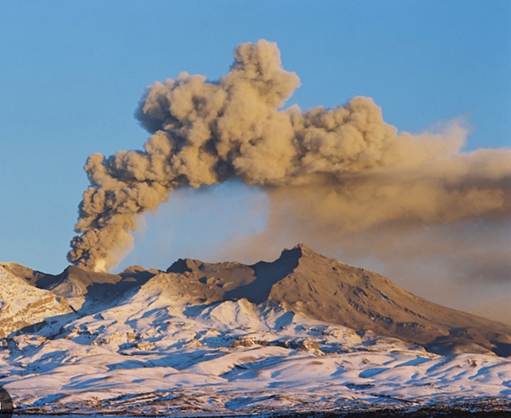
Mount Ruapehu
Rotorua is also the home of distant cousin Peter & Gwenda Russell and their daughter Anna & husband Paul. We checked in to the On the Point hotel with its glorious view across the lake ….
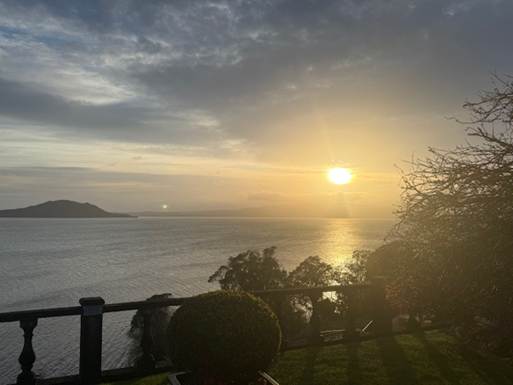
… and drove out to their home. I’d first met Peter & Gwenda in London almost twenty years ago, been to stay in their then house in Tauranga and now find them co-located with their daughter Anna. How we live out our later years is a challenge for all of us; The Russells are a good example of how to do it. Gwenda developed a huge interest in our Nation family story and remains curious and enthusiastic, adding for instance a little colour where none existed.
Anna & Paul recommended we visit Te Puia – ‘a place that changes you’ – and it did just that the following morning. Patrick, our engaging Māori guide,
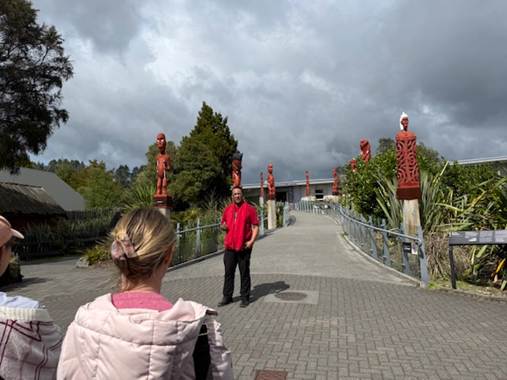
took us first to the New Zealand Māori Arts & Crafts Institute, where students are trained in carving and weaving, using traditional techniques.
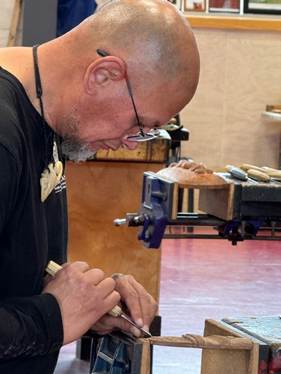
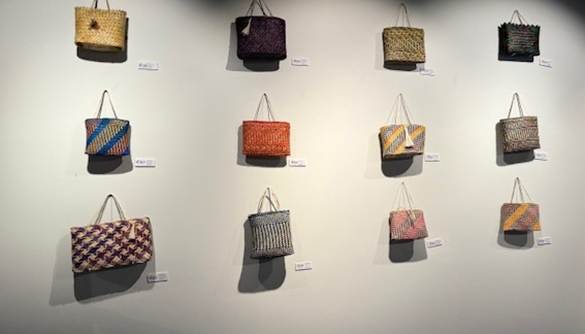
A Master craftsman was concentrating on a little wood carving while elsewhere an apprentice was sharpening a chisel. The craftswomen weave beautiful bags, made from New Zealand flax, but they are expensive; for instance, the second left on the bottom row around £210.
I found the whole enterprise fascinating and, in another life, might have become a student!
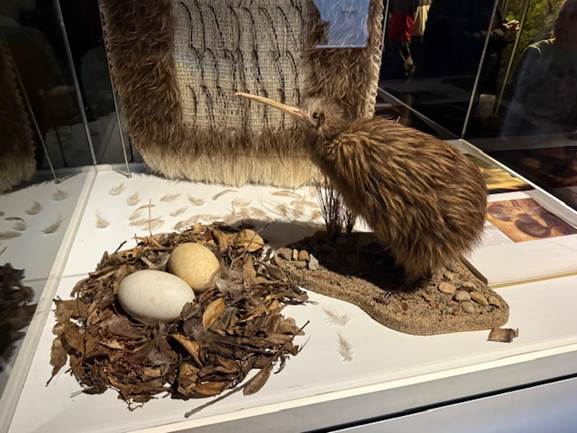
The Kiwi, a small flightless bird, is recognised as an icon of New Zealand and the human population are often referred to as Kiwis. It’s the smallest of the ‘ratites’ family, which includes ostriches, emus and rheas. In Te Puia there are a number of these nocturnal birds in a carefully controlled habitat. Obviously, photography is forbidden in their hide but this photograph shows a stuffed bird and its eggs. Think the eggs rather large for a small bird; must be painful?
Mud pools, grey and bubbling, …….
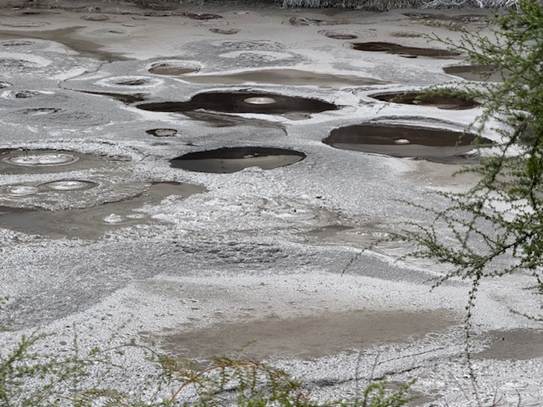
…… form the backdrop to the Pōhutu geyser, which erupts once or twice an hour. It’s easy to become completely mesmerised by the constantly evolving geothermal landscape but eventually we had to move on.

We left, as the brochure suggests, changed, thoughtful,

.. and drove back to Auckland.
As you do when you hire a car, you look for the last possible petrol station, so you deliver the car back with a full tank of fuel. We had a very new Yaris ‘something’ and I knew the fuel cap was on the passenger side of the car. We pulled up to the pump, I walked around to the panel covering the fuel cap and pressed ….. and pressed …. and pulled ….. and pressed again …… I looked in the car for some lever ….. couldn’t find one, went back and pressed again. Just then James, or Nick or Good Samaritan appeared; filling up his own truck, he’d seen me making a fool of myself, Googled the make of my car and came around and said: “Oh! There’s a level under the dash somewhere” …. and so there was, not obvious (obviously!).
We caught an Air New Zealand flight to Christchurch, a city a third of the way down South Island and, glancing out of the window as we crossed the coast, I could make out Farewell Spit where great grandmother Eve was shipwrecked in 1877. (See PCs 169 Shifting Sands & Feathers and 170 100% Pure New Zealand January 2020)
New Zealand lies on one of the many fault lines of the earth’s crust, this one between the Indo-Australian and Pacific Plates, part of the Pacific Basin Ring of Fire. To keep it in perspective, about 14,000 earthquakes occur in and around the country each year, of which some 175 are big enough to be felt. Within living memory, the February 1931 Hawke’s Bay earthquake, also known as the Napier earthquake, remains the country’s deadliest natural disaster. Two hundred and fifty-six people died when the quake, with a magnitude of 7.8, devasted the Hawke’s Bay region; aftershocks continued for two weeks.
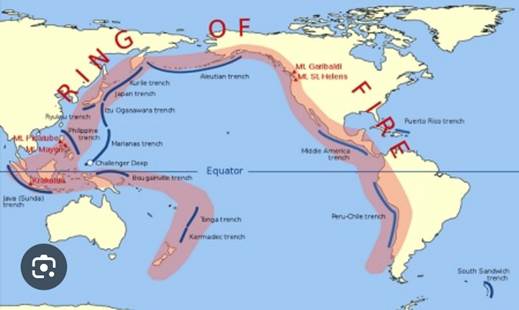
The disaster prompted a review of the country’s building codes, deemed woefully inadequate. By way of illustration, today there are only four buildings in the Hawke’s Bay region taller than five storeys. In Christchurch on 22nd February 2011, a total of 185 people died, more that 7000 were injured and over 10,000 made homeless when a magnitude 6.3 earthquake struck the city. (Note 1) It caused over NZ$52.2 billion’s worth of damage.
If you live in a part of the world which is prone to earthquakes, there’s not much you can do about it, except be vigilant ….. and maybe have a ‘Go Bag’ always handy! We were planning to stay for a few days in Christchurch, so the topic wasn’t mentioned – a little like not watching an aeroplane disaster film when you’re about to fly somewhere!
Continues in PC 464 ….. next week
Richard 31st October 2025
Hove
Note 1 Seventeen days before the first Nation family get together in Auckland.







 postcards