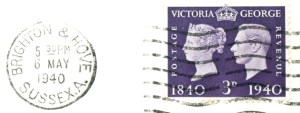
PC 458 Singapore – again (1)

I covered our first visit to Singapore in 2019 in PC 168 Singapore. One of that postcard’s paragraphs is worth repeating here:

“Singapore is a small island (50 kms east to west, 27 kms north to south; about 720 sq kms) strategically situated between the Indian Ocean, the South China Sea and the Pacific, on the trading routes from China and Japan to Europe. Its unique position was appreciated by Sir Thomas Stamford Raffles who in 1819 developed it as a trading port. In December 1941, during World War Two, Japan invaded Malaya at about the time it attacked Pearl Harbour. A few weeks later, in February 1942 it overran Singapore and some 90,000 troops became prisoners of war. It was subsequently reoccupied by British, Indian and Australian Forces following the Japanese surrender in 1945. In 1963 it gained independence from Britain as part of Malaysia and became an independent republic two years later. Its population is predominately Chinese, but Malays make up 15% and Indians 7% and there is a significant expat community amongst the 5.65 million people who live on this very crowded island.”

I first flew to Singapore in 1987 when I was working for Short Brothers, the Aerospace company based in Belfast in Northern Ireland. I was asked to accompany a colleague giving a presentation and he insisted we flew from London’s Heathrow on Cathy Pacific, whose home hub was Hong Kong, as he didn’t trust any pilot who wasn’t white!! A dinosaur you might think and, because of his racist views, we suffered a six-hour stopover in Hong Kong before flying down to Singapore. I never flew Cathy Pacific again. I clocked up over 250,000kms with Singapore Airlines in the next four years and reckon them to be one of the world’s best.

Thinking about the current trip before we left Hove, I was reminded of Frederick, a wooden Quail I saw in Tangs large department store on Orchard Road on one of my many times in the city.

The minute I saw him I thought I should buy him and take him home. But Frederick’s carved from some very dense wood and weighs a great deal; he’s about 50cm x 40cm x 40cm. The obvious question was how to get him home without spending an arm and a leg on extra baggage charges. After my meetings in Singapore I was flying to Sydney in Australia, returning to London via Singapore. Frederick was securely packed and taken to Changi Airport, where I popped him in Left Luggage before checking in for my Sydney flight. A few days later in Sydney I checked in for my return flight, ensuring my suitcase was ticketed all the way to London.
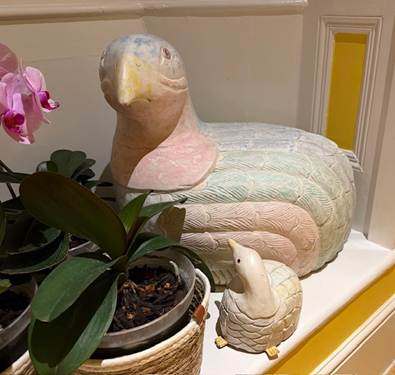
Frederick and his/her friend Eric

At Singapore I went out through Passport Control, collected Frederick from his locker and checked in for my Singapore – London flight. “Have you any baggage to check in Mr Yates?” “Yes, just this cardboard box.” I replied, looking down at Frederick on the weighing scales! In the photograph you’ll make out his little friend, Eric. He also came from Singapore on another visit but didn’t require any subterfuge!

Lee Kuan Yew

It’s rare for Singapore for make international news, but a news item the other day is worth mentioning. Singapore became independent from Britain in August 1965 and its first Prime Minister, Lee Kuan Yew, is widely recognised as being responsible for building this city state into the trade powerhouse it is today; the founding father of the country, if you like. He died in 2015; coincidentally his birthday was during our time in the city!

His two sons are quite different, Lee Hsein Loong entering politics and serving as Prime Minister and his younger brother Lee Hsein Yang spending almost twenty years in the military before entering the world of commerce. The news item concerns their father’s will’s direction that the family house on Oxley Road should be demolished, not wanting it to become a shrine. Older brother Loong wants it preserved, the younger Yang demolished, honouring his father’s wishes. It all turned rather nasty and the latter was granted asylum in the UK. Brothers huh?

The second time I flew long-haul to the Far East, on Singapore Airlines, I wore some casual slip-on work shoes but not lace-ups. Just before we landed I tried to put my feet into my shoes ……. the big toes made it but not much else! An outward sign of travelling in a pressurised tube. It was very undignified way to leave the airplane … a sort-of soft shoe shuffle.

Having stayed at The Marina Bay Sand hotel on our last visit, this time we opted, through our travel agent Pettitts Travel (pettitts.co.uk and part of Good Travel Management (Note 1)), for the Fullerton Hotel across the bay. Built in 1928 it became the General Post Office Building.
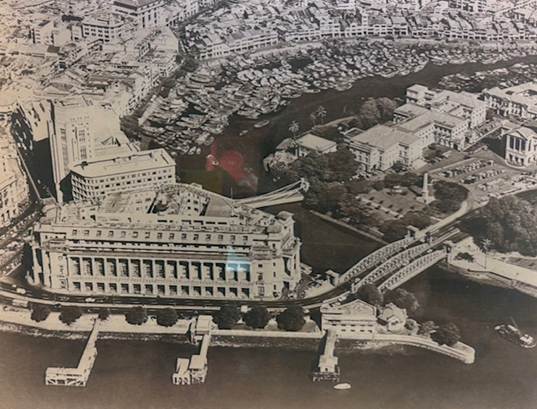
In the linking underground walkway are historic photographs of workers sorting the mail. At the end of the last century the whole area was redeveloped, with the hotel opening in 2001; it’s in a prime location. According to our taxi driver the construction of a fourth tower is underway at the Marina Bay Sands Hotel; there’s debate about whether it will be possible to link it to the other three.
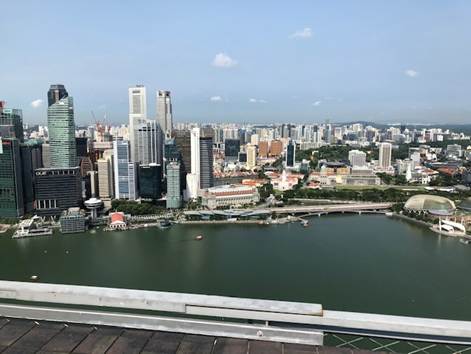
The view in 2019 from the pool; the Fullerton Hotel is in the centre!

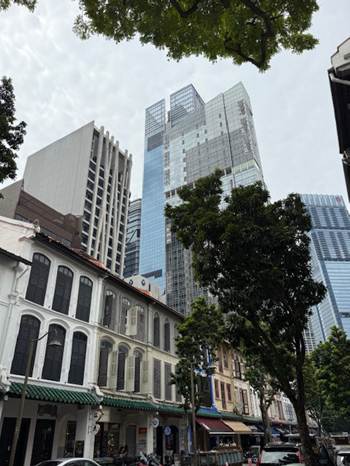
‘China Town’, an area a kilometre from the Fullerton Hotel, still houses traditional eateries, temples and shops. Look up and modern tower blocks scrape the sky.
Next week I’ll continue this postcard, but finish with a word of caution. If you take any prescription drugs, you need to check the rules; some require a written licence!

Richard 26th September 2025

Auckland

www.postcardscribbles.co.uk

PS Half written in Singapore but then we flew to Perth and that week’s postcard, (PC 457) about low level health care, was in the mailbox.  …… hence the Auckland postmark!

Note 1 I was a consultant to the John Good Group for many years in my Leadership Coaching role. Pleased to return the favour!

PC 457 Low Level Health Care in the United Kingdom

(Following on from PC 456; I was talking to Lisa in the Hope Café)

“Earlier this year I recognised that my ‘gut health’ was in a poor state following three general anaesthetics in 14 months, so started taking a probiotic, Symprove, one recommended by a dietician/nutritionist called Caroline Laidlaw.”

“Surely you can just eat more fermented fruit and vegetables and drink Kombucha. Isn’t that the same?”

“Possibly!! According to the various health bibles, ‘you can support your gut health by eating a diverse, fibre-rich diet, managing stress, prioritising sleep, exercising regularly and staying hydrated, while also limiting processed foods, sugar and excessive alcohol.’ I wish! Anyway, I decided to follow Caroline’s advice and sense a big improvement. Sadly the ‘original’ flavoured liquid tasted like cat’s piss, so now I’ve opted for the Strawberry & Raspberry flavour.

“Cat’s piss? How would you know what that tastes like? Actually don’t answer that!”

“We use ‘piss’ in a variety of ways. There’s ‘weak beer’s the colour of piss’ and then ‘he’s pissed’, in informal English suggesting someone’s angry and annoyed, a contraction of ‘pissed off’. Confusingly ‘he’s pissed’ might also mean ‘he’s drunk’, probably because one’s subsequent actions may piss off those around you.” 

“Come on Richard. Forget about gut health for a moment, I need you to concentrate on GPs etcetera. Having done lots of research already I suspect that low level healthcare provision in the United Kingdom is not in a good shape.”

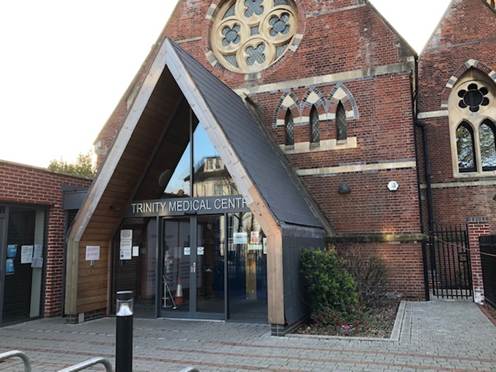
“Well, I looked at my own, Trinity Medical Centre, the one I am registered with in Hove.”

“Ah! I am just up the road with Charter. And ……”

“According to their website, they have eight doctors who are partners and eight who are salaried general practitioners, but not all the doctors spend five days a week in the practice, carrying out other roles within the NHS, committee work, training research etc.”

There’s a certain symmetry in having a medical centre in a decommissioned church!

“So, 16 doctors in total. The World Health Organization norm is one doctor for 1000 patients. Here in the UK the average is some 2250, an increase of 17% in ten years. ….”

“That’s a huge increase!”

“My doctor at Charter says they plan on some 8-12 minutes per patient ….. and you can only present one issue!”

“Trinity has, according to their website, about 24,000 registered patients. GP Surgeries are paid £136 per patient per year for the Practice’s operational costs, including heating, staff wages and administration. There are separate funds for specific patient care services such as specialist referrals or prescription drugs. Twenty-four thousand registered patients give them an income of £3,264,000. One of the doctors told me that unscrupulous practices just sign up as many individuals as possible, giving them more revenue and making that patient/doctor ratio unworkable.

“You know that one in seven GP Practices have closed since 2018? There are now 6,229 active practices in England, down 14 per cent on seven years ago. Just at a time when there are additional 5 million individuals registered”

“I had an interested comment from one of the GPs at Trinity. Some years ago, very few patients needing to see a doctor were in the 18-50 age bracket, so a practice could cope with a large number of registered individuals. Today everyone clamours to see a doctor – especially the ‘worried well’ and the anxious Millennials and Generation Z; and they want to be seen ….. now!”

“I assume that, when they can’t get an appointment, in frustration they head to the private practices, of which there are more and more.”

“Well I have certainly done that …….”

“I’ve got this note: The Royal College of General Practitioners’ plan ‘Fit For the Future’ urges new investment and retention measures, warning of a mass exodus of nearly 19000 GPs in the next five years.”

“That’s interesting; I have first-hand knowledge of this. I asked a couple of GPs, actually friends, actually a couple, how they were. “We are in the process of moving out of NHS general practice in the main due to the issues outlined in the RCGP’s ‘Fit for The Future’ plan. We as a bunch are highly resilient, committed and actively excited by the ability to change, to suit our patients’ needs, but the clunky system is no longer able to deliver this and we are fatigued. For a long time we’ve been squeezed financially and our newly qualified GPs don’t have job prospects. And those of us with experience have to work longer hours to earn the same pay, as our practices are aware they can employ someone willing to earn less because there is such demand. Morale is low! All a bit gloomy I’m afraid! But we are fine!” This really annoys me! On the one hand we have a high wastage rate of skilled individuals, on the other the Department of Health and Social Care saying: “GPs are front of centre of the Ten-Year Health Plan ……..  that’s why they will benefit from an increasing proportion of NHS funds, and we’ve already made great progress, including recruiting over 2,000 extra GPs in a year”.

“Wouldn’t it be better to try and reduce the wastage rate? I was told about 30% of trained doctors leave within five years. This seems such a waste of time, talent and experience.”

“My daughter says it’s the same, the wastage rate, in the teaching profession. Maybe it would be possible to work on some retention scheme ….. or improve the working conditions. No business would accept this loss of skill; they would start looking as to why it was happening and how to lessen the wastage.”

“Richard this has been really useful and I’ve probably got enough copy for my article. Thank you!”

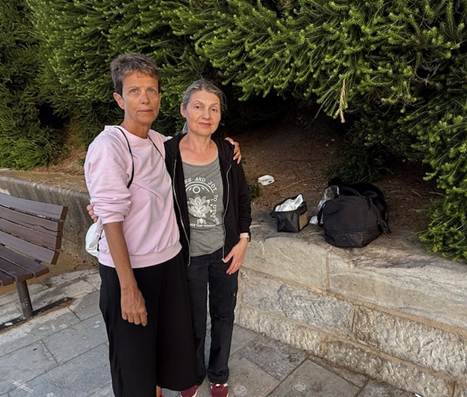
“No problem. Before you go …… we were talking about cat’s piss ….. in Estoril, Portugal Celina feeds a black cat that lives on the street and has also made friends with Mirela Gatos (Note 1), a Romanian who looks after dozens of strays down on the promenade.

Celina and Mirela

Ah! We always need examples of good deeds. Enjoy Singapore, Perth and New Zealand.”

“Thank you. We will.”

Richard 19th September 2025

Perth Australia

www.postcardscribbles.co.uk

PS The provision of both good health care and education are the bedrocks of a mature society.

Note 1 ‘Gatos’ is Portuguese for Cat!

PC 456 How was Portugal?

Managed to get a couple of hours in the Hope Café this week, in between returning from Portugal and flying to Singapore on Sunday evening. I had promised to meet Lisa, as she is gathering information for a piece she’s writing about Low Level Health Care in the United Kingdom. We agreed to meet on Tuesday, before my haircut with Monika at Amor on Palmeira Square.

Tuesday afternoons in the Hope Café are never very busy and, despite a manic diary for this week, I found myself slightly early for Lisa. With an espresso in hand, went and sat at one of the tables, my mind running over our recent three weeks in Estoril (See PC 454 Portugal’s Estoril). One of the joys of being with Cecilia and Toni is that every now and again the conversation uncovers a gem of a story. I shouldn’t be surprised, given that Cecilia has lived in Boston and Washington as well as in Rio de Janeiro and Toni’s parents were Brazilian diplomats so lived a peripatetic life. I think it was Toni who happened to say he knew someone whose mother had accumulated a great deal of money through a number of failed marriages. Then Cecilia remembered a Brazilian named Lily Safra whose story is one of a colourful and intriguing life, worthy of writing just the highlights!

Lily Safra was born in 1934 in Porte Alegre in Brazil, grew up in Rio and moved with her family to Montevideo, Urugay. Aged 17 she married Mario Cohen with whom she had three children, before divorcing some ten years later. So far, so normal, you might think. In 1965 she married Alfredo Monteverde, a Romanian Jewish immigrant, who ran the Ponto Frio household appliance distribution business, only for him to commit suicide four years later. Her late husband’s banker, a chap called Edmond Safra, a Sephardic Jew, helped her secure control over her late husband’s entire fortune. A brief romance with Safra ended as his family disapproved of Lily’s Ashkenazi Jewish faith, so in 1972 she married a businessman called Samuel Bendahan, separating after two weeks and divorcing a year later.

Four years later, in 1976, she and Edmond Safra, who had founded the Republic National Bank of New York, married. The couple divided their time between homes in New York, Monaco, Geneva and the Villa Leopolda on the French Riveria. A day after the couple gained Monegasque citizenship, on 3 December 1999, Edmond died in a fire in his apartment. The fire was started by a former US Green Beret, Ted Maher, whose plan was to rescue Safra and be forever in his debt; it went out of control! Maher was sentenced to ten years in goal but sawed his way out of his prison window and escaped to France. There’s a film here, isn’t there? (See PS)

Edmond and Lily Safra

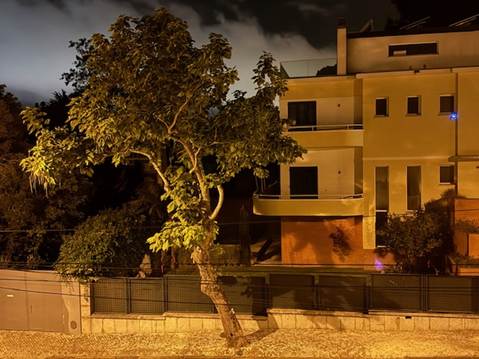
In my last Estoril PC (PC 454) I included the view from the bathroom window around 0200 one morning, the street brightly lit with the sodium streetlight.

Note the little grey gate to the left of the tree

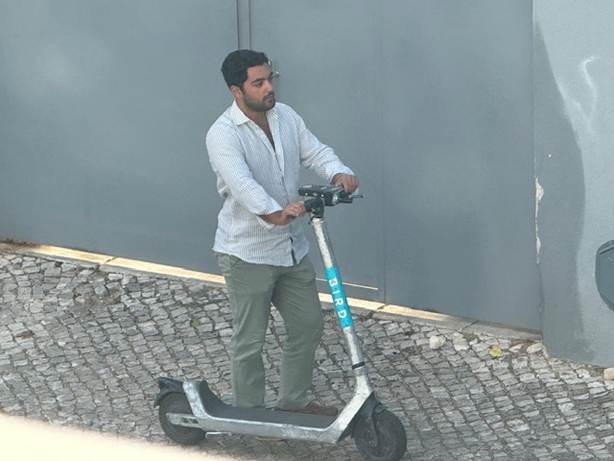
The other morning around 0320 I needed a pee …. and noticed a chap outside the gates of the house almost opposite. He had arrived on a smart electric scooter, parked it on the pavement and was interrogating his mobile phone. I realised he was actually texting or talking to someone ….. at 0322! A minute or so later the pedestrian gate swung open and he disappeared up the driveway – leaving his scooter, lights on, outside. I imagined a number of scenarios; a male escort arriving to party was dismissed as he would have taken the scooter inside; no Pizza delivery or Uber Eats as he wasn’t carrying anything; … so I suspected he was your local drug delivery chap ….. just dial a number, order your Cocaine or ecstasy and in no time it arrives.

The same chap the following afternoon

My colourful thoughts were dashed when I saw him the following afternoon, again trying to interact with someone inside the house, but his efforts were rebuffed by a chap at the gate and he was shooed away. Romance has its ups and downs and I don’t now think he is a drug delivery man.

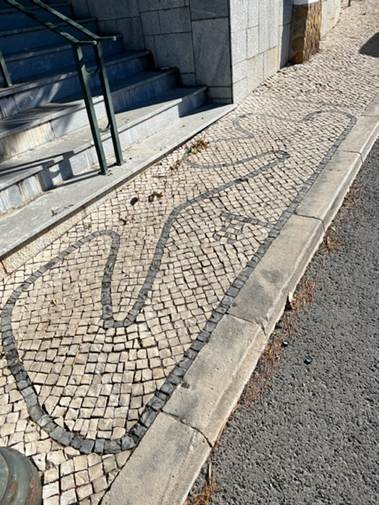
The family apartment is on the northern slopes of Estoril. Outside a house in the square near the casino, the Estoril motor racing circuit is laid out in black blocks on the white pavement.

The circuit itself is some 6 kilometres further inland and last week they were hosting the Porsche Cup Brazil.

Sound carries and it becomes a tedious background noise, unchanging except for the gears. I imagine the drivers taking their cars around the circuit know what they’re doing and how to handle the vehicles. Sadly, the majority of Portuguese drivers demonstrate some of the worst aspects of driving, possibly summed up by their brain saying: ‘I am entitled to do what I want.’ Woe betides a pedestrian who gets in their way. Those who can’t elevate their skills to going around the racing track take to the streets in the early hours, both the car and the driver screaming with delight. Not a view shared by the light sleepers.

Just as I was thinking Lisa wasn’t going to show, she rushes in in a bit of a lather ……..

Hi! Richard. Gosh! I am so sorry I’m late. Got involved in a meeting with the editor of The Argus, discussing current assignments and what we might like to look at. You know I want to get any views you have on the current GP system here?”

“Yes, and in preparation I asked a couple of doctors I know …… and I will come on to that but, a couple of afterthoughts from Portugal …..”

(To be continued)

Richard 12th September 2025

Hove

www.postcardscribbles.co.uk

PS Lily died in 2022 from pancreatic cancer aged 87, with a net worth of some $1.3 billion.

PC 455 A Nation State? Or the State of the Nation

Writing in the summer months should be light-hearted, tackling subjects like the size of the marrows in the annual Village Fete, one’s recollections of, or lack of, attendance at one of the many festivals, either musical or book-related, or even, if you’re of a certain age or persuasion, at one of the many summer Scouts Camps. The 16th World Scout Jamboree Parade was held this year in the Portuguese city of Porto. Or, of course, of one’s memories of taking part in the 2025 Fastnet Race.

Recently two pieces in The Times prompted this postcard, inevitably a little more serious than posting a selfie on Instagram of you and your friends at the Edinburgh Fringe Festival (1st – 25th August). One was the personal view of the United Kingdom by author Lionel Shriver who has moved abroad and the other The Sunday Times’ survey of 2,113 British adults (excluding Northern Ireland), carried out by More in Common between 22nd and 24th July.

It’s fashionable at the moment to be critical of Britain, not where it stands in the world, but of the mess that our society, you and me, us, are perceived to be in.

I remember reading Lionel Shriver’s 2003 book ‘We Need to Tak About Kevin’, a fictional story of a school massacre in the United States, written from the first-person perspective of the teenage killer’s mother. It was Shriver’s seventh novel, won the 2005 Orange prize and was made into a film in 2011. I have read a number of Shriver’s other novels; some I’ve liked and some I’ve found hard going.

Lionel Shriver’s piece started: “An American based in the UK for 36 years, in 2023 I absconded to Portugal (She’s aged 68). So how dismal does Britain look from a distance? I’m still emotionally and politically enmeshed in British affairs. But my personal fate is no longer joined at the hip with the increasingly distressing fate of the UK.” Nice huh! Diving straight in!

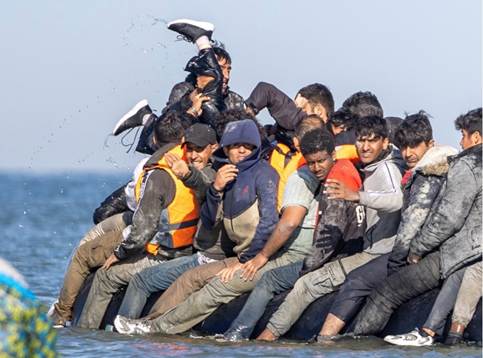
The easy target for anyone concerns the levels of immigration, legal and illegal, and the way the state meets its humanitarian obligations. The current Labour Government won last year’s General Election with a promise to ‘stop the small boats’; so far, they have failed miserably! This tide of humanity, mainly but not exclusively single men aged 18-30, has been washing up on the Kent shore for some years, increasing year-on-year; so far this year 28,000 have made the crossing. Every shade of the political spectrum claims to have an answer, but so far the stream continues unabated.

Shriver continues:

“Small boats and sky-high legal immigration will continue to wreak demographic havoc. This change is permanent. Millions of immigrants from clashing traditions will bring only more of their friends and families.”

If you look at the projected demographic changes in European countries and the shifting burden of increasing pension provision onto a smaller workforce, most show their populations in decline; apart from Britain, due to net immigration! The trick will be to assimilate these immigrants into our society and no one seems to be very creative in this respect. We haven’t insisted, for instance, on immigrants learning English within a few years, as a prerequisite of citizenship; in some towns there are enclaves of people who arrived in the latter half of the last century, still unable to speak the language. Across the North Sea, potential Danish immigrants have to have proof of a certain income level, proficiency in speaking Danish, passing a citizenship test and integrating into society. This policy, introduced last year, has slowed the flow of potential immigrants to a trickle.

From the Times survey for ‘More in Common’, when asked the main reasons people crossed the Channel in small boats to get to the UK, voters agreed the government needs to crack down on the UK’s black market for labour and welfare payments. According to the poll, 54 per cent believed the most likely reason people came was to access the UK’s welfare system. This was followed by claims it was easier to gain asylum in the UK than elsewhere (49 per cent) and because they were fleeing conflict in other countries (37 per cent).

In one focus group, Peter, a dockyard manager from Plymouth, described Britain as a “soft touch” because as “soon as [migrants] land on our shores, they’re entitled to healthcare, food and a roof over their head. There won’t be many countries in the European nation[s] that will offer them that. I think we need to harden our borders and take advice maybe from America or Australia, which I appreciate. Seems harsh, but the country is on its knees.” He speaks for the silent majority.

Shriver followed up with: “Supposedly, a leading “British value” is “fair play”. So let’s talk about fairness. Amid an ever-escalating housing shortage, itself powered by mass immigration, your government uses your money to provide a free water-taxi service to your shores and to put up low-skilled, overwhelmingly male foreign citizens in four-star hotels. No one’s putting locals in free hotels.”

This sort of popularist comment is swallowed by the unquestioning masses. It’s recognised, for instance, that successive governments have failed to ensure sufficient houses are built to meet national demand; the current immigration crisis has simply exacerbated an already bad situation. Until their asylum application is processed, it’s perceived that these immigrants might make our streets unsafe. But, as Fraser Nelson says: “It chimes with what a great many Brits now believe. Poll after poll finds the public convinced that crime is getting far worse. The reality is different; NHS hospital data shows knife assaults last year fell to a 25-year low, with the number treated for violent assault close to half what it was in 2000. Crime surveys agree. By such measures our streets have seldom, if ever, been safer.”

I am as concerned as Shriver is when she writes: “Ten million working-age inhabitants are on benefits. Almost half of universal credit recipients need neither work nor look for work, and over a million are foreign-born.” If I understand it correctly, you can apply for benefits online, with no face-to-face meeting. Self-diagnosis? Absolute nonsense. A quick way to reduce this ridiculous figure would be to have face-to-face reviews; those who genuinely need support can be identified from those who are gaming the system.

Fraser Nation gives a final perspective. ‘Perhaps the ultimate sign of national confidence is the migration figures: not so much the arrivals, but the departures. Last year, just 77,000 Brits emigrated, the lowest since records began. Among those who remain, I like to think, are some who share my deeply unpopular belief: that in spite of our problems, this is an amazing country. And that now, more than ever, there is no better place in the world to call home.’

Richard 5th September 2025

Hove

www.postcardscribbles.co.uk

PS Shriver makes the point that Portugal has an immigration backlog of over 400,000 cases.

PPS Jeremy Clackson’s column in last weekend’s Sunday Times was titled: ‘Britain is awful. But here’s why you shouldn’t leave.’  This made me smile: ‘Then there’s the problem of Europe’s unpredictability. One minute Portugal has the welcome mat out for Brits who wish to escape from the menace of Keir Starmer, but then they change their minds.’ 

PPPS The queue at Passport Control Lisbon Airport yesterday morning was enormous; 55 minutes? Almost Third World!!