PC 449 Sexual and Racist Thoughtlessness

PC 449 Sexual and Racist Thoughtlessness

If you are of a certain age, you will remember the saucy postcards picturing, oh! I don’t know, a dog tugging at the knickers of a large breasted woman, or this:
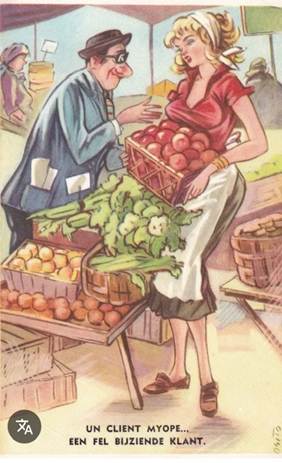
Or these ……
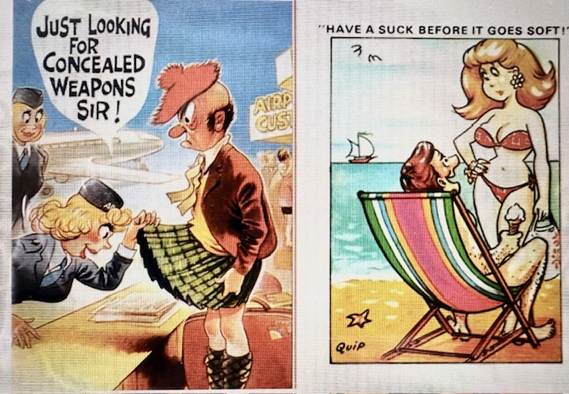
Was there anything harmful in these, produced in an era before television, a genre of comedy that appealed to all but the frigid? Barrack-room humour, pub male banter, it seemed part of the social fabric; just as comedians like Ken Dodd and Frankie Howard hammered the sexual jokes and innuendo to the point they became, to a degree, their trademark. I always pitied the mother-in-law! Sexual bluntness but at arm’s length; nothing personal. If we didn’t laugh out loud, we maybe sniggered silently, not wanting to be seen as outwardly coarse, but appreciating the creator’s skill.
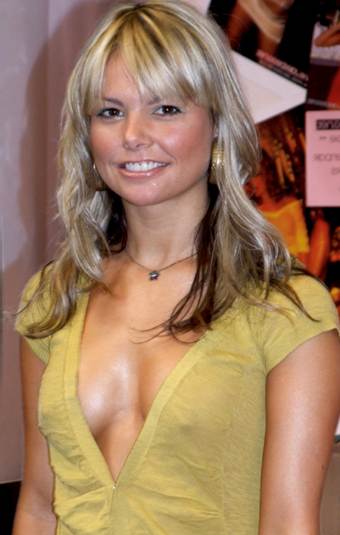
Page 3’s Jakki Degg

The Sun, a British tabloid newspaper and part of the stable of Rupert Murdoch, from 1970 featured ‘topless glamour models’ on its third page. The Sun’s Page 3 became a defining aspect of the paper and a cultural phenomenon, with models like Katie Price aka Jordan gaining fame through it. ‘Page 3’ was discontinued in 2015 after criticism about how it was portraying women.

Whilst I am not a fan of some of the reality television shows that grace our screens, such as Love Island or Celebrity Big Brother, I do like creative programmes, such as MasterChef (Presented by Greg Wallace and John Torode), The Great British Bake Off (Presented by Alison Hammond and Noel Fielding, with judging by Paul Hollywood and Prue Leith) and Bake Off The Professionals (Presented by Liam Charles and Ellie Taylor, and judged by Benoit Blin and Cherish Finden), although you can identify a bit of a theme in these! I could add ‘The Great Pottery Throw Down’ (Presented by Siobhán McSweeney and judges Keith Brymer Jones and Rich Miller) all about using clay.

I mention these four because in some episodes, sometimes, someone will make what used to be called a smutty joke, some comment with sexual undertones. And everyone laughs, presenters and participants, and the comment is never challenged; presumably if it was it would be edited out. Challenging would have been viewed as prudish; no one wants to be called a prude. So the inference is that the programme makers believe these titillations add colour to the conversations, to the banter. “It’s what we do, its harmless fun …..” until it isn’t. How do you know when you might offend someone? I love sex, love reading about sex, watching its portray in films and am no prude for sure, but I have always failed to understand why there is this incessant underlying sexual inuendo present in programmes that have nothing to do with sex. I watch and cringe, think ‘is that comment really necessary?’ In baking, ‘buns’, ‘cream’ and ‘rising’ are good examples of cross-over words not leaving much to the imagination.

Greg Wallace and John Torode

Both presenters of Master Chef, Greg Wallace and John Torode, have had their contracts terminated in the last few weeks, the former as a result of a BBC investigation into allegations of sexual misconduct. Greg is now considered old school, the dinosaur who doesn’t understand that what was considered fun and OK, is now not OK; certainly not fun if you are the victim.

Interestingly Wallace has apparently claimed that he often does not wear underpants as his autism manifests itself in extremely sensitive skin. This obviously explained why he was wearing a sock on his cock when someone opened the door of his dressing room during the making of a MasterChef programme. Another female member of the production crew recalled that Wallace, in his dressing room, said he needed to change his trousers and simple dropped them in front of the woman. ‘Oh! Sorry, I never wear underwear!

A great example of a reality television show that seemed to be squeaky clean was Handmade: Britain’s Best Woodworker, which was first broadcast in 2021. Talented woodworkers were set a ‘big project’ challenge, like making a bed, as well as skills tests, designed to demonstrate a particular expertise. Sadly it only ran for three series and there’s no news of it coming back. Perhaps too squeaky clean?

I must obviously question whether the audience love and laugh at the sexual inuendo, just part of the relaxing point of television – not paid to think! Whilst sexual jokes and suggestive scripts may be, some might argue, harmless, they are not if you are the victim or target.

As Wallace was being shown the door, there was an unsubstantiated allegation that John Torode, his co-presenter, had used ‘an extremely racist offensive term.’ Despite insisting he had no recollection of any of it, he too was gone.

Racism is a nasty and insidious aspect of human interaction. We have come a long way from the popular views of our grandparents or even great grandparents, where foreigners began at Dover, the British Empire was possible because of the superiority of the white race, and certain races had a bad reputation. We still have further to go.
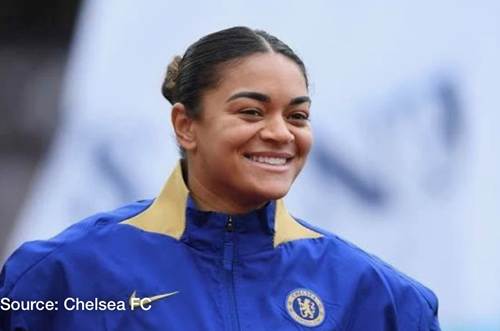
At the weekend news came that one of England’s Lionesses football team, Jess Carter, has been the target of racist abuse during the current Euro 2025 football competition. I thought ‘monkey chants’ from the football terraces were becoming, thankfully, rarer, but in this case the perpetrators are using social media to broadcast their unwelcome and unwarranted bile.

Maro Itoje

Interestingly the England Rugby Union international Maro Itoje believes that rugby suffers less from racist than football does because “rugby fans, and people in rugby, are a little bit more educated than those in football. The strength of tribalism between football clubs is partly to blame; when an oppositional player who’s a person of colour does damage to their team, the fans want to throw abuse at them. Rugby is nowhere near as tribal.” Even today I sadly find some of my generation use what in the C21st are rightly considered racially offensive words. The further out in the sticks you live, the more likely to hear such things. It will take years for everyone, whatever their race, their skin colour and their religion to just accept that others may be different but that they have a right to exist….. in their own way.

Richard 25th July 2025

Estoril, Portugal
www.postcardscribbles.co.uk

PC 448 Books & Hope (2)

Whilst I love the mug of Illy coffee I make in the morning with our Gaggia Espresso, I also love the interaction and social scene of The Hope Café; long may it last. And obviously I hope the additional draw of its co-location with a real book shop and reading room will increase the footfall for both enterprises.

The other morning I bumped into our neighbour Olga, on her way back to her apartment with her morning coffee in its disposable cup. She’s Ukrainian, a lawyer in the Worthing firm Mortimer Clarke and works from home some days. She loves the coffee from Gails, an expensive coffee shop and bakery founded in 2005 by Gail Mejia and Tom Molnar; there’s an outlet at the top of our road. (Note 1) We know it’s expensive as we buy our San Francisco sourdough bread there – £4.50 a loaf! Olga’s coffee is over £4 and I teased her that she could buy a small coffee machine like ours for under £200, equivalent to only 50 cups from Gails – probably paying for itself in less than six months.

However, we all have our peculiarities when it comes to ‘having a coffee’. Some of us make it in the comfort of our own home, wearing whatever takes our fancy; others, like Olga, prefer to go and grab a ‘take-away’ (Note 2), interacting with the barista and maybe others in the inevitable queue, while welcoming places like The Hope Café entice one to sit, and chat, and read, and savour the closeness of others. ‘Time to stand (sit!) and stare’.

If you want to know more about coffee, buy James Hoffmann’s The World Atlas of Coffee. You’ll find answers to questions like ‘Is it worth grinding your own beans?’, ‘Is coffee good/bad for you?’ and ‘What’s the difference between Arabica and Robusta beans?’. (Published in October 2025)

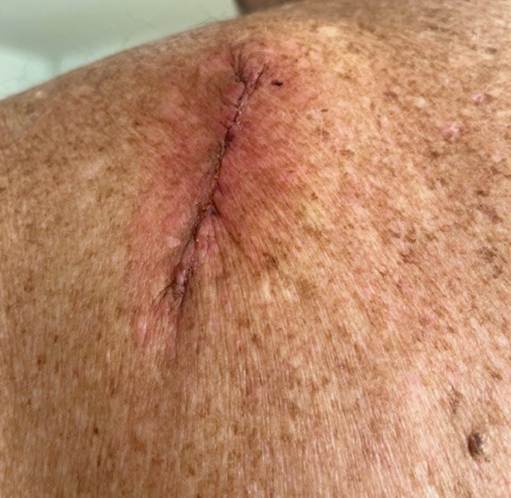
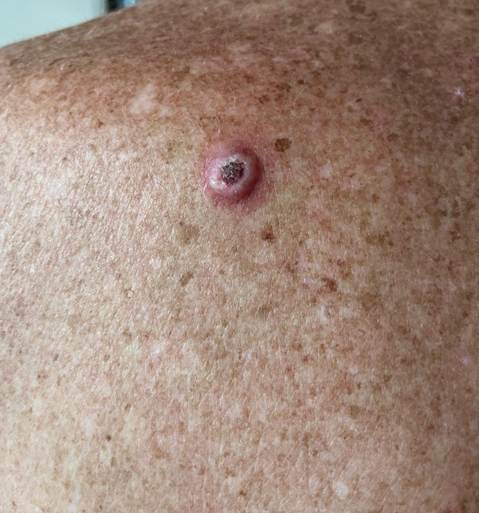
I went to the Hope Café in the morning towards the end of last week. Usually we have our 90-minute hot yoga class at 1000, but I had to let a new scar heal; ‘No yoga for two weeks!’ The scar on my left scapula was the visible sign of the removal of a Squamous cell carcinoma.

Squamous cells make up the middle and outer layers of the skin. Squamous cell carcinoma is a common type of skin cancer, not life-threatening but better removed than left to grow.

I had had a ‘melanoma in-situ mole’ removed 18 months ago, so am aware of the harm a life of sun-worshiping has had on my skin. As a teenager no one knew or cared about skin cancer, caused by too much sun. Now we know and care and can alter our habits accordingly. So, if in doubt about a spot on your skin, get it checked out as soon as possible.

My middle grandson, Reuben, had his 12th birthday last week and we sent a rendition of ‘Happy Birthday’ by WhatsApp to his mother, as we imagined he’s too young to have a mobile. Actually we found out that he has had one since the beginning of the year, mainly for parental needs; sensibly there’s a strict list of what he can/can’t access. His birthday reminded me that, at my first boarding school, one’s birthday was marked by a little knitted figure, rather like Golliwog. The boy celebrating his birthday was called out at breakfast and presented with a knitted Golliwog aka Robertson, which was placed in their jacket breast pocket, where it stayed all day. (Note 3)

The BBC Two unlikely hit ‘Couples Therapy’ is back for a second series, with Dr Orna Guralnik in her chair. The first series introduced me to ‘Afro-American generational trauma’, the belief that the psychological and emotional impact of historic events like slavery and systemic racism can be passed down through families over generations and it’s an emotional burden Afro-Americans carry today. Many older American black adults, according to research, view mental health conditions as a consequence of personal weakness and that the belief is an excuse.

I was reminded of this belief in generational trauma when Boris Kodjoe and his wife Jessica sat before Orna. Boris’ parents came from the USSR; Boris can’t believe why his wife isn’t sympathetic with his internal struggles, his generational trauma, and doesn’t understand him. The trouble seems to be that whenever she says she is and does, he moves the goalposts and there’s a different challenge. We are in the middle of this series, so it’ll be interesting to see how they resolve, with Orna’s guidance, this issue …. or not! 

Mo saw me and said she’d remembered the subject of my PC 421 ‘Not the Way to Go’, when she’d read a review of ‘Ghosting On Disappearance’ by Dominic Pettman. The dictionary definition of ‘Ghosting’, added in 2012, is ‘the action or ignoring or pretending not to know a person, especially that of suddenly ceasing to respond.’

“Oh!” I exclaimed, “I am constantly ghosted! When I send a WhatsApp message to someone asking a simple question like: ‘Are we on for coffee tomorrow?’, I see those two blue ticks lurking underneath the read but unanswered WhatsApp message and wonder why they haven’t replied. We’re either on or not!”

“Absolutely!” exclaimed Mo.

Richard 18th July 2025

Estoril Portugal

www.postcardscribbles.co.uk

Note 1 We are surrounded by independent cafes in Brighton & Hove. I adore some of the names: Trading Post Coffee Roastery, Café Coho, The Bystander Café, Small Batch Coffee Company, Milk no Sugar, the Flour Pot Bakery, Grocer & Grain, 17 Grams, Coffee at 33 and many more.

Note 2 Delightfully some people go and pick up their take-away still wearing ‘whatever takes your fancy’.

Note 3 Since 1910 Robertson’s marmalade jars had a golliwog on the label and brooches were collectable. For the last 40 years it’s no longer there, but you can still ask for a brooch! Seen now as racially insensitive. ‘Wog’ is an English slur against dark-skinned, brown-skinned people and as a racist epithet is comparable with spic and nigger. A lovable icon or racist symbol? (Wog being an abbreviation for Western Oriental Gentleman.)

PC 447 Books & Hope

Sounds a little like the name for a firm of family solicitors, ‘Books & Hope’, doesn’t it, but Duncan thought it brought together those who wanted to simply have a coffee and a chat, and those for whom a good book is an essential accompaniment to a tasteful coffee or herbal tea, with a delicious pastry from Teresa’s Brazilian delicatessen counter of course!

There’s been a great deal in the news about schemes in the UK encouraging more individuals of every age to read. ‘Reading should be accessible to everyone, whether English is a second language, literacy is a challenge, or life has simply made it difficult to maintain the habit. The written word is the foundation of so much of our culture and ensuring more people can engage with it will have a far-reaching impact.” says creative director of the charity The Reading Agency Shanz Gulzar. Reading fiction fires the imagination; one’s person’s pictorial setting of a story is different from another’s. Just like watching the film of a book one’s thoroughly enjoyed, only to find the director’s take is theirs and not yours! Non-fiction, biographies, historical accounts, whatever, broadens one’s knowledge.

To be able to enjoy the written word you need to be able to read. Adult illiteracy is not uncommon; Bombardier Broad, one of my men in a Royal Artillery regiment in Germany in 1974, struggled to read. Getting help for him was essential for his developing career and personal confidence.

On Tuesday a news item caught my attention. ‘Some children are reaching Secondary School with a reading age of 5!’ It went on to suggest some of the reasons, one being the Covid-enforced lockdown and for some its traumatic effect. And we can all understand the huge impact game-playing on digital devices has; time that might have been used to get inside a good book. Interestingly nowhere in the discussion were parents mentioned. It’s as if we have collective amnesia as to the responsibilities that come with having children. Some see criticism of parents as a sensitive issue, maybe linked to labels like deprivation and poverty, single parents and lack of education. Personally I think a national drive to improve parenting skills and responsibilities would have a big impact, as too often it’s our schools that must cope with children who haven’t been taught the very basics, poor sods!

But then was a parting comment by one of the interviewees, that here in the United Kingdom, 1 in 5 children do not attend school regularly; twenty percent! So the poor sods don’t get what help there is by being absent! This might be a topic for another postcard, but in a First World country this is disgraceful.

Despite the proliferation of digital reading devices and the advantages of such when weight is a factor, travelling for instance, the popularity of physical books, either hardback or paperback, has not diminished. Last week for instance the Number One slot in the Sunday Times Bestsellers, fictional and factual, totalled 40,000 sold books.

I met Duncan in his new venture next door to The Hope Café, which quietly opened its doors last month. I sense ‘Books’ is going to take a while to get established; good places often do, but the book shop’s association and co-location with The Hope Café will ensure there’s lots of crossflow. Just sitting and having a coffee with a good friend will often prompt a ‘I must buy a card for great aunt Maud, she’ll appreciate it no end; back in a sec’, sort of action. (note 1) I knew Mo was going to be working there three afternoons a week and sure enough she was there on Tuesday. She was already busy and no chance to chat, mouthing ‘talk later’ as she served a customer, so I meander back into The Hope Café and find Sami, looking cross.

Regular readers will recall Sami’s history with the Post Office, falsely accused of stealing money from one of his two Post Offices and being made bankrupt. He’s moved on, accepted the £600,000 compensation that was, at one time, on offer, formed a great relationship with Lisa Wallace, a journalist and writer from Derbyshire, and put it behind him. It doesn’t of course prevent him from taking a keen interest in how the issue of compensation is being handled.

“Don’t you just love weasel words Richard?” asks Sami, pouring over an article from last Saturday’s Times.

Over his shoulder I can read the headline – ‘345 Horizon victims have died before getting a payout.’ Sami read the preamble: ‘Close to six years after the scandal was exposed by a High Court judge, more than 3700 postmasters have yet to receive compensation. Thousands of sub-postmasters were wrongly blamed for financial losses as a result of the Horizon computer system. More than 900 were prosecuted and 236 sent to prison.’ Then the drivel:

‘The Post Office says it is an absolute priority for us and the government that all victims of the Horizon scandal receive full redress as quickly as possible”.

On 8th July Sir Wyn Williams, chair of the public inquiry, published the first part of his report, focusing on compensation and the human impact of what is believed to be the one of the biggest miscarriages of justice in UK history. The second report, establishing what happened and who is to blame, may not be published until 2026, suggesting any criminal trials may not start until 2028. (Note 2)

As an outsider, I read this and think, couldn’t someone just say: “Pay them NOW, this week, don’t quibble about certain aspects of the claim, and close this sorry, sorry episode.” Both the Post Office and HMG could fix this this month.

Richard 11th July 2025

Hove

www.postcardscribbles.co.uk

Note 1 On reflection they may not, given that a First Class postage stamp now costs £1.70.

Note 2 The United Kingdom justice system is, frankly, in crisis. There are some 77,000 cases awaiting their time in court, stretching the search for and resolution of justice to incredulity. There’s an average wait of two to three years for a case to come to court. For both parties, accused and victims, that’s cruel.

PC 446 Mid-Summer

PC 446 Mid-Summer

For those of my readers who live in the Southern Hemisphere, and especially those in South Island New Zealand whose north has been ravaged by torrential rains, you’re moving, albeit slowly, towards Spring and warmer weather. Here the summer equinox passed a fortnight ago and we will gradually slide towards Autumn. But now it really is mid-summer!

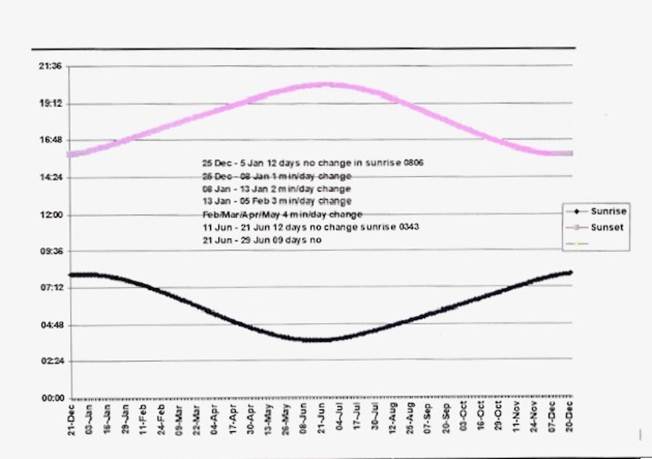
Many years ago I was curious about the lack of symmetry of our sunrise/sunset times and created a chart showing exactly how it is. I find it fascinating, but understand if you shrug your shoulders and say: ‘So what?’

You can see that here the sunset time reaches its latest some days before the sunrise time reaches its earliest.

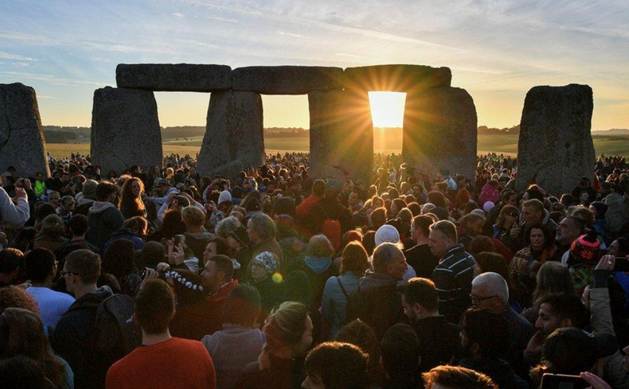
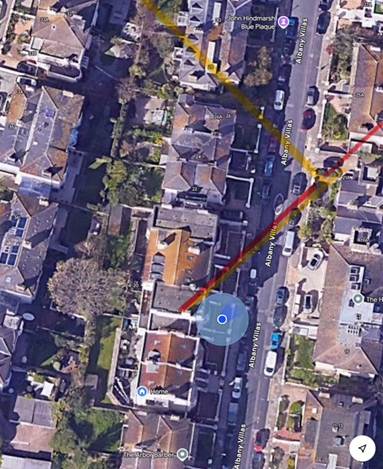
Our apartment in Amber House is what an estate agent would call a duplex (note 1), as well as having a double aspect, our living room’s 3m tall windows facing both east and west. Although it doesn’t have a sea view, it catches the early morning and late afternoon sun at certain times of the year. Additionally at mid-summer we observe the wonders of the celestial movements of both sun and earth. Every year hundreds of people gather at Stonehenge in Wiltshire to watch the midsummer sunrise.

I must admit I’ve always liked the alternative view, that the henge was built to celebrate the winter solstice, marking the time when days started getting longer.

On the summer solstice in Hove, the sun rose at 0447 on a bearing of 048deg, almost Northeast. By 0640 (Note 2) it was high enough to be over the houses on the other side of Albany Villas and its rays were pouring into our living room.

Then, a day later, when the sun is sinking towards its 2115 set, on a bearing of 312deg, almost Northwest, we experience something rather false.

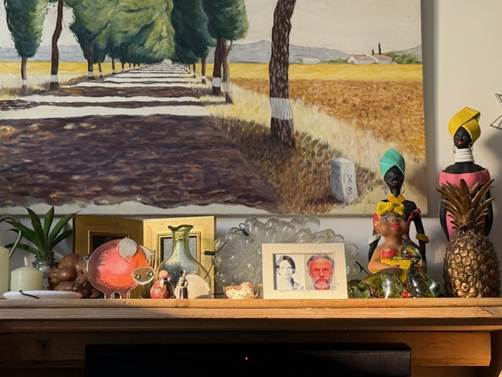
Red sunrise rays, yellow reflected rays

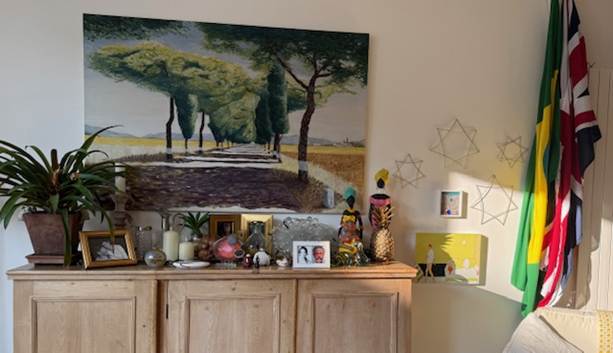
At around 1940 the sun’s rays bounced off a window on a house across the street and poured into our living room, illuminating the photograph of Celina’s parents, just like the rising sun had the day before.

I think by now we are all aware of our changing climate. The arguments about whether human activity is responsible for all of it, some of it, or whether the planet will grow warmer, whether we like it or not, will go on and on. However, its effects are already being felt. There was an interesting chart on the BBC News the other evening. It showed how the likelihood of June temperatures in the UK being above 30°C has increased over 70 years. In the 1960s there were one or possibly two days in the month, now it’s more like 8-10. And we can expect shorter, more intense weather, whether it be temperatures or floods.

I don’t think it’ll happen in my lifetime but ‘Families Like Ours’ was an interesting television drama broadcast recently. It featured Denmark, a country I know well from business forays and as a sailor. Climate Change was causing rising sea levels in the Baltic, so much so that the government decided the country could no longer exist ….. and everyone had to leave. Go where, you might ask? Watch it for a glimpse of what may happen.

In Britain the seasons are marked with traditional events. In mid-Summer The Wimbledon Tennis Tournament (23rd June – 13th July 2025) is preceded by the Lexus Eastbourne Open (21st – 29th June 2025) if tennis is your thing. My dental hygienist Jennyis a great fan and had tickets for both Eastbourne and for Wimbledon. Cricket Tests against India have started and the Henley Rowing Regatta (1st – 6th July 2025) is a wonderful example of Britishness. ‘Glastonbury’ (Note 3) 25th – 29th June was just one of many festivals around the country, that feature not only ‘pop’ music but classical, often in the grounds of some stately home. And midsummer would not be complete without strawberries and cream and maybe a glass of Pimms!

Over my lifetime I have learned how to navigate over the land, using a paper map and a compass and over the seas, using a mixture of charts, compass sightings of land features, ‘dead reckoning’, working with boat speed, leeway, tide and time, and on longer passages with a sexton for sun shots. The advent of Global Positioning Systems has changed forever the way we now move from A to B, but the basic knowledge is ingrained in my DNA, as is the need to understand where people are!

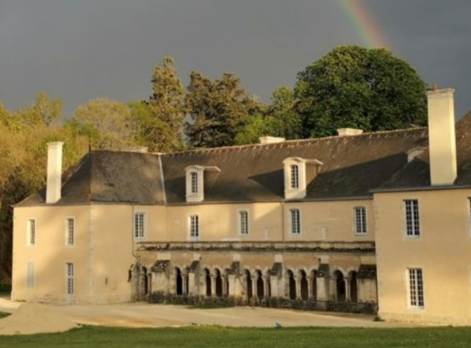
Recently Celina told me her mother was going off to a religious retreat in France. ‘Where abouts?’ I asked. “Near Poitier – Bonnevaux.” France is the size of the USA’s state Montana; demographically the former has a population of some 68 million people, whereas Montana only 1.1 million. So, despite travelling in France and finding parts of it are ‘empty’, it has a density of 123 people per square kilometre, compared with Montana’s 18, which is really empty! I dived onto Google Maps to search for Bonnevaux and found one north of Montpellier. A further question revealed that the retreat is in the Abbaye de Bonnevaux Centre ‘pour le paix’, near the village of Marçay ….. near Poitier. The WhatsApp message came with warning – ‘mobile phones are kind-of banned’!

The Abbaye de Bonnevaux

Peace in midsummer.

Richard 4th July 2025

Hove

http://www.postcardscribbles.co.uk

Note 1 An apartment on two floors. In our case our bedrooms are at the lower ground level, which has the advantage of being quieter.

Note 2 On the north coast of Scotland, in the northern hemisphere, on the longest day, the sun rises at 0403 and sets at 2225.

Note 3 The first music festival to be held at Worthy Down Farm was called the Pilton Pop, Folk and Blues Festival and took place in 1970. It was attended by 1500 people who paid an admission charge of £1 which included free camping and free milk. Twelve thousand people attended the first festival named ‘Glastonbury’ which took place the following year.