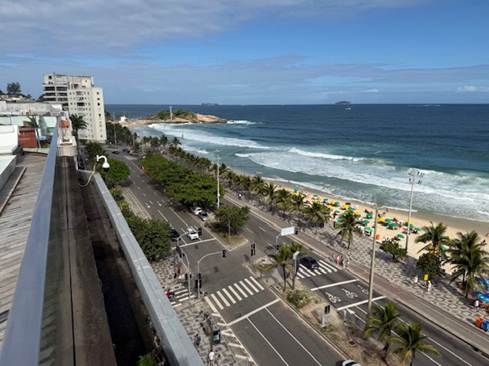
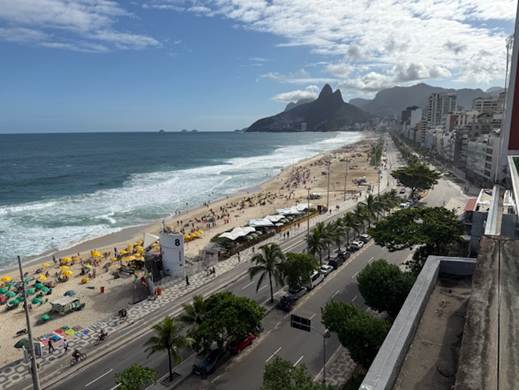
On this visit we rented an AirBnB in the Lanai Condominio, around the corner from an apartment owned by Celina’s bother, in Barra da Tijuca. The suburb lies to the west of Ipanema and Barra’s beach, just across the road, is even better than Ipanema’s; the girls probably are the same.
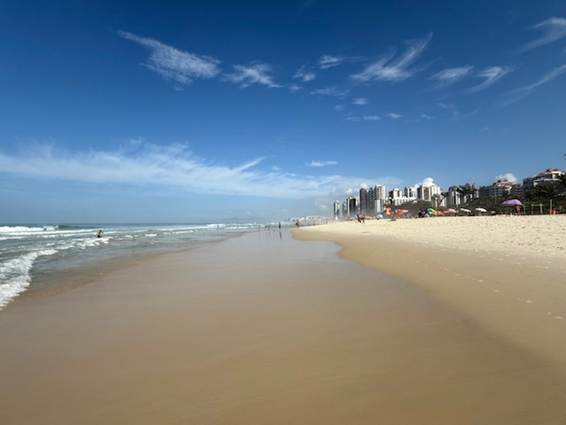
I’ve written about this long stretch of sand before, collecting thoughts in PC 08 ‘Beach Life in Brazil’, which has a short postscript concerning dental floss. (See PS) On another visit in September 2014, almost eleven years ago, I wrote PC 21, questioning happenings in the world; I think the first two paragraphs are worth repeating:
“We walked along the line of the surf of the crowded beach on a Sunday in September in Barra da Tijuca; the sun was warm on our backs. I looked at the carefree groups of families and friends, at children playing either in the surf or with a football, this is Brazil after all (!), and at other adults, just splashing in the shallows. It was totally divorced from the obscene photograph of a black figure brandishing a knife in front of a kneeling, orange-suited human that had appeared on the front page of my digital Times that morning.
I had looked at the photo of the latest British hostage, a 44-year-old man with a family, with friends, with loved ones. It was so surreal. I knew from the news report that, moments after the photo had been, he would be murdered, in cold blood, in the most barbaric and inhuman way.”
‘Plus ça change, plus c’est la même chose.’ Then it was ISIS, trying to bring about a C7th Caliphate in the Middle East; today for example it’s the slaughter in Ukraine. A poem by Robert Burns in 1786 included the line – ‘man’s inhumanity to man’; we don’t learn, and some of those who profess to lead don’t care.
I am no ornithologist but am mesmerised by one particular bird that populates the Brazilian coast; it looks almost prehistoric, like a pterodactyl perhaps.
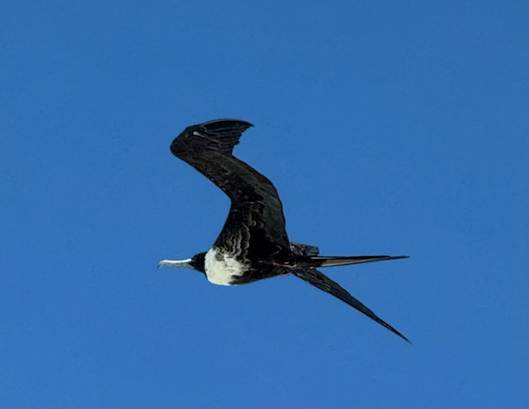
With the aid of Google I learned it’s called a Frigate bird. They are apparently found across all the tropical and subtropical oceans. Characterised by black plumage, deeply forked tails and long hooked bills, there are five extant species. Wonderful!
Currently the temperature of the sea at Barra is fine but, surprisingly as the littoral current moves in a southerly direction from the equator, it can be very cold. Additionally, the underwater profiles of the seabed mean it’s not a particularly safe beach. Undercurrents, fierce draw-backs and constant breaking waves mean those wanting a dip do just that, have a dip. The only swimming going on is by those on surf or bodyboards, making their way beyond the breakers. Every 400m or so is a manned lifeguard station and if someone thinks it’s safe further out, the warning whistles start and they are encouraged to come back to the shore.
It’s always interesting going to other countries and engaging with those people who live there on a permanent basis. The moans I hear today in Rio are an echo of those I hear in Hove; distrust in politicians, the cost of living, the energy/climate crisis, streets unsafe at night and more frequently in some areas during the day, the pervasiveness of social media, the lack of acceptance of opposing views, the lack of common sense etc etc. The locals complain of the traffic, especially at rush hour along the coast road that leads from Barra da Tijuca, past São Conrado and into Lebon and Ipanema. I remind them that in the UK the normal commute is at least 90 minutes.
The southeast corner of the UK is fairly prosperous; relative poverty rarer here that further north. In Brazil poverty is never far from the surface, that and the insidious drugs, their peddling and their use. Surprisingly the city administration clears the streets of those with nowhere to live, ensuring they get shelter and food. (Note 1) The rich here would hope that Rio de Janeiro remains globally famous for its Christ the Redeemer statue, Sugar Loaf Mountain, carnival and its beaches, and maybe for the girl walking along Ipanema beach. But in the last thirty years its favelas have been making the news; some are more famous than others, some more dangerous than others, and the nearest one to Celina’s mother’s house is Rocinha.

Rochinha houses cling to the mountainside in all directions
Times change and its residents have benefitted from the provision of a new tube line and station in 2016, part of the Olympic infrastructure, and lately by a Tourist Office opening within the favela. This is creating more money for the inhabitants, which can only be a good thing.
We had little rain during our visit and what we had was tropical.
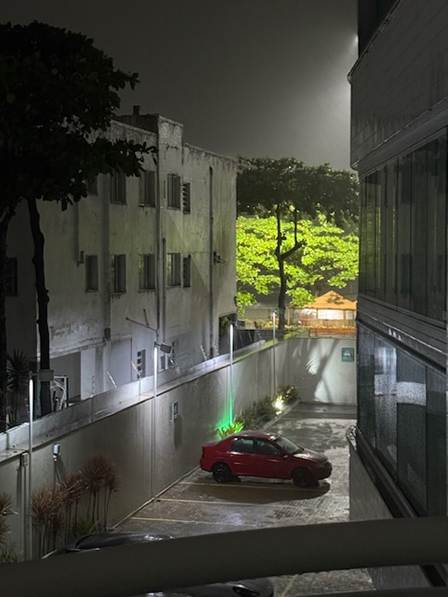
Downpour at 0300!
Our AirBnB had air conditioning, essential if you want a good night’s sleep, but the pouring of water onto the external metal box made such an horrendous noise that sleep was impossible. Being a practical sort of chap, I wondered why no one had glued a thick piece of insulation material or rubber matting to its top. Think it would have worked! Of course, electricity failures are common here and then there is no air conditioning! And if you didn’t, read ‘PC 145 Extreme Weather’ from February 2019 about the floods in Rio de Janeiro.
So that girl, that ‘tall and tanned and young and lovely’ woman from the 1960s, is no longer visible. There seemed something innocent about her and I don’t think that’s true of the woman on Ipanema beach today!
Back in Hove, we miss the warmth, we miss the constant noise, we miss the friendly carefree Brazilian people; I don’t miss the mosquitoes!
Richard 25th April 2025
Hove
PS For those of you who might like to read more of my Brazilian scribbles, look at: PC 01 Bahia, PCs 3&4 Rio de Janeiro, PC 5 São Paulo & Cananeia, PC 6 Petropolis, PC 8 Brazilian beach life and PS PC 09, PC 10 Paraty, PC 11 Reflections on São Conrado, PCs 17 & 20 The Pantanal, PC 34 Recife, PC 37 A Small Town in Brazil, PC 51 Foz, PC 63 Santa Catarina and PC 91 Japanese São Paulo.
Note 1 Pricilla Goslin, author of ‘How to be a Carioca’, told me that some streets in Seattle, near her Portland, Oregon home, are a permanent ‘tent city. Echoes of San Francisco perhaps?


 postcards