PC 424 We are Nothing Without Hope

There was a very good reason that Duncan named his café here in Hove ‘The Hope Café’, as on that single word hang our todays and our tomorrows. Without hope, in whatever form, we are nothing. Last Monday was International Holocaust Memorial Day, this year’s made even more poignant as it is the 80th anniversary of the liberation of Auschwitz.

Back in February 2022 I wrote about the atrocities sections of our global society have inflicted, one against another, in PC 268 Least We Forget. Whilst acknowledging that unspeakable horrors committed, man on man, have not been exclusively the preserve of the Nazis, the latter managed to create an industrial killing machine within their concentration camps. Just remember these words: ‘In Auschwitz it’s estimated that a million Jews were killed’; 1,000,000 individuals expecting, as we do today, to have a reasonable life expectancy, simply snuffed out because of their race. The testimonies of survivors at Monday’s Ceremony of Remembrance at Auschwitz shared a common theme, that current and future generations must heed the alarm bells already ringing from rampant antisemitism on display in the Middle East and elsewhere.

Last December I read ‘The Happiest Man on Earth’, the autobiographical account by Eddie Jaku (Note 1) of his life, particularly the years he spent in Buchenwald and Auschwitz. For those who are uncertain whether these camps existed, this story lays it out in all its horror and degradation. You may have already read what King Charles wrote on Monday in the Auschwitz Visitors’ Book: “Remembering what took place here, and those who were so cruelly murdered, is a duty, a sacred duty that must be protected. Being here today, hearing the stories of those who experienced its horrors, seeing the shoes of children whose lives were taken when they’d just begun, and walking the paths upon which such cruelty was inflicted is something I will never forget.”

Tova Friedman, now 86 but aged 6 when Auschwitz was liberated, should have a final word. “I stood and watched helplessly as little girls were marched away to the gas chamber. ….. I thought it was normal that if you were a Jewish child, you had to die.”

Let us hope.

I was hoping to have a chat with Lisa, Sami’s partner, when I went to The Hope Café on Wednesday, as I hadn’t seen her this year. Sure enough she’s at a table, tapping her laptop keyboard as if her life depended on it. Incidentally I hope that schools are teaching children to type properly and not just using two fingers. Unlike mine, their future is digital. Lisa’s happy to be interrupted.

Hi! Richard. I enjoyed your last postcard …. what was its title ….  ‘There Are Standards, Carruthers.’  Excellent! I bet it garnered a lot of comments?”

“It certainly did! Funny how we find something so simple as manners and common courtesies an interesting topic. There were a lot of new readers who ‘liked’ it, so I am pleased. How are you and Sami?”

“We’re very good, thanks. With the weather so vile we’ve probably watched more television that we usually do and really enjoyed a new drama called Patience, set in the City of York. The character of the title, Patience, played by Ella Maisy Purvis, has autism, as has Ella. I read “In an overcrowded crime drama market it is the slowly developing connection between Bea (Ed. Bea Metcalf is a detective working for Yorkshire Police) and Patience that is the Bechdel test-passing USP of this show.”

“Er! What’s the Bechdel test?”

“Glad you asked. I was aware of it but it’s become very popular of late, so I looked it up. Essentially it asks whether a work featuring at least two female characters have a conversation about something other than a man.”

“Can you imagine? But seriously, that is interesting. And I assume Patience is neurodiverse….”

“Absolutely! Just like Bill Gates and see where that got him.”

“Celina and I occasionally watch dramas on Channel Four which are sponsored by a user car dealership called Arnold Clark; the advertisements always feature a car … surprising huh! One of the latest shows a chap taking an electrical charging cable, walking to the charging point on the rear of his electric car, and plugging it in. Then he seems to stand there, holding the cable handle, looking up …… at an imaginary petrol station pump display ….. as he had always done!

Ah! Habits die hard.”

“You may remember in PC 422 ‘Back in The Hope Café’, right at the end, I admitted to Mo that I had asked someone who was due to have an acupuncture session whether it was online or were they going to the practice. Since then, the acupuncturist has confirmed he charges 25% more for online appointments!

Then I had an amusing exchange with our masseuse, Kay, who had a tree in her garden that needed trimming. She asked by text whether she could borrow a saw. She’d dictated her text and hadn’t checked it before pressing ‘send’. It came out as ‘I would love to borrow your soul if that’s possible.’ A day later she realised: ‘Just realised I’ve asked to borrow your soul. I’ll let you keep it and just stick with the saw. Anyway, didn’t you sell your soul a long time ago?’ My response was short: ‘Too long ago to remember; too short a time to forget.’”

“Brilliant! By the way, I noticed Libby’s looking very subdued and quietly asked Josh if he knew why.  Apparently, she’s admitted to him that she’d been the victim in a Romance Scam, has lost a lot of money and is feeling very embarrassed.”

“I am not surprised! I’ll have a chat with her sometime, not now, and see if she can put it behind her.

Richard 31st January 2025

Hove

www.postcardscribbles.co.uk

PS For clarity, I am not Jewish, simply a human being.

Note 1 Eddie Jaku OAM (Order of Australia Medal) was born Abraham Jakubowicz in 1920. He died in Sydney in October 2021.

PC 423 There Are Standards, Carruthers (PS)

There are standards, there are passing fads and there are habits. But even the standards that you grew up with, understood them to be sacrosanct and embedded in your DNA, can and should be challenged sometimes. Take men’s shoes; I am using them as an example as to comment on women’s would be like me commenting on whether wedges are more comfortable than stilettos, and I am not qualified to do so!

I grew up in the days of leather, leather shoes and leather soles. I think I had a pair of suede shoes, not Hush puppies, but it was the leather polished ones which defined my upbringing. At Sandhurst we were taught how to polish one’s brown shoes, getting the wax into the welts, and one’s parade ground Drill Boots, with their steel quarters on the heels and the studs on the sole. We were even told that one should polish the instep of the shoes so that, when you were sitting down, if you crossed one leg over the other, exposing the instep, it looked cared for and polished. These habits became part of the collection of one’s standards. Like having a crease down the length of one’s trousers.

Then I got into suede boots and the number of shoes requiring polishing diminished. Back then trainers were what you wore if you were training, obviously; in the gym, on the running track, playing squash or going for a jog. They went with track suits, not an item of clothing for everyday wear, surely, Caruthers. Now I have more trainer-type footwear than leather shoes, the latter growing Mold at the back of the wardrobe. But if I do wear leather ones, they have to be polished beforehand.

Table manners are another ‘standards’ issue. In one of my PCs I mentioned I went to be interviewed by the C-in-C BAOR for a role. The first test would be over luncheon (Note 1), the unspoken ‘knife-and-fork test’; how did I hold my knife and fork, what did I do with them when I wasn’t eating, did I speak when I had food in my mouth and was still masticating etc. I was brought up to believe that these things mattered and still do. I try not to show how sad I am when others stab their food as if it will jump off the plate, hold their knife and fork vertically as if to indicate no one should try to take something off their plate or just speak with an open mouth showing the half-digested potato or sausage. Just so gross!

Writing about individuals eating with their mouth open reminded me that, many years ago, a new client sat down at my table in the Institute of Directors in Pall Mall, the start of some coaching sessions, expecting us to get straight into it. We did, after he had disappeared to the Men’s Room to remove his chewing gum. There are standards, Carruthers!

And if you are wondering, puddings should be eaten with a fork or a spoon and fork, not a spoon on its own!

Napkins or serviettes, call them what you will, are another essential when eating. Because I like ironing, I am happy we use proper napkins, linen or cotton and not some paper replica, unless it’s for a party, like these:

And if you use a napkin, it’s good to have your own napkin ring in which to put it. There are standards after all.

I am not sure when it started but it has for me become one of the most annoying habits to witness and it’s mainly actioned by, I think, under-thirties women. Although in this age of equality I wouldn’t want to exclude some members of the opposite sex and anyone in between. For any multitude of reasons, the individual is feeling anxious and that anxious emotion brings a certain wetness to their eyes. Whether in disbelief that they’re going to cry or pleased that they’re showing their feelings, they move their hands towards their cheeks, fingers extended, nails prominent …. and shake their fingers, brow creased ….. mumbling ‘I don’t want to cry’ or somesuch. Someone could choreograph a little ballet with each finger having its own independent part to play. Any tears are carefully wiped away with the finger-print part of the finger; otherwise, their fashionable nails would stab them in the eye. (Note 2) I know we’re encouraging everyone to show their feelings more, especially young men, but this is absolutely ridiculous. And it goes on and on and no one says: “Oh! For God’s sake, Emma, get a f**king grip!” because that would breech their human rights.  

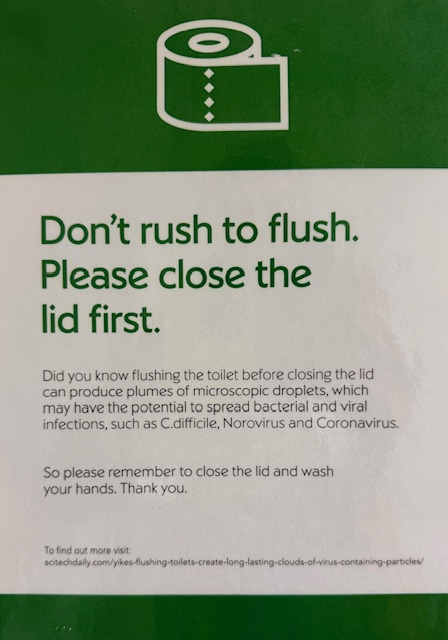
I have written before about ‘Loo Paper’ (PC 47 Aug 2015) and ‘The Loo’ (PC 54 November 2015). After using the loo, I think it’s important to close the lid, but I hadn’t factored in the latest advice. Close the lid then flush and not the other way around:

And finally, if you go to someone’s house and use a knife & fork, ie having something to eat, you should write a Thank You letter. With the cost of postage sky high, I write mine in cursive script with a fountain pen, take a photo then send it via WhatsApp. A rather modern take on old-fashioned standards; Carruthers would smile.

Richard 24th January 2025

Hove

www.postcardscribbles.co.uk

PS Carruthers is an old Scottish surname which reeks of upper-class aloofness. Inter alia, the main protagonist of Erskine Childers’ novel ‘The Riddle of The Sands’.

Note 1 Another word that defines a class and an age …. and an indefinable ‘meat’! Actually ‘fine-particle meat products enriched with pork fat and flavouring additives.’ Sounds very healthy.

Note 2 Nail extensions have become longer and longer, so much so that some should be registered as dangerous weapons and the owners of others will have problems in the future as in order to use a keyboard today, they have to hold their fingers in a convex manner.

PC 422 Back in The Hope Café

After a couple of postcards that, on reflection, were quite serious in content, I needed to relax a little, so headed to The Hope Café for some R&R (Note 1). With a pastry and double espresso in hand, I found a corner table and sat … and relaxed … and observed. Such a great pastime, watching other people living, doing, engaging, focused; fortunately, most people who are here in The Hope Café come to meet others or just get some relaxation, some space away from their hectic life outside. Well, most; apart from our budding novelist Robert, who is tapping away on his laptop at the window counter, lost in his own world of fictional stories and subplots and characterisation. He gets the best of both worlds, working with headphones clamped over his ears listening to a podcast or music, whilst absorbing the café’s ambience and warmth by a process of osmosis!

 I guess we’ve all noticed a very modern trend; where acquaintances get around a restaurant table, order some food and drinks and then get their mobiles out and catch up with their social media lives and have no conversations IRL (in real life).  It doesn’t happen here in The Hope.

I was struggling with one of The Times’ hard Killer Sudokus, which I do on a daily basis as it keeps the grey matter well oiled, when I had a tap on my shoulder. I looked up to see Mo. Pleased, I motioned to her to sit down.

“Listen, Richard; I bet you had a lot of comments about your last scribbles about the Cancel Culture. (PC 421 Not the Way to Go January 2025). I thought you did a great job, highlighting this very real issue. It’s awful and a very worrying state of affairs, especially for those with low self-esteem. The new ‘being sent to Coventry’, perhaps; used to mean deliberately ostracising them, by not talking to them and acting as though they no longer exist. Sounds about right?” (Note 2)

“I got a lot of reaction, yes, but all rather sad, huh! One friend whom we met in the Portslade yoga studio has two sons in their early twenties. The older one did a Video Gaming course at university; “Bullied online over the last few days. Really awful; impacted his physical and emotional well-being; seems as though younger people are losing their kindness and the ability to discuss differences openly and curiously without judgment; he had to remove himself from one gaming group.

“You may have read about 66-year-old Martin Speake, who taught jazz for 22 years at the Trinity Laban Conservatoire in London?”

“Not a name that rings any bells. Tell me more?”

“It’s a complex story with many nuances but in essence when Speake was asked for feedback on the school’s equality and diversity policy, he said he didn’t agree that black musicians were discriminated against in the UK’s jazz scene (Note 3). Martin Speake is white. His response was ‘shared’, his classes were boycotted …. and he was eventually forced to resign. It was claimed by a student that his email has made black musicians feel unsafe at Trinity. He believes that students are treated like customers so they’re in charge but they don’t have the maturity to know what they are doing; ‘they have destroyed my life’.”

“That’s such a sad reflection on the world in which we live. We can only hope that common sense will return. By the way, I know you read The Times; did you see the obituary of Cherry Hill?”

“Never heard of her, no.”

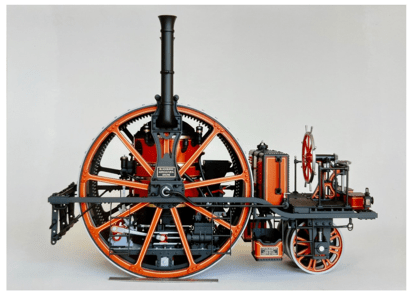
“She was a prize-winning model maker, who spent a lifetime creating elaborate scaled-down versions of Victorian traction engines and other machines, some of which had not even been built at full size.”

“And why are you mentioning her?”

“Because I was astounded by her skill and attention to detail. I took this screen shot of her model of a Blackburn agricultural engine of 1857:

“Wow! That’s incredible. Incidentally, you asked whether I had lots of comments about my last PC. Yes, but PCs 417 and 419 (Have you Read …) were equally popular. One of my readers, Priscilla Goslin, author of ‘How to Be a Carioca’ (Note 4), not only passed them on to one of her adult sons, who has ‘difficulty of letting go of past disappointments’, but also admitted to having copy of Zen Flesh Zen Bones: ‘on my shelf forever. I’ve never known anyone who had it! I can still recite a few of the stories.’ Priscilla lives 50/50 in Brazil and the USA.

Before I go, Mo, I thought you would be amused at my recent stupidity. We get so used to doing things online that when someone I know said they were going to see an acupuncturist, I immediately asked: “Is that online or are you going to their practice? Bye ….”

Good to chat!  

Richard 17th January 2025

Hove

www.postcardscribbles.co.uk

Note 1 R&R is an abbreviation for Rest & Recuperation, a term I first came across in 1973. Halfway through our four-month operational tour in Londonderry, Northern Ireland, we had three days ‘R&R’. Those soldiers who were married flew back home to Germany, those who were single flew to the UK mainland. After living in a heightened state of alert for weeks, it was weird and strange to re-enter ‘normal life’, even for a few days.

Note 2 The phrase may date from the English Civil War (August 1642 – September 1951) when Coventry had a military prison. Others suggest it dates from the C18th when Coventry was the nearest town to London that lay outside the jurisdiction of the Bow Street Runners, so London criminals would flee there to escape arrest.

Note 3 Probably some ‘tick box’ survey.

Note 4. An international best seller since 1992, this is a humorous look at what makes up one of the world’s most colourful characters – the Carioca, a resident of Rio de Janeiro, Brazil.

PC 421 Not the way to go

I hope most of my readers will be aware of the phrases ‘cancel culture’ and ‘ghosting’. The latter was the subject of a book entitled ‘Ghosts’ by British millennial author Dolly Alderton; an interesting if heartbreaking story. What concerns me is the long lasting, often traumatic, effect that either action has on its victims. Last year there was an article in The Times entitled “Cancel Culture on Campus; ‘Most of us are terrified’” by Alice Thomson. She was prompted to investigate what is going on by the death of Alexander Rogers, an Oxford undergraduate who committed suicide after being ‘cancelled’. Someone killed themselves because they were cancelled?

The coroner, Nicholas Graham, seemed to think that the punishment of ostracization exacted immediately before Roger’s suicide played an influential role. He cited an independent review commissioned by his college, Corpus Christi, describing an establishment and normalised culture in which students would rush to judgement without knowledge of all the facts and shun those accused. Finally, he urged those in positions of responsibility to take cancel culture, ‘the exclusion of students from social circles based on allegations of misconduct, often without due process or a fair hearing’, seriously. Thomson wrote that whilst at 20 one is old enough to take responsibility for one’s actions, nothing should be unforgiveable.

Blimey! Actually ‘blimey’ doesn’t do it! ‘What the f**k?’ would be a better expression of my reaction. What a very sad reflection on the realities of the social scene for our young adults, a time when they should be experiencing and learning about relationships in real life, not shunning them for fear of being cancelled; in real life and not on-line! A graduate of Cambridge, Ceci Browning, wrote: “This is the paradox of my generation. We are meant to be the most tolerant and liberal, yet when one of our friends slips up and falls out of step, they become the enemy. We cut friends and acquaintances from our lives on the basis of second-hand information about something deemed morally iffy that they may or may not have done. But we are also perpetually afraid that precisely the same thing could happen to us.”

We know that the difficulties of learning how to start, continue and stop relationships start in one’s teenage years. My own childhood, although privileged, was very mixed. Whilst I have fond memories of the second preparatory boarding school where I spent my pre-teenage years, I shudder at some of the early memories I had of my teenage ones. Bullied and ostracised, rather wet by nature, feeling abandoned by my parents, I took a long while to find my feet and my confidence. Then of course there was no instant messaging, no aggrieved soul venting their hurt on social media, for others to share with God knows who. So rumours rose and died, snuffed out by the smallness of the audience.  

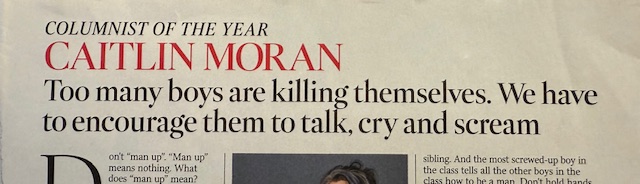
The suicide of Alexander Rogers is another statistic to some, but Caitlin Moran’s recent article ‘Too Many Boys are Killing Themselves.’ highlights a worrying trend. I read her book ‘About Men’ last year, an unusual topic for her, and subsequently wrote PCs 352 & 354 (About Men and More About Men) in September 2023. Moran writes that too many boys/young men are killing themselves. I have three grandsons so this subject is right there, on the front burner for me, trying to understand the modern pressures and how the three of them will be able to develop sensible values and self-discipline, able to filter out the crap peddled by influencers like Tait, who want to encourage boys to become incel – ‘unable to find a romantic or sexual partner’.

Socially relationships are key to our social fitness. The concept is not new; Aristotle, writing more than 2000 years ago, said that ‘man is by nature a social animal’. Moran described the difficulties of both sexes interacting in the digital world. For instance, what to one person might be an attempt to give an affectionate ‘touch of the neck’ could be construed by the object of their actions, someone who perhaps has watched too much internet porn, as a preliminary move towards a strangle hold and shock and revulsion is their response; a touch of the lower back easily extrapolated into an imagination of unwanted sexual advances. And this at a time when everyone is experimenting, trying what works for them, understanding what doesn’t.

It’s also important to remember that the ‘squishy part of the brain responsible for sensible decision-making’ isn’t completely developed until one’s mid to late 20s. ‘Students are still especially susceptible to making stupid mistakes and perhaps overreacting to perceived slights’. Rather than try and discuss and understand and accept an apology, they reach for their social media account. Stories are gobbled up in such an insatiable way there is no thought to pause, to think if it’s true or somewhat exaggerated; ‘share’ and ‘share’, part of the herd. So when someone is cancelled by those whom they believed to be in their ‘friends and acquaintances’ circle, it doesn’t take much to understand how their whole world comes crashing down.

I wonder whether those involved in the story of Alexander, either personally or by association, feel any lasting blame for their actions, any lasting shame. What has changed since the independent report commissioned by Corpus Christi? Has it really made it easier for students to talk about the inappropriate behaviour of other students, as part of a normal discourse about growing up and developing proper boundaries, or has the college decided that its reputation is more important than that of one individual?

In the final analysis we think and no one else can do that for us; we feel what we think, these feelings coloured by past experiences and expectations; then it’s our responsibility whether we act …. or not.

Richard 10th January 2025

Hove

www.postcardscribbles.co.uk

PS Read ‘The Happiest Man on Earth’ by Eddie Jaku if you’re a bit down; time to reflect.

PC 420 Contentious Issues in the UK for 2025

The complete resolution of contentious issues here in the UK seems impossible, taking forever, so much so that one suspects a certain degree of wilful obstruction and reluctance in the decision-making organisations. For example, I wrote about the scandal that engulfed sub postmasters and sub postmistresses back in June 2021, in PC 235 Generosity in Government, a piece which dealt with both the Post Office (PO) Scandal and the aftermath of the 2017 Grenfell Tower fire and its inflammable cladding. Then I met Sami in The Hope Café, listened to his own experience of working for the PO, which had ended up in his bankruptcy (See PC 271 Friday 25th February 2022). The last Tory government and the new Labour one both committed to ensuring every postmaster and mistress was exonerated and given compensation, no questions asked. And some still wait, PO lawyers arguing about levels of the latter. The Post Office Independent Inquiry finished on 18th December 2024 but don’t hold your breath for criminal charges to be brought. One estimate is two years! A good example of lack of action for fear of organisational reputation.

The Church of England is our ‘established’ church and in an ideal world should not only reflect the current mores of our society but also set some standards; if it can’t I think the link between church and state should be severed. The last Archbishop of Canterbury, Justin Welby, was a political appointee, famous for asking the population before the May 2023 Coronation to show obedience to and genuflect before the new king. Shades of ‘doffing one’s cap to the landowner’; fortunately, he was put right. What it showed was someone out of touch with society and his organisation’s role in it.

This aloofness was further demonstrated by his inability to get rid of a known paedophilic priest; he completely misunderstood the public mood, its belief that the church continues to protect its own. He was forced to resign and formally leaves the role on Monday. So far, so right and proper, you might think. A good example of lack of action for fear of organisational reputation. Sadly, he added insult to injury by making light of the whole saga in his House of Lords (Note 1) final speech, neither offering an apology nor mentioning the victims. His possible successor, the Archbishop of York, has also been linked to a sexual abuse case within the church and his inaction in ridding the church of the abusive priest. Another example of lack of action for fear of organisational reputation.

The threads remain. At two of Scotland’s prestigious schools, Edinburgh Academy and at Fettes College in the 1970s, ‘Edgar’ was notorious for his sexual abuse of dozens of boys. Rather than have him investigated by the police, he was given a glowing reference and allowed to take up a post in a school in South Africa, where he continued his evil behaviour. In this case, those who ran the schools are guilty of putting the reputation of the school before the victims. Edgar did not face his victims; he died whilst the UK and South Africa were agreeing his extradition back to the UK. The only good thing to come out of this is that more and more individuals are coming forward to tell their stories; those in charge in schools must be held to account.

Sami and I chatted about the Infected Blood Scandal in PC 392 Hope Continues (June 2024). After the inquiry concluded ‘the NHS and successive governments of all colours took part in a chilling cover-up and closed ranks to hide the truth’, the government announced a £11.8 billion payout. But the compensation scheme for some reason differentiates between those who contracted HIV from those who contracted hepatitis C. Somone with HIV gets over £2 million whereas someone with hepatitis C around £750,000; now the latter group are dying at a faster rate than those with HIV. Another example of a lack of urgency and fairness to settle the matter.

I can’t finish this postcard without wondering whether the fallout of the trial of Dominique Pelicot will have any lasting effect in France or indeed over here. It was his own actions, being caught ‘upskirting’, that led to the discovery of his cache of videos, but it was the courage of his wife, Gisèle, that led to an international furore and his subsequent very public trial. The media have made much of the remarks of the mayor of their village of Mazan, Louis Bonnet: “…. after all, no one died. It could have been far more serious. There were no kids involved. No women were killed.” He later apologised but there’s a feeling that the actions of Pelicot and those men who participated merely deserved a Gallic shrug. Sadly, society has a long way to go to accept that women and men should be given completely equal treatment. This not only applies to Christian societies but also to those who treat women in an unequal way.

There are many other contentious issues for the UK, but I’ll highlight another two to finish this postcard. I mentioned the Assisted Dying Bill in PC 418 Hope Christmas News. This is such a huge moral issue its unlikely to be far from the headlines. This month it’ll start its Committee Stage in the House of Commons.

The other is a change to Inheritance Tax rules. When I die my estate will attract a tax of 40% on my assets, after a tax-free threshold of £325,000. If I leave my home to Celina, there’s no tax. If I leave it to my daughter, I have a tax-free threshold of £500,000. I suspect she would have to sell it to pay the tax. The new Labour government have said that farmers, hitherto exempt, will have to pay inheritance tax at 20%. It’s a complicated scene, with tax allowances and the value of land, generational ownership etc but it brought the tractors into London …… and the furore is unlikely to go away.

Happy Contentious Issues 2025

Richard 3rd January 2025

Hove

www.postcardscribbles.co.uk

PS Today the news is that the urgent review of Social Care overhaul is delayed until 2028. Government urgency huh!

Note 1 The Archbishops of Canterbury and York, the Bishops of London, of Durham and of Winchester and the next 21 most senior diocesan bishops are all members of the House of Lords.