Britain has been a Christian country seemingly for ever and religion plays a crucial if understated role in the conduct of war, both at a personal level but also at an organisational one. One of our Captain instructors was a lay preacher and, on a weekend’s adventurous training exercise, led a small Sunday morning service – in the middle of a wood, in the rain. One comment has always stayed with me: “There are no atheists in a slit trench”. Fortunately I have never been in an operational slit trench, waiting to go ‘over the top’, but understand how those who were might have prayed to some higher being. At Sandhurst every Sunday we paraded in front of the Commandant and then marched off across the square to the chapel.
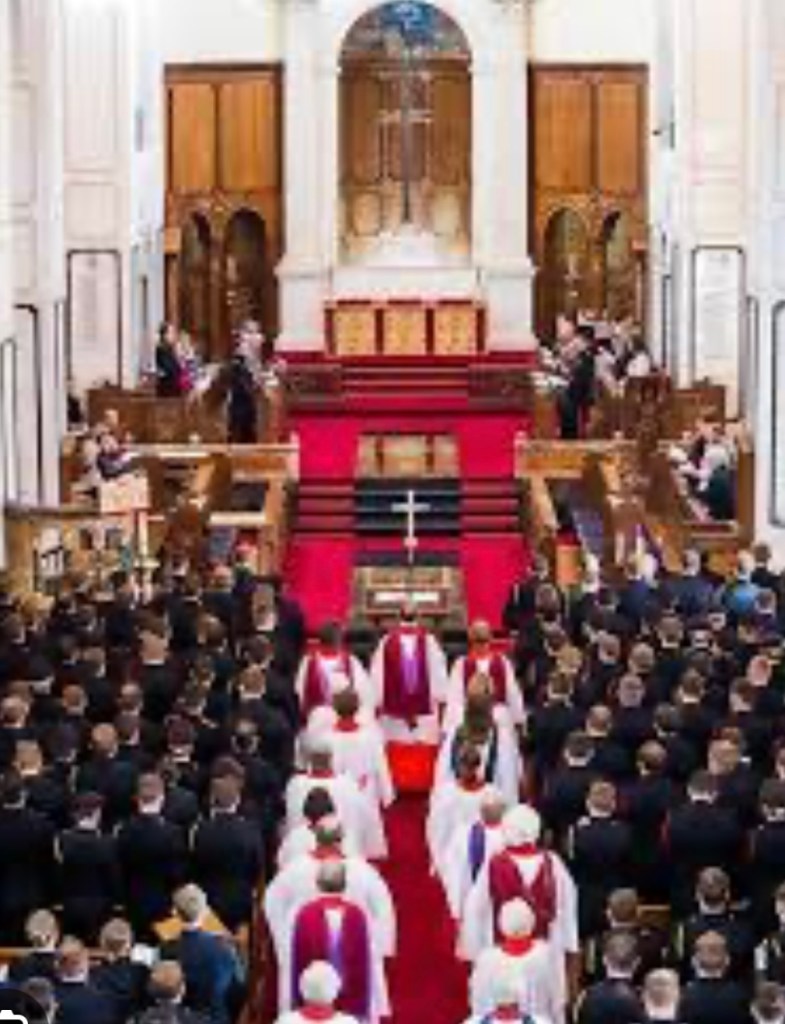
Nine hundred male voices singing hymns would lift anyone’s spirits and the memory of kneeling in the pew in the final minutes, quietly murmuring ‘Eternal Father, Strong To Save’ to the tune Melita by John Dykes, still brings goose pimples to my neck!
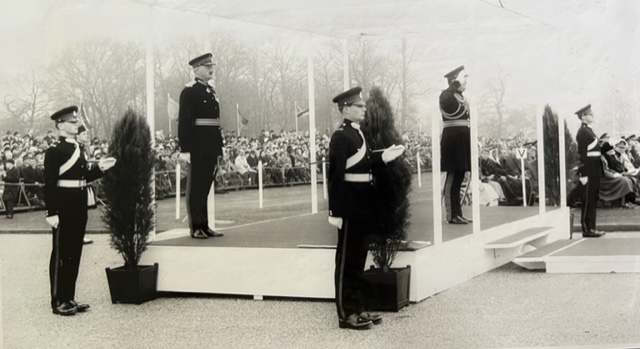
If you were tall and reasonably good at drill, you might be picked to be a Stick Orderly, as were Charlie Wilson, Edward Armitage, William Burrell and myself; four of us out of the 225 officer cadets in our intake, Number 39. (See PC 341 Tradition June 2023) On ceremonial occasions we stood on the corners the Inspection Dias, although I am not sure how effective my stick would have been in protecting the Commandant!
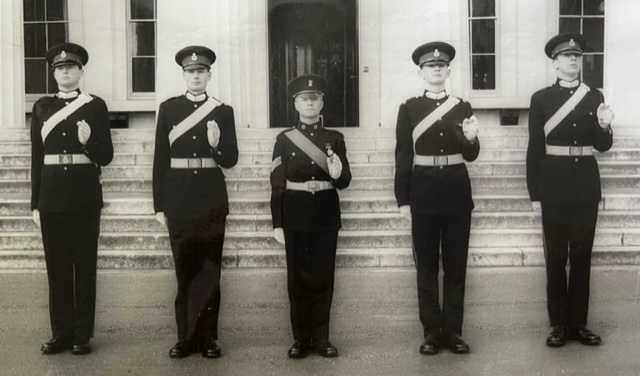
Prior to the Commandant’s Parade on a Sunday morning, the four Stick Orderlies would join him and his family for breakfast in the extremely large house which went with the job. I was a Stick Orderly for a year and recall that, after breakfast and before we needed to get moving, we would gather in the Games Room in his basement and compete on his Scalextric set. Such fun and far removed from our next task, the tradition of escorting him and the Adjutant to where the other 886 cadets were lined up for inspection.
I was assigned to Burma Company in Victory College, one of three colleges making up the Academy. The other company names in Victory were Alamein (North Africa 1942), Rhine (1944) and Normandy (1944). Old College represented the past glories of Dettingen (1743 War of Austrian Succession), Waterloo (1815), Inkerman (1854 Crimea) and Blenheim (1704 War of the Spanish Succession). New College companies reflected the First World War with Ypres (1914), Somme (1916), Gaza (1916) (Note 1) and Marne (1914). The organisational structure today is different, the number of companies reflecting the total number of officer cadets under training. Company names now include ‘Falklands’ and ‘Borneo’.
There is something fundamental to being a soldier, being capable of using weapons in times of war. Later I would serve in artillery regiments equipped with ‘medium’ artillery, the 5.5in howitzer and subsequently the 155mm Self Propelled M109, but at RMAS it was the self-loading rifle (SLR) and the general-purpose machine gun (GPMG), both using 7.62mm ammunition. I gained my marksman badge for the GPMG, taking in the instruction like a duck to water …… and it’s all about the breath! We were tested at various times, for instance after a 10-mile speed-march, and we developed the habit of keeping one’s small arm (aka personal weapon) close and clean. Obviously out on exercise or on the firing ranges, not in a classroom learning about Chemistry for instance. I highlight chemistry, as I had failed it twice at ‘O’ level and I needed to pass it. The lecturer was more interested in teaching us about his passion, seeking out the runners and their form in some horse race! We learned his techniques, lost a lot of money and I passed my Chemistry examination!
I have written that academic studies took up more than 50% of our working day. Having followed the science route in my choice of A Levels, I joined the ‘Special Maths and Science’ set, a pass ensuring my place at university a couple of years after commissioning. Non-science subjects covered International Relations, War Studies and Military Law. The latter is designed to “maintain order and discipline within the armed forces, and to ensure they can carry out their duties effectively. It covers a wide range of offences, from minor breaches of discipline to more serious crimes such as murder and rape.” As a commissioned officer, for minor offences I was ‘judge and jury’; for more serious ones there’s a Courts Martial system, run by the Judge Advocate General’s Department.
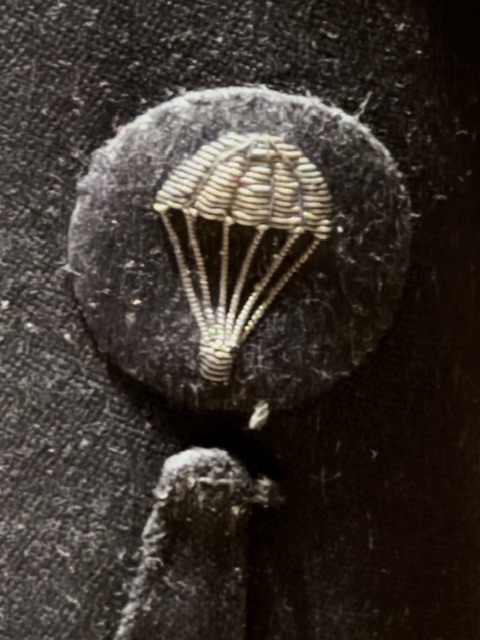
One Easter holidays some of us volunteered to become military parachutists. I asked Crichton, who was also in Burma 39 and with whom I have kept in touch, who else was there, apart from him. “Sorry! I suffer from old git syndrome and simply can’t remember who was with us. Pity!” Anyway, twenty or thirty of us went off to some RAF Base, I think Brize Norton as that’s where they’re trained today, for three weeks. During that time we learned exit, flight and landing techniques in large hangers with mock-up fuselages, completed three jumps from a balloon tethered at 800ft and a further five from a DC8/9 aircraft, the last one at night. Back at Sandhurst we wore a little light-bulb badge on our uniform to signify our proficiency, joined The Edward Bear Club (See PC 28 Balloons, Bacteria & Bloating December 2014) and jumped out of an aeroplane over Hankley Common near Aldershot for a summer picnic – called ‘the Teddy Bears’ Picnic’ obviously!
There will be a Part 3!
Richard 25th October 2024
Hove
Note 1 The Middle East was fought over during the First World War and that arena of conflict was recognised by Gaza Company. The land borders one sees today were laid out in the Sykes-Picot agreement of 1916, created by the French and British, with tacit assent from Russia and Italy. It defined their mutually agreed spheres of influence and control. Over 100 hundred years later it remains a troubled and unsettled part of the world. (See PC 286 I’ve Read That …. June 2022)
 postcards
Enjoyed this one para Richard Eddie
LikeLike
Very interesting and the touch of humour at the end is great! Also the fact that you remember such detail is incredible……I don’t think you suffer from old git syndrome!
LikeLike
👍👍❤️
LikeLike