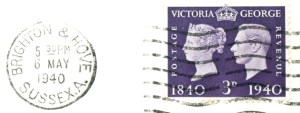
Towards the end of last year, I decided I needed a couple of medical referrals (see PC 366 Medical Decluttering December 2023) and the quickest way was to see a private doctor. Fortunately, Celina has a good one, one whose opinion and professionalism she values, so I fixed myself an appointment. After some 50 minutes of inspection and chat, I left with three, not two, referrals and a personal endorsement as to his efficacy. Wind the clock forward six months and it occurs to me it would be nice to have the doctor and his wife to supper one evening in the autumn. Not sure of the modern etiquette, I email him at his practice, tentatively outlining my thoughts, looking for agreement before trying to pin him down to a date.
His reply was disappointing, wishing to maintain the boundaries of the doctor-patient relationship, so declining. I think this is a rather sad reflection on modern life, for as a teenager I remember the local doctor, an Ivor Haire, coming to supper with my parents when they lived in the village of Balcombe, some twenty miles north of Brighton. And some of the individuals who went through my coaching sessions became good friends and sometimes came to supper. There was of course an implicit understanding that what had been discussed in the coaching sessions stayed there. It gave a little more colour to my life and I had rather hoped that Celina’s doctor could have accepted the invitation.
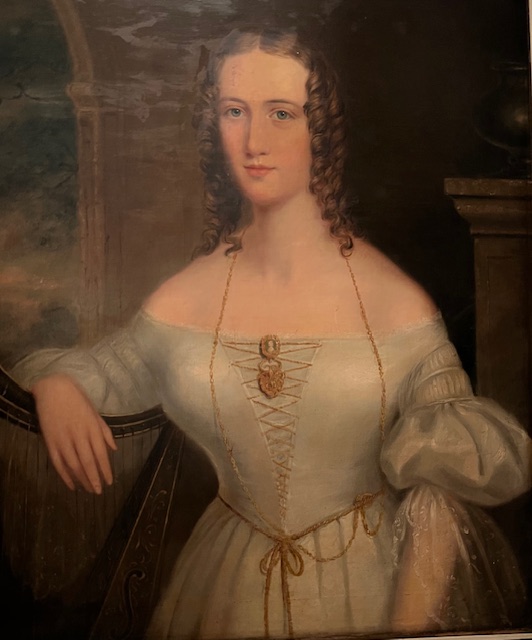
I am lucky enough to be the current guardian of an oil painting of my great great grandmother. Sarah Fosbery (née Smith) was born in 1822, aged 17 married Francis Fosbery in Adare Ireland (see PC 127 I Went Looking For a Family Seat – September 2022), delivered nine daughters and died, presumably exhausted, in 1861 aged 39. Her 8th daughter, Eva Constance Fosbery, emigrated with seven of her siblings to New Zealand. (see PC 169 Shifting Sands and PC 170 100% New Zealand January 2020). Varnish yellows with age so it needed a clean, which was professionally carried out by Stig Evans here in Brighton. Those of us lucky enough to own these historical heirlooms have a responsibility to keep them in good shape.

In Portugal I finished Simon Winchester’s book ‘Atlantic’, chock full of information and well researched. I was so taken by Simon making a fascinating link between problems in Britain during World War One and the founding of the State of Israel in 1948 that I thought I could share it. Stay with this story, even if it’s a little convoluted! Back in 1915 there was a shortage of cordite, a smokeless explosive, for shells that were used to attack surfaced German submarines. For the non-chemists, cordite is made from a mixture of nitro-glycerine, guncotton, acetone and petroleum jelly; it was the acetone that was in short supply. CP Scott, the editor of the Manchester Guardian, by chance had lunch with a White Russian émigré and science professor at the University of Manchester in early summer of 1916; his name was Chaim Weizmann. Sometime during the main course Weizmann said he had developed a new bacterial method for producing acetone.

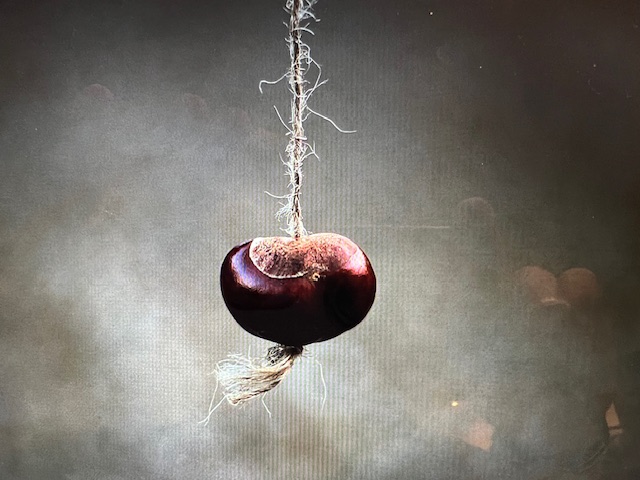
Scott told his friend David Lloyd George, then Minister of Munitions and soon to be Prime Minister, about Weizmann and the latter was invited to London. Within a few weeks, Weizmann had an industrial space to start production, but needed a ready supply of cellulose, found in maize and surprisingly in chestnuts. Horse chestnuts are normally used by schoolboys (Note 1) for the very traditional game of ‘conkers’, but in the autumn of 1916 thousands of tons were brought to the factory and, after various chemical reactions, acetone was produced in sufficient quantities. Eventually the Royal Navy destroyed enough German submarines in surface engagements to tip the balance in Britain’s favour. Such a good story, but how does this relate to Israel you might well ask?
Prime Minister Lloyd George asked his foreign secretary, a chap by the name of Arthur Balfour, to suggest an honour for Weizmann, who was also the leader of the British Zionist League. Chaim Weizmann desired no official recognition but his closeness to those in power enabled him to push for some form of government recognition of the Zionist’s aims. In November 1917 The Balfour Declaration formalised the British Government’s support for the birth of a Jewish State in Palestine, something that was achieved in 1948.
In PC 402 Connected Thoughts August 2024 I mentioned that I was doing a morning walk, leaving the Estoril apartment at 0700, then down to the sea, west to Cascais and back through the residential areas of Cascais, Monte Estoril and Estoril; in all about 7kms. Most people’s morning routines are intentionally timed to the minute, Monday to Friday, to catch a train, drive to work, take the children to school; for example, Celina and I leave our apartment at 0915, give or take a minute, to go to yoga.
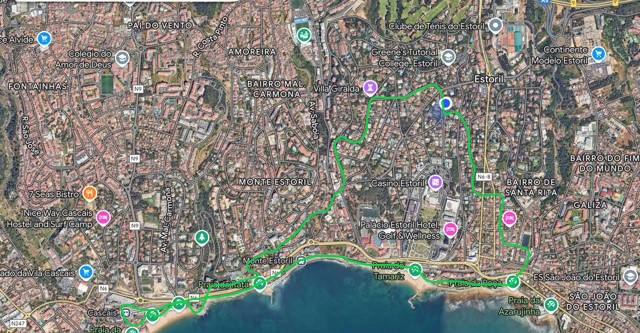
So it is in Portugal. Just before I get to Jardim dos Passarihos, I pass an apartment block with beautifully landscaped gardens and an underground car park.
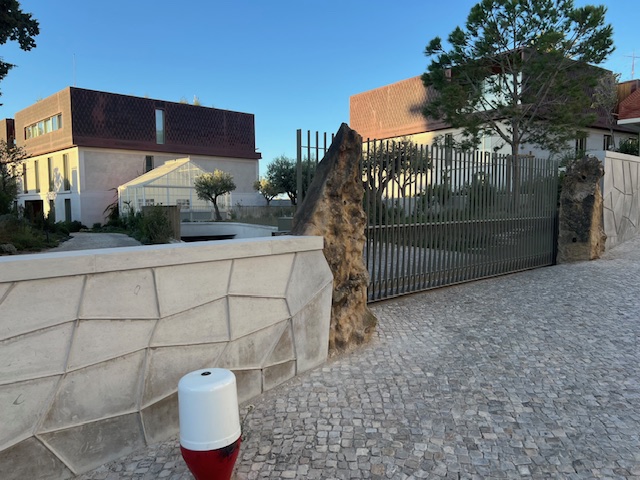
The driver of a green Mini wouldn’t have recognised me on the Monday or even on the Tuesday, but by the Thursday, as she triggered the sliding gate onto the road to open, she might have thought: “I’ve seen that chap before!” I have generally got there a second or two before her, so she’s let me get clear!! Given that my own walking speed varies and I occasionally stop to take a photograph or have some water, it’s strange that I have been in exactly the same place as the Mini driver on 4 out of 5 days in a week!
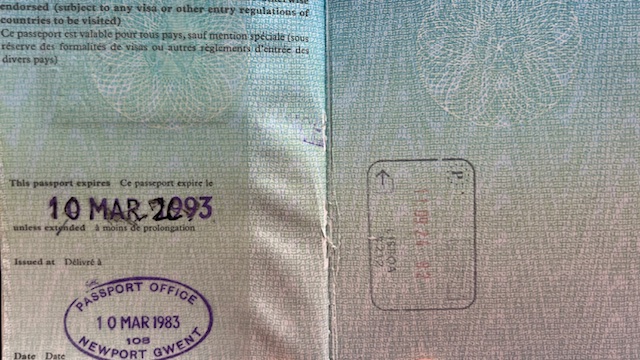
Finally, Francisquinha’s new passport (See PC 403 Idle Thoughts September 2024) is no longer virginal. Leaving Lisbon on the 11th, an understanding officer stamped it … with a little bit of encouragement!
Richard 20th September 2024
Hove
Note 1. I had a tuck box full during the autumn term. To harden a horse chestnut (conker) you popped it vinegar. The harder the conker, the more difficult to break.
 postcards