PC 406 The Snail aka Brian

If you walk down a pavement in any town after overnight rain, you’ve probably noticed a snail or three, making their way slowly across the paving stones. Sadly some get crushed by people’s shoes and a gooey mess and broken shell are all that remains. But I don’t think anyone does this on purpose, extinguishing life just for the hell of it. I certainly don’t, carefully side-stepping the little creature and wondering what urges it to travel in a certain direction. And if you ever wondered, on the ends of a snail’s tentacles are its eyes, which can’t focus or see colour but can discern different intensities of light, helping it to navigate towards dark places.

When I put my small gardening hat on, it’s a different matter.
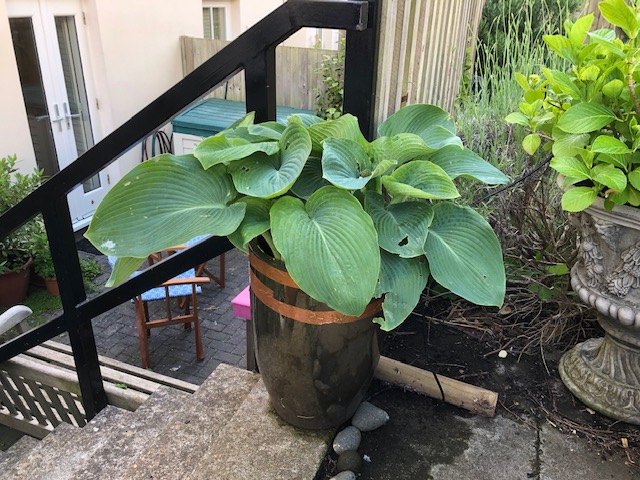
I love the Hosta, a large-leaved plant that produces white flowers around July time. In the winter months it hibernates under the soil, then in the spring little shoots appear and the cycle begins all over again.
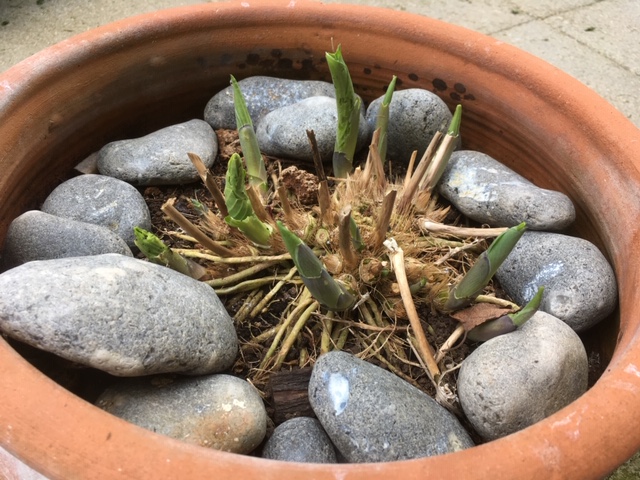
Snails love Hostas! Not wishing to use pesticides, I have tried a number of different things to discourage them from eating my plants. Placing the pot in water sort of works for small pots, as snails are not good swimmers, but that’s impractical for a large pot of Hostas. I read that applying some grease around the rim of the pot creates an uncrossable boundary; it works for a week or so then the little buggers wade through it or jump it or …… I bought a roll of copper tape, well, three actually as it was on offer, and stuck it in a thick band around the top, having first got rid of any grease! The pot looks nice with a copper-coloured band around it but, contrary to the advertising blurb, the snails still got across.
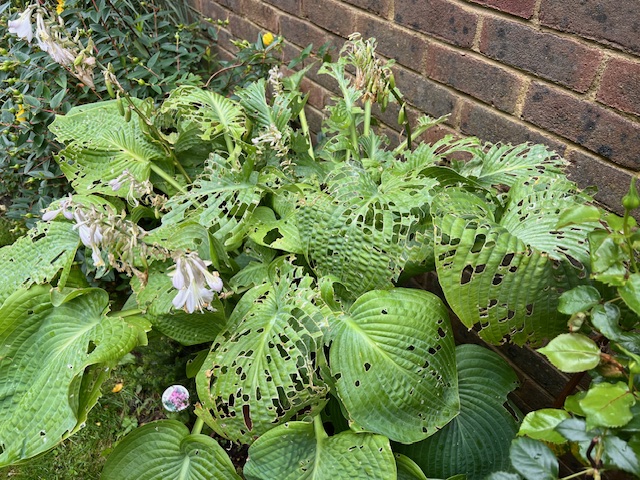
Now I have resigned myself to thinking I grow Hostas as a food for snails.
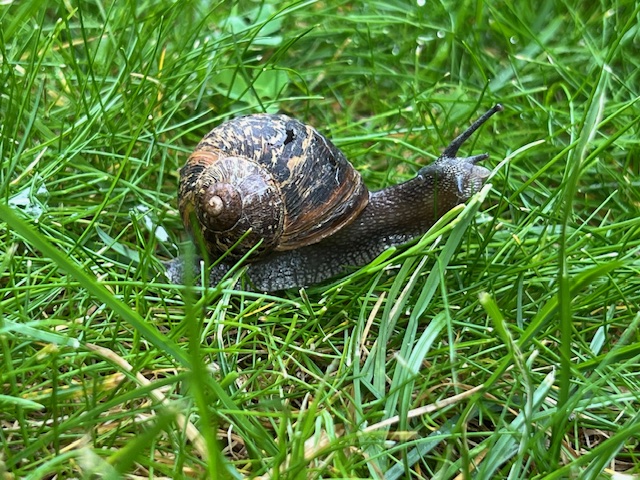
I love watching them slide across the grass, I hate them munching through my juicy Hosta leaves, and I loved eating them, although I haven’t for over 15 years as my tastes have changed. You used to be able to buy them in little plastic tubes, complete with garlic butter and parsley; pop them into the oven for the requisite number of minutes and ….. yum! yum! …. But you have to like garlic.
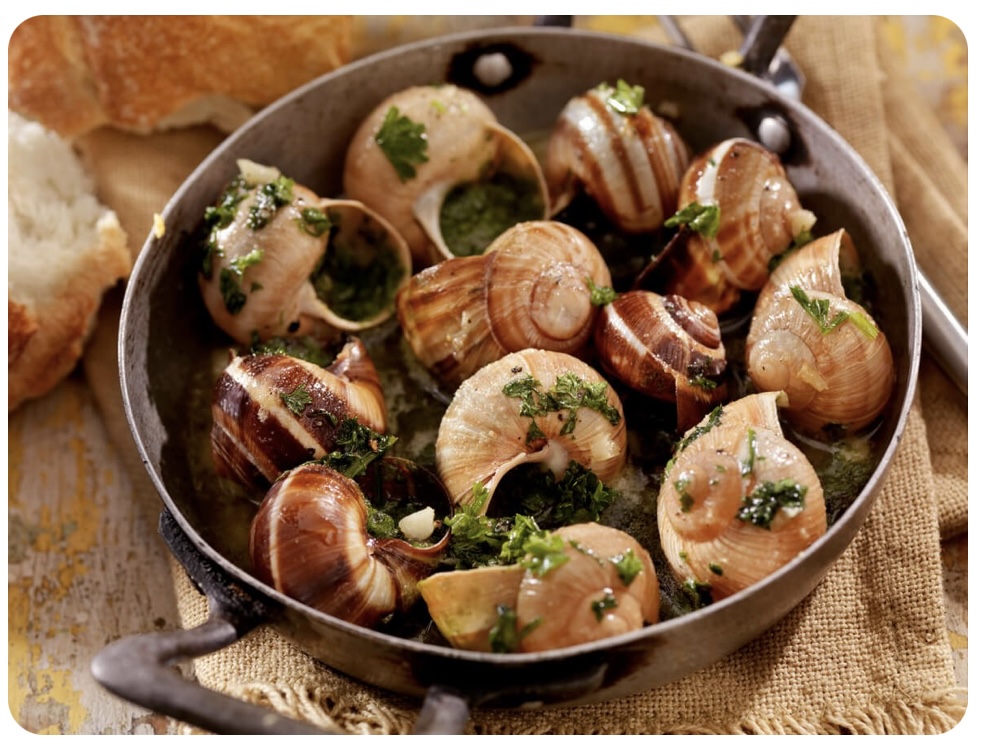
The Portuguese eat an estimated 4000 tonnes of Caracóis a year. Some are of the tiny variety, usually about 1cm in diameter. Cooked in a broth with lots of Rosemary and not swimming in melted garlic butter, normally you’re presented with about 100 in a small bowl and enjoy them with a cold beer. Or if you visit a cheap tasca bar they come as grilled appetizers. Helix Pomatia is often referred to as the land lobster for its superior flavour and texture. The French eat about 25,000 tonnes of snails a year; about 6.5 per person per year, normally cooked in garlic butter or chicken stock. I remember whenever I sailed across the English Chanel to Cherbourg, supper was at a bistro that specialised in snails and mussels; it could have been called Madame Escargot?

In Britain snails are available in supermarkets or delicatessens but I am reminded how on The Continent you can buy live ones. Many years ago I was on holiday with my daughter near Estepona in southern Spain, staying with cousin Susie and husband Robin. Tasked with foraging for things for lunch, we went to the local market. Jade, aged 8, saw a large cardboard box and sensed it was moving. Closer inspection revealed it was full of live snails. After the screams and tears subsided, she was placated with buying a dozen ….. which she set free in Susie’s garden; we didn’t tell Susie!

Used to small snails, I saw a photograph of a giant one. It turns out to be the Giant African land snail (Lissachatina fulica) which can weigh nearly a kilo and whose shell is some 20cms long. Celina tells me they also live in Brazil.
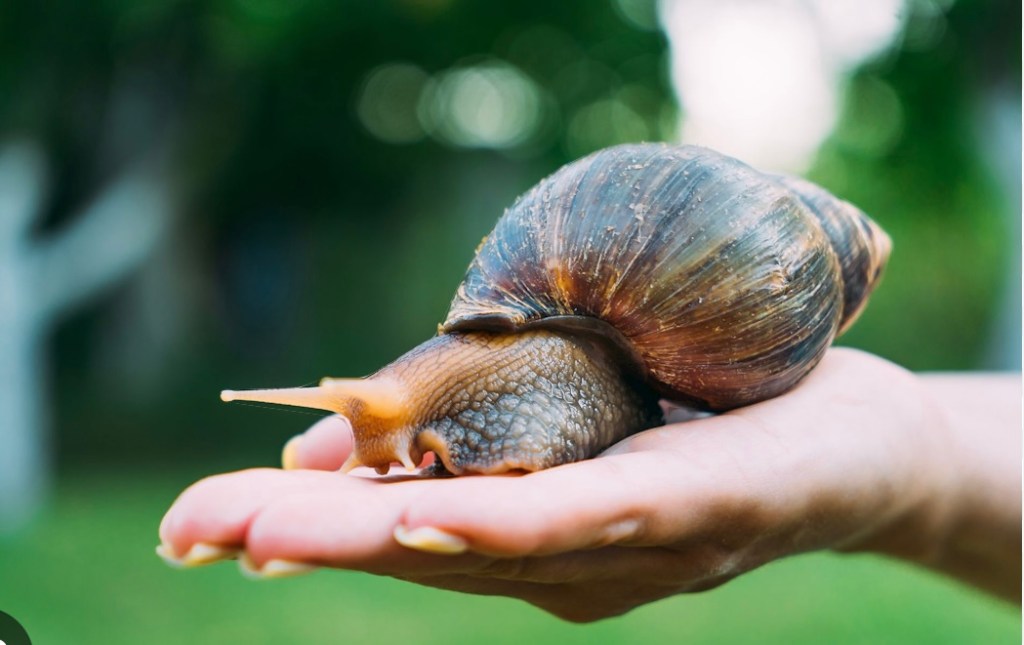
Sadly it really is a pest; it feeds voraciously and causes severe damage to agricultural crops and native plants.

In my postcards from our time in Croatia this summer (PCs 390 & 391 Tales of Croatia) I wrote that our guide in the seaside town of Split was a very tall chap called Pero Ugarković and he’d written a book about the sea snail. Sea snails breathe with gills whereas land snails with lungs. There is another type, the freshwater snail which use either gills or lungs.

I think we could call snails nomads for they take their home with them! The shell is created from calcium carbonate and has a protein outer coating. Other creatures consume the shells to obtain the nutrient calcium. There’s something very practical and endearing about carrying your home with you, self-contained and all that, and snails often feature in stories written for children.  
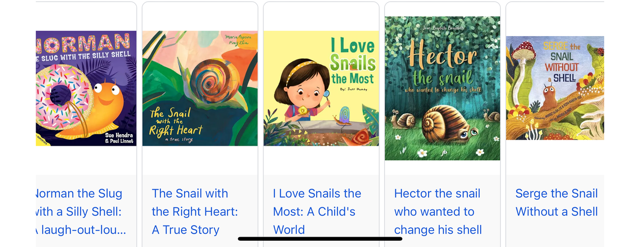
“Soon, which in cosmic time means millions and millions of years, they crawled out of the ocean and onto the land. Not knowing whether they would find a home, some of these brave early explorers carried their homes on their backs. So snails took to the earth!” extracted from ‘The Snail with the Right Heart: a True Story’ by Maria Popova     

Still wondering why I have titled this postcard ‘… aka Brian’? In 1965 the BBC bought a French children’s programme ‘Le Manège Enchanté’, created by Serge Danot, and used the footage with new English-language scripts unrelated to the original story lines to produce ‘The Magic Roundabout’. It proved a great success and achieved cult status. Its characters included Dougal, a drop-eared variety of a Skye Terrier, Zebedee, a talking jack-in-a-box who kept crying “time for bed”, Ermintrude the cow, Dylan a hippy rabbit and a cheerful, bashful and intelligent snail called ……. Brian. (Note 2)

Richard 27th September 2024

Hove
www.postcardscribbles.co.uk

Note 1 There are three main species of helix snails that are edible: Roman or Burgandy snails (Helix Pomatia), Garden snails (Helix Aspersa and the European Snail (Helix Lucorum)

Note 2 Who knows why the writers called the snail Brian. But if you’re called Brian, I hope you’re cheerful, bashful and intelligent!
PC 405 I was musing about ……

Towards the end of last year, I decided I needed a couple of medical referrals (see PC 366 Medical Decluttering December 2023) and the quickest way was to see a private doctor. Fortunately, Celina has a good one, one whose opinion and professionalism she values, so I fixed myself an appointment. After some 50 minutes of inspection and chat, I left with three, not two, referrals and a personal endorsement as to his efficacy. Wind the clock forward six months and it occurs to me it would be nice to have the doctor and his wife to supper one evening in the autumn. Not sure of the modern etiquette, I email him at his practice, tentatively outlining my thoughts, looking for agreement before trying to pin him down to a date.

His reply was disappointing, wishing to maintain the boundaries of the doctor-patient relationship, so declining. I think this is a rather sad reflection on modern life, for as a teenager I remember the local doctor, an Ivor Haire, coming to supper with my parents when they lived in the village of Balcombe, some twenty miles north of Brighton. And some of the individuals who went through my coaching sessions became good friends and sometimes came to supper. There was of course an implicit understanding that what had been discussed in the coaching sessions stayed there. It gave a little more colour to my life and I had rather hoped that Celina’s doctor could have accepted the invitation.

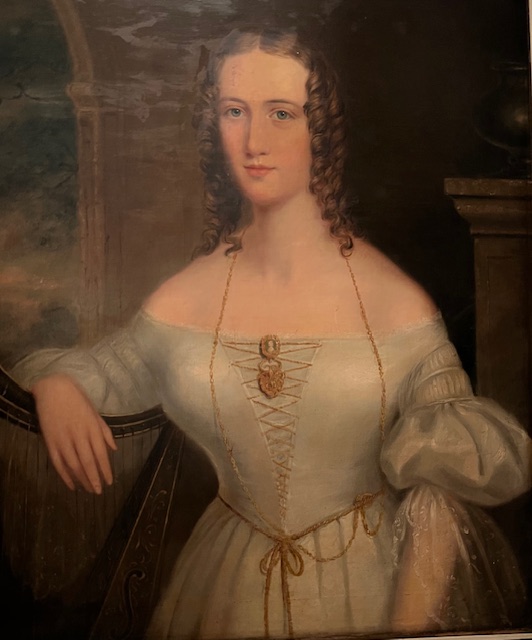
I am lucky enough to be the current guardian of an oil painting of my great great grandmother. Sarah Fosbery (née Smith) was born in 1822, aged 17 married Francis Fosbery in Adare Ireland (see PC 127 I Went Looking For a Family Seat – September 2022), delivered nine daughters and died, presumably exhausted, in 1861 aged 39. Her 8th daughter, Eva Constance Fosbery, emigrated with seven of her siblings to New Zealand. (see PC 169 Shifting Sands and PC 170 100% New Zealand January 2020). Varnish yellows with age so it needed a clean, which was professionally carried out by Stig Evans here in Brighton. Those of us lucky enough to own these historical heirlooms have a responsibility to keep them in good shape.

In Portugal I finished Simon Winchester’s book ‘Atlantic’, chock full of information and well researched. I was so taken by Simon making a fascinating link between problems in Britain during World War One and the founding of the State of Israel in 1948 that I thought I could share it. Stay with this story, even if it’s a little convoluted! Back in 1915 there was a shortage of cordite, a smokeless explosive, for shells that were used to attack surfaced German submarines. For the non-chemists, cordite is made from a mixture of nitro-glycerine, guncotton, acetone and petroleum jelly; it was the acetone that was in short supply. CP Scott, the editor of the Manchester Guardian, by chance had lunch with a White Russian émigré and science professor at the University of Manchester in early summer of 1916; his name was Chaim Weizmann. Sometime during the main course Weizmann said he had developed a new bacterial method for producing acetone.

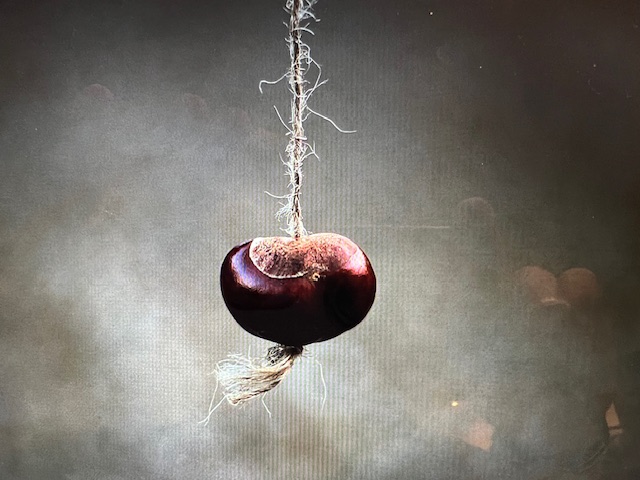
Scott told his friend David Lloyd George, then Minister of Munitions and soon to be Prime Minister, about Weizmann and the latter was invited to London. Within a few weeks, Weizmann had an industrial space to start production, but needed a ready supply of cellulose, found in maize and surprisingly in chestnuts. Horse chestnuts are normally used by schoolboys (Note 1) for the very traditional game of ‘conkers’, but in the autumn of 1916 thousands of tons were brought to the factory and, after various chemical reactions, acetone was produced in sufficient quantities. Eventually the Royal Navy destroyed enough German submarines in surface engagements to tip the balance in Britain’s favour. Such a good story, but how does this relate to Israel you might well ask?

Prime Minister Lloyd George asked his foreign secretary, a chap by the name of Arthur Balfour, to suggest an honour for Weizmann, who was also the leader of the British Zionist League. Chaim Weizmann desired no official recognition but his closeness to those in power enabled him to push for some form of government recognition of the Zionist’s aims. In November 1917 The Balfour Declaration formalised the British Government’s support for the birth of a Jewish State in Palestine, something that was achieved in 1948.

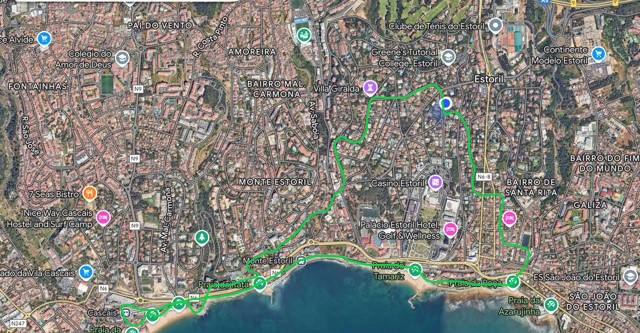
In PC 402 Connected Thoughts August 2024 I mentioned that I was doing a morning walk, leaving the Estoril apartment at 0700, then down to the sea, west to Cascais and back through the residential areas of Cascais, Monte Estoril and Estoril; in all about 7kms. Most people’s morning routines are intentionally timed to the minute, Monday to Friday, to catch a train, drive to work, take the children to school; for example, Celina and I leave our apartment at 0915, give or take a minute, to go to yoga.

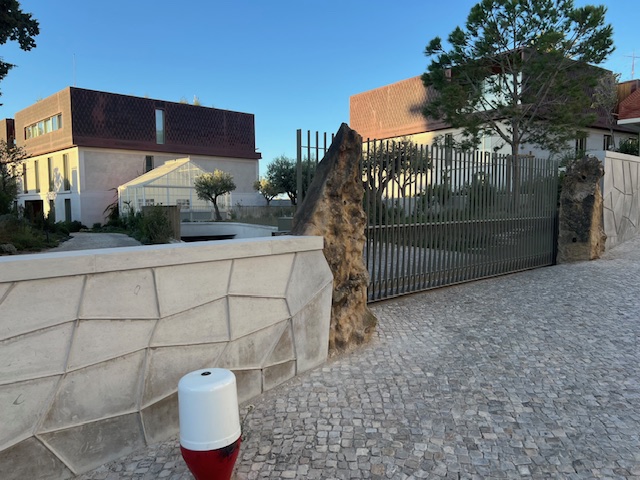
So it is in Portugal. Just before I get to Jardim dos Passarihos, I pass an apartment block with beautifully landscaped gardens and an underground car park.

The driver of a green Mini wouldn’t have recognised me on the Monday or even on the Tuesday, but by the Thursday, as she triggered the sliding gate onto the road to open, she might have thought: “I’ve seen that chap before!” I have generally got there a second or two before her, so she’s let me get clear!! Given that my own walking speed varies and I occasionally stop to take a photograph or have some water, it’s strange that I have been in exactly the same place as the Mini driver on 4 out of 5 days in a week!

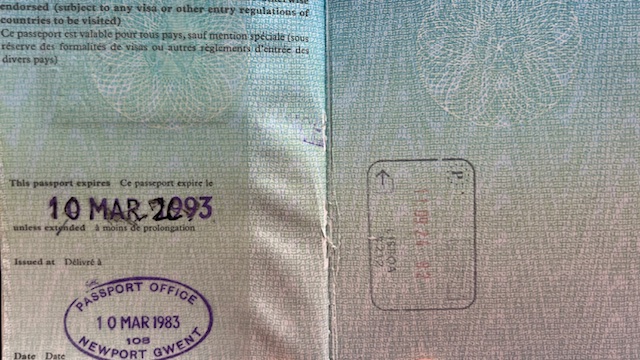
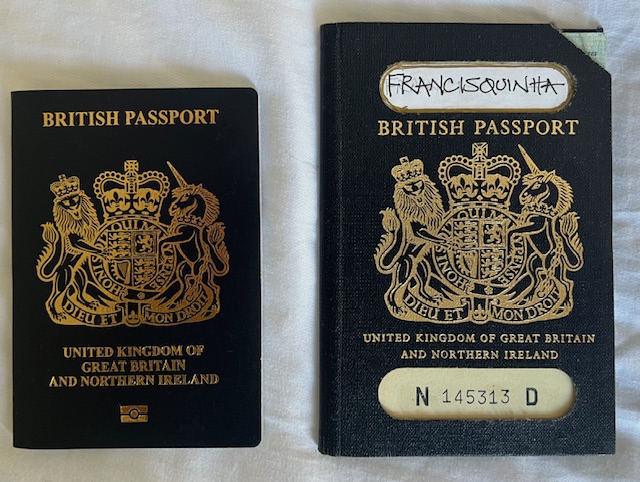
Finally, Francisquinha’s new passport (See PC 403 Idle Thoughts September 2024) is no longer virginal. Leaving Lisbon on the 11th, an understanding officer stamped it … with a little bit of encouragement!

Richard 20th September 2024

Hove

www.postcardscribbles.co.uk

Note 1. I had a tuck box full during the autumn term. To harden a horse chestnut (conker) you popped it vinegar. The harder the conker, the more difficult to break.

PC 404 Destiny

Our French friend Benedicte was supposed to visit her mother in France one Saturday last month. When she found she couldn’t check-in at home with EasyJet for her flight from London Gatwick, she drove to the airport, about 40 minutes from Hove. EasyJet had overbooked her flight and offered her one on the Monday. She texted me:

I had to cancel the trip. It’s fate ….”

“Fate can play a funny part – is that why fate’s feminine?”

La destinée.”

“Exactly!”

Yes but we also have ‘le destin’. I wonder why we have those two words; there must be a slight difference in meaning. I think ‘destin’ is what you are born with. What is written for you at birth, influenced by your place of birth, your family economic status, your race… you can’t do anything about it. Destinée is more something you can influence. You take your journey in life into your hands. But the difference between the two is also a big philosophical conversation that can vary according to religious beliefs.”

It’s clear that ‘la destinée’ is actually ‘destiny’ in English and ‘le destin’ is Fate. I turned to a dictionary to find some definition. … of destiny:

A noun. The events that will necessarily happen to a particular person or thing in the future. For example: She was unable to control her own destiny’. Or ‘The hidden power believed to control future events.” (Which is confusing!)

…. and ‘fate’:

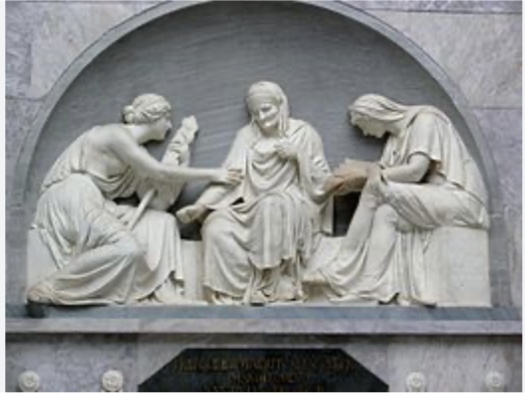
A noun: the development of events outside a person’s control, regarded by some as predetermined by some supernatural power. In Greek and Roman mythology, there were three Goddesses who presided over the birth and life of humans. Each person’s fate was thought of as a thread spun, measured, and cut by the three Fates, Clotho, Lachesis and Atropos.”

There’s a phrase in English ‘It’s all Greek to me!’, meaning I have no idea what you’re talking about. (Note 1) It appears in Shakespeare’s Julius Caesar (1599) so it’s not modern, but it sums up my knowledge of Greek mythology and stories of Icarus and Hades and Odysseus and Achilles and ……. However, they had an interesting take on fate, those ancient Greeks.

The ‘Fates’, otherwise known as the Moirai, were the personifications of destiny. They were three sisters: Clotho (Note 2) aka The Spinner, Lachesis, the allotter, and Atropos who was ‘the inevitable’, the metaphor for death. You can see where this is going, can’t you?

Their role was to ensure that every being, mortal and divine, lived out their destiny as it was assigned to them by the laws of the universe. For us mere mortals, this destiny spans our entire lives and is represented by a thread spun from a spindle. I only hope that when Clotho was spinning my life, she didn’t run out of thread too early, and that Lachesis was generous in her use of her measuring rod! These female fates were considered to be above even the gods in their role as enforcers of fate, although they did acknowledge orders from the chief of the gods, Zeus. (Note 3)

The Ancient Greeks were not alone in their beliefs about Fate. In Norse mythology the Norns were a trio of female beings who ruled the destiny of gods and men, twinning the thread of life. One was called Urḋr, from Old English wyrd from which comes the modern English weird.

One source suggests that ‘although they are used in similar contexts, they cannot be used interchangeably’; that’s an ugly word! Fate implies a lack of control or inevitability, like the situation that Benedicte found herself in, no personal control when EasyJet’s overbooked her flight; destiny suggests a sense of purpose or direction that can be within one’s control.

The composer Guiseppe Verdi wrote the opera ‘La Forza del Destino’ (The Power of Destiny). As Shakespeare and the Greek dramatists have taught us, man is not always in control of his own destiny. In Verdi’s opera, based on a Spanish drama, the power of destiny contrives at every turn to frustrate the happiness of Leonora and Alvaro. In 1960 at the Metropolitan Opera, the famous baritone Leonard Warren collapsed and died during a performance of the opera in New York. The supposed curse reportedly kept Luciano Pavarotti from ever performing the opera and the tenor Franco Corelli used to follow small rituals during a performance to avoid bad luck.

You can imagine William Shakespeare had something to say about destiny, and you’d be right. For instance – “This above all; to thine own self be true. And this must follow, as the night the day. Thou canst not then be false to any man. It is not in the stars to hold our destiny but in ourselves.” This was from ‘Hamlet’ and then we have: “We know what we are but know not what we may be.” Knowing what we are, who we are, is essential to knowing how to be oneself (PC 399 Why Can’t I just be Me? July 2024)

And who could forget Destiny’s Child, the name of an R&B/Soul Quartet that formed in 1990? Its most famous member was Beyoncé Knowles and I’m told its hits included ‘Say My Name’ and ‘Survivor’.  I am more likely to remember the hits of Paul Anka, a Canadian singer born in 1941, particularly ‘You Are My Destiny’, the first line of which goes “You are my destiny, you share my reverie, you are my dream come true, that’s what you are.”

Finally John Dryden, England’s first Poet Laureate (1631 – 1700), wrote of fate:

“Tis fate that flings the dice,

And as she flings

Of kings makes peasants,

And of peasants kings.”

So was it fate that caused you to read this postcard ….. or destiny?

Richard 13th September 2024

Hove

www.postcardscribbles.co.uk

Note 1 Other nations have the same saying. For instance the Czechs think it’s all Spanish and the Dutch ‘That’s Chinese to me’ (Dat is Chinees voor mij)!

Note 2 Clotho’s Roman equivalent was Nona, a goddess called upon during the 9th month of pregnancy.

Note 3 In Shakespeare’s Macbeth the weird sisters were prophetesses, but also known as the three witches.

PC 403 Idle Thoughts about This and That

In the early Nineteen Seventies, in the Officers’ Mess of 39 Medium Regiment Royal Artillery in Sennelager, Germany, we had a monthly ‘film night’ on a Sunday evening, the 16mm film being shown in two parts through an old-fashioned projector. In the interval we tucked into traditional curries and their accompanying side dishes. For a year or so I was the Mess Secretary, responsible for all the Mess’s social events and in this case for choosing the film. One Sunday evening we showed Klute: ‘John Klute’s best friend has disappeared, and he has only one lead, a prostitute. While he struggles to get her to help him, he doesn’t know her life is in danger.’ The film came out in 1973 and starred Jane Fonda and Donald Sutherland.

It was sad to read that Sutherland had died in June aged 88, for I loved his films, particularly ‘Don’t Look Now’ and ‘Death in Venice’. But then I remembered ‘Klute’ and how Sylvia, the wife of the Commanding Officer Guy Watkins, had come up to me in the interval and criticized my choice of film: “I don’t like smutty films!” Such a good word ‘smutty’; such a great film!

The memory of the 16mm film and its projector reminded me how important radio was in providing entertainment when I was growing up.  Television was in its infancy and my step-father was not, at the time, a fan. One of the best comedy shows was ‘Beyond Our Ken’, which was broadcast from 1958 -1964, and starred Kenneth Horne, Kennith Williams, Hugh Paddick, Betty Marsden, Bill Pertwee.

It was replaced by ‘Round The Horne’ (1965-1968). I can still hear one of the regulars on his show introducing himself: “Hello! I’m Jules and this is my friend Sandy.” in an extremely camp voice, something which wouldn’t be acceptable these days! The Goon Show, with Harry Secombe and Michael Bentine, was another must as were some of the American comedians like Allan Sherman (Camp Granada: Hello Mudduh, Hello Fadduh) (1924 – 1973), Shelley Berman (1925-2017) and Bob Newhart who died last month aged 94.

Two of Newhart’s sketches are worth highlighting; bear in mind his gift was to make you the listener fill in the other side of his one-sided dialogue.

In his ‘The Driving Instructor’, he imagines the instructor making all sorts of allowances for his student: “You want to start the car?  ….. You turned on the lights. The controls all look alike, don’t they? …. All right, let’s pull out into traffic. What’s the first thing we are going to do before we pull out into traffic? I mean besides praying, let’s say. No, what I had in mind was checking the rearview mirror. DON’T PULL OUT! Haha! Please don’t cry. I’m sorry, but there was this bus . . .”

Ironically, when he first performed this monologue, Newhart could not drive.

His Walter Raleigh sketch relied on huge assumptions. We do not hear Raleigh, who is in Virginia. Instead, the speaker is the English importer, with the voice of a wise-guy modern-day American, reacting to the 16th-century Raleigh’s despairing description: “What’s tobacco, Walt? It’s a kind of leaf, huh? Oh, it has a lot of different uses. What are some of the uses, Walt? You can chew it or put it in a pipe. Or you can shred it and put it in a piece of paper and roll it up. Don’t tell me, Walt, don’t tell me. You stick it in your ear, right? Oh, between your lips. Then what? You set fire to it. Then what do you do, Walt? You inhale the smoke, huh?” His genius is obvious.

I read them now, hear his voice narrating the skit, and find them funny. I wonder whether they transcend the generations.

I am an avid fan of the books of John Grisham and some years ago read The Testament, about a rich American leaving his fortune, much to the anger and bewilderment of his ex-wives and children, to a missionary living in Pantanal. (See PC 17 Pantanal – a Prequel August 2014). I had never heard of the Pantanal, the world’s largest, flattest wetland, 800kms north to south, 500 east to west. On our next visit to Brazil, Celina and I decided to spend a few days at the Fazenda Barranco Alto, one of the agrotourism eco haciendas (see PC 20 Pantanal September 2014) We spent some time on the Rio Negra, often in the company of two Americans, Tim & Diane Tinnes. We kept in touch and in 2015, after our two weeks in Alaska (See PCs 44 & 45), dropped down to visit them in San Francisco for a couple of days.

Tim continues to read my PCs and occasionally comments. Recently he highlighted an article in The Guardian about the current state of the Pantanal, how it’s drying out at a horrendous rate, so much so that large parts of it have been ravaged by fire and fauna and flora are dying. Maybe it will recover but we’re pleased to have had the opportunity to visit it and understand its importance.

During the WhatsApp conversation with Sami and Mo in the Hope Café (PC 401 23rd August 2024) a couple of weeks ago, Mo and I chatted about OE (Note 1). I was about to tell Mo about Joe Baines-Holmes, a neighbour who was off on the ultimate OE and the internet had connection dropped out. What I wanted to say was that Joe, a computer engineer, has flown out to Wisconsin on a 17-month contract. In a few weeks he will travel via Christchurch New Zealand to the Amundsen-Scott South Pole Base (Note 2) where he will spend twelve months ensuring the base’s computer equipment is serviced and maintained. The Antarctic has two seasons; winter, when it’s completely dark, starts in March and lasts until October; summer, when the sun doesn’t set, from October to March. And in the winter the temperature varies between -40C and -70C. Quite an experience for anyone; not sure any other OE could beat this?

My regular readers will already have been introduced to Francisquinha. If you have only recently started reading these scribbles, you could update yourself by reading PCs 172 and 217. I had to apply for a new passport around Easter this year so thought I could apply for one for Francisquinha. Both arrived back in the same envelope, although hers is slightly bigger than mine!

Richard 6th September 2024

Estoril

http://www.postcardscribbles.co.uk

Note 1 OE is a New Zealand abbreviation for Overseas Experience.

Note 2 https://en.wikipedia.org/wiki/Amundsen%E2%80%93Scott_-South_Pole_Station