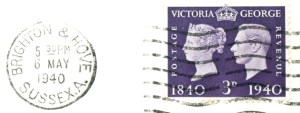
Back in 1965, post-A Levels, myself and five others from Daunstey’s School packed ourselves into a hard-topped Land Rover and drove southeast across Europe to Greece. Part of the trip was down the coast of what was then Yugoslavia. After Trieste we drove down through Rijeka, Šibenik, which required a ferry crossing, Split and Dubrovnik, before turning inland at Kotor to skirt around Albania. (See PC 346 Puds to Greece August 2023). Ten days later we retraced our route, up to Venice and home. Since then I have had a couple of ‘bare-boat’ yacht charters, with no charter-company skipper, one out of Trogir and one out of Dubrovnik.
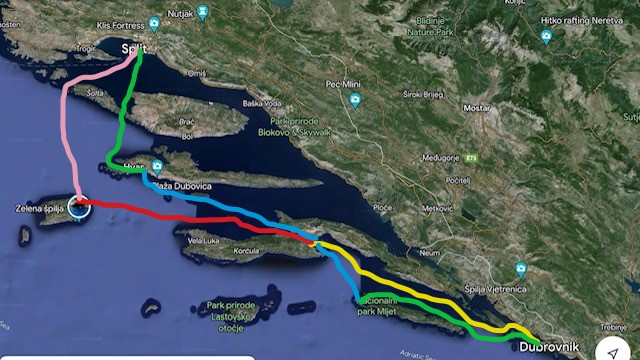
Attracted by a Sunday Times advertisement back in October last year, we booked a small boat cruise out of Dubrovnik for May 2024, which concluded in Montenegro in the first week of June.
It was an early start on Sunday 26th May, our flight for Dubrovnik leaving at 0555. Having got new reading glasses after my recent cataract operations, I have got into the habit of tucking them into the neck of my shirt/T-shirt. I was surprised to be asked to put them in the tray at Airport Security – “Really I thought?” …. But you don’t question a request from someone who could make the whole experience very tedious!
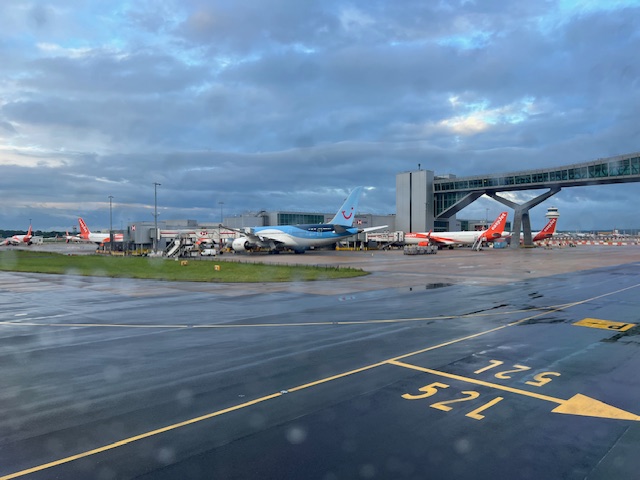
Gatwick at 0555 on a wet Sunday morning
The female EasyJet pilot smiled to the cabin crew and said we would leave slightly early! The male steward running the cabin had a strong Australian accent and I asked him where he was from:
“Perth”
“One of my favourite authors is from Western Australia; Tim Winton.”
“Ah! He’s great isn’t he! ‘Cloudstreet’ huh!”
“Such a great book, so atmospheric of its time.”
“I have never met anyone who’s read it …. mate!”
We had a connection! We arrived early as predicted and, having been joined by two other couples, were taken to the boat in Dubrovnik’s new port on the northwest side of the old city; others would arrive later.
I often find it strange meeting people for the first time, whether for a conference, supper at a friend’s, a group training activity or even for a cruise ….. and I am sure most of our fellow passengers felt the same, that slight awkwardness part of the English DNA! We discovered later that in our complement of 36 passengers, one couple had come from South Africa and two couples live north of the border in Scotland; no hint of the English habit!
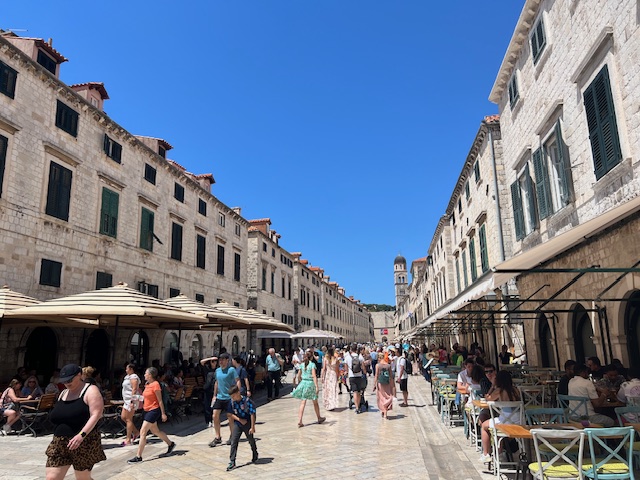
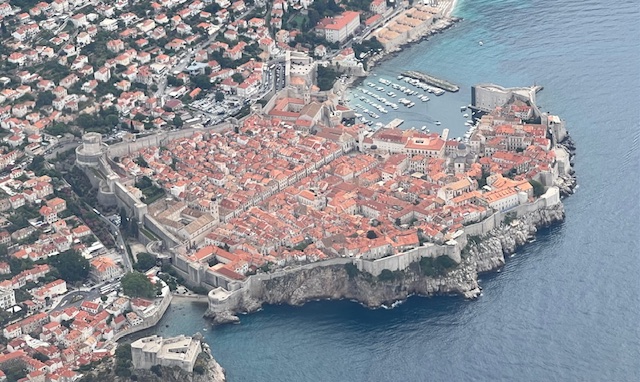
Dubrovnik is always a delight; on our guided Saturday tour I learned from Ana that it had started off as two cities, one Slavic and one Roman, that the walls were very thick, some 5 metres, and that today few people actually live within the city walls, being forced out by the tide of tourists washing around the narrow streets (Note 1) and by the paucity of ordinary shops – these replaced by ice cream parlours, shops selling huge bowls of jellied sweets and liquorice and, strangely, ones where the only items for sale are small, yellow, plastic ducks, decorated in every imaginable design, tempting you to spend some €15 – on a plastic duck? In 1991 the city was of course badly damaged during the Balkan War by the Montenegrin Artillery but, with the help of UNESCO, has been completed restored to its former glory – sadly that doesn’t apply to the 114 civilians who died in the city.
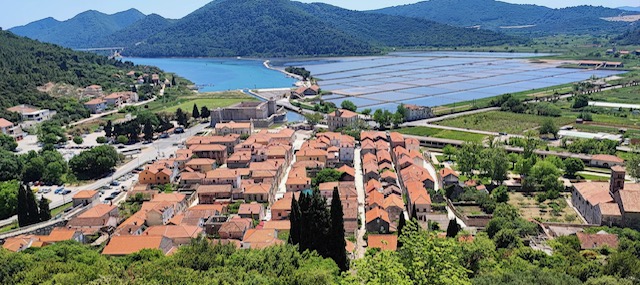
Ston salt production today
I also learned that in the nine crystallization pools at Ston, some 55kms to the northwest, salt production started in 167 BC and today they’re producing 500 tons per year. In 1000AD about one third of Dubrovnik’s income came from the exportation of salt; salt was more valuable than gold! Ana added that in these walled cities, the good counsellors made sure enough food and water was preserved for the inevitable days of sieges – and salt was used in the food preservation process.
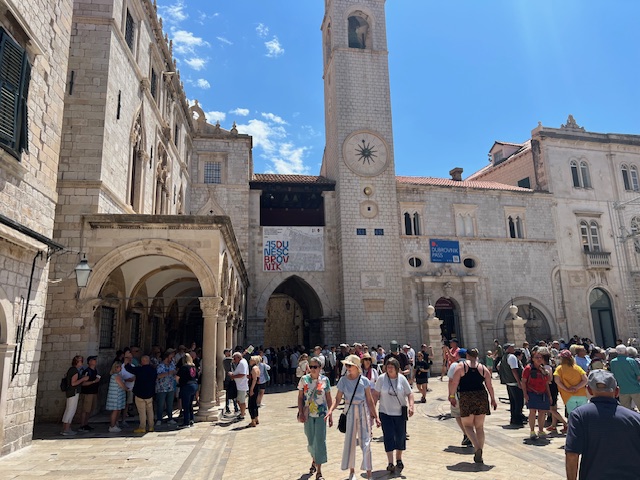
Before we left, Ana reminded us that the city has suffered many earthquakes over the centuries, the most major one, 6.4 on the Richter scale, in 1667 when the entire city was almost destroyed and some 4000 inhabitants killed. The latest was in 1979 when 1071 buildings within the city walls were damaged. But what she added was most interesting, especially to someone who studied, inter alia, cement and concrete at university. Those buildings that suffered least had used mortar made with fresh water; those which had used sea water seemed more vulnerable to the earthquake’s forces. I never knew!

‘Cruise ships’ seem to have become bigger and bigger, more floating hotels than ship, but MS Roko was very definitely a ship, some 50m long with a total of 18 cabins. Captain Ivan ran the ship ……
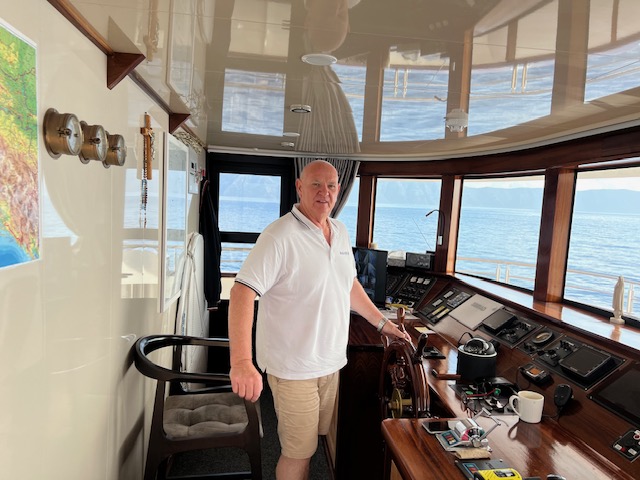
…… and Viktor, a 40-something Croatian, was the delightfully unflappable chap who made sure everyone got what they wanted, did want they wanted, and ensured everyone was on board before engines were started and mooring ropes slipped.
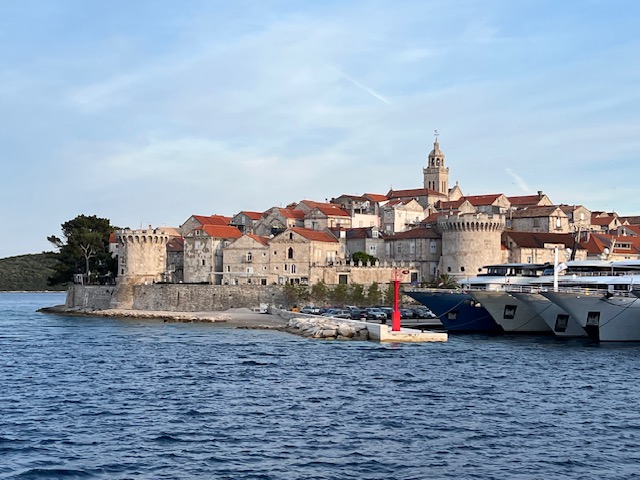
Our first port of call was Korčula’s old town, just north of the eastern end of the island of the same name (Note 2). St Mark’s Cathedral, which sits on the highest ground in the middle of the promontory, dominates. The view from the tower is spectacular and worth squeezing oneself up a very narrow stone staircase for, but not for those prone to claustrophobia!
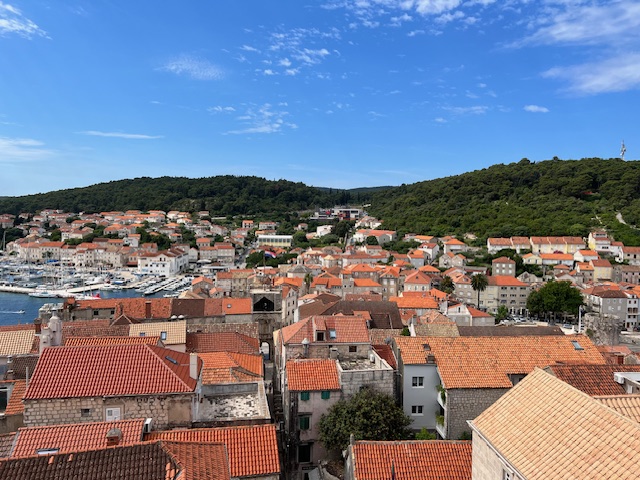
The streets were busy with tourists and the shops selling sponges and red, legally harvested, coral doing a good trade. Whoever designed the layout took account of the various winds that blow; in some cases the closely-packed narrow streets are curved, to lessen the effects of wind from a certain direction. Paying with cash for supper in one of the waterside cafes, the Serbian waiter explained that in his country credit cards were hardly used, as corruption and scams were common; a sad observation on one’s place of birth.
To be continued …..
Richard 7th May 2024
Hove
Note 1 Talk about ‘killing the goose that lays the golden egg’. Venice is another city where the high tide of mass tourism, on which these cities depend, is having a negative impact on the experience! The ratio inhabitants/tourists in Dubrovnik is apparently 1:39
Note 2 The island of Korčula is twinned with Rothesay in Scotland
 postcards