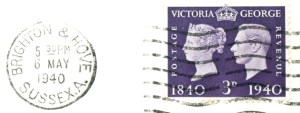
After Easter I spent a few days with my daughter and family near the Surrey town of Farnham. There is no sensible comparison with the city of Brighton & Hove but like any experience, you appreciate the differences when you return home!
On the Thursday, as my middle grandson was having his haircut, I wandered off with Theo, aka KitKat and aged 7, to find a decent cup of coffee for me and an ice cream for him. Hamilton’s Tea House on Downing Street had Illy coffee, my favourite, so in we went. “Sorry, the seating area has just closed!” My watch said it was a quarter past three! Somewhat surprised and pissed-off, we took our purchases up the little lane to St Andrew’s church, where we found a bench in the church yard.
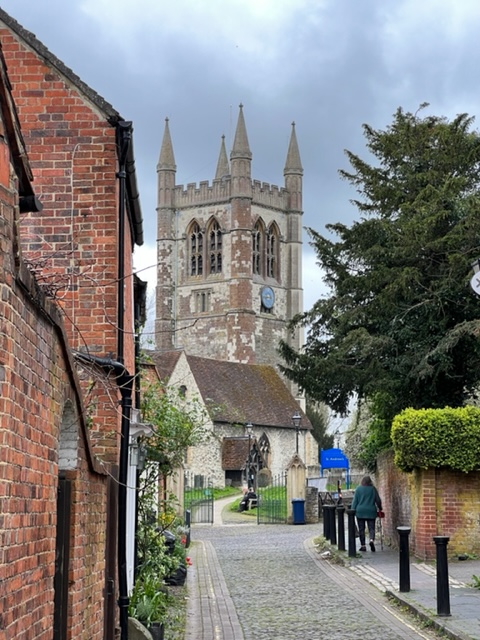
We finished our little refreshments and then strolled through the long grass, looking for enlightenment from reading the inscriptions on the headstones. Most had been there well over 100 years and the ravages of weather, pollution and lichen were obvious. A few words here, a date there, leaning forward, leaning to one side, some leaning backwards and only with God’s will were they still sort-of upright; good examples of a town’s visual historical record disappearing in front of one’s eyes.
St Andrew’s graveyard got me thinking of one grave I particular, in the churchyard of St Stephens in Shottermill, a very small village near other Surrey town, Haslemere.
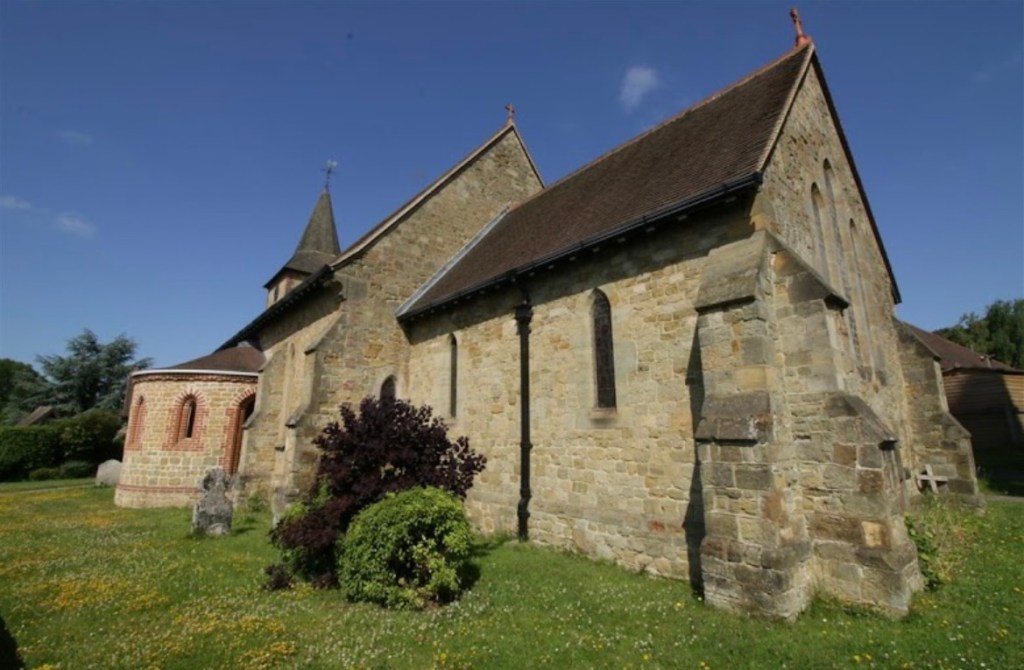
For here lie my great grandfather George Nation, his wife Eva Nation (See PCs 44 & 45 (Alaska 2015), PCs 127, 152 & 154 (Family seat and Fosbery Connections) and PCs 169 & 170 New Zealand 2020) and their son Cecil, who’d died of TB aged 59 in 1936. The years have taken their toll on the words carved into the stone and it’s possible that future generations will not be able to read a thing.
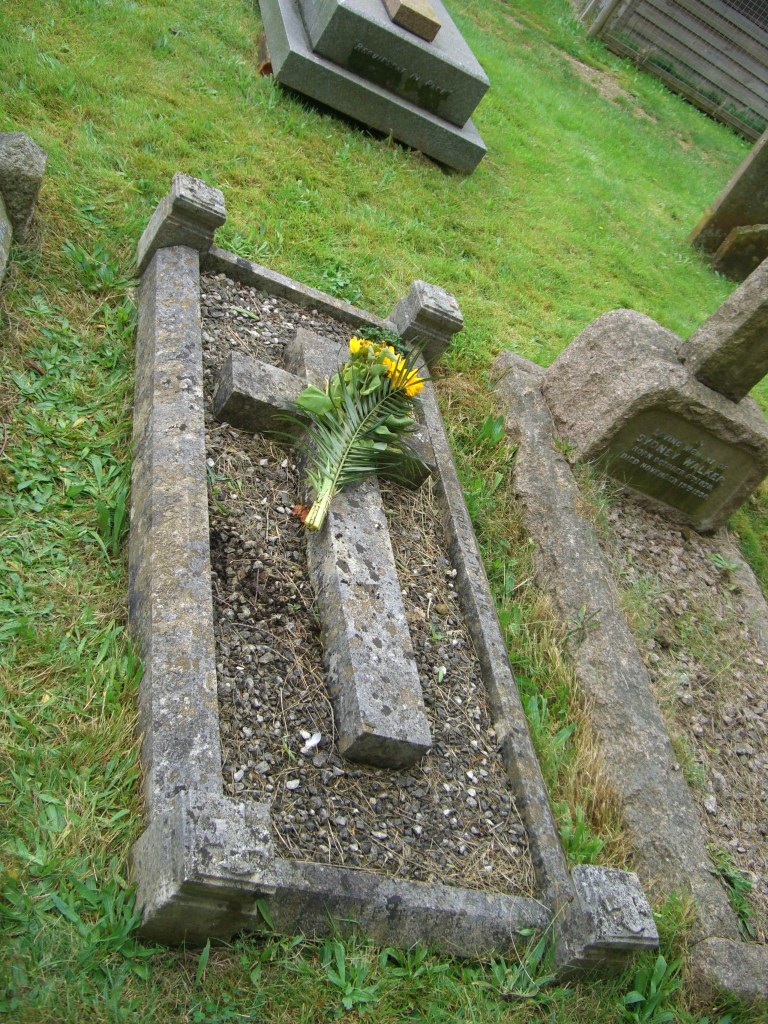
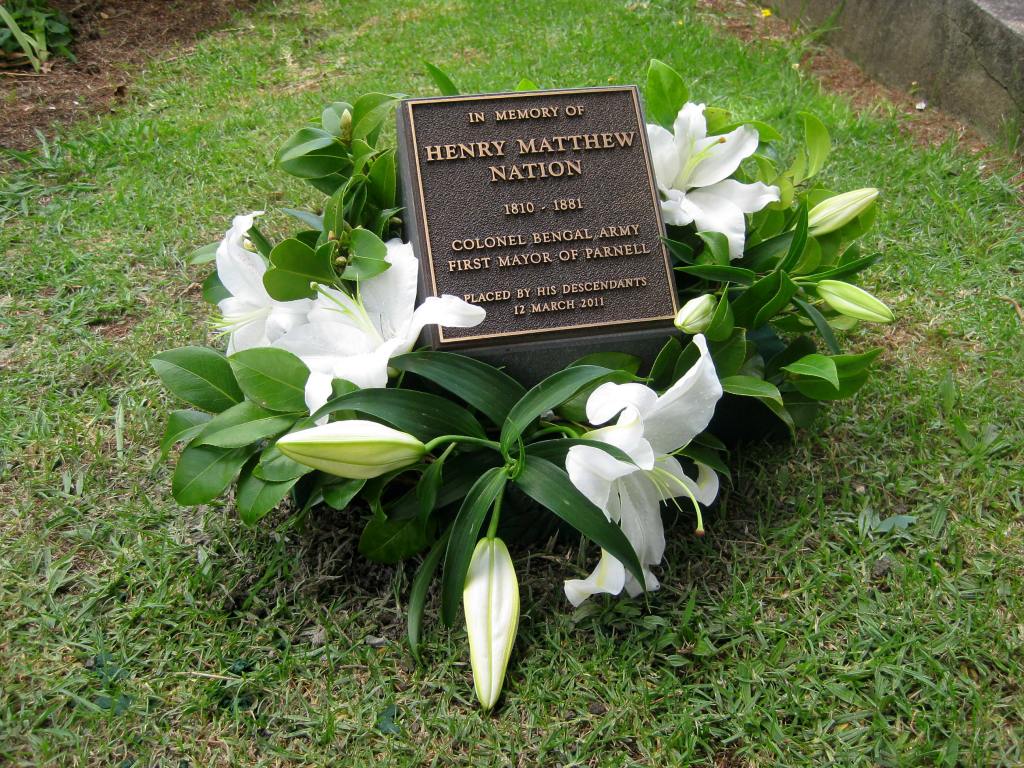
I wrote to the appropriate Diocese asking whether a simple plaque could be stuck in the ground next to it (for example: George Mitchell Nation 1847 – 1931, Eva Fosbery Nation 1860 – 1947 and Cecil Fosbery Nation 1887 – 1936) and was told that I could have the stonework recut or replaced, at some expense, but couldn’t have a plaque! I had managed to have one made for George’s father Henry Matthew Nation, whose grave in St Stephens (Note 1), in the Auckland suburb of Parnell, New Zealand, had been unmarked.
So I think the Diocese’s stance is extremely sad and shortsighted; it suggests that in the not-too-distant future visitors to a closed church, which might hold written records of the occupants of the graveyard, will simply see a number of stone rectangles at various angles!
But just discernible on George’s gravestone are the dates recording their birth and death, and a hyphen was there, separating the start and the end of that life. It seemed that all their life’s activities, successes and failures, loves and life, were compressed into a single mark of punctuation. I read somewhere how odd it is to wander through a graveyard, look at the details on the gravestones and see ‘life in a hyphen’.

So what did ‘de Mackay’ do between 1931 and 2022?
If the observer has some basic knowledge of history, gravestone dates can recall national and global events of that period, so give an insight into living and working conditions of the occupant. But this hyphen, this simple line, not long, not thick, separating two numbers is recognised in some weird way as the extent of the person’s life. There is obviously a need for brevity when paying someone to chisel words on stone, but surely there is a better, more modern way for people to discover?
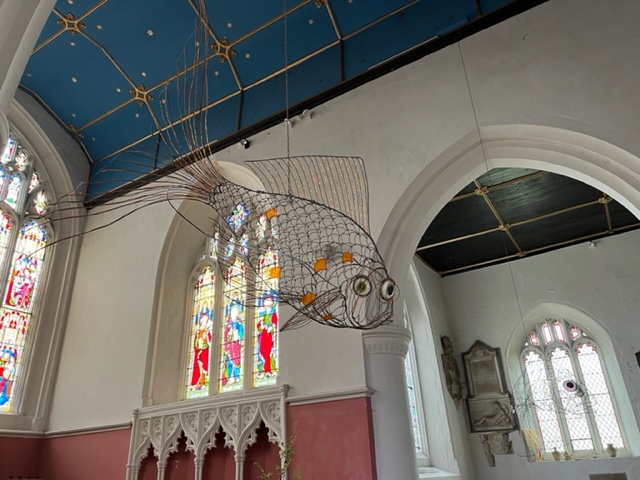
Kitkat suggested we went inside St Andrew’s, where we found some lovely wire sculptures of fish suspended from the rafters.
“Why fish?” asked Kitkat.
“Probably a nod to the belief that Jesus Christ asked two fishermen to become ‘fishers of men.’”
My daily reading of the digital version of The Times includes a brief look at the ‘Register’ where obituaries are found. You wouldn’t want to write your own obituary for publication, although as a personal exercise it can be quite enlightening, just for amusement or as a stock-take of where you are today and where you want to get to, and how you want to be remembered. Try it! When we die we leave it to others to comment and judge our life, the good bits and the not so good bits.
Epitaphs, a ‘form of words written in memory and often used as an inscription on a tombstone’, try to encapsulate a life in a few words. Frank Sinatra (1915 – 1998) asked that ‘The Best is Yet to Come’ was engraved on his tombstone.

Then you have other more general comments like ‘gone from our sight but not from our hearts’, or ‘too well loved to be forgotten’, or ‘to live in the hearts of those we leave behind is never to die’ or ‘in memories we find comfort, in love we find peace’ – but there’s no visible mention of what the individual did! For example they could have been a ‘doctor’, or ‘monarch’, or ‘architect’, or ‘saleswoman’, or ‘actor’, or ‘singer’, or ‘inventor’, or ‘civil servant’, or ‘balloonist’, or ‘writer’, or ‘policewoman’, or engineer – and the hyphen doesn’t divulge the information!
Maybe in the future there will be a QR or Barcode beside the grave that you can interrogate with your smart phone and find more information. In Sinatra’s case it might say: ‘I was a singer. Regrets? I had a few ……”
Richard 10th May 2024
Hove
http://www.postcardscribbles.co.uk
PS During Easter there was news coverage of some of the Christian services here in the UK and I heard someone say “today, Easter Sunday, is the most important day in Christianity”. I got confused – surely someone’s death can’t be more important than their birth in the sense one has to come before the other? But then I realised it was actually about the Christian belief in the Resurrection.
Note 1 A lovely coincidence that both churches are named St Stephens!
 postcards