PC 389 Lymington (continued)

It’s often that first time you visit a place you remember years later, no matter how many times you subsequently go back. My first visit to Buckler’s Hard (Note 1) was over 55 years ago!

As a Second Lieutenant I had joined my first regiment, 27 Medium Regiment Royal Artillery, in Devizes, Wiltshire in February 1968. My Troop Commander was a Captain James Scarlet, who was also responsible for a small Royal Artillery Yacht Club yacht moored at Marchwood on Southampton Water; despite not knowing much about sailing at that time, he delegated the task of its bosun to me! Braganza (Note 2) was a 19 feet Bermudian sloop, with a lifting centre board; you couldn’t stand up below decks except immediately by the little sink and stove. It wasn’t booked much that summer and in June 1968 Gerry Ackhurst and I sailed down Southampton Water and into The Solent. One evening we decided the tide was perfect to sail over the sandbar at the entrance of the Beaulieu River and make our way upriver to Buckler’s Hard, about 6kms. The Solent sailing guide book said it was a good place to visit; we did not disagree!
Screenshot

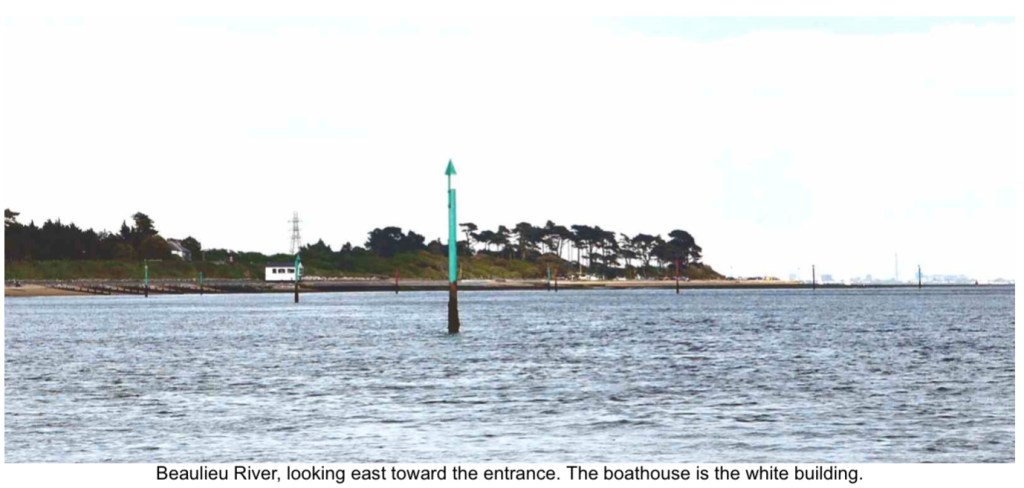
For those of you interested in these things, estuary or river entrances are delineated by red and green marker posts. Convention has it that coming in from seaward, one has to keep the red posts to port (left) and the green ones to starboard (right). So far so good; a scenic tidal river leading to a very sheltered spot where you could tie up to a pontoon or large piles.
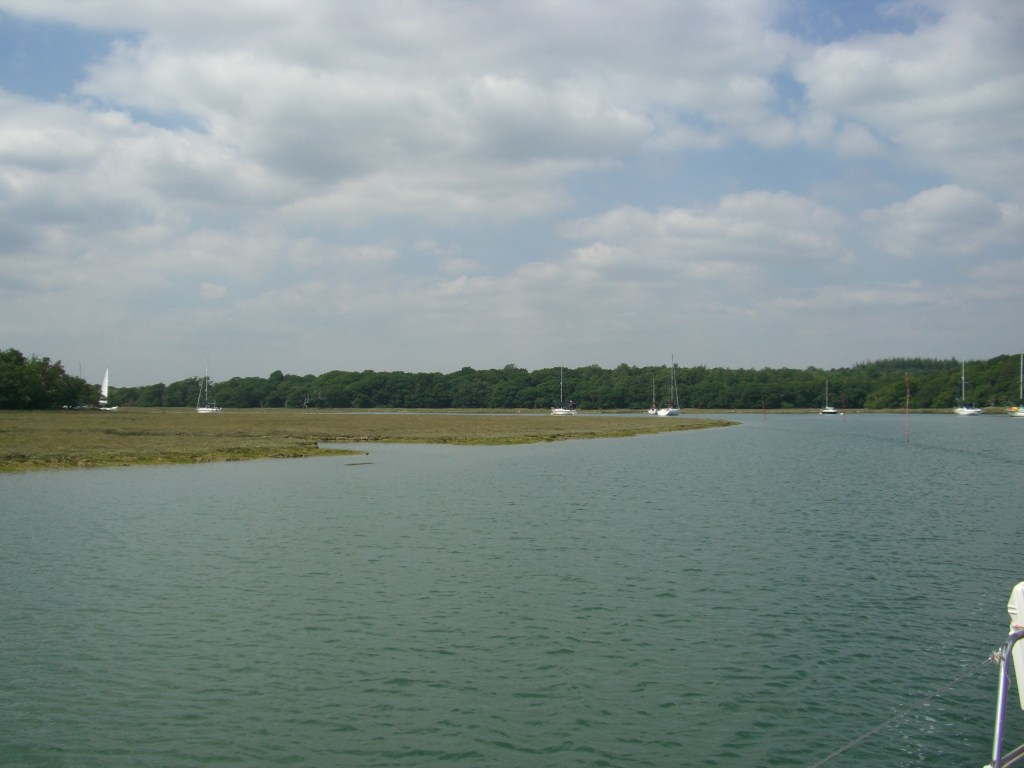
Fifty years’ ago there were few facilities at Buckler’s Hard, save for somewhere to secure your yacht, a diesel pump and the Master Builder, an atmospheric pub. The following day we took advantage of the incoming tide and sailed all the way up to the little town of Beaulieu, home of the late Lord Montagu (1926-2015) who founded the National Motor Museum (Note 3). With her centreboard up, Braganza only drew about 2 ft (in old money), so it was unusual but possible! 

A close inspection of the first photo will reveal a little indentation, just below the ‘B’, on the spit of land that forms the entrance to the river. ‘Gins Run’ was a little cut-through when leaving the river, tide-dependent! I used it a couple of times but gradually by 1986 nature had closed it with the shifting sands of the estuary.

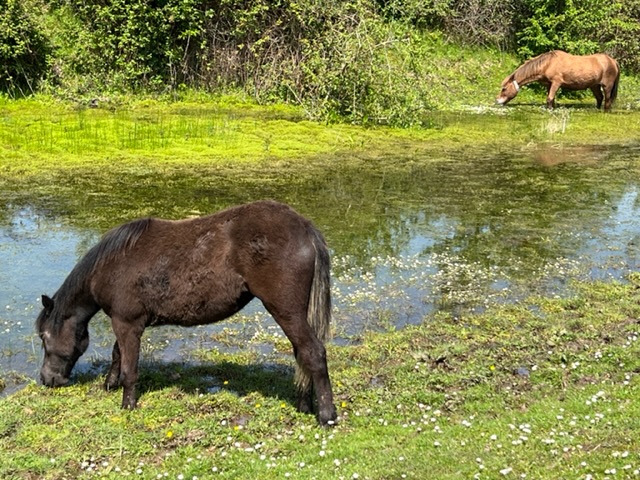
So Celina, Cecilia, Toni and I leave Lymington and follow the smallest of roads northeast through the New Forest towards Buckler’s Hard. Having mentioned the free-roaming ponies to Cecilia, it was good to be able to find a couple munching some weed in a road-side pond!
Leaving the car in the carpark, our first stop was the excellent museum where you begin to understand the historic significance of Buckler’s Hard in our Nation’s story and why the pub is called the Master Builder. Originally founded as a free port for the trading of sugar, it flourished as a naval shipbuilding centre and has become famous for building a total of over 50 warships for Admiral Nelson’s navy. Three, Agamemnon, Euryalus and Swiftsure, took place in the Battle of Trafalgar in October 1805. Today it’s difficult to imagine the riverbank being such a hive of activity and industry, scores of expert carpenters, sailmakers, woodsmen and the like, working to construct these huge vessels. The museum has some terrific illustrations and for those of you who have not been, it’s highly recommended. What I find most surprising is that these large ships sailed down this small river to The Solent!
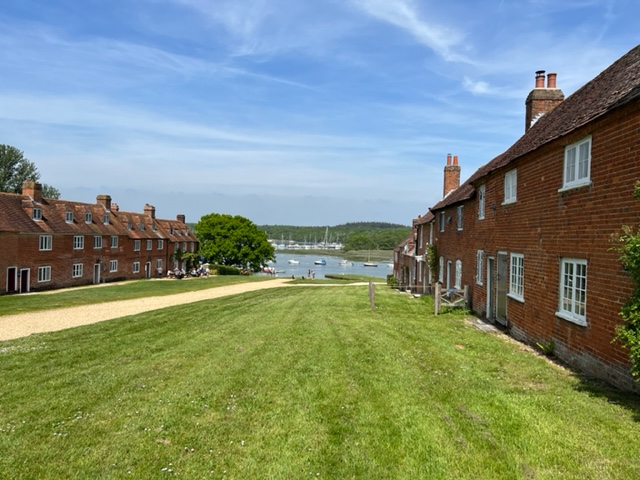
Worker’s cottages on right, Master Builder near the river on left

In addition to a huge amount of information about building these warships, such as how it took 100 oak trees to construct one ship and that the wood had to dry out for two years before it could be fashioned into the appropriate shape, there are stories of those who lived and worked here. Buckler’s Hard has become a popular tourist destination as well as a sailing centre!
.

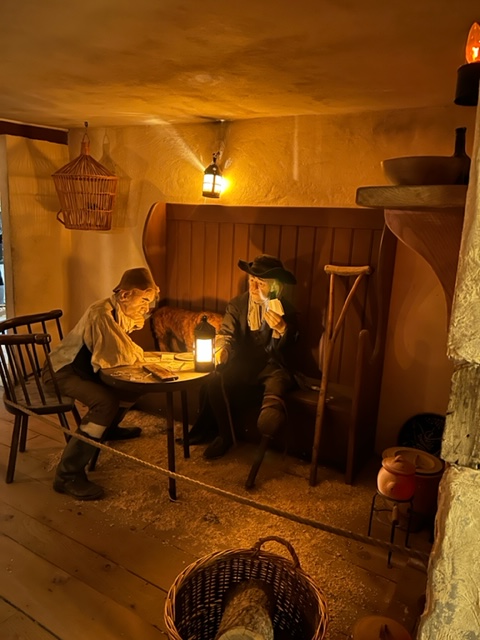
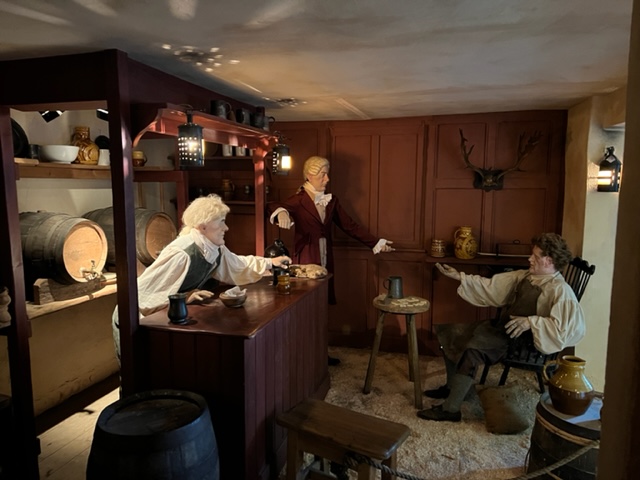
There are some very realistic recreations of what the Master Builder public house might have looked like and the ‘one (room) up, one (room) down’ layout in the workers cottages. It meant extremely cramped living conditions for everyone, but I guess that view’s with the benefit of hindsight; they didn’t know anything different!
We had lunch at the Master Builder, its passageways hung with suitable nautical photographs and paintings, and sat in the garden in the sunshine. On one visit decades ago the yacht I was skippering arrived late in the evening, after the Master Builder’s kitchens had closed. However, with a great deal of diplomacy and persuasion, eventually we managed to get some soup and defrosted bread rolls which were devoured by the hungry crew; offshore sailing always generates healthy appetites!

Back into the C21st for our trip back to Hove which, on a Friday afternoon, was always going to be in heavy traffic.

There will be a postcard about our time in Croatia at some stage.

Richard 31st May 2024

Korčula Croatia

www.postcardscribles.co.uk

PS Braganza was not big enough to have an onboard loo (heads in nautical terms). This didn’t matter when the crew were only male but critical for onboard females. Later that summer I had another week on her, myself, Gerry and two girlfriends. I still remember approaching Wootton Creek and being asked to hurry up by the two girls, anxious to get ashore to find a loo!

Note 1 The ‘Hard’ here refers to the road that led down to the Beaulieu River.

Note 2 Funny coincidence! The Braganza dynasty (1640 -1910) was Portuguese and ruled Brazil from 1822 to 1889 when it became a republic. The town of Bragança is in northern Portugal.

Note 3 The current Lord Montagu is Ralph Douglas-Scott-Montagu, the 4th Baron. The family have owned the Beaulieu Estate for over 400 years.
PC 388 Lymington

My late father-in-law Carlos Rocha Miranda was a Professor of Neurophysiology in Brazil and spent almost all his professional life researching aspects of how brains work. Decades ago he was joined in Rio de Janeiro for some months by Hugh Perry, a graduate of Oxford University and eventually Emeritus Professor of Experimental Neuropathology at the University of Southampton. Hugh stayed in the family home in Iposeria, Rio de Janeiro and they became close friends.

Wind the clock forward a substantial number of years and the planning for a visit from my mother-in-law Cecila and partner Toni included a possible lunch with Hugh and his wife Jess. They live in Lymington, just to the west of Southampton and on the southern edge of the New Forrest, so lunch would have to include an overnight stay. The plans firmed up and on the third day of their visit in early May we drove off to Lymington.

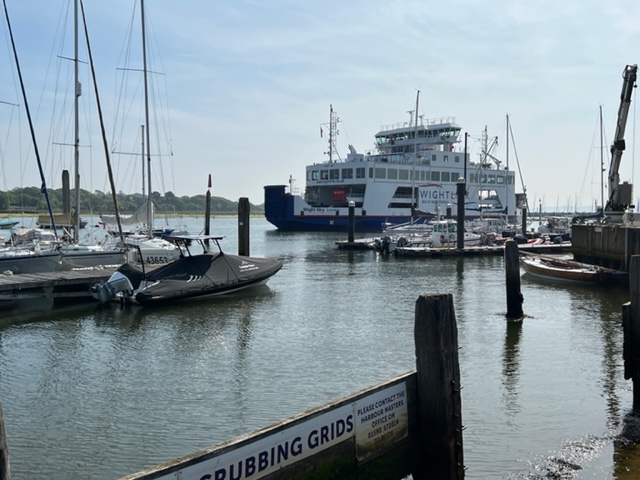
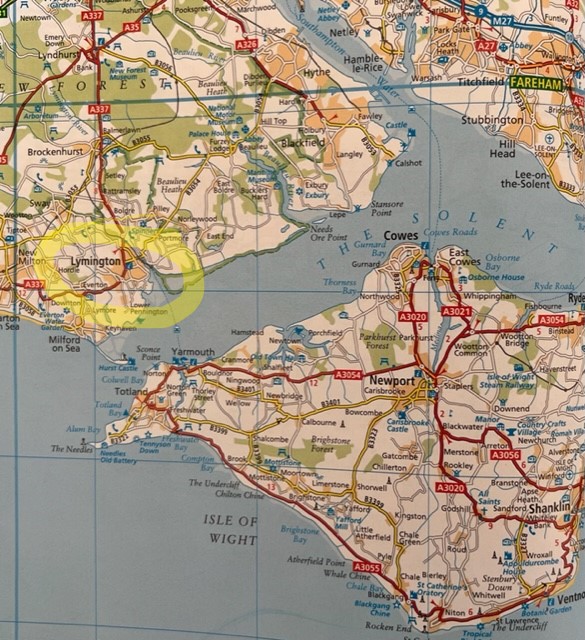
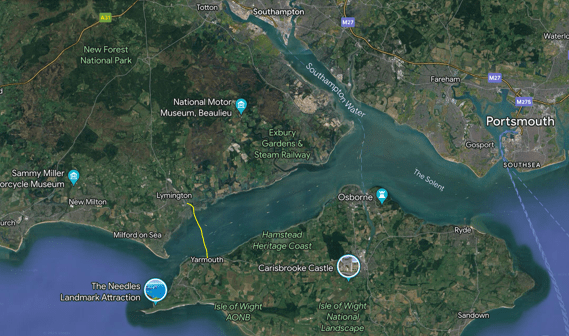
I have some historical connections with the town, so it was a delight to return. Lymington has a ferry link to Yarmouth on the Isle of Wight (IOW) and the service is run by Wightlink.

The ferry link in yellow

In 1996 I secured some leadership coaching assignments with Wightlink, which at the time was owned by Sea Containers, so spent some time on the ferry.

The Wightlink ferry arriving in Lymington from Yarmouth

Sea Containers also owned Hoverspeed which operated cross-channel ferries out of Dover to Calais and Boulogne and my work was often located near Dover. The managers were all down-to-earth, lovely people and I hope whatever I contributed made a difference to both the individuals and to the bottom line!

Four years later, in 2000, I organised a couple of days’ team building for NM Rothschild, which included a day on a 45ft yacht I had chartered out of the Lymington Marina. We had stayed in the Stanwell House hotel so this time it seemed the obvious place to book a couple of rooms. It had recently been completely refurbished over an eleven-month period and had only reopened in February this year so our timing was perfect.

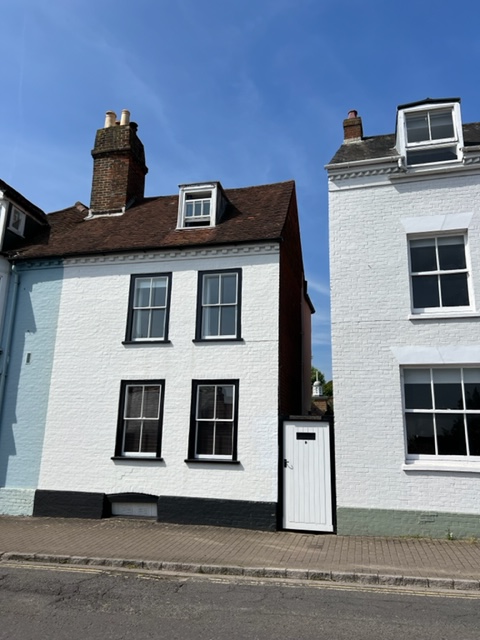
After spending an inordinate amount of time looking for a section of the municipal carpark reserved for hotel guests, we dropped our bags at the hotel and made our way to a delightfully named street called Captains Row. Hidden behind an insignificant façade was a house that had been added to over the centuries and now provides a comfortable family home, albeit rather elongated, and a south-west facing garden.

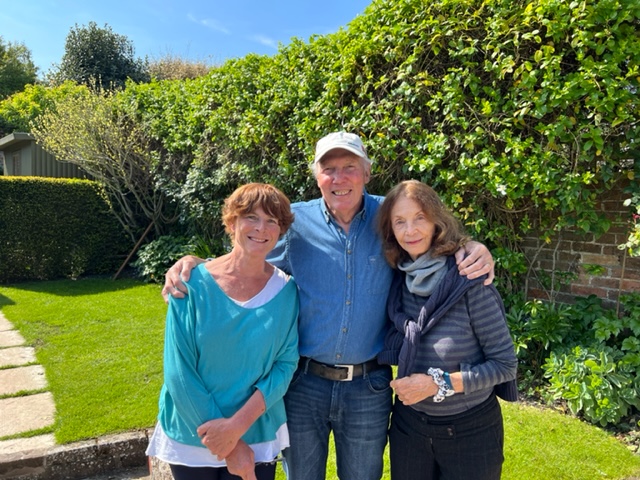
Hugh and Jess are one of those couples that you immediately feel at ease with, welcoming and warm. Chat … drinks …. admire their house ….. chat ….. food …. puddings … chat ….. all under the warmth of some early summer sun. Time passed quickly; my mother-in-law was obviously delighted to be renewing a close friendship and the rest of us were curious to know more about this interesting couple.  

Before supper in the hotel Celina and I walked up the High Street and, opposite St Thomas’ church, we found a self-designated ‘lifestyle’ shop called Willow. A glance through the window revealed a whole host of items to create ‘that look’ …. and somewhere some rather practical-looking dining chairs, so in we went …. and out we came some twenty minutes later significantly poorer. When they arrive in July, I am sure they will forever be reminders of Lymington!

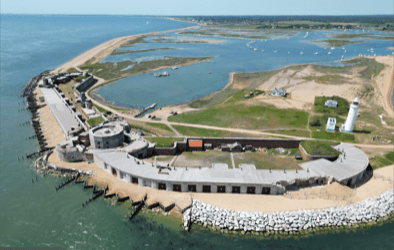
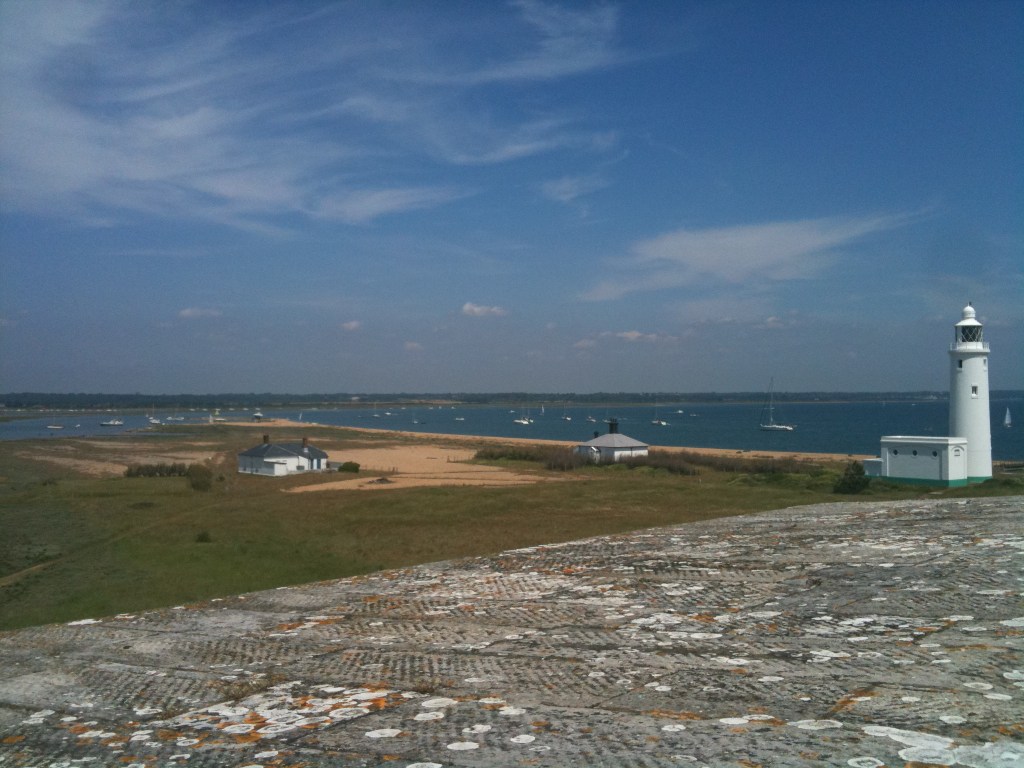
If we had had the time, we could have driven south, parked the car and walked to Hurst Castle, a fortress with 38-ton guns and a lighthouse on the edge of The Solent.

Hurst Castle was built in 1544 on the orders of Henry VIII as part of his Defence Forts programme to guard against invasion from France. It defended the western entrance to The Solent.

The view north from the ramparts towards Lymington

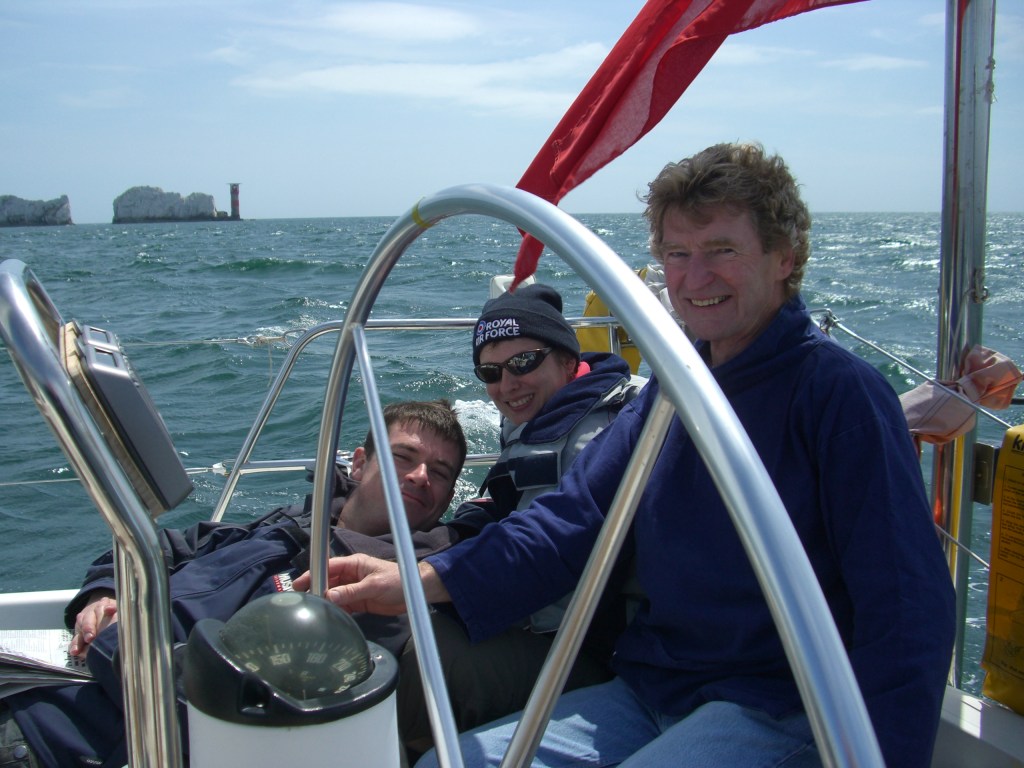
Up against the ramparts there would have been a clear view of the iconic Needles on the western extremity of The Isle of Wight.

With friends of my daughter in 2011 off The Needles

Our visit to Lymington also reminded me of my stupidity concerning filling water and fuel tanks on a yacht. A client of mine had a share in a 40ft yacht based in the town marina and offered me a day’s sailing by way of saying ‘thank you’. After some good sailing on The Solent and a spot of lunch anchored in Alum Bay, famous for its colourful sand striations, we returned to the marina and cleaned up the yacht. I was asked to top up the freshwater tanks. To this day I cannot understand why the filler cap for the water wasn’t a different design to that for the fuel. Ten seconds of water funnelling down into a fuel tank and the damage was done!

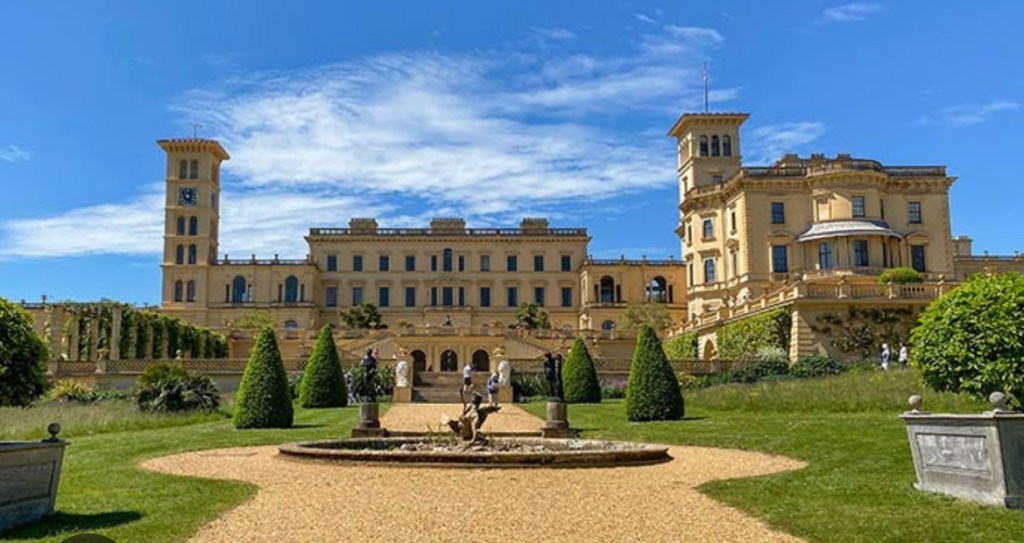
Many years ago I visited Osborne House, the summer retreat of the late Queen Victoria and her husband Prince Albert, which lies just to the east of the IOW town of Cowes. Recently there has been a television documentary about it, how it was gradually increased from a summer pavilion to a large palace and how Queen Victoria stayed in mourning there for 15 years after Albert died aged 42 of Typhus. It’s already on the programme for the 2025 visit of my mother-in-law!

Osborne House

On my visit to Osborne I had noticed the mirrored floor-to-ceiling shutters in one of the State Rooms. I pinched the idea for our apartment here in Hove.

Options for the following day included taking the ferry to Yarmouth, a 40-minute trip, and lunch at The George, driving north to Salisbury to visit the cathedral or northeast to Winchester to see its cathedral. Both cities and cathedrals are stunning, but a fourth option was the most tempting. Lymington’s on the edge of the New Forest, with its stunning countryside and free-roaming horses …… and some 30 minutes from Bucklers Hard on the Beaulieu River and, blessed with gorgeous early summer sunshine, we plumped for this last one.

(To be continued)

Richard 24th May 2024

Hove

http://www.postcardscribles.co.uk

PC 387 Accident and Emergency (A&E)

If, having read and taken in the title of this postcard, you are wondering where the clothes you normally wear to funerals are, and should they be dry cleaned to get rid of the rather ‘unused’ whiff, relax! Hopefully, as far as I am concerned, you won’t need them for a while yet.

But my experiences on a rather quite Sunday evening at the end of last month are worth a few reflective comments!

On several occasions back in 2012, I experienced a tightness across my chest and was eventually sensible enough to go to my GP. By August 2013, after two ECGs and one angiogram, I am in the Royal Sussex County Hospital here in Brighton having a triple heart bypass. “Good for thirty years” said Jonathan Hyde my surgeon …… and I believed him, although now, when I get the odd twinge, I have my doubts about the ‘30’! Anyway, I have a sublingual Glyceryl Trinitrate spray which normally relieves the ache pretty much instantly.

That Sunday evening I had just sat down to watch the early evening news when I felt a twinge. Rather reluctantly I got up, found my spray and gave myself a dose. I sat back down but the ache persisted, so much so that Celina asked whether I was OK! I explained ….. then she said I looked very pale (I felt quite sweaty!) and she was on the phone to the emergency services. The enormous pressures on our NHS are well documented, with response times for ambulances way beyond guidelines and apocalyptic scenes in A&E the norm; somehow I hoped I would not see first hand their state on that Sunday evening.

While we waited for the ambulance, I was told to take four 75mg Asprin tablets. Paramedics Ben and his teammate arrived – within 14 minutes – and after various checks and tests, declared that the only sure way of eliminating any heart issue was to have two blood tests, four hours apart, to check levels of Troponine. Grabbing my kindle and iPhone, off we went, although I was reassured that the paramedics didn’t feel the need to advertise our presence with blue lights and sirens!

Ben and I chatted in the back of the ambulance, as I am always intrigued by everyone’s back-story! He had started as a Royal Military Policemen then ten years ago joined the Ambulance Service. Arriving at A&E Ben asked me to sit in a wheelchair so he could take me in. “Oh! I feel OK! I can walk.” “More than my job’s worth, Richard. Get in the chair.” Once inside I was confronted by the organised chaos of A&E. Not quite sure whether to look at the beds, the trolleys, the occupants some half-dressed, some moaning, some in severe pain, most with a family member or friend (Celina had offered but I reckoned I could cope!) and a multitude of different-coloured uniformed staff, moving confidently and expertly, to deliver whatever was needed. I sense everyone is looking at me and that’s probably always the case, observing the new arrivals, while you wait … and wait.

There is a high level of noise and I assume, if you work here, you have to shut it out, somehow! Somewhere in the background a woman is sounding off, ‘f**k you’, ‘f**k off’, etc, not appreciating the staff trying to assist her. It’s reckoned around 45% of those attending A&E have a drug or alcohol problem.

Wheeled into a curtained-off bay, I am transferred to a bed and given the obligatory backless gown. Omar comes in to administer an ECG and take blood. He has just qualified and is off to a residential doctor’s role in Chichester. Many years ago I was advised by member of a hospital blood team never to let a doctor take blood, but Omar was quite competent. Then Kojak aka Telly Savalas arrived to tell me what to expect; actually Savalas died in 1994 but this doctor was a dead-ringer for him! “Providing both blood tests are OK then you can go home, but the second one can only be in four hours’ time!” By now it was 1930 so home by midnight – fingers crossed.

While you’re here let’s have an X-Ray of your chest.”– and on the journey to and from the X-Ray department it was very apparent how stretched our A&E departments have become; trolleys along corridors, constant noise and movement, orderlies called hither and thither. The difficulty of getting a face-to-face appointment with one’s local GP encourages people to simply turn up to A&E, knowing they will not be turned away …. even if they have to wait four hours.

I was ‘parked’ in a room with a selection of large chairs, told my next test would be in three hours and asked whether I wanted something to eat. Grateful for something to while away the time, my chicken sandwich was followed by some yoghurt and some biscuits – but I wasn’t sure how to cope with a small orange with very thin skin and only a spoon.

Trying to concentrate on the book on my Kindle, invariably I eaves-dropped to understand why others were here, in this darkened room, on these large blue chairs. There wasn’t much chat going on, but I did managed to ascertain that the twenty-something chap next to me had had a bad trip on some drug at a party, so much so that his girlfriend had brought him in and was talking in a quiet concerned way to a nurse, whilst the chap moaned and shivered and groaned.

Somehow the time passed, eventually I had a second set of bloods taken, a doctor said they were fine and I could go. I called a taxi and when it arrived another chap in the carpark thought it was his; as he also lived in Hove I suggested we went together. His backstory? He had taken some laxative and had a severe allergic reaction!

A&E on a Sunday night!

Richard 17th May 2024

Hove

http://www.postcardscribbles.co.uk

PS A&E in Brazil is known as Urgências and in Portugual ‘Serviço de Acidentados e de Urgências’.

PC 386 Life in a Hyphen

After Easter I spent a few days with my daughter and family near the Surrey town of Farnham. There is no sensible comparison with the city of Brighton & Hove but like any experience, you appreciate the differences when you return home!

On the Thursday, as my middle grandson was having his haircut, I wandered off with Theo, aka KitKat and aged 7, to find a decent cup of coffee for me and an ice cream for him. Hamilton’s Tea House on Downing Street had Illy coffee, my favourite, so in we went. “Sorry, the seating area has just closed!” My watch said it was a quarter past three! Somewhat surprised and pissed-off, we took our purchases up the little lane to St Andrew’s church, where we found a bench in the church yard.

We finished our little refreshments and then strolled through the long grass, looking for enlightenment from reading the inscriptions on the headstones. Most had been there well over 100 years and the ravages of weather, pollution and lichen were obvious. A few words here, a date there, leaning forward, leaning to one side, some leaning backwards and only with God’s will were they still sort-of upright; good examples of a town’s visual historical record disappearing in front of one’s eyes.

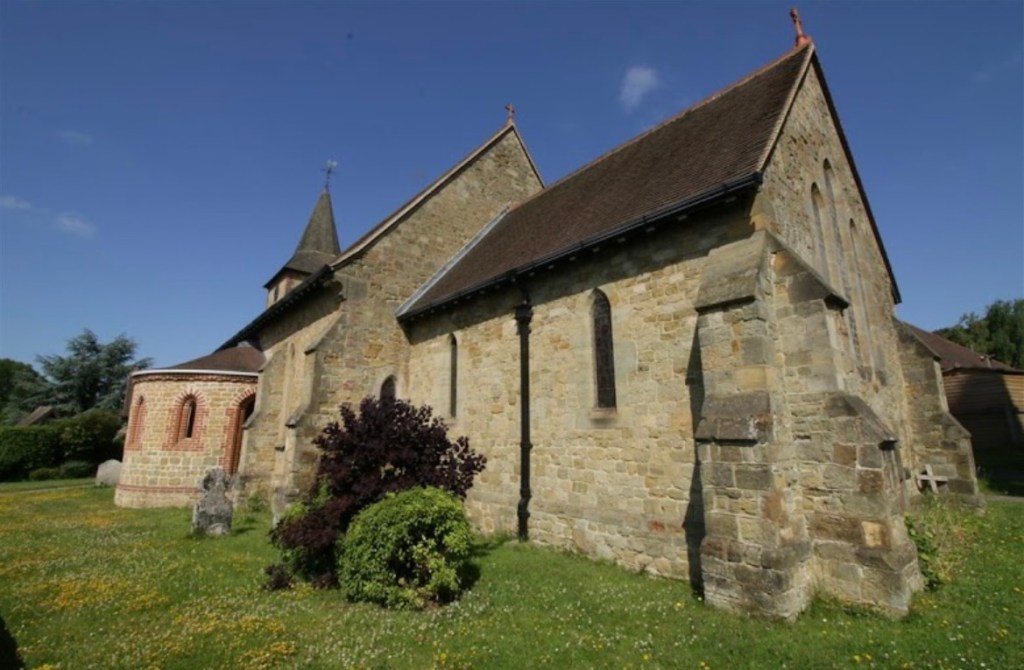
St Andrew’s graveyard got me thinking of one grave I particular, in the churchyard of St Stephens in Shottermill, a very small village near other Surrey town, Haslemere.

Screenshot

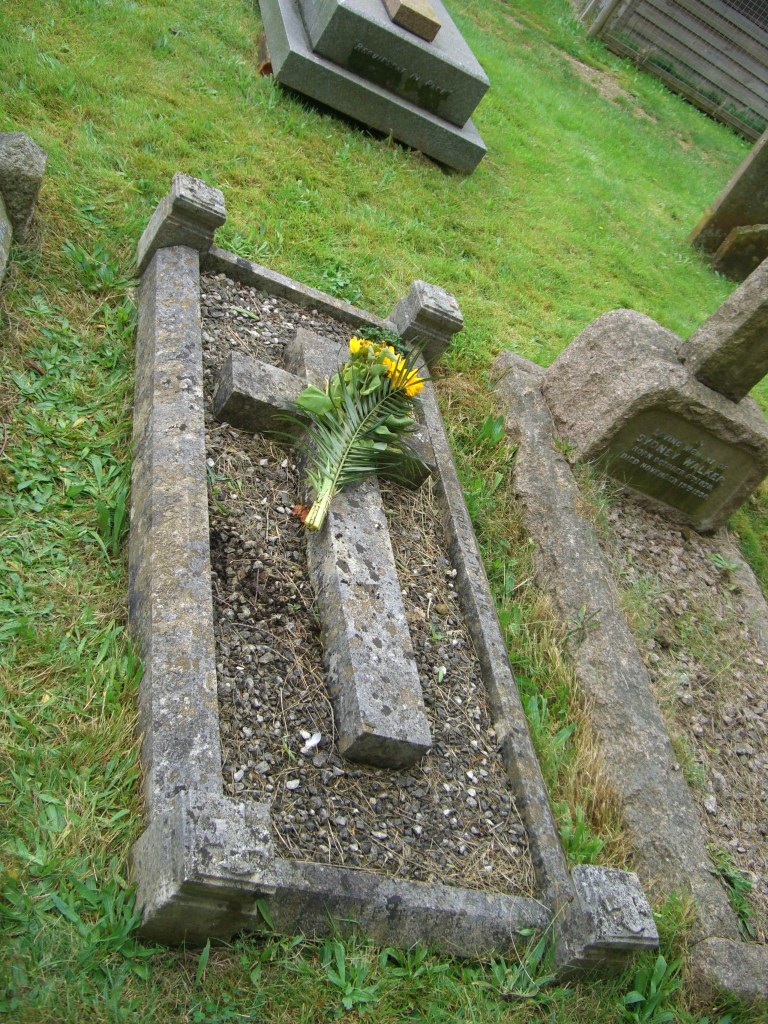
For here lie my great grandfather George Nation, his wife Eva Nation (See PCs 44 & 45 (Alaska 2015), PCs 127, 152 & 154 (Family seat and Fosbery Connections) and PCs 169 & 170 New Zealand 2020) and their son Cecil, who’d died of TB aged 59 in 1936. The years have taken their toll on the words carved into the stone and it’s possible that future generations will not be able to read a thing.

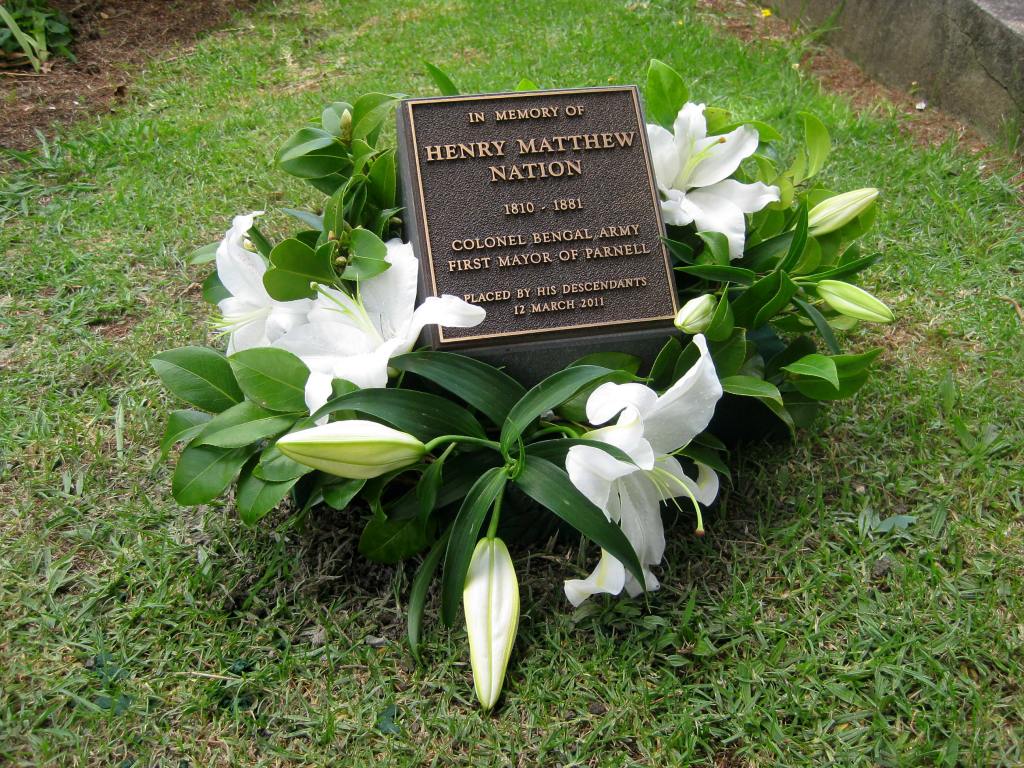
I wrote to the appropriate Diocese asking whether a simple plaque could be stuck in the ground next to it (for example: George Mitchell Nation 1847 – 1931, Eva Fosbery Nation 1860 – 1947 and Cecil Fosbery Nation 1887 – 1936) and was told that I could have the stonework recut or replaced, at some expense, but couldn’t have a plaque! I had managed to have one made for George’s father Henry Matthew Nation, whose grave in St Stephens (Note 1), in the Auckland suburb of Parnell, New Zealand, had been unmarked.

So I think the Diocese’s stance is extremely sad and shortsighted; it suggests that in the not-too-distant future visitors to a closed church, which might hold written records of the occupants of the graveyard, will simply see a number of stone rectangles at various angles!

But just discernible on George’s gravestone are the dates recording their birth and death, and a hyphen was there, separating the start and the end of that life. It seemed that all their life’s activities, successes and failures, loves and life, were compressed into a single mark of punctuation. I read somewhere how odd it is to wander through a graveyard, look at the details on the gravestones and see ‘life in a hyphen’.

So what did ‘de Mackay’ do between 1931 and 2022?

If the observer has some basic knowledge of history, gravestone dates can recall national and global events of that period, so give an insight into living and working conditions of the occupant. But this hyphen, this simple line, not long, not thick, separating two numbers is recognised in some weird way as the extent of the person’s life. There is obviously a need for brevity when paying someone to chisel words on stone, but surely there is a better, more modern way for people to discover?  

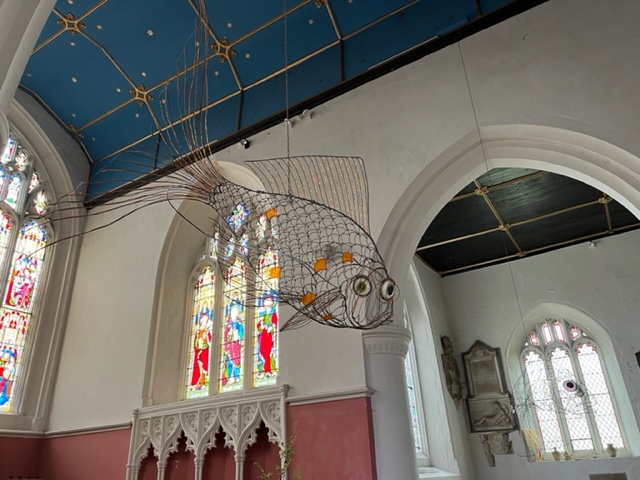
Kitkat suggested we went inside St Andrew’s, where we found some lovely wire sculptures of fish suspended from the rafters.

Why fish?” asked Kitkat.

“Probably a nod to the belief that Jesus Christ asked two fishermen to become ‘fishers of men.’”

My daily reading of the digital version of The Times includes a brief look at the ‘Register’ where obituaries are found. You wouldn’t want to write your own obituary for publication, although as a personal exercise it can be quite enlightening, just for amusement or as a stock-take of where you are today and where you want to get to, and how you want to be remembered. Try it! When we die we leave it to others to comment and judge our life, the good bits and the not so good bits.

Epitaphs, a ‘form of words written in memory and often used as an inscription on a tombstone’, try to encapsulate a life in a few words. Frank Sinatra (1915 – 1998) asked that ‘The Best is Yet to Come’ was engraved on his tombstone.

Then you have other more general comments like ‘gone from our sight but not from our hearts’, or ‘too well loved to be forgotten’, or ‘to live in the hearts of those we leave behind is never to die’ or ‘in memories we find comfort, in love we find peace’ – but there’s no visible mention of what the individual did! For example they could have been a ‘doctor’, or ‘monarch’, or ‘architect’, or ‘saleswoman’, or ‘actor’, or ‘singer’, or ‘inventor’, or ‘civil servant’, or ‘balloonist’, or ‘writer’, or ‘policewoman’, or engineer – and the hyphen doesn’t divulge the information!

Maybe in the future there will be a QR or Barcode beside the grave that you can interrogate with your smart phone and find more information. In Sinatra’s case it might say: ‘I was a singer. Regrets? I had a few ……”

Richard 10th May 2024

Hove

http://www.postcardscribbles.co.uk

PS During Easter there was news coverage of some of the Christian services here in the UK and I heard someone say “today, Easter Sunday, is the most important day in Christianity”. I got confused – surely someone’s death can’t be more important than their birth in the sense one has to come before the other? But then I realised it was actually about the Christian belief in the Resurrection.

Note 1 A lovely coincidence that both churches are named St Stephens!

PC 385 More Hope ….continued from PC 382 Hope (12 April 2024)

At that very moment, we saw Duncan enter the café with a professional-looking woman and as they sat down at one of the tables, Josh brought over two cups of coffee. After what seemed like an intense 30 minutes, discussing some plans and drawings, the woman left and Duncan, looking around at who was ‘in’, came over to Mo and me. Maybe some sixth sense had encouraged him to join us.

“We were just talking about you! Your ears must have been burning. We were wondering how your ideas for the bookshop were coming on?”

“Well, that was Melanie from Elixir Interior Design and she’s helping me develop my ideas.”

“Who are Elixir Interior Design?”

“Think you would call them creatives and we’re lucky here to have such a large thriving sector. They have been involved in many of the city’s success stories and currently are working on a new hotel in Regency Square, Number 29. Melanie told me she’s just become a consultant for the company developing the old Hippodrome Building in Middle Street.

“Ah! Yes. That place has a long and chequered history.” says Mo. “I think it opened at the turn of the C20th and was, until 1964, one of the most popular and famous theatres in the country. It then fell into disuse and disrepair until 2020 when it was bought by Matsim Properties. Isn’t that right?”

Behind this rumpty-tumpty facade is a huge magnificent circular plastered ceiling

Yes. Planning consent was given at the beginning of last month for a performance space, a hotel and shop, and a private members’ club. Quite an undertaking and I suspect a huge ‘money pit’.”

“It’s just up the street from my yoga studio, Duncan. Pass it five days a week. ……. So, the bookshop?”

“I am confident it’s going to be a big success. I have raised some money from my family and in my mind have it opening in January 2025.”

Mo asked: “But what about higher wages and coffee bean prices, as well the hike in energy prices? Aren’t they creating a huge pressure on your overheads?  

I chipped in: “Didn’t the government advise reducing the time in the shower at home to 4 minutes? Personally don’t spend more than three minutes but ……”

          “Wages have overtaken raw materials as my biggest cost – at the beginning of April the National Living Wage rose by £1.02 an hour to £11.44. And yes, the cost of Arabica coffee beans has been affected by the impact of climate change in Brazil and Ethiopia. But you know what, people come for more than a coffee, which they could make at home; it’s the whole community feeling, belonging by a process of osmosis, even if you don’t engage with anyone!

Duncan says he must go, hopes we have a great day and with a nod to Josh goes out into a sunny morning.

Turning to Mo I asked:

“Mo, you know how we have habits which we have invested years and years in to perfect and then we get challenged by some news that questions whether what we have been doing is right?

Yes. Like that British habit of using a bowl in the sink to wash up – our continental cousins are horrified!!

“Well, actually anyone not British! I have been aware for maybe a year that dentists do not like us using mouthwash but know I couldn’t start or end the day without a good swill of Listerine – no alcohol of course ….”

Why don’t they like mouthwash?”

“It’s all about the fluoride that’s been an active ingredient of our toothpaste since the 1960s. Fluoride needs time to work, some 20 minutes, so if you habitually rinse and spit out, then use a mouthwash, the positive effects of the fluoride are nullified.”

But I recently read more modern thinking is that whilst fluoride has dental benefits, fluoride-free toothpaste with some nano stuff (Ed: Nano Hydroxyapatite) is just as effective without the systemic toxicity concerns that Fluoride has.”

“I suspect you would have to have kilos of Fluoride before it became an issue! By the way, did I tell you the other day Celina and I went for a ‘Mole Map’, a way of making sure we are not surprised by the development of a malignant melanoma? (See PC 366 Medical Decluttering 22 December 2023). We sat in the waiting area of the Worthing Skin & Laser Clinic and Celina offered to get some water from the dispenser, which offered a choice of either normal temperature or cold water. She wanted the former, my choice was the latter. Sipping from a paper cup, it was lovely and cold. Celina’s was exactly the same temperature, something we would not have appreciated if we had been on our own!! Technology? Plumbing problem more like!”

               “That’s sweet! Listen, this may be really passé but there is a cocktail called Gin & French. I love cocktails but never knew the ‘French’ refers to the vermouth but if the vermouth is Italian, the cocktail is called Gin & It!(Note 1)”

“Neither did I. Mo, I need to go but did you see that wokeism is losing favour?”

“Yes! Wonderful news! What a load of tosh!”

“I agree. You know, as I am no longer on the merry-go-round of paid work, growing up, social interactions, having offspring and suchlike, these issues have really passed me by. I can think ‘The lady doth protest too much’ (Note 2) but then I probably would have to discover whether Queen Gertrude would have preferred a different pronoun and whether she had some little badge on her chest telling the world.”

Ha! Ha! The rise of wokeism brought these gender neutral pronouns, which had been the preserve of the LGBTQ+ communities, into more common usage but I hope their continued use will not be at the expense of common sense. You need to go?”

“I do! See you next time. Bye Mo!”

Richard 3rd May 2024

Hove

www.postcardscribbles.co.uk

Note 1 ‘It’ short for ‘Italian’.

Note 2 from Hamlet by William Shakespeare