Here in the United Kingdom we don’t have national Identity Cards, although most would argue we do by default! It’s an issue at the heart of libertarians, wishing the State has a rather light hand on our personal lives. (See Denis Macshane’s view from Wednesday’s Times) (Note 1). Why should someone know how old I am? Apparently, some people don’t want others to know, but if you drive it’s not a State Secret! Rather clumsily, the Driving & Vehicle Licensing Authority (DVLA), responsible for issuing driving licences, got around the problem with its format of one’s Driving Licence number!
For example, my identification/driving licence number is:
‘YATES410246RC8CS 37’. My birthday is 24.10. 46, hidden (?) between the ‘S’ and the ‘R’. The year wraps the month and the day. If you hadn’t realised this, I am sure you’re going to check your own driving licence?!

My regular readers will remember that at the end of last year I embarked on a medical MOT. As part of this review, I had to have a couple of day-surgeries in local hospitals, one the Montefiore here in Hove and the other the Nuffield hospital in Woodingdean (Note 2), which lies to the east of Brighton and has stunning views over the English Channel.
Being a day-patient requires inter alia two things. One is to accept the white plastic wristband that carries useful information, your hospital ID if you like; name, date of birth, patient identification number, possibly your address or postcode and the name of one’s consultant. The second is to resign oneself to the fact that every time the bell rings, someone will ask you for your date of birth and postcode. Even the chap from the catering department with his smart iPad ready to take my order for lunch had to ask: “just confirm your date of birth and postcode?” Not sure who else might have been sitting in a chair with DVT socks and a backless gown – apart from me?
At some point within one of the hospitals I went to a waiting room and interrogated the complicated coffee machine to get a double espresso. Was I imagining it when I heard a computer-generated voice from within the machine ask: “Date of birth and postcode please.”?
I am not sure I had any identification number until I signed up for military service in August 1965, in the nearest Army Recruitment Office to my parent’s house in Balcombe, here in Brighton. My soldier’s number was 24067711 and, although it was superseded by an officer’s number when I was commissioned, it remains on the tip of my tongue.
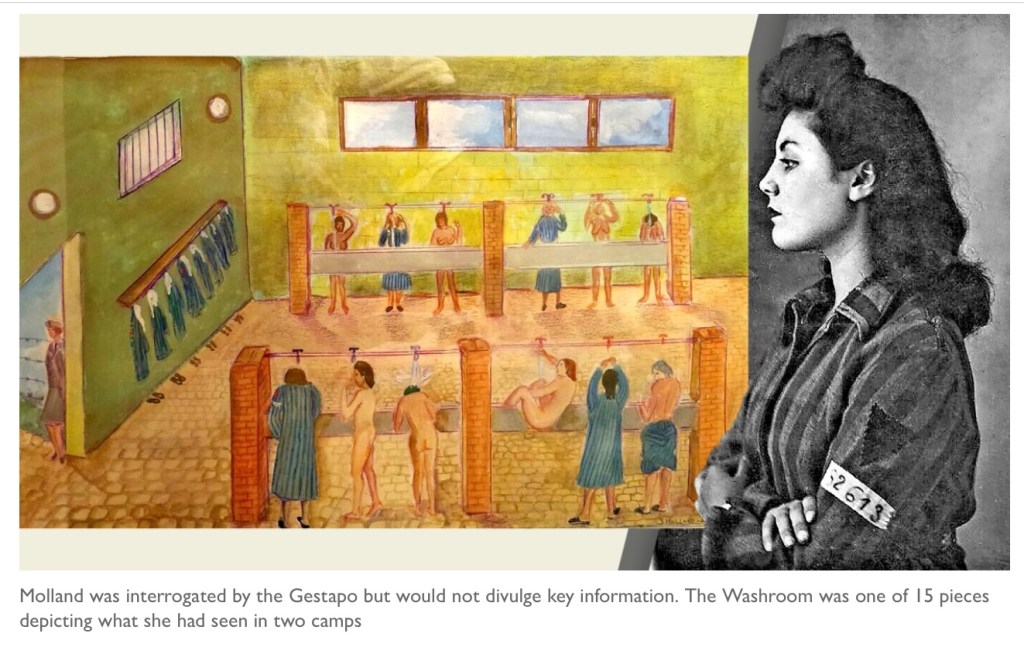
Part of the prompt to write about identification was reading the obituary of Josette Molland (1923-2024), who survived the inhuman Nazi concentration camps and illustrated her experiences through her art. She probably had a number tattooed on her wrist as well.
During my two operational tours in Northern Ireland I was required to wear a set of ‘dog tags’ (Note 3) around my neck. In addition to my name, obviously, they had my Army officer’s number, in this case 484065, my blood group, O Positive, and my declared religion – CS standing for Church of Scotland.
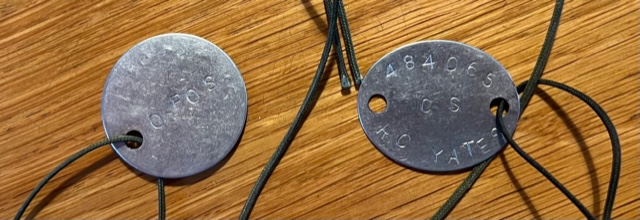
Made of metal, they clanked together; not good if you were on some operation which required stealth! Most were therefore covered with duct tape! There was probably some regulation about their use in the event of their owner being killed; ie one with the body, one to the file, but one never wanted to find out!
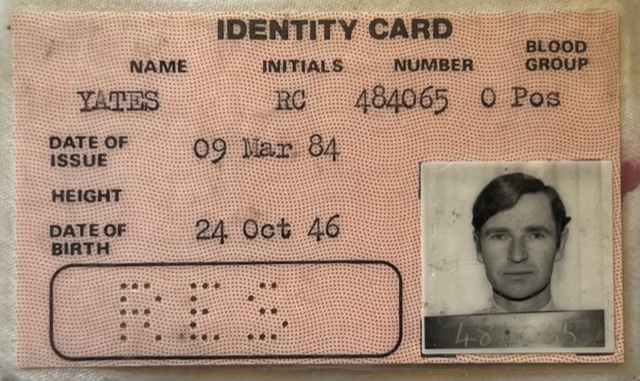
I still have my Army ID card, albeit a ‘reserve’ one and that reserve commitment lapsed when I turned 55. Many years ago I was in Copenhagen on business and a friend was going to Malmo on the ferry in Sweden (Note 4). I thought I would go with them, but my passport was back in the hotel. So I chanced it by just waving my ID card. There and back; no problem!
Celina gifted me a haircut with Simon Webster, a skilled hairdresser with a salon in the North Laines in Brighton. Such a pleasure to be pampered occasionally and Simon’s a lovely character. As you do, we chatted about this and that and he revealed something fascinating. Returning to the UK after a holiday in Portugal, he tried the ‘Face Recognition’ Passport machine at Gatwick Airport. It didn’t work and, after a second attempt, he reluctantly joined the queue to present his passport to a human. Simon asked the Border Force individual why his passport always failed using the Face Recognition software. The answer’s amazing:
“Someone with the same name has a criminal record, so we will always do a physical check on your identity.”
“But my face is my face! Surely those biometric details are unique to me?”
Apparently ‘the rules are the rules’.
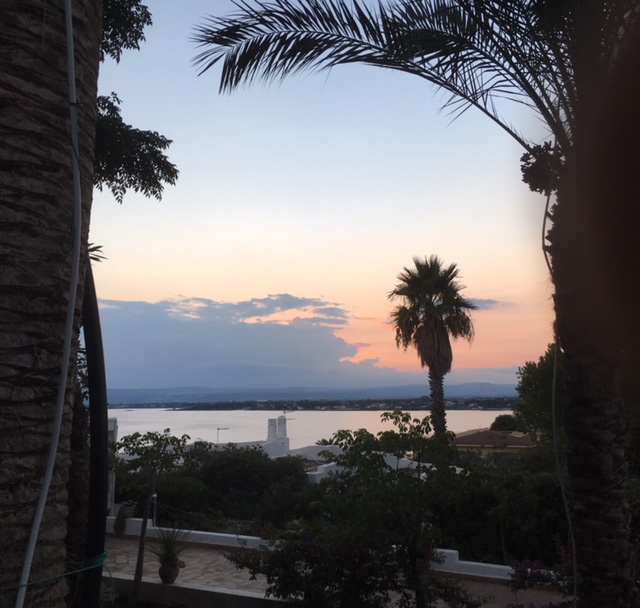
In PC 134 I scribbled about a week in Sicily, the largest Mediterranean island. My memories of our time there are tainted by the experience of getting our Avis hire car when we first arrived, around 2000. Eventually finding the outside cabin that was their office, on opening the door we were confronted by some ten would-be renters like us. One agent was on duty; ‘take a number and wait’. We took an identity number, 69, and immediately did the maths; we were in for a wait of 90 minutes or more as currently they were dealing with ‘55’! Very fortunately a couple has taken two numbers and, having successfully hired their Fiat, gave us their spare – 60! Still, it was almost midnight when we arrived at our apartment south of Syracuse.
In Brazil they have a CPF (Cadastro de Pessoas Fisicas – Natural Persons Register) with its 11-digit number issued by the Brazilian Inland Revenue service. If you want to purchase anything more than your normal groceries, you have to present your CPF, making it pretty much essential for life in Brazil. Brazilians also must carry a traditional ID card, complete with a photograph and date of birth.
Richard 5th April 2024
Hove
http://www.postcardscribbles.co.uk
PS EU countries will not accept a passport issued more than ten years ago.
Note 1 “ID cards are the key to knowing who is in this country.” https://www.thetimes.co.uk/article/12144546-2b16-4e3f-9b85-08e66307aeb2?shareToken=48334f5b085167a7abc7487cd64b7113
Note 2 Spelt dean, but originally in old English ‘dene’, it’s a common name for a valley and frequently found as a compound to place names. To the east of Brighton are Rottingdean, Ovingdean, Saltdean and Woodingdean. Two of the city’s northern suburbs are called Coldean and Withdean.
Note 3 The UK Armed Forces refer to them as Identity Discs but ‘dog tags’, the American term, is almost universal.
Note 4 This was before the long, beautiful bridge that now spans the Oresund was built.
 postcards