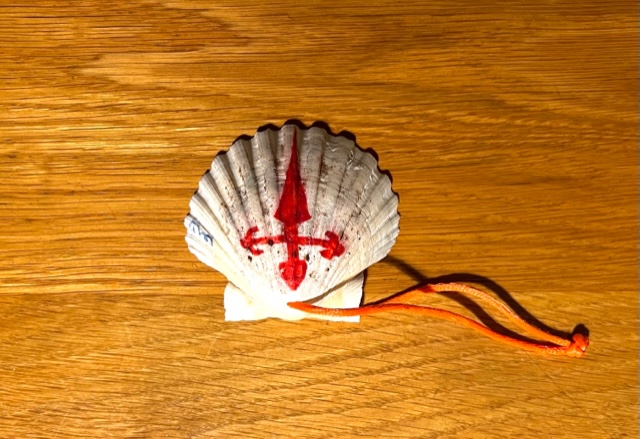
My friend and yoga chum Armi, an Italian from Naples who is a head trainer within the Schwarzkopf company, likes nothing better than sitting on a mountain top in solitude for days at a time, his antidote for the crazy modern world of his work and of his home city. Recently he walked the second piece of the Camino Trail from Santiago to Finisterre where Spain meets the Atlantic. On his return he gave me a little shell. Deeply touched, I asked what the cross was. “St James’. Obviously.”
Well actually it wasn’t obvious to me so I googled it and one thing led to another and hence these scribbles.
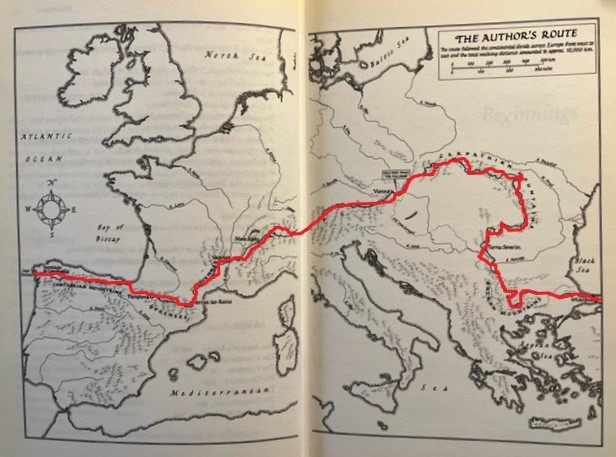
If you’re into walking, it’s possible you’ve thought of walking one of the Caminos, the famous pilgrim routes that converge on Santiago de Compostela in northwestern Spain. Regular readers will remember my mentioning the amazing walk undertaken by Nicholas Crane in 1992 from Cape Finisterre in the west of Spain to Istanbul, the capital of Turkey, recounted in ‘Clear Waters Rising’. Nicholas’ route was along the ridge of Europe; rivers to his left ran to the Bay of Biscay, the English Channel and the North Sea, those to his right south into the Mediterranean. His wife Annabel accompanied him on the first five-day 100kms, along the pilgrim way to Santiago de Compostela. (Note 1)
You may not be into walking but feel to need to get back in touch with yourself during a period of enforced solitude, for walking can do that; you could easily, of course, find yourself chatting to total strangers along these pilgrim trails, if you so wished. For those of a religious conviction and/or spiritually inclined, walking the path to the final resting place of St James is a way “to pay penance and seek forgiveness for one’s sins before arriving at his tomb”.
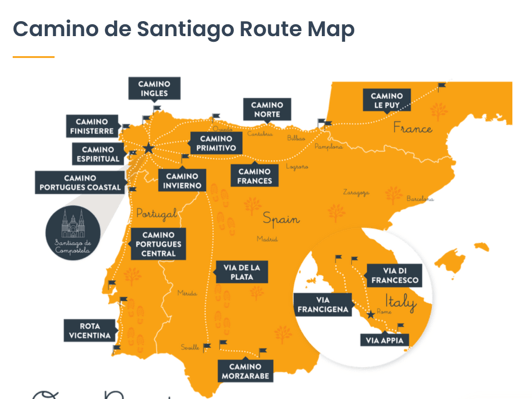
The most well-known camino is the French Way, Camino Francés, which starts in Saint-Jean-Pied-de-Port in the French Pyrénées and runs through Pamplona, Logrono, Burgos and Leon before reaching Santiago de Compostella; some 800 kms. The Portugues Way should start in Lisbon, run through Coimbra and Porto, then through Vigo to Santiago. The Camino Ingles, for those pilgrims coming from Ireland and England by boat, starts in Ferrol or A Corunna.

But who was Saint James and how did his remains end up in northwestern Spain? It’s believed that St James had travelled from Jerusalem across Europe, preaching the gospel and had ended up in present-day Galicia, where he recruited seven men to be his apostles. On returning to Jerusalem, he was arrested and in 44AD King Herod Agrippa ordered his beheading. Apparently, his head was placed under the altar of the Armenian Apostolic Cathedral of St James, where I suppose it remains.
Hearing the news, those seven local apostles travelled to Jerusalem, found his headless body and transported it by boat to northern Galicia. I understand the need in storytelling for the suspension of fact and the growth of mystery and there’s much in this history. Coming ashore, they laid his body on a rock, which proceeded to grow around the body forming a holy sarcophagus; you just have to believe this could happen! His body lay undiscovered until 813, despite someone having thoughtfully placed a sign on the rock which read “Here lies James, the son of Zebedee and Salome.” The discovery was reported to the King who visited the site, appointed James Patron Saint of the Galicia-Asturian Kingdom and built a church in his honour.

St James by the Dutch painter Rembrandt
St James the Patron Saint of Spain, a simple disciple dressed in brown robes, somehow metamorphosed into a warrior saint complete with sword and became known as St James the Moorslayer (Santiago Matamoros). (Note 2) But the battle in which he was supposed to have appeared, the Battle of Clavijo, is a mythical one, believed for centuries to be historical but used as a popular theme of Spanish traditions regarding the Catholic expulsion of the Muslims.
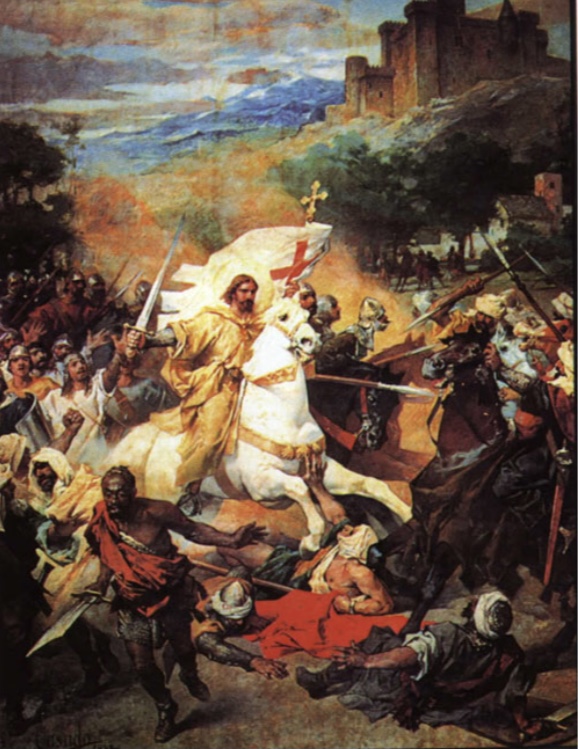
Muslim bashing is no longer tolerated in modern Catholic Spain, those in power seeking more understanding and less offence and there’s been some debate about whether the paintings and statues of St James the Moorslayer should be removed, particularly as there’s no evidence of the battle taking place. Further reading revealed another image of James on a horse killing white faced men, so historical fact, myths, superstition all into the melting pot!
Myths abound. After my medical decluttering postcard one could be forgiven for thinking that if you brought all the ‘sacred’ bits and bobs of Christian martyrs from all over the world together, you could make a number of bodies with quite a few extra bits. The authenticity of James’ remains has generated much debate and research. The difficulties of transferring his body to Galicia is just one of the gaps in this mixture of magical legend and historical fact. According to catholic tradition the corpse of James the Greater (minus his head because that’s under the altar in Jerusalem) was retrieved from a shipwreck near large scallop beds and buried in Santiago de Compostella (Note 3). So that’s how his cross is formed on a scallop shell, and why one of the best recipes for cooking scallops is Coquilles St Jacques.
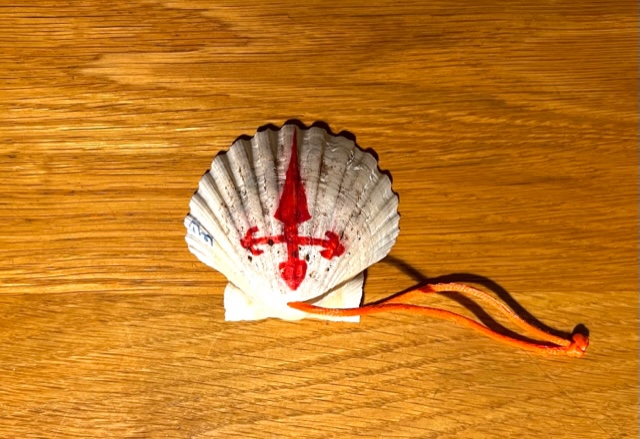
So, St James’ cross is the sword with which he was beheaded, or the one the mythical St James used centuries later in his warrior role, and the three fleur-de-lis represent ‘honour without stain’, a reference to the character of the Apostles.
Phew, that took some explaining. Thank you Armi!
Richard 29th December 2023
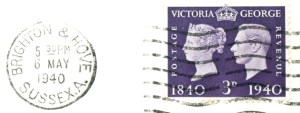
Hove
http://www.postcardscribbles.co.uk
PS In ‘The Way’ (2010) Martin Sheen plays Dr Avery. a father who travels to Spain to retrieve the ashes of his son, killed during a storm walking The Camino. Avery decides to continue to Santiago with his son’s ashes in his backpack.
Note 1 Nicholas reckoned his trip would involve 20 million steps. It took him from May 1992 to October 1993.
Note 2 Moors from Morocco crossed the Straits of Gibraltar in 711 and ruled Spain until 1492, when they were finally defeated by the Catholic King Ferdinand and Queen Isabel
Note 3 Compostella translates into ‘Field of Stars’
 postcards
Brilliant research and a very witty conclusion !
It always intrigues me as to how and why various myths and legends have surrounded the Christian faith.
LikeLike