
I hadn’t thought of Arthur Stace for way over a decade, but his name came up in an excellent book, The Household Guide to Dying, by Debra Adelaide, recommended by my chum Chris Popham (See PC 348 Frogmore Devon).
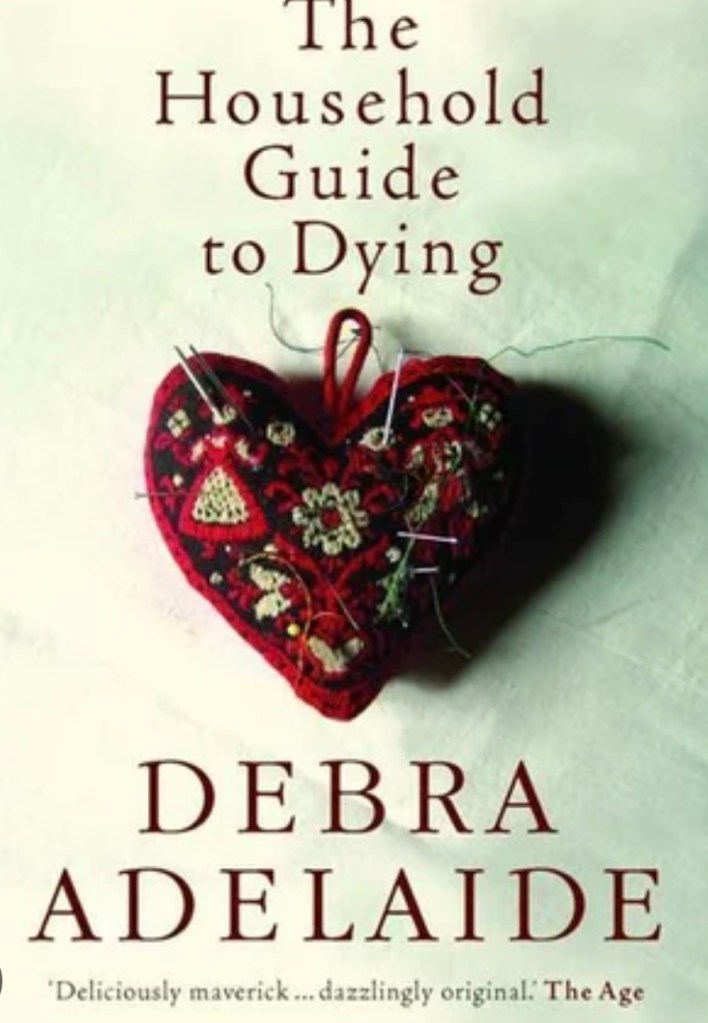
Initially I wasn’t sure whether this was my sort of book, the title suggesting something mawkish and sad. How wrong I was! I finished it some weeks ago, sitting by the pool in Estoril, soaking up both the sun and the interesting story. It concerns Delia, an established author, who has written many family guide books, ‘The Household Guide to Laundry’, ‘…. to Gardening’ for example. Suffering from terminal cancer, she persuades her commissioning editor that she should write a guide for her family and others, so they can continue without her; they call it ‘The Household Guide to Dying’. Additionally, there are things she feels she needs to do while she still can, for example go to places that were pivotal in her life and the story is interwoven with these threads.
It took me a while to understand it was set in Australia but when Delia mentions Mr Eternity, Arthur Stace, it made sense.
In theology eternity means an endless life after one’s earthly death – the concept of one’s ‘immortal’ soul destined for eternity. This is a fundamental belief in Christianity, in Islam and in Hinduism. But Buddhism teaches something completely different, that there is no perception of an eternal metaphysical aspect of human personality. The only common ground is a belief that one’s spirit leaves the body. Buddhists believe that, as we are such a mixture of the physical and psychical, the spirit is ‘reborn’ is some form, depending on the laws of karma, the ‘cause-and-effect’ laws of our material existence. All religions believe where your spirit goes depends on how you perform in your life. You might go up, you might go down, you might go sideways although reincarnation in some animal form is viewed in a negative light and is seen as a backward step in the journey to self-mastery. So no concerns about ‘coming back’ as a snake, for instance!

Eternity is a noun and eternal an adjective. Classic philosophy defines eternity as what is timeless or exists outside time. Eternal and forever are synonymous but there is a subtle difference. Forever refers to an endless or seemingly endless period of time. Eternal means always lasting without a beginning or end: think of eternal as existing outside of time. Easy huh?
A British R&B girl group formed in 1992 called themselves Eternal and there are ‘eternal flames’ in cathedrals and public squares across the world that pay homage to those who died in battle. For me the word will always take me back to the closing minutes of the Sunday morning service at the Royal Military Chapel at Sandhurst. Kneeling on hassocks and, hoping our highly polished parade boots were not being scuffed by the flagstones, one thousand officer cadets sang quietly ‘Eternal Father’, in memory of Merchant and Royal Navy sailors who had lost their lives during conflict:
“Eternal Father, strong to save, Whose arm does bind the restless wave, Who bids the mighty ocean deep
Its own appointed limits keep; O hear us when we cry to thee For those in peril on the sea.”
From ‘Here to Eternity’ was the title of a 1953 American romantic war drama starring Montgomery Cliff, Burt Lancaster, Deborah Kerr and Frank Sinatra, based on the James Jones book of the same name. I guess we’ve all seen the B&W photograph of Burt Lancaster and Deborah Kerr on the beach?

James Jones found that the phrase ‘from here to eternity’ was first used by Rudyard Kipling in his 1892 poem ‘Gentleman Rankers’. Kipling wrote about soldiers of the British Empire who had lost their way and were ‘damned from here to eternity’. It had been incorporated into the ‘Whiffenpoof Song’ by junior students at Yale University and Jones liked it!
In the British Army in the C19th a ‘gentleman ranker’ was an enlisted soldier suited through education and social background to be a commissioned officer, It’s a long poem but the final verse is:
“We’re poor little lambs who’ve lost our way, Baa! Baa! Baa!
We’re little black sheep who’ve gone astray, Baa – aa – aa!
Gentleman rankers out on the spree,
Damned from here to eternity,
God ha’ mercy on such as we, Baa! Yah! Bah!”
Mr Eternity? Oh! Yes! Sorry … got distracted! Somewhere ‘Delia’ mentions Arthur Stace! Arthur Stace (1885 -1967) was the fifth child of alcoholics and brought up in poverty in the Sydney suburb of Redfern, By his 12th birthday, with no formal schooling and often in trouble with the authorities, he was an alcoholic, had already spent some time in prison and was made a ward of the state. In 1916 aged 32 he joined the Australian army and served for three years during World War One. Over ten years later Arthur Stace was moved to attend church and in 1932 heard these words from the Reverend John Ridley:
“Eternity, eternity, eternity; I wish I could sound or shout that word to everyone on the streets of Sydney. You’ve got to meet it, where will you spend eternity?”
Something clicked inside the head of Arthur Stace; in some way the words spoke directly to him.
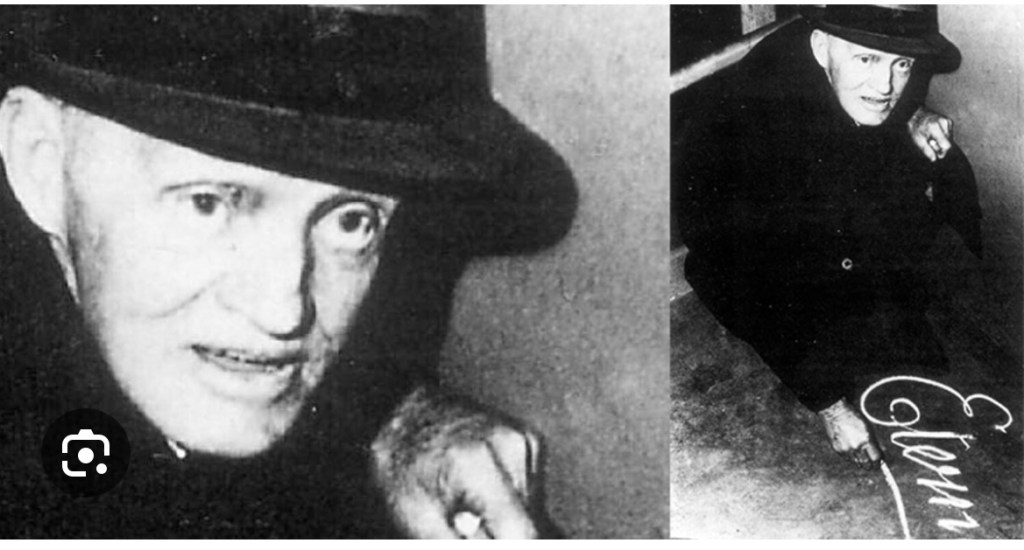
He was so touched that for the next 35 years Stace got up early and wrote the word ‘Eternity’ in yellow chalk wherever he could, on pavements, on buildings, on walls. For those living in Sydney at the time, the fresh yellow script was there during their morning commute into work, but whoever was doing it was a mystery; so the man who wrote ‘Eternity’ became a Sydney legend, only resolved in 1955 when the Reverend Lisle Thompson saw Stace take a piece of yellow chalk and write ‘Eternity’ on the pavement. It’s estimated he wrote it over half a million times.

So, see you in the next life …. or more likely, next week.
Richard 24th November 2023
Hove
 postcards