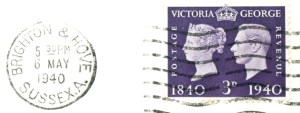
I am no more qualified than anyone else of my gender to write this postcard, but I am indebted to Caitlin Moran for raising the issues in her book, ’what about men?’ – printed with no capital ‘W’ so very modern!
I mentioned earlier in part one (PC 352 15th September) that teenager boys are now frightened about talking to teenage girls. Curiosity about females is often met by a visit to a soft porn site, easily accessible through their mobile phones. Years 7 and 8 will watch porn in groups, huddled around someone’s mobile and begin to think that what they are watching is real life, it’s what they expect when they try sex for the first time!
Recently there was an interesting piece by 30 year old Sean Russell, a features sub-editor and writer at The Times, on just this subject: “The Problem with porn and teenage boys? I should know.” (Friday 18th August 2023) It’s a long article so read if you can: (https://www.thetimes.co.uk/article/2b5f2a4e-b8f6-404c-993e-2ffca1a161ba?shareToken=f6a3836070dd738b4d8e661572034d00) Simon finishes by saying ‘After some time and having formed proper relationships in my twenties, porn became something separate from sex and it was wonderful.’

And for an IRL example? Two 15 year olds formed a relationship over this summer and the strength of their feelings eventually led to a bedroom. After the initial inevitable fumbling, they got into it …. until the boy started to choke the girl, having learned from some porn site that this was what girls wanted. Sadly these two teenagers are no longer together, both probably traumatised by their experience and fearful of committing to a future relationship. Rejected and confused boys often get drawn to the misogynistic world of Andrew Tate and his influence has become odious (Note 1).My daughter, a teacher in a secondary school in Farnham, says Tate’s views are absorbed by innocent teenagers like water by a dry sponge.
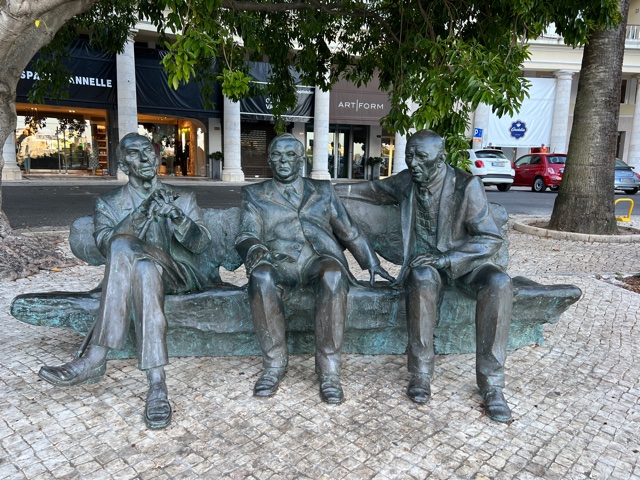
In Estoril there is a bronze piece of three men sitting on a bench. It could be titled ‘A Male Conversation’ as the body language frozen in bronze suggests little empathy or interest between the three! (Note 2)
Moran has a great vignette of a male conversation involving two male cyclists. They had just competed in a time trial up and down mountains and get onto the same train to go back to their respective homes. I looked up the dictionary definition of a conversation: ‘a talk especially an informal one, between two or more people, in which news and ideas are exchanged’. In the overheard conversation these two exchanged every aspect of the race they had just taken part in but a simple exchange of information without a drop of personal emotion. When they arrived at the rail terminus they probably simply said: “Bye! Good talking to you.” And went their separate ways without even knowing the name of the other person; whereas two women, according to Moran, would have known each other’s names, how many children etc etc!
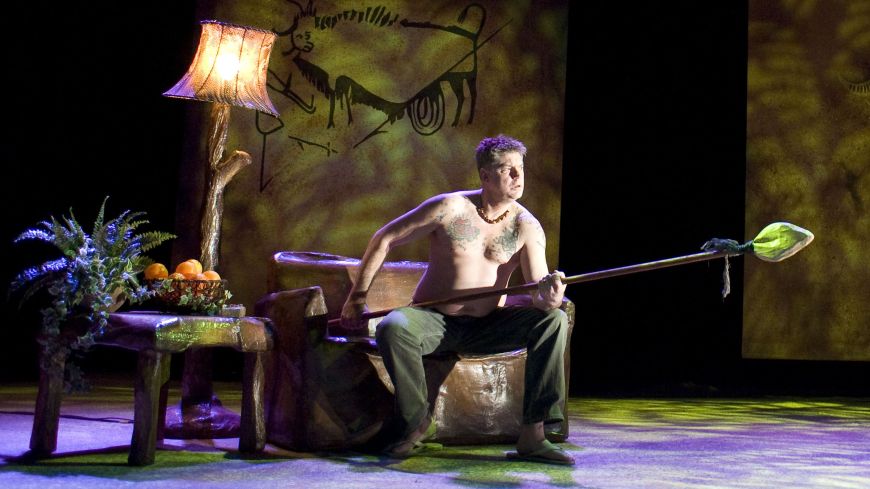
Many years ago a group of us went to see Australian Mark Little’s “Defending The Caveman”, a one-man show in Wimbledon London. The show ‘catalogues the instantly recognisable traits that separate men and women’; understanding our differences, he suggests, gives us the potential to build bridges rather than engage in open warfare.’ Moran’s simple vignette of the cyclists mirrors Little’s sketch about two male anglers, who arrive at the river bank for a few hours of fishing. They immediately stake out their pitch with a suitable distance between them, cast their flies, and settle into contented silence.
After half an hour, one shouts to the other:
“Fancy a beer? There are some in the car.”
A minute goes by.
“Yup!”
Another minute.
“You goin’ to get them?”
Another minute.
“No! I paid for them. You go!”
Another minute.
“OK! Then.”
This is a good example of the average male’s ‘deep and meaningful conversation’.
But how can we accept the stark statistical differences between the sexes:
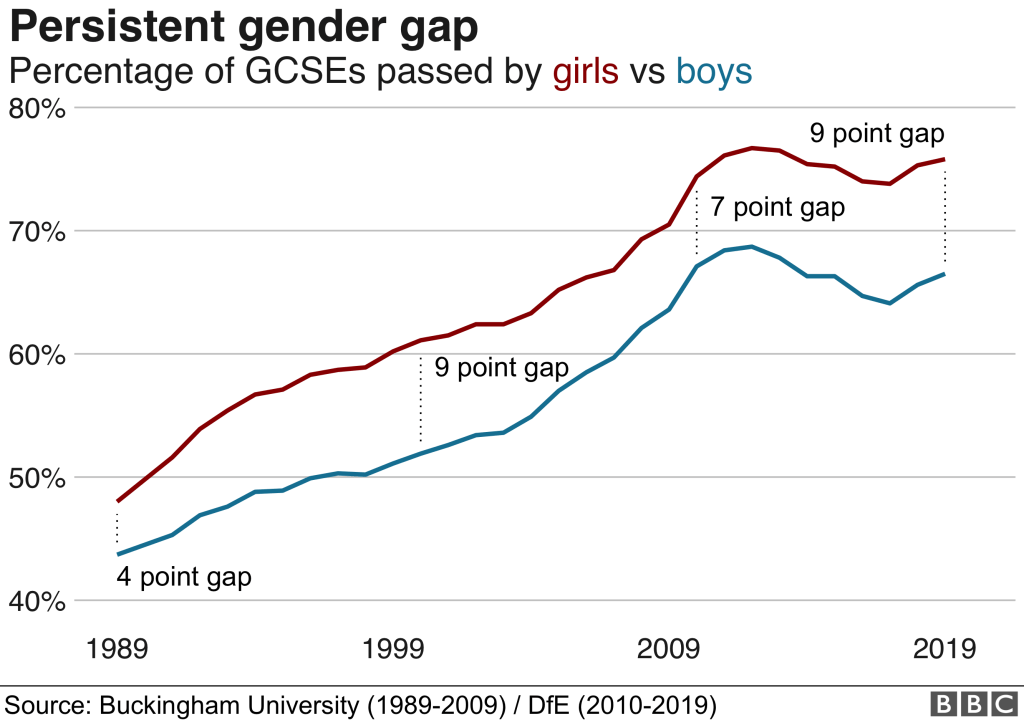
Boys underachieve at school compared with girls, are more likely to be excluded, less likely to go into further education and more likely to be prescribed medication for ADHD.
After school, men make up the majority of gang members, of the homeless, of the unemployed, of suicides (75%), of the prison population (95%) and are most likely to lose custody of their children in a divorce.
Statistics are always open to interpretation and one glaring factor skewing the percentages in adulthood is the fact that only females can give birth. But it’s an extremely depressing list of lost opportunity, lost lives, of negativity and we all need to change what some see as the inevitable!
A British MP has suggested there be a Minister for Men to mirror that for woman. Predictably the columnists had their field day but one more credible suggestion was a Minister for Young Men or even Boys? I obviously have my finger on the national pulse, as a few days ago an ex-client of mine who works at AWE, Bob Kingston, posted on LinkedIn about someone wearing a T-shirt with the words ‘Boys Get Sad Too’ emblazoned on the front. Further enquiries revealed a website (www.boysgetsadtoo.com) promoting male mental health. Bob wrote: “I think what they stand for is very true in this day and age, in that boys/men don’t share feeling and bottle them up as it’s seen as a sign of weakness. In my view sharing feelings should be seen as a strength.”
I am proud to be a man; my gender at the time of my birth was not my choice! Would I want to be any other gender, as Moran questions? Never given it much thought, although nowadays gender fluidity offers new options! So if you are a man, read this book. If you are a woman, also read this book.
Richard 29th September 2023
Hove
Note 1 Andrew Tate is an extreme misogynist encouraging young teens to, among other things, become ‘incels’, a woke description meaning involuntary celebrate.
Note 2 It’s not meant to illustrate male conversations! The three men, Jan Karski, Jerzy Lerski and Jan Nowak-Jezioranski were Poles living in Portugal and were noted for helping their nationals escape the clutches of the Nazis during WW2.
 postcards