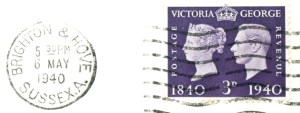
‘The time has come’ the Walrus said ‘to talk of many things, of shoes …. and ships …. and sealing wax, … of cabbages … and Kings.’ (Note 1)
I love museums but often find that after an hour or so my initial enthusiasm and interest has waned, especially if you can see through to another exhibition hall …. leading on to another exhibition hall ….. leading on to …… and then the inevitable shop!
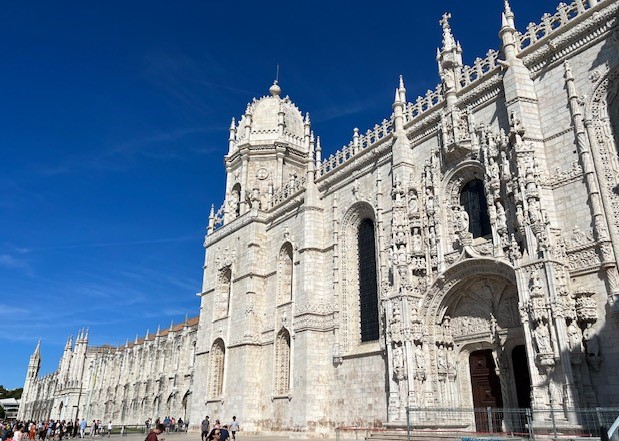
At some stage during my current stay in Estoril it was suggested that we visit the Jerónimos Monastery in the Lisbon suburb of Belém, after an admission that I hadn’t yet wandered the hallowed corridors where the monks had first created the little custard tarts know as Pastel de Nata or Pastel de Belém (Note 2). We could also see the Torres de Belém.
Having booked online for a 1030 admission, we parked the car, saw a huge queue and thought it was a good thing we booked! We walked over to the head of the queue to show our tickets and were pointed to the back of the queue, some 200m long! Something was seriously wrong with the way this is organised! It as a warm, sunny day but the queue was stationary so we decided to see the Tower of Belém first.
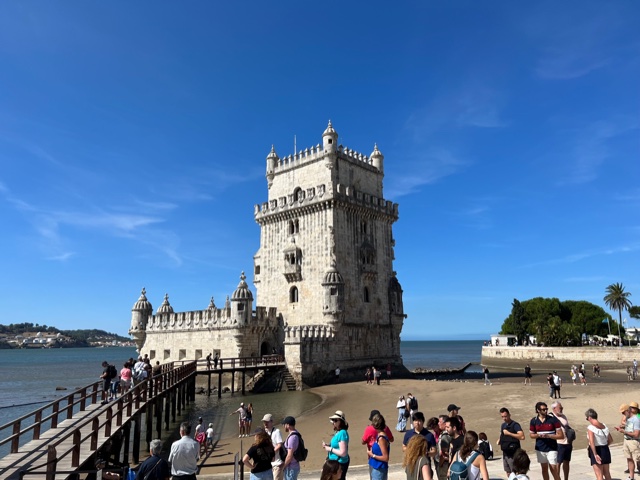
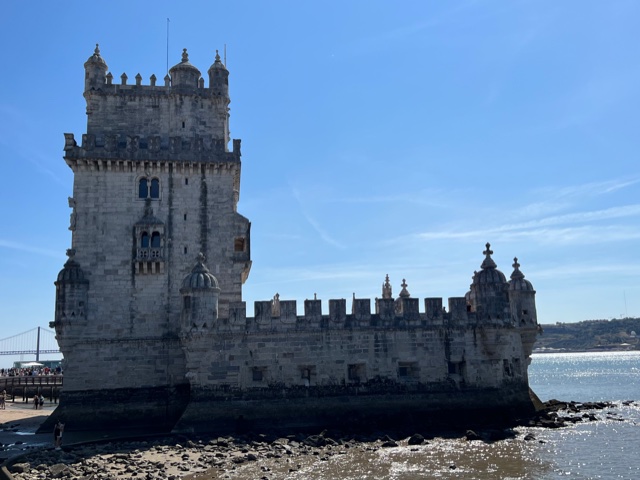
The tower, which used to stand on an island in the Tagus River before some land reclamation, had a similar length of queue so we asked a ticket seller whether we could get a refund and why there was a problem. Apparently the authorities has decided to reduce the visitor capacity of the monastery from 200 to 60 but hadn’t altered the online booking system!
Near to the tower stands a very powerful stone projection of the reach and influence of Portugal in the C15th and C16th. Today in the C21st it’s hard to remember just how powerful this little country of 10.5 million people (Note 3) had been.
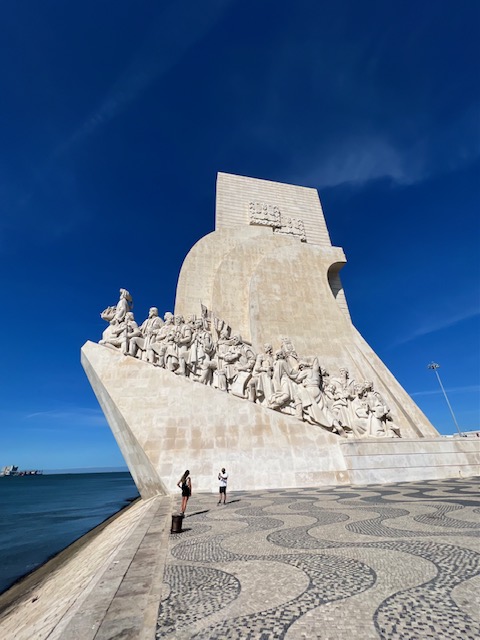
The first figure on the ‘prow’ of the Monument to the Discoverers is Prince Henry The Navigator (1394-1460), tasked by King Manuel I to explore!!
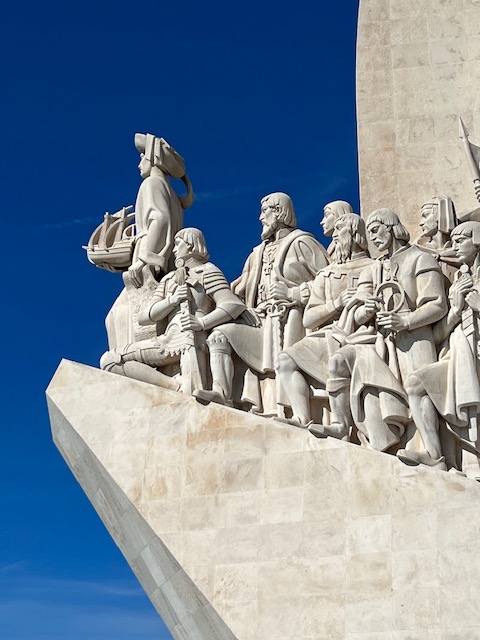
Third on the eastern flank is Vasco de Gama who discovered India in 1498 and next Pedro Alvares Cabral (see PC 349) the first European to reach Brazil in 1502. Further exploration saw Portuguese influence stretching across southern Africa, to Australia, Goa (Note 4), Macao and East Timor.
In 1788 Governor Phillip claimed the continent of Australia for Britain, but only as far west as the 135° east longitude, not wanting to upset the Portuguese who, under the Treaty of Tordesillas, still had a presence in the area, particularly in Macau and East Timor. By 1825, however, Britain was powerful enough and found it convenient to adopt the original line of 129° east, which today demarcates Western Australia from the Northern Territories.
So we planned to return, just Toni and me, to see the Maritime Museum; plenty of ships there, one might think.
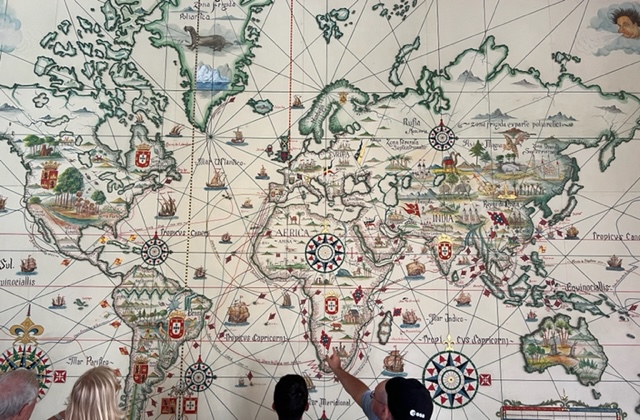
The charts are fascinating, given the age when they were drawn …..
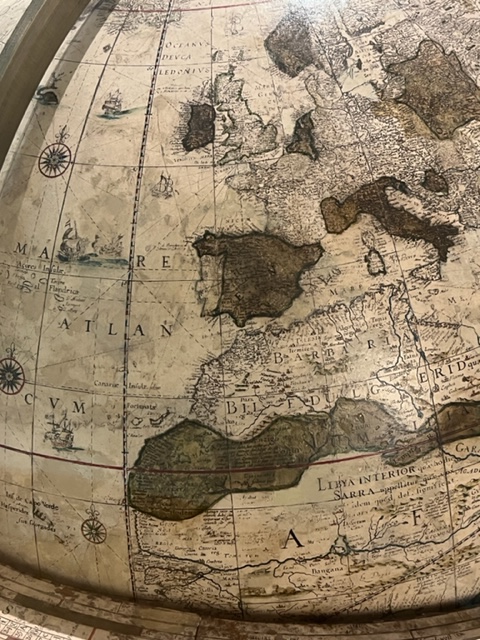
…. and this glorious globe dated around 1645 by the Dutchman Willem Jansz Blaeu, amazing in its details …….
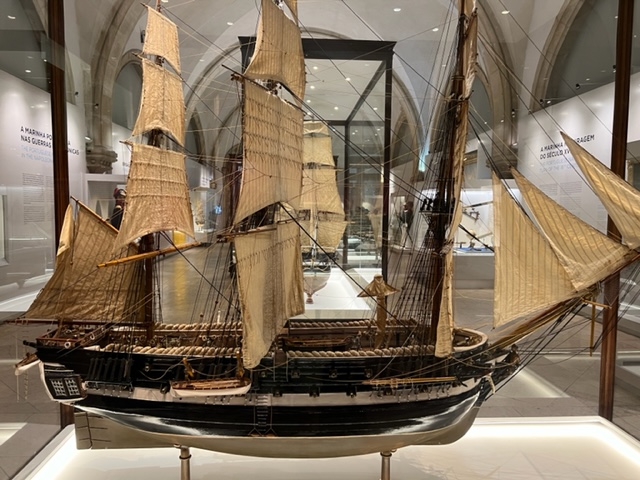
….. and some models and oil paintings.
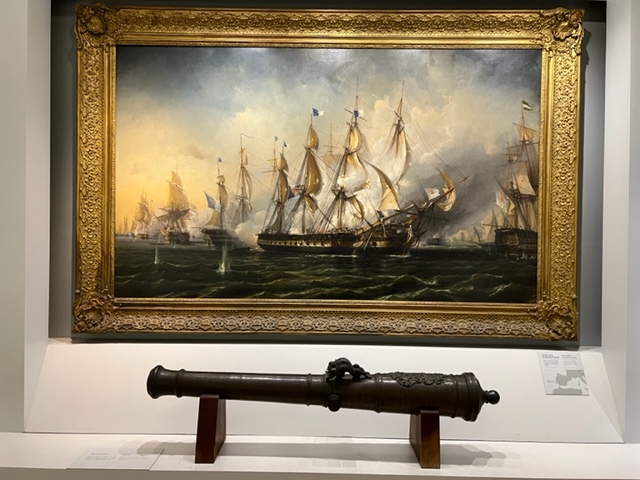
In the third exhibition hall, or was it the fourth (?), we came across ‘The British Ultimatum’ of 1890. The British required Portugal to give up the land between her African colonies, Angola on the west coast and Mozambique on the east; Britain would use force if necessary. So Portugal acquiesced and the land became the British colonies of Malawi and Rhodesia, now Zimbabwe, Malawi and Zambia. Portugal was extremely embarrassed by its inability to resist the British demands, and one can see here the seeds of dissent that would flower in revolution at the beginning of the C20th.

Angola on the west coast and Mozambique on the east
In some ways the large hanger-like building that houses a collection of boats, yachts and state barges is a metaphor for Portugal today.
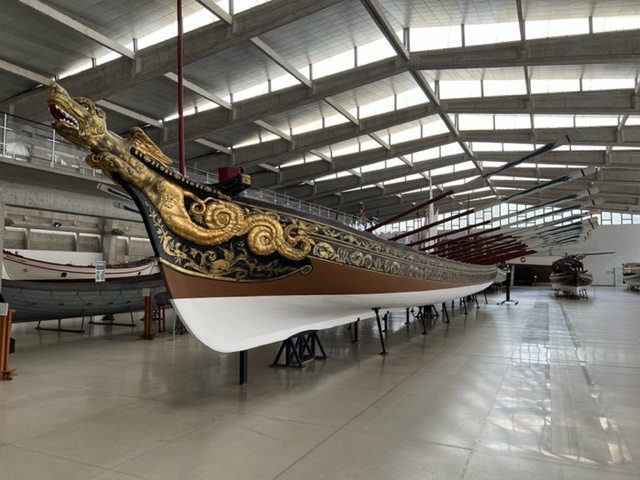
Fascinating but rather dusty, reflecting a more glorious age. The Royal Barge was constructed in 1784 and was powered by 78 oarsmen using 40 oars.
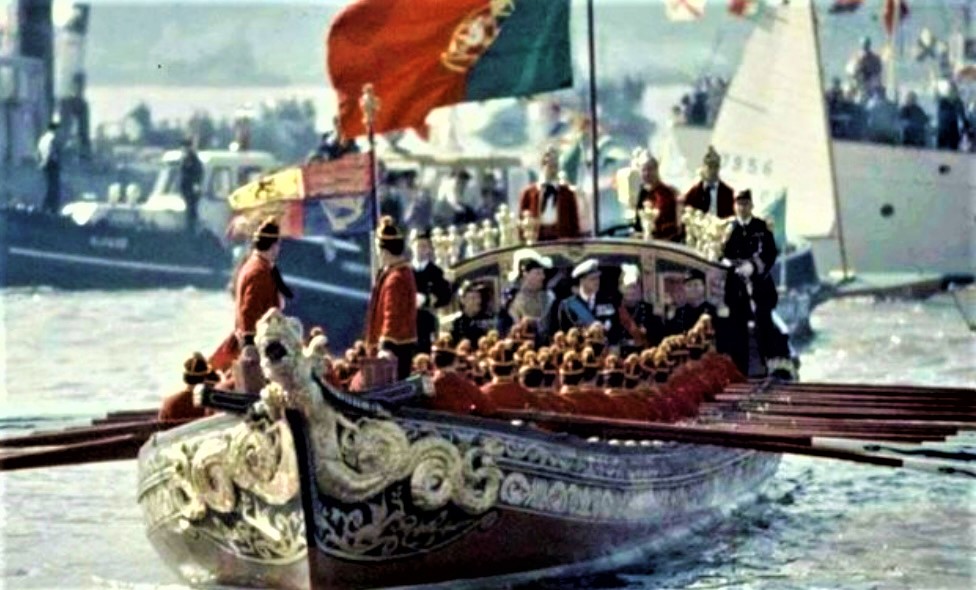
It was last used when the late Queen Elizabeth II came on a State visit in 1957. Today it’s dusty!
So, onto Lewis Carroll’s ‘… and Kings’!
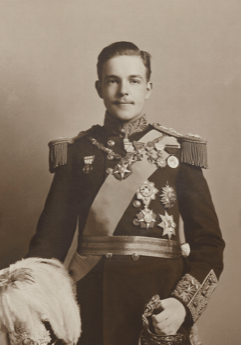
In my postcard about Mafra (PC 130 from 2018) I mentioned that when the republic was declared on 5th October 1910 the King, Dom Manuel II, one of whose nicknames was The Unfortunate, left the country rather quickly by sea. He eventually settled in Fulwell Park in Twickenham, London. His rapid departure was probably prompted by the memory of his father King Carlos I and his elder brother Crown Prince Luis Filipe’s assassination in Lisbon in 1908. Manuel died young in 1932 aged 42 and conspiracy theorists did not rule out foul play! His body was returned to Portugal by a Royal Navy Cruiser (HMS Concord) and, after a State Funeral, interred in the Royal Pantheon of the House of Braganza.
So no cabbages but ships, shoes on our feet, sealing wax on an ultimatum and now, no kings!
Richard 22nd September 2023
Estoril
PS Next year on the 25th April Portugal will mark the 50th Anniversary of the 1974 Carnation Revolution which saw the return to democracy after the dictatorship of Salazar (1928 – 1968)
Note 1 Lewis Carroll, best known for his ‘Alice’s Adventures in Wonderland’, also wrote a poem called ‘The Walrus and the Carpenter’. It’s about entitlement and encroachment; it’s lovely nonsense but please ….. read it in full?
Note 2 Traditionally large quantities of egg whites were used to stiffen the clothes of the monks and nuns. The surplus egg yolks were used to make pastries and custard tarts. After the Liberal Revolution in 1820 and under increasing likelihood of closure, the monastery monks started selling Pastéis de Nata to the nearby sugar refinery. The monastery closed in 1834 and the recipe was sold to the refinery.
Note 3 Of these 10.5 million, 94% are Portuguese, 1.5% Brazilians, 1.5% Black, 1.5% mixed race and 1.5% other Europeans – but ask another reference and you get a different make up!
Note 4 Goa on the western seaboard was invaded by India in 1961 and after a mere 36 hours became an Indian state. (See PC 330)
 postcards