PC 341 Tradition – Just the Way It Is

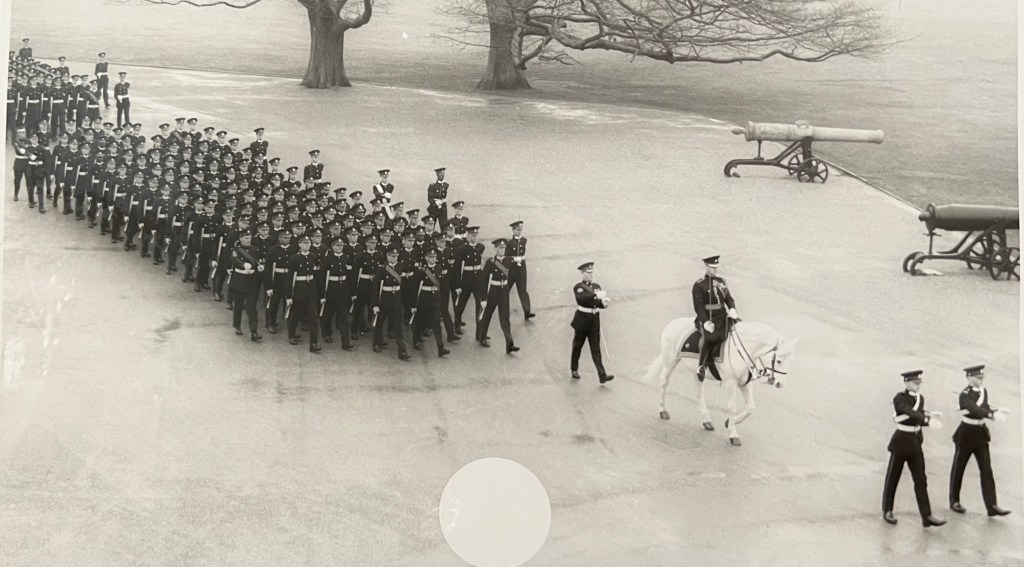
Traditionally two stick orderlies led the 1000 officer cadets onto Old College Square at the Royal Military Academy Sandhurst for the end-of-term parade. That’s me on the extreme right!

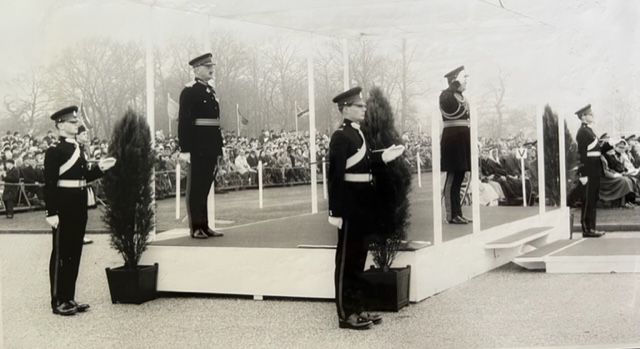
I don’t think I have personally contributed to the rich fabric of our traditions, rather pompous to think I might have done, but the late Queen’s funeral and more recently the new King’s coronation have reminded me just how deep tradition is imbedded into the way we do things in the United Kingdom. Seems a long time ago now when Charlie Wilson and I were ‘Stick Orderlies’ and formed the guard for the Inspecting Officer for the Commandant’s Parade; in fact December 1966! Tradition at Sandhurst dictated everything.
In a constitutional monarchy the coronation of a new sovereign (Note 1) is a hugely important event, a time when tradition dictates so much of what happens and we the public marvel and gawp in equal measure.

Unless you’re involved …… like the current Leader of the House of Commons, Penny Mordaunt, who had to carry the Sword of State, weighing 3.6kgs, for nearly an hour – keeping it upright of course! (Note 2)

Unless you’re involved …..  like Charles who, as King, placed his hands on a bible from the C6th: the Augustine Gospels are regarded as the most precious and important medieval manuscript to survive in England. Then tradition had it he had to be dressed in the colobium sindonis, supertunia and girdle, a sort of solid gold overcoat before being given some spurs, representing bravery and knighthood, the bracelets of sincerity and wisdom, the Sovereign’s orb, the Ring of Kingly Dignity and the rod of Equity and Mercy.

Caitlin Morran of The Times wrote it reminded her of the end of a TV game show called Crackerjack, when kids had to hold an increasing load of prizes and cabbages. I think the ‘Glove of God’, looking remarkably like your average oven glove, was the last straw! No wonder Charles looked rather overwhelmed by the whole occasion.

Unless you are involved ….. like the Archbishop of Canterbury who played an important role, having earlier put his foot in it saying he thought the public should swear ‘allegiance to the new king’ – sort of ‘touch the forelock’? In 2023, I don’t think so!

And each to their own, but I personally find it difficult to believe that the chrism or holy oil used to anoint the king came from God. I would prefer to understand that our upmarket Waitrose had a special offer, or maybe they bought it at the King’s grocer Fortnum & Mason, but I do know it was vegan.

Other snippets of information that intrigued me? The Roman Catholic prelate Vincent Nichols became the first of his office to play a part in a coronation since the Reformation (1517-1555). The Chief Rabbi, Ephraim Mirvis, reminded the congregation that in 1189, when Jewish leaders came bearing gifts to the coronation of Richard Coeur de Lion (Note 3) they were stripped, flogged and thrown out of the abbey. Fortunately we have a different view in 2023. And you have heard of King’s Troop, Royal Horse Artillery? The ‘king’ in this case was George VI and the troop provides gun carriages for state funerals and uses its 13 pounder guns to fire salutes on State occasions. Apparently, at the moment, all the riders are female, as is the Officer Commanding.

As I dutifully watched the King’s Coronation Concert in the back garden of Windsor Castle, on the Sunday evening of that weekend, I was reminded of the overheard conversation between two American tourists. As a Boeing 747 (so that dates it!) roared overhead on its way to landing at London’s Heathrow airport, one turned to the other and yelled:

“Why did they build the castle so close to the airport?”  (Note 4)

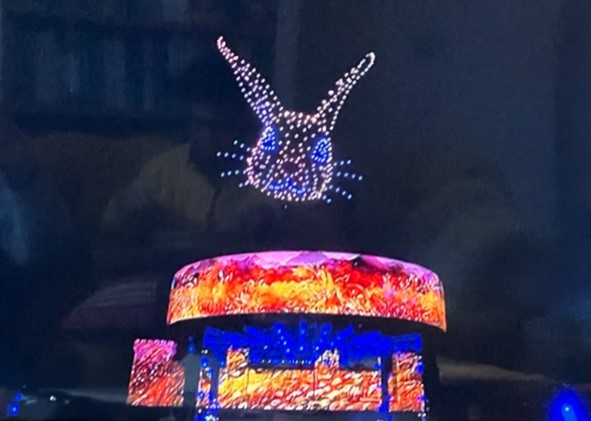
And never one to miss an opportunity to have fun, our rabbit Francisquinha (see PCs 172, 217 & 331) managed to appear above the castle holding on to dozens of drones!
It goes on! Next week, on July 5th the new King & Queen will be presented with the ‘Honours of Scotland’. The oldest crown jewels in Great Britain, they were first used in the coronation of Mary Queen of Scots in 1543, then in 1707 put away in a chest when Scotland was joined to England in The Union.

The newspaper says they were ‘rediscovered by Sir Walter Scott (and others?) in 1818’. Brief descriptions such as this create incredulous thoughts! What? Stuffed in the attic, in a cellar, in someone’s bothy, these priceless items wrapped in some cloak or blanket. And who told Scott where to look? Ah! History huh!

But at the end of the coronation, seven thousand of the troops who had taken part marched into the grounds of Buckingham Palace and formed up in long ranks on the grass; not easy marching in time on grass. Rifles were laid on the ground, headgear was removed and as the new King and Queen arrived at the rear of the building, the Sergeant Major in charge of the parade gave the order:

 “Three cheers for His Majesty. Hip! Hip!”

 ……… and the sound of thousands of voices shouting ‘Hurray’, three times, reverberated around the grounds, over the roofs of  the palace and down The Mall to Trafalgar Square.
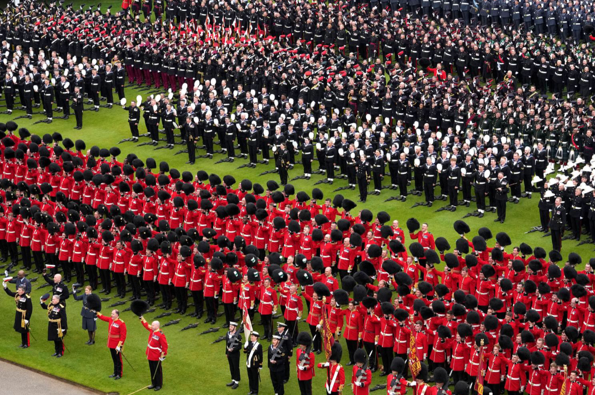
Watching it on television produced a lump in my throat, the slight wetness in the eyes and the thought: “Yes! Wonderful! We do this sort of thing really well. That’s tradition.”

Yes! That’s tradition.

Richard 30th June 2023

Hove

www.postcardscribbles.co.uk

PS At a rehearsal for the King’s Official Birthday Trooping the Colour Parade, one of the bandsman succumbed to the heat.

Looks as though, even horizontal, he is still trying to play – probably a flat note!

Note 1 For instance, Victoria in 1838, Edward VII in 1902 (delayed a month because of acute appendicitis), George V (1911); Edward VIII’s was cancelled due to his abdication and his brother George VI was crowned instead in 1936; then Elizabeth II in 1953.

Note 2 The weight of the sword was eased by placing its hilt in a small pocket at the bottom of a sash around her shoulders.

Note 3 Richard 1 (1157 – 1199) also ruled as Duke of Normandy, Aquitaine and Gascony. His statue is outside the Houses of Parliament.

Note 4 The building of Windsor Castle was started by William the Conqueror in 1070 on some high ground overlooking the River Thames. It was completed 16 years later.
PC 340  Serendipity

My postcards have covered an eclectic range of subjects; you have only to look at the vague synopsis in PC 300 (September 2022) to see I have, for instance, scribbled about travel, about health issues, about sailing, about current news and whatever has peaked my interest. This week’s title was prompted by reading a recent obituary, but let me explain.

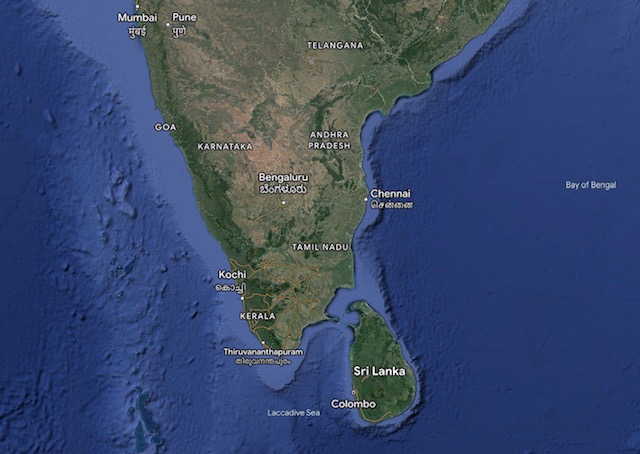
If I reach for my dictionary I find: “Serendipity – The occurrence and development of events by chance in a happy or beneficial way.” Apparently Britain’s favourite word, it was first coined by English writer Horace Walpole on 1754. (Note 1) He had made an unexpected discovery of a Persian fairy tale of the Three Princes of Serendip, an ancient Persian name for Sri Lanka (formerly also Ceylon), often referred to by Arab traders as ‘Sarandib’.

A little like a water droplet on the tip of the Indian sub-continent

First written down in 1302, the fairy tales of the Three Princes of Serendip are based on the life of the Persian king Bahram V, who ruled the Sassnid Empire between 420 and 440 AD. Briefly, the three sons of King Giaffer are sent abroad to learn more about the real world. They come across signs of a blind, lame camel carrying butter, honey and a woman …. but never actually see the animal. When they report their findings, they are arrested, accused of stealing the camel and taken to Emperor Beramo. Suffice to say the camel is found, the Emperor is impressed by the princes’ sagacity (Note 2) and their powers of observation and appoints them as his advisors. They were always making discoveries by accident and sagacity, of things which they were not looking for …. so we have ‘serendipity’! There’s also a version of the fable of the camel with a blind eye included in the Talmud!

There are many examples of serendipitous discoveries:

Perhaps the most famous is that by Sir Alexander Fleming in 1928 of the antibiotic penicillin. On his return from a holiday, he found a petri dish containing a staphylococcus culture that had been left on his laboratory bench. Peering into it, he noticed it had been infected by a Penicillin mould.

In 1954, on his return from a bird hunting trip (Note 3), the Swiss George de Mestral removed from the outside of his trousers some cockleburs and put them under a microscope. Each burr was covered in tiny hooks. He named the hook-and-loop fastener he subsequently developed Velcro (from the French words ‘velour’ and ‘crochet’).

When you next use your microwave oven, think of its inventor Raytheon scientist Percy Spencer. Fiddling with some radar equipment in 1945, he noticed a chocolate bar in his pocket had been melted by heat-generating microwaves emitted from a magnetron! The laboratory equipment was the size of a house but by 1976 it had been reduced to a viable commercial size.

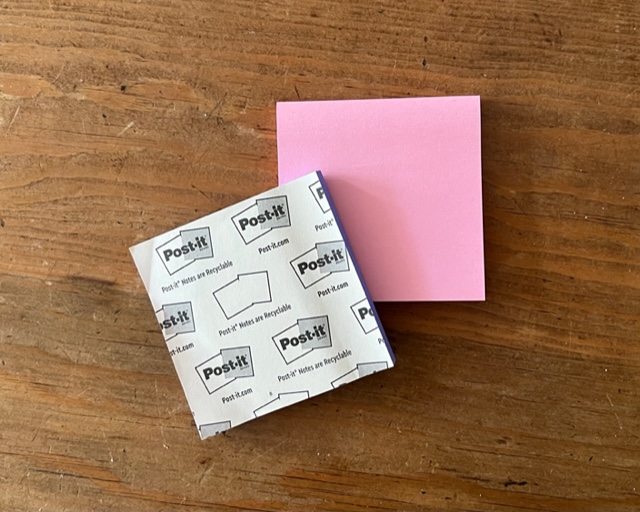
And another one worthy of mention as serendipitous is the Post It note. A colleague used some of a weak adhesive produced by 3M scientist Spencer Silver to keep temporary bookmarks in place in his church hymnal. It was 1979.

Are you still wondering whose obituary prompted these scribbles? Well, back in March 1963 in New York, Joāo Gilberto, a Brazilian guitarist, singer and composer who was a pioneer of the music genre of bossa nova in the late 1950s, and Stan Getz, the American jazz saxophonist, sat in a recording studio intent on producing an album. One of the songs they planned to record was Garota de Ipanema (the Girl from Ipanema), about a beautiful teenage girl called Heloisa Pinheiro whom the Brazilian pianist Antōnio Carlos Jobim and lyricist Vinicius de Moraes had admired as they sat at the Veloso bar on Rio de Janeiro’s Ipanema Beach.

Ipanema beach on a cloudy day!

Originally written by Moraes in Portuguese the lyrics had been translated into English by Norman Gimbel, who had come up with the wonderful opening lines: “Tall and tanned and young and lovely/the girl from Ipanema goes walking/and when she passes, each one she passes goes, ‘ahhh’”  The album’s producer, Creed Taylor, decided they should record the song with its English lyrics but immediately realised they was a problem; Joāo Gilberto spoke no English and neither did any of the other professional singers in the studio that evening. Creed looked across to the control room and saw Joāo’s wife Astrud. He beckoned her in and asked whether she could sing the lyrics: she volunteered and proceeded to sing “in a dreamily romantic and sensual voice that fitted the song like a glove.”

The single of the song didn’t even have her name on the credits, but the following year,1964, an album entitled ‘Getz/Gilberto’ included a second track of hers and it went on to become a million-seller: ‘Astrud Gilberto made the album a smash hit’. Astrud died on 5th June 2023 aged 83. Surely a wonderful example of serendipity, the occurrence and development of events by chance in a happy or beneficial way,?  

Richard 23rd June 2023

Hove

www.postcardscribbles.co.uk

Note 1 There have recently been accusations that Beatrix Potter ‘stole’ the stories she used to create ‘Peter Rabbit’ from earlier tales known as Brer Rabbit, told by enslaved Africans working on American plantations. I think one thing we can be certain about is that over the centuries stories get retold, translated, adapted and often skewed to suit their new audiences. The story of the Three Princes of Serendip started around 420 ….. only one thousand six hundred and three years ago and not written down for 900 years! You can find the same feature in modern songs, often using tunes familiar to classical music adherents! For example, Leonard Bernstein borrowed a tune from Beethoven’s Emperor Concerto for his song ‘Somewhere’ for the musical West Side Story. Nothing new under the sun!

Note 2 Sagacity. Such a lovely sounding word, one that is rarely used these days, means foresight, discernment or keen perception.

Note 3 I never understanding the fascination people, particularly Europeans, have of blasting little migratory birds out of the sky.

PC 339 With a Connecting Door

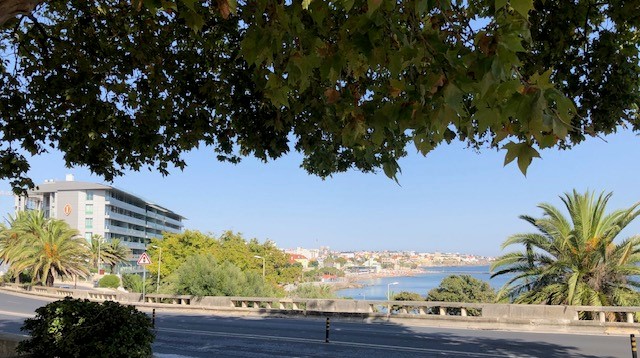
We have stayed in the hotel in Estoril a number of times and have always managed to secure a room with a view over the sea; there are some rooms with an unexceptional view over the roundabout on the land side!! This time we had a room, number 230, right at one end ….. with a connecting door. I wasn’t really sure whether this door would take me to Narnia or whether I should have tried the real wardrobes in the room. Tempting to open it; no doubt faced with a locked door!  Have you ever tried the door already knowing that your friends or colleagues are in room 233 and not next door in 231?

During ‘Covid’ times we had stayed here and been subjected to all sorts of rules and regulations …. ones that we were obviously happy to go along with! One was the lack of a breakfast buffet. I am sure you have stayed in hotels or Bed & Breakfast places where anything you want has been laid out on long tables? Generally they are covered with items like juices, cereals, milks of various types, yoghurts, grilled fish (especially in Norway), hard boiled eggs, all sorts of fruit, ham, cheeses, cold meats, brioche, pain au chocolat, croissant, bread for toasting etc and you watch other guests piling stuff onto their plate, either suggesting they didn’t eat the previous evening, or that they are going to forgo lunch so need to stoke the boiler or that, faced with a lavish spread that they feel they’ve paid for, just need to get their money’s worth. Most are unworried if they have a cough, the snivels, or runny nose and that the odd dribble wouldn’t matter.

Then Covid came along and everyone was recalling that graphic UK government NHS campaign aimed at reducing the spread of influenza, where someone in a crowded lift sneezed and, switching to slow motion for maximum effect, the green coloured vapour spread across the occupants, across the walls and across the handrail – and of course if you put your hand anywhere in a lift, it is on the handrail or on the buttons!

You certainly didn’t want anyone near the breakfast buffet. It disappeared and actually I sort of hoped it was gone forever, as it’s never an example of good food hygiene. But now it’s back and why can’t people put the spoons provided for you to have a dollop of scrambled egg, or slices of bacon or a couple of sausages or a spoonful of tomatoes or a hash brown back properly? It’s as if say ‘I’ve got mine …. and I subconsciously couldn’t care about the others!’  

The scanning of the Dinner menu has stayed as an improvement to a physical one – but I like to leaf backwards and forwards, looking at this potential main and, if I had that. would I have a pudding and, if so, what that might that be or should I have a starter and a main and forgo the sweet offerings and feel good about it but then know that when the time comes my heart will overrule my head and that Tiramisu or Crème Brûlée will just have to be ordered!

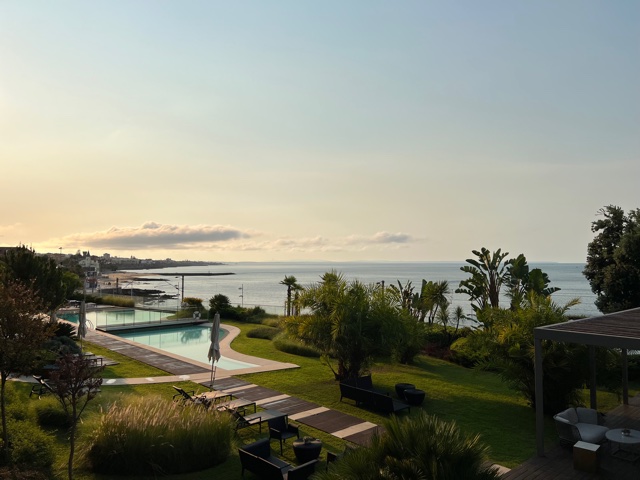
Between the hotel and the sea lay the pool.

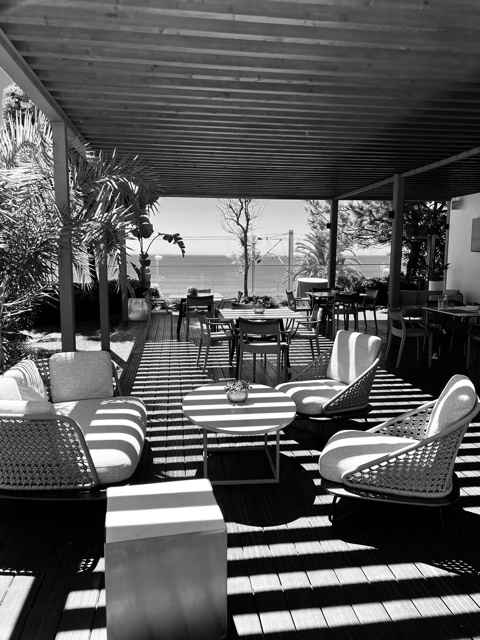
Diogo, Miguel and Bernardo spent their days walking from the pool bar/café to the customers and back. Every item of food came from the hotel’s main kitchen so there was a 30 minutes delay and it required Diogo, Miguel or Bernardo to go and collect it. Cocktails and drinks were always available. And I get cross: “Another towel? No problem!” “Thank you and would you mind moving the sunbed for me as I am so weak/helpless/entitled and that’s your job anyway?” Simple observations!

Hotel pools are a magnet for guests, some like Mr & Mrs Brown from Huddersfield, both pale and overweight; then there was Giles Davis from Dubai posing by the pool for a selfie or 10, uploading them to his social media accounts and having loud  conversations with distant chums; Mr & Mrs Benson from Atlanta and their offspring, who think they are entitled to do what they want and not a care about the others around the pool; Ms Samantha Boyes, obviously an Influencer (note capital I), and maybe the first time I have consciously seen one of this new breed of human, taking care with her selection of clothes, make-up etc.

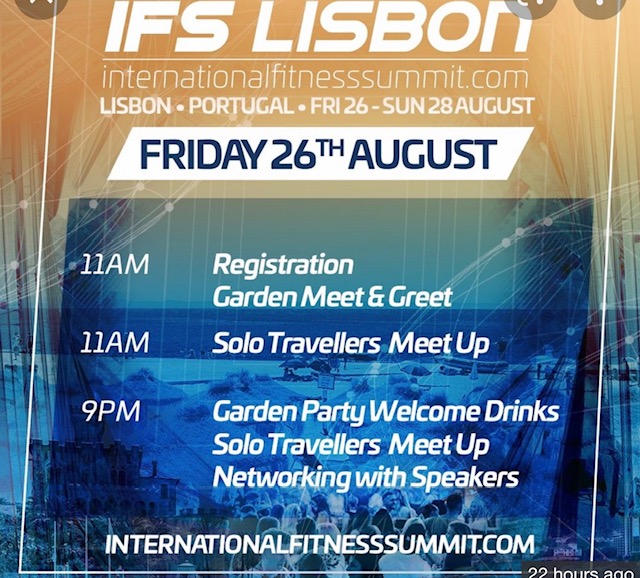
The International Fitness Summit took place in Lisbon and some of the attendees were staying at the hotel – the swimming pool their opportunity for selfies and posturing in their speedos, miniscule bikinis and with their obligatory tattoos. Mind you they were nothing like the Russians in Sicily.

In PC 134 (The Largest Mediterranean Island October 2018) I wrote: “Any ‘group’ is bound to dominate a small place but these people had no respect for others, demonstrating a lack of understating of acceptable behaviour; and because there were 8 of them they became a real nuisance. Their second morning they occupied more than 50% of the sun deck (tut! tut!) and plugged their USB into a loudspeaker; there was nothing quiet about this Russian playlist!! One of the men was a real comedian, or so he thought, as after everything he said he screamed with laughter and his chums joined in too; a nightmare if you’re trying to concentrate on a story!! After a couple of hours I asked the pneumatic blonde whether she could turn her loudspeaker off. She turned questioningly to this head of family. He rose up to his full 1.9m height, his belly extending way over his trunks: “Wot? You no like music?”  

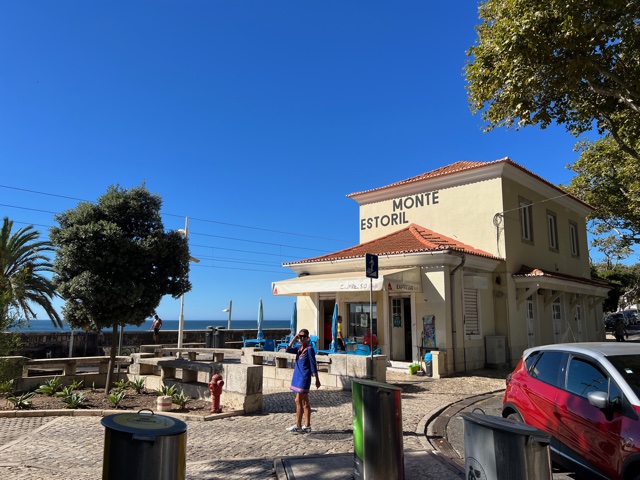
Back in Estoril the hotel lies along the shoreline, separated from the sea itself by the Cascais – Lisbon railway and the pedestrian/cyclist promenade (actually this should only be for walking although if you use it as a verb, you can of course drive/cycle/ride/walk providing you are doing whatever you’re doing to be seen by others!)

Monte Estoril station

To get to the promenade you pass the station of Monte Estoril and walk through a pedestrian underpass. The curve of the railway track here is such that as the train departs for end-of-the-line Cascais the wheels create a banshee loud enough to wake any sunbed snoozer!

          I never did open the connecting door.

Richard 16th June 2023

Hove

www.postcardscribbles.co.uk

PC 338 There’s Always Hope

Being relatively organised I have a string of ‘titles’ that might become postcards and today’s started off in draft last Saturday, after the final of MasterChef and after our meeting up with Richard, Debbie and Isla. It clearly was the right title this week as the person in the Sunday Times Magazine’s ‘A Life in the Day’ column was someone called Vick Hope!

The latest series of the televised cooking competition ‘MasterChef’ has just finished. Over the last eight weeks Celina and I have watched 45 ordinary people, who individually dream of running their own restaurant or writing a cook book or both, fight to reach the final three. We had wanted Robin to stay but his soufflé failed to rise, prayed Gloria could finish within the time deadline and been disappointed when Caitlin’s ‘modern take on Fish ‘n’ Chips’ didn’t wow the judges. Inevitably one develops favourites, then they bring the hurdle crashing down and are out of the race and you look for another on whom to put your money. The MasterChef logo is a brilliant take on an electric hob!

In the end this year’s three finalists reflect the diverse nature of those living here in the United Kingdom: Chariya Khattiyot, a master coffee roaster (40) originally from northern Thailand, Anurag Aggarwal, an accountant (41) originally from India and Omar Foster, a Toy Developer (31) from Barnsley.

Anurag had obeyed his somewhat traditional Indian parents as a youngster living in Gurgaon, India and trained to be an accountant. But subsequently he moved to the UK to be able to indulge his passion for cooking. His numerical training was evident in his hugely detailed spread-sheets which he laid out on his workbench before the relevant challenge, coloured coded and actions timed to the minute. Omar was an inventive cook and his dishes challenged and amazed the two judges in equal measure. But while it was Chariya who lifted the 2023 trophy it is the neat, precise, humble Anurag whose hope for his future is echoed in his final comments that I remember:

“It’s as if my wings were hidden somewhere and I have found them on MasterChef. I just want to fly free!”

I started this postcard mentioning a Vick Hope; my regular readers may recall another ‘A Life in the Day’ individual, Ayesha Vardag and her words of wisdom in PC 325. Another gem came from Kaleb Cooper, the Farm Manager and unlikely star of Jeremy Clarkson’s Diddly Squat. (Note 1) In the column after Ayesha Vardag’s, his advice: “To anyone thinking of farming (or any other option, journalism, finance, nursing, acting, being a chef for instance) as a career, dreams don’t work, unless you do.” Very aptly put!

“Dreams don’t work, unless you do!”

On Tuesday I popped into The Hope Café as I wanted Sami’s opinion on the latest revelations from our Post Office. It’s now over 700 days since PC 235 “Generosity in Government” (June 2021) when I expressed the hope that the government would be generous to our sub-postmasters in the wake of the Horizon IT scandal. Some hope! Here we are two years later: some of those wrongly convicted have died without receiving a penny in compensation and now a Freedom of Information request has revealed a code that applied to the compensation cases.

You know Richard, it’s as if they (The Post Office) thought that the non-white sub-postmasters and mistresses, and I included myself in this group as my parents were Anglo-Indian, wouldn’t kick up a fuss as they had no one fighting their corner. Now we understand that they opened a file on each ‘suspect’ and coded their ethnicity. I assume so their race would affect the way the post office dealt with their claim.

“Give me an example Sami?”

“A number on their file referred to a list. Claimants were classified, for example, as ‘negroid types’ (West Indian, Nigerian, African etc), ‘Arabian/Egyptian types’, ‘Chinese/Japanese types, ‘dark skinned European types etc etc.”

“That’s absolutely shocking and if I understand correctly these codes were in use in 2008 and onwards. I am ashamed to think that this still happens; it’s not the 1950s for God’s sake!”

“And do you know that only 85 of the 700 wrongly prosecuted postmasters have had their convictions overturned?”

“Let’s hope those responsible within the Post Office are brought to account. Sami, just seen Mo so need to catch up with her. Lisa OK?

Yes! Back down here next week and planning a trip to Berlin.”

I walk over to where Mo has a Brazilian Brigadeiro and a coffee in front of her. We exchange the normal pleasantries and then she tells me a story from her mother:

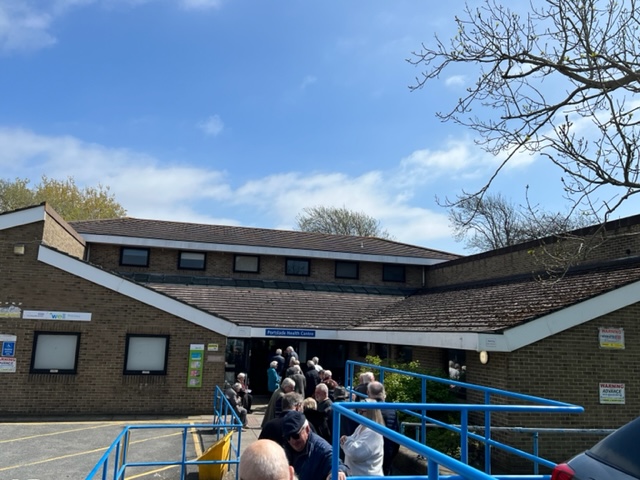
“She had been invited to have an ‘Over 75’s Covid Spring Booster’ and overheard a conversation between a nurse at the Portslade Health Centre and a chap in the queue for his vaccination.

“Are you in the right place? This is for the Over 75s.”

“That’s OK then.”

“Can I ask how old you are?”

 “76”

“Well, you don’t look it! Congratulations!”

          Then she watched as this young-looking 76 year old went into the cubicle and heard the nurse there, after explaining about allergic reactions and stuff, ask the same question!!”

“Well, there are those who look their age, some who don’t; some stay mentally young and have an attitude which says ‘I am only 76 ….”

There is always hope I guess!!

And last Friday we encountered a real example of hope over adversity. A chum from my time in London had come down to visit Brighton & Hove, bringing his wife Debbie and 5 year old Isla – oh! and the dog Millie! Isla has Grade 5 Spina Bifida. We caught up at The Lawns Café …… and walked home discussing how life sometimes deals a tough hand, but the love these three individually exhibit is a wonderful example of HOPE!

Richard 9th June 2023

Hove

http://www.postcardscribbles.co.uk

Note 1 Clarkson named his farm in Chipping Norton ‘Diddly Squat’, reflecting his belief you never make any money farming! 

PC 337 An American in Bath

The title for this postcard is a take on the 1951 film ‘An American in Paris’, which was itself inspired by the wonderful 1928 orchestral composition by George Gershwin. I am sure Gershwin wouldn’t have minded my appropriation. Its content is simply a repeat of only one side of a conversation, overheard whilst having a cup of tea at a nearby table in the garden of the Royal Crescent Hotel in Bath (See postscript below). I have added some personal photographs where it helps.

I surmise that an American couple, Ted and his wife Glenda, are on another visit to the UK. They have ‘done’ Oxford this year and then tomorrow drive down to Tenby in South Wales before finishing a week later in The Cotswolds. He’s talking to his son Russell who lives in Boulder, Colorado.

“You remember we were last here in 2019, Russell? Such a special place and the hotel’s just got better and better. We spoiled ourselves this time and had a minor suite with views over the lawns in front of the crescent.

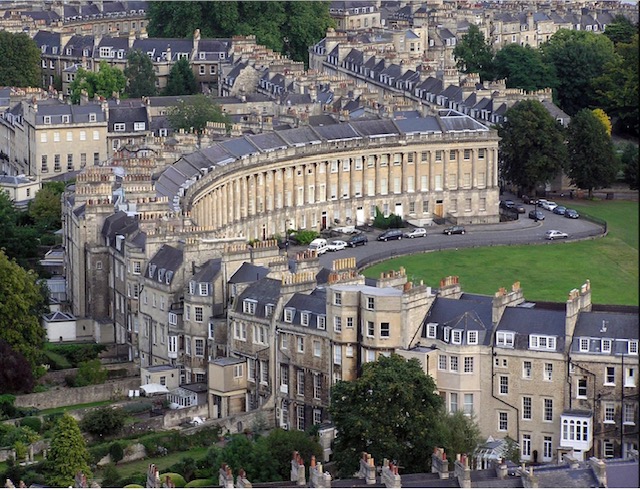
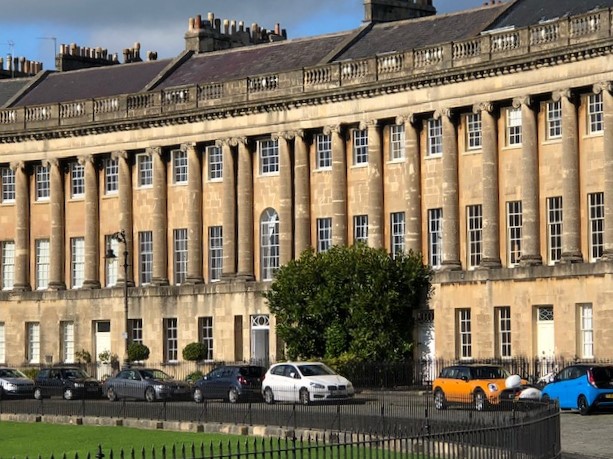
What? You’re asking whether a crescent’s a semi-circle, right? No! No! It’s very clever, it’s a semi-ellipse. You’ll remember that stuff from school but I had to look it up and found this diagram. It’s a brilliant design for a row of houses ……

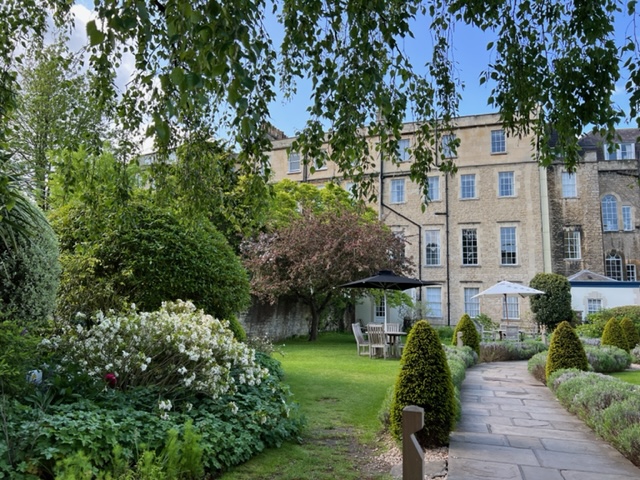
…. and I have noticed that the three central houses are slightly wider, with four windows across and not three. The central point in the crescent is marked by two pairs of columns and the rear elevations of the houses are all different.

Each rear elevation is different!

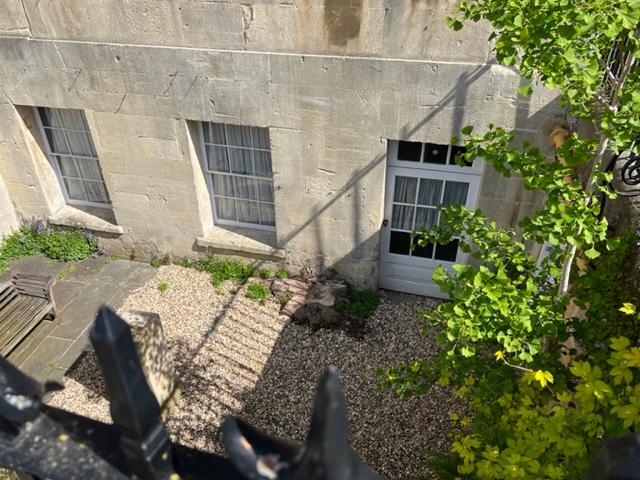
There used to be a huge Magnolia tree growing from the basement in the front of Number 15; so big it reached up to the second floor. (Note 1)

Before!

Sadly the roots were obviously causing too much of a problem and it’s been cut down; looks very bare now and, you know me Russell, I wonder just how much damage it was causing or was it simple expediency? Probably been there for 90 years or more.

Now!

What’s that? Is your mother around? No! She’s treating herself to a 90 minute massage in the Spa here, while I’m gorging myself on the hotel’s tea; a snip at US$50! Tonight we’re going to eat in the hotel’s restaurant; wonderful English name – ‘Montagu’s Mews’. It’s the same place where we eat breakfast and where my tea this afternoon comes from. Interestingly there is not one English-looking waiter!

Rear of No 15

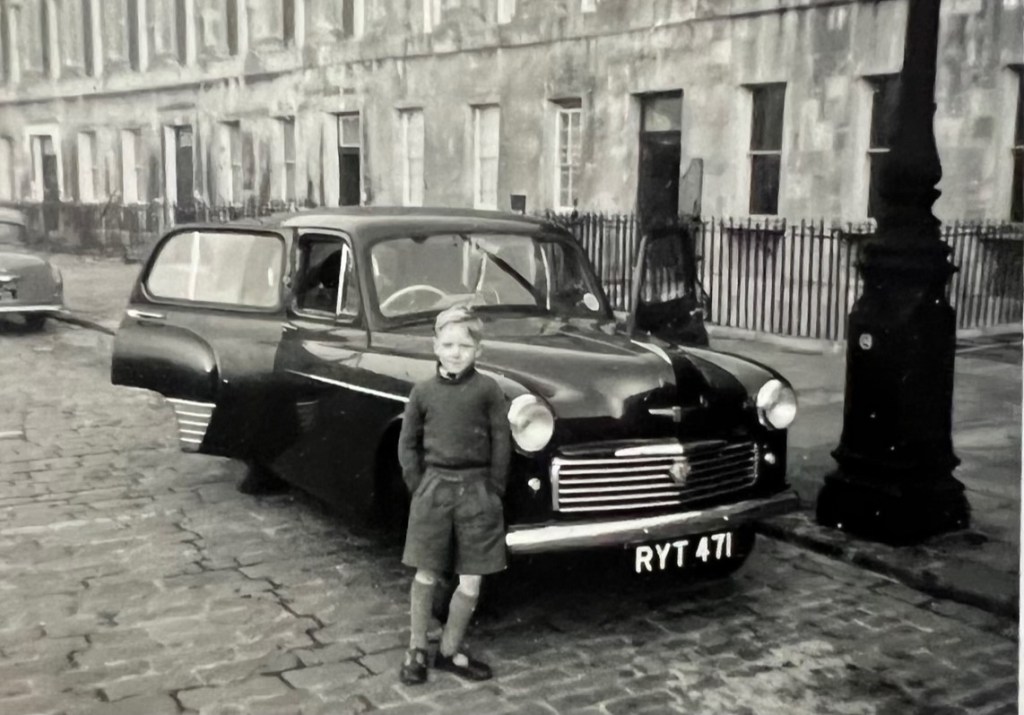
‘Montagu’s Mews’ used to be garages for first coaches then cars and there’s a rear entrance onto Julian Road. In the hall there’s a photograph of one of the cars, Thomas Tizzard’s large Humber Super Snipe – almost as big as some of our American gas-guzzlers.  He owned Number 15, now part of the hotel.

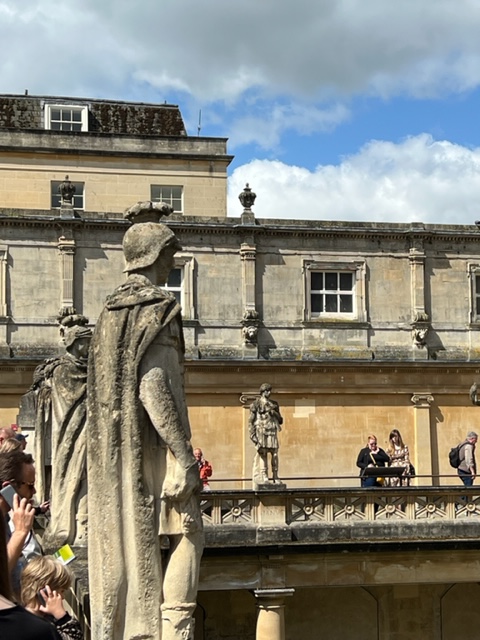
Last time we came we didn’t have time to visit the Roman Baths but this morning your mother and I spent a couple of hours immersed in this magnificent example of Roman building and planning. Used by the great and good of the time, so it was OK if you weren’t a slave I guess! Apparently they are the second largest existing example in the world, the other being in Rome itself.

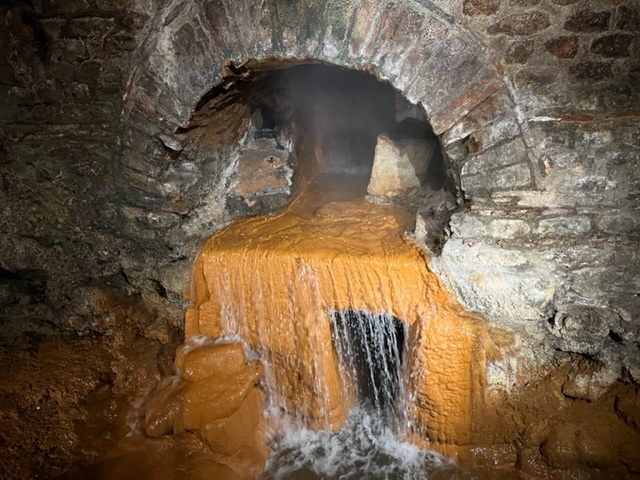
I find this stuff fascinating Russell – hope you do too? Bath’s Roman name was Aquae Sulis (meaning the Waters of Sulis) and a temple was constructed over the hot springs sometime between 60 and 70 AD. The baths were used until the Romans withdrew from Britain in the first decade of the 5th century (about 410!), variously in the following centuries and then they became a famous tourist and health attraction in the C18th. Major renovations took place in the 1980s and the whole complex is brilliantly shown.

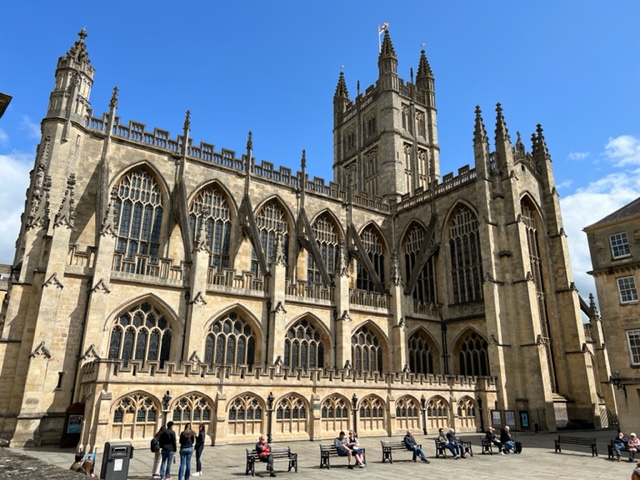
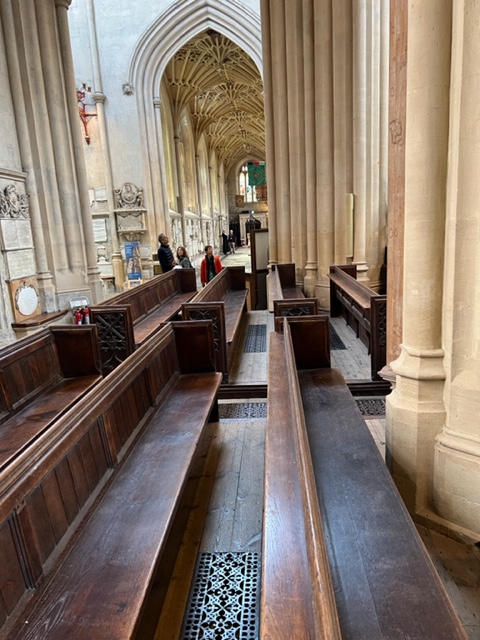
While we were down there in the city centre we popped into the Abbey. I think I showed you photos from our last visit. Major renovations were going on then, lifting all the flagstones and skeletons from under the floor, installing under-floor heating pipes and connecting them to the hot natural spring hot water. Incidentally I learned that the spring water gushes up at over a million litres a day at 46°C – Mother Nature at its best huh!

Some of the pews have gone back in and I overheard someone saying to his wife and another couple that he used to attend the Sunday service back in 1955 as an 8 year old school boy, the pupils filling the pews just where I was standing. Here he was, 68 years later, sitting in quiet contemplation.

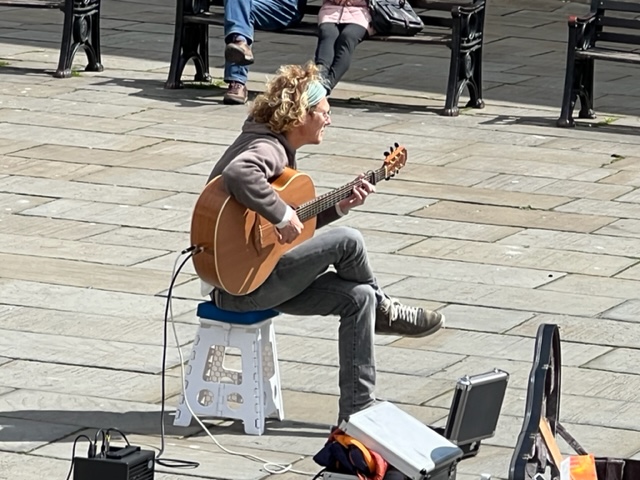
Bath is built of a wonderful local honey-coloured stone and the centre of the city has a great buzz about it, albeit sometimes the 1.3 million visitors that pour into it every year are slightly overwhelming! Tourists mingle with shoppers and I have noticed virtually every High Street chain in the UK has a presence here. Then I saw this student from Bath University sitting on his little stool, earning some beer money!

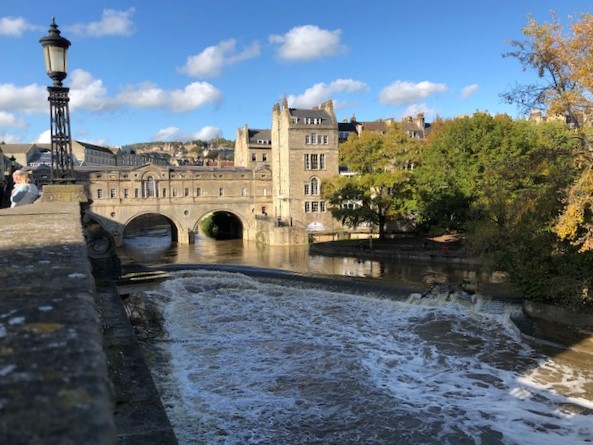
Pulteney Bridge is another photogenic place and it’s only when you come to places like this, Russell, that you realise how young a country the United States is, well to us white folk. The Native Americans wouldn’t agree. We think Boston and New York are old but Bath ……. now that’s old. Hang on, your mother’s just surfaced and she looks like she needs a glass of champagne. Talk to you later from Tenby. Love you son.”

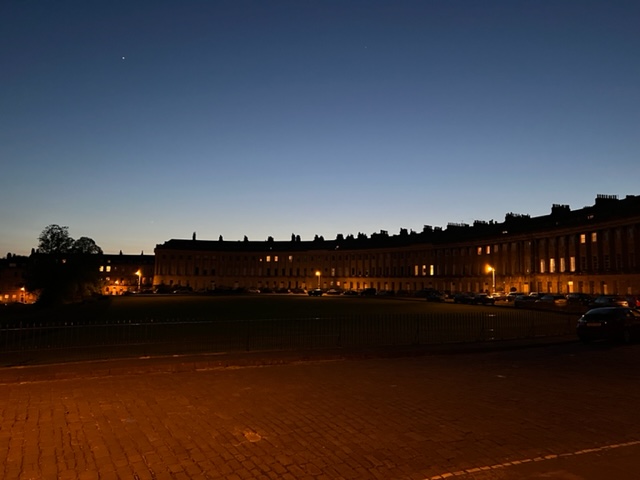
So Ted ordered a glass of Tattinger champagne for Glenda and one for himself, I finished my tea and later, much later, took this evening photograph of the famous Royal Crescent in the City of Bath.

Richard 2nd June 2023

Bath

http://www.postcardscribbles.co.uk

PS See also PCs 164 & 165

PPS I have used English spelling despite the American origin of the conversation!

Note 1 The Americans call what in the United Kingdom would be the ‘ground’ floor the ‘first’ floor. The Magnolia reached the UK first floor!