PC 302 Update from Sami in India

My regular readers will know that I frequent The Hope Café here in Hove, looking for inspiration, ideas for ‘copy’, a good coffee and some chat with the staff and regulars. One of the individuals I have taken a shine to is Sami, an ex-Post Office Manager who was wrongly charged with fraud and eventually made bankrupt (see PC 235 June 2021). Sami had taken to having a coffee and reading a good book in the friendly atmosphere. His story has appalled me but now, many years on from his financial ruin, there is an indication that the inquiry will recommend compensation to the over seven hundred individuals who were the victims of what is being called Britain’s greatest miscarriage of justice.

Maybe as a result of telling him about my own research into my family background Sami, whilst waiting for the enquiry to conclude, has taken off to Gujarat in India to look for his own Indian roots; he knew precious little – rather like the scant knowledge of my own! My mother wasn’t really interested and it was only after her death that I met a cousin of hers, who had a very sketchy family tree. Four years later there was a gathering of dozens of relatives in Auckland New Zealand!

Sami knew that his mother Fiona had worked in the English colonial civil service in Gujarat and had married Aadit Gupta in1946. They had moved to UK after the infamous partition of the Indian sub-continent into India, East Pakistan and West Pakistan. Euro-Asians found they didn’t really fit well into either nation and Sami’s parents settled in Southall in west London, an area known locally as the Little Punjab; Sami was born in 1956.

I received this email early last month:

“Grand Mercure, Gandhinagar, 3rd August

Dear Richard

I knew my father Aadit had been born in 1926 in a little town in Gujarat, so last month I flew direct from Heathrow on Air India to Gandhinagar, the state capital; the business capital Ahmedabad lies to the south. I have never been to India before; when I grew up international travel was for the rich and for us Indians life is either work or family. The idea of walking in the Lake District for instance would never be on our wish list! When I stepped off the plane I was enveloped by India’s heat, by its dust, by its noise, by its busy inhabitants. It’s well known that the Indians learned bureaucracy from the Victorian British and they’ve become even more succinct and pernickety about record keeping, so it wasn’t surprising I was able to find some details of my father’s family in the Records’ Office. Delightfully I have found an aunt who was twelve years younger than my father and will visit her soon.

Give my best wishes to Josh and Susie.

Take care! Sami

Gujarat State in western India

Then another email, dated 11th August, a week later:

“Saw Indira yesterday; she lives with her daughter and family in the foothills to the north west, into Rajasthan, in a city called Barmer, so I took a very crowded, smelly and overloaded bus with loads of luggage on its roof. It took six hours so I stayed for a couple of nights! She’s 84 and rather frail but her mind is razor sharp. She has told me much about the family, those alive today and those past, some of whom fought in what you call The Indian Mutiny and what was also referred to as the First War of Independence or Indian Rebellion of 1857. I met a couple of her children. Children? They must be in their late 50s!
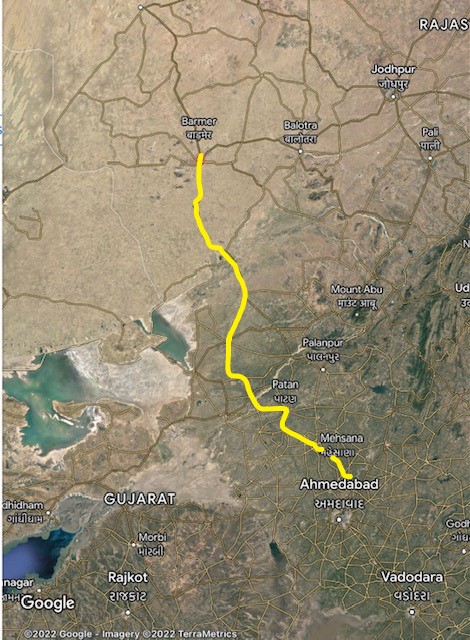
My bus trip to Barmer

My knowledge of the Indian Rebellion is non-existent and I find all this stuff fascinating, so have signed up for a tour of what’s often talked about as the triangle – Delhi and Meerut, where the uprising started, then down to Agra, on to Kanpur/Cawnpore then Lucknow. Maybe I can persuade one of my cousins to come too?

The local papers are full of the current Prime Minister Narendra Modi’s idealistic desire to make India a Hindu State and is talking of removing the rights to Indian citizenship from the Muslim population. Like you I imagine, I don’t know the details of the political history in India that well but I have learned Modi was Chief Minister of Gujarat in 2002 when there were anti-Muslim riots. It started with a fire on a train carrying hundreds of Hindu pilgrims home and 60 people died. Modi claimed it was a terrorist attack, blamed local Muslims and fanned the flames that encouraged the Hindus to act. Quick to anger, the locals rioted; the result was 790 Muslims and 254 Hindus killed and 150,000 driven into refugee camps.

Modi became Prime Minister of India in 2014 and is in the process, the press claim, of marginalising Muslims. You can hear the echo of the violence that accompanied the partition of the Indian sub-continent into India and Pakistan in 1947 and I wonder when this end, where it will go. (Note 1)

Probably be back in Hove in a month or so, depends how the ‘tour’ goes! That and Indira’s idea for a family reunion! Best wishes Sami.”

I haven’t been in The Hope Café since mid-July, so it was sad to receive a text from Josh saying that Edith has passed away (See PC 224). Apparently she hadn’t been in for a fortnight and Duncan found out she’d died. In keeping with her Jewish faith her funeral was the next day. These survivors of the Holocaust and of the Kinder transport, of whom Edith was one, are thinning out; a page of global history turning. 

Email 9th September 2022. “Sad to hear of our monarch’s death. God Save the King. Sami.”

Richard 30th September 2022

www.postcardscribbles.co.uk

Note 1. The partition of the Indian sub-continent into predominately Muslim Pakistan and predominately Hindu India required that Muslims living in what would become India moved to Pakistan and Hindus living in what would become Pakistan moved to India. Within six months of the August 1947 partition, 15 million people had been uprooted and between one and two million were dead, many in the most violent manner. As the nation responsible for the plan to divide the sub-continent, we should be ashamed it happened in such a horrific manner.
PC 301 And Still They Came

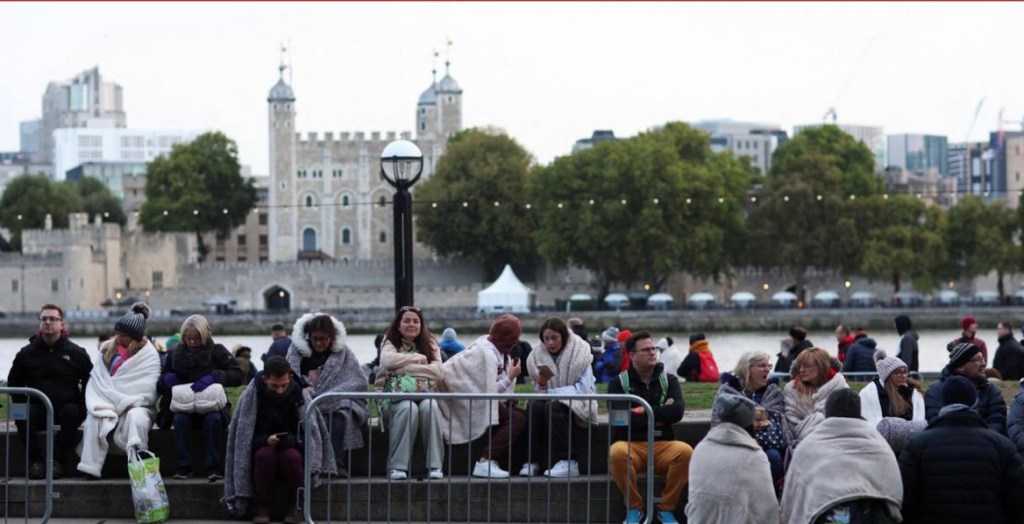
And still they came and the drums sounded the slow beat and the bell of the Elizabeth Tower, Big Ben, tolled …. one ring for every year of the late Queen’s life.

I opened the newspaper on Sunday and found that Christina Lamb, a well-known reporter and commentator, had started her column: “And still they come. From morning till night, tens of thousands of people of all ages, backgrounds and places across the land defy warnings of 24 hour waits and swarm to pay their last respects to their monarch – and to be part of the greatest queue on earth. ‘The Queue’ has its own Twitter feed, Instagram account and YouTube channel.”

We arrived back in the UK on Thursday of last week but were following the ramifications of the Queen’s death on the BBC News. Back home and the sense of loss is palpable. Should I join the queue to see her lying in State? Four hundred thousand did, including our Yoga Studio’s co-owner Simon and David, Mimi’s husband, both pulled inexorably to be part of this moment in history.

The remarkable success of The Queue was down to a Professor Keith Still who advises on the science of crowds. He suggests The Queue became an animated object, with a life of its own! “The crowd itself is looking after people within it. People need to know what is happening in advance, to have their expectations met and to be kept constantly informed and updated and, in The Queue, they have had that. So long as people know what’s happening, what’s expected of them, how long it’s going to take, they no longer face the uncertainty.” (Note 1)

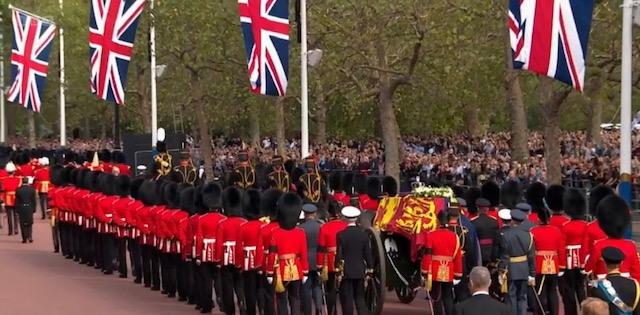
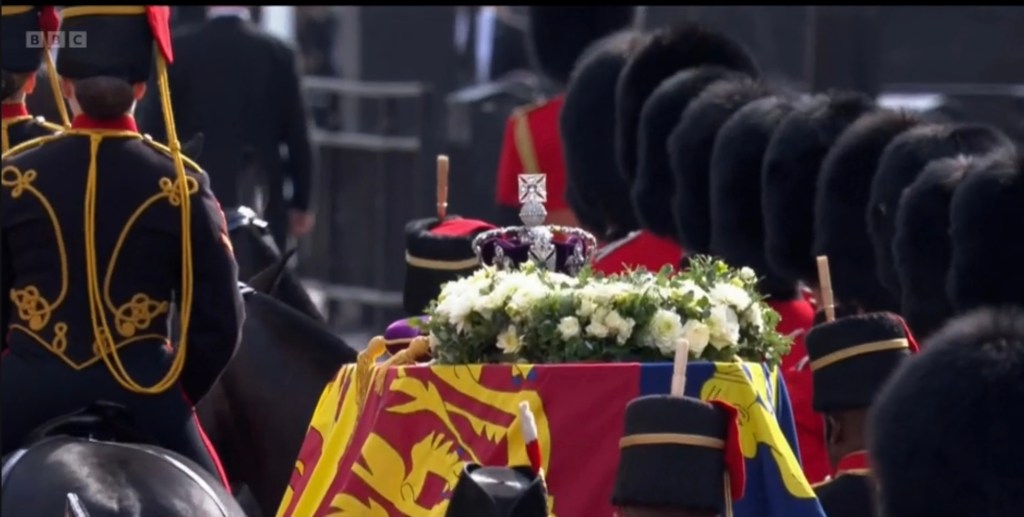
On Wednesday 14th September the late Queen’s coffin was taken from Buckingham Palace to The Palace of Westminster, the enormous hall built in 1096 where it was to ‘Lie in State’. As a muffled Big Ben tolled, the solemn procession made its way down The Mall that only recently had been the site of the Platinum Jubilee party. There was something very hypnotic about this spectacle; bands playing dirges from Beethoven or Mendelssohn, flags flying and leather reins creaking, the Gun Carriage with its precious cargo draped in the Royal Standard pulled by horses from Kings Troop Royal Horse Artillery, escorted by men of Her Household Cavalry, all marching at a slow 76 paces per minute.

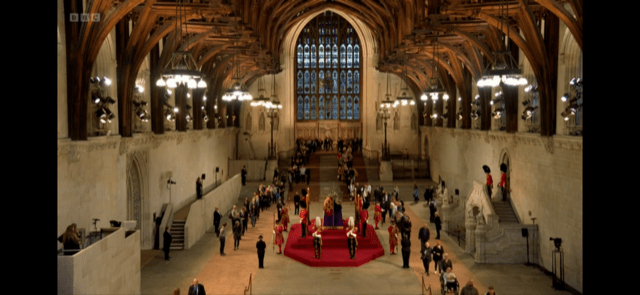
Her ‘Lying in State’, surrounded by officers, by family members, by Beefeaters, was televised live by the BBC. “And still they came ……” The old, the young, the curious, those the Queen had touched, families and those in wheelchairs, Chelsea Pensioners and retired military personnel, those who felt it their duty, their obligation ….. and to hell with the potential problems of queuing. Over five days 400, 000 people filed past her coffin, including Michael Tropp from Atlanta, who spent nine hours on an aeroplane to spend a further 8 hours in The Queue! “For 70 years she’s been the mother of this country. There will never be anything like this again in my lifetime.” I sense this echoes in ever heart here in the United Kingdom.

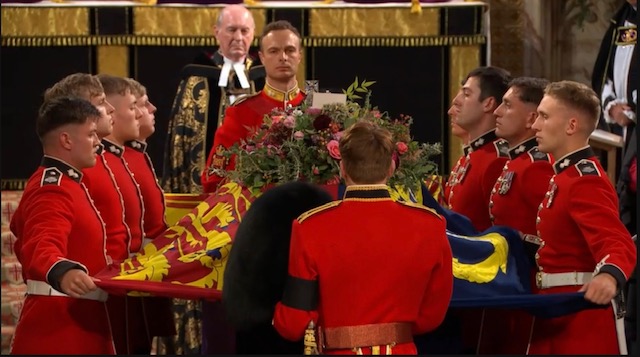
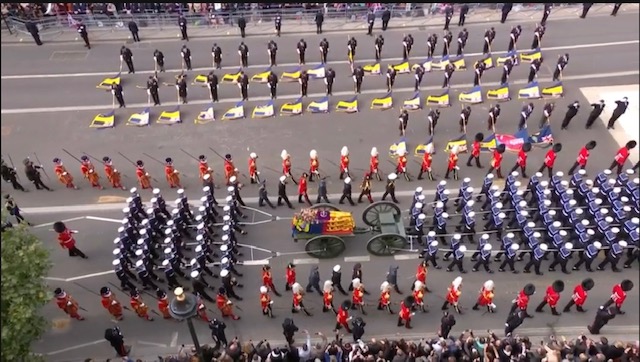
Monday 19th September 2022 – Her Majesty Queen Elizabeth II’s funeral. The coffin was carried by eight bearers from 1st Battalion The Grenadier Guards (Note 2) from the hall and placed on the Victorian Gun Carriage. The Gun Carriage was then pulled by 96 Royal Navy ratings to Westminster Abbey; a further 44 were used at the rear as a brake! (Note 3) Historically the State Funeral Service took place in St George’s Chapel in Windsor but, in a break with this tradition, The Queen had wished it to be held in Westminster Abbey. Plans for this mammoth state occasion were first drawn up on 2006 and updated regularly.

My heart had gone out to a dear friend and retired Gunner officer Mark Corbett-Burcher, who has a responsibility within the Ministry of Defence for the protocol of ‘Inward Visits’; he would get involved in the planning for VIP visits to the UK. This week has seen close to 500 ‘VIPs’, foreign Heads of Government, Presidents and Royalty, coming to the Capital; can’t imagine he had much sleep before Tuesday!! 

Following the service the funeral procession made its way back to Buckingham Palace and on to Hyde Park Corner, where the coffin was transferred to a hearse for the drive to Windsor Castle. There, after a Committal Service, the coffin was placed in the Royal Vault.

Old enough to have watched the State Funeral of the United States President JF Kennedy, I saw for the first time the age-old tradition of a Commander-in-Chief’s coffin being followed by his horse, with his riding boots fixed in the stirrups facing backwards. As Her Majesty’s coffin approached the final few hundred metres before the walls of Windsor Castle, there was her favourite Fell pony Emma. Given her life-long love of horses, I half-expected to see her riding boots in the stirrups …… facing backwards. 

Somewhere in one of the services William Wordsworth’s poem The Extinction of the Venetian Republic was quoted. The ‘she’ in the poem is Venice so substituting HM The Queen seems a bit odd – but I wasn’t asked!!

“ ……….. She was a maiden City, bright and free; …….. She must espouse the everlasting Sea. ….. Men are we, and must grieve when even the Shade of that which once was great is passed away.”

Everyone’s mother dies; one’s father too! When you get into your mid-90s the chances are sooner rather than later. In a monarchy the people have no say in who is the king or queen; it’s just luck as to whether they are good, bad or indifferent!

In Elizabeth II we were extremely lucky!

Richard 23rd September 2022

www.postcardscribbles.co.uk

PS Today is the Autumnal Equinox, when there’s an equal amount of daylight and darkness everywhere in the world and the sun rises exactly east and sets exactly west!

Note 1 And of course the converse is true: “As soon as that information flow stops that you get a degree of uncertainty and people start behaving as individuals rather than as a collective.” he says.

Note 2 One, Fletcher Cox is 19, reflecting the youth of the Bearer Party

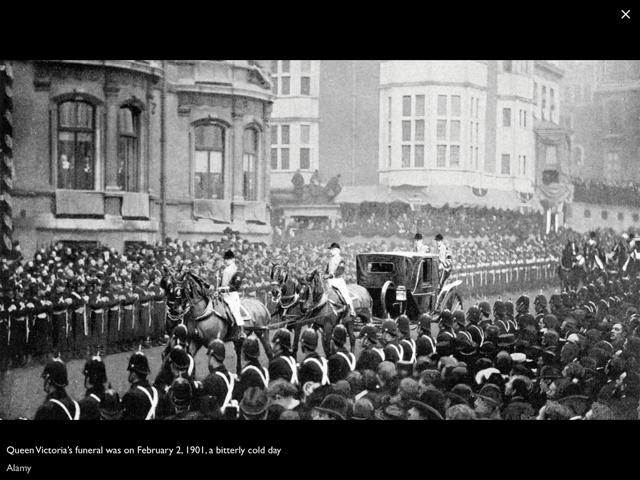
Note 3 During Queen Victoria’s funeral in February 1901, the icy cobbles around Windsor Castle caused the horses pulling the hearse to slip and shy, so much so that at one point it seemed the coffin would fall off its carriage! Quick thinking officials entrusted the pulling to chaps in uniform and that’s what happens now.

PC 300 Three Hundred Postcards!

I started writing the obligatory postcards, as one did before the days of texts/instagram/facebook etc, to ‘friends & family’ during my first visit to Rio de Janeiro, Brazil in April 2012. It wasn’t until my third visit in late December 2013 that I started sending what I might have written on a postcard, electronically. Abbreviated to PCs, the titles of the first seven sounded like something from a travel digest of Brazil: Rio de Janeiro (3&4), Sāo Paulo & Caneneia (5), Petropolis (6), Carnival (in Rio) (7), Beach Life in Brazil (8&9), Paraty (10) and Sāo Conrado (11). Wasn’t I a lucky chap?

Along came my lovely techie son-in-law Sam and he set up my page on WordPress, www.postcardscribbles.co.uk. ……..

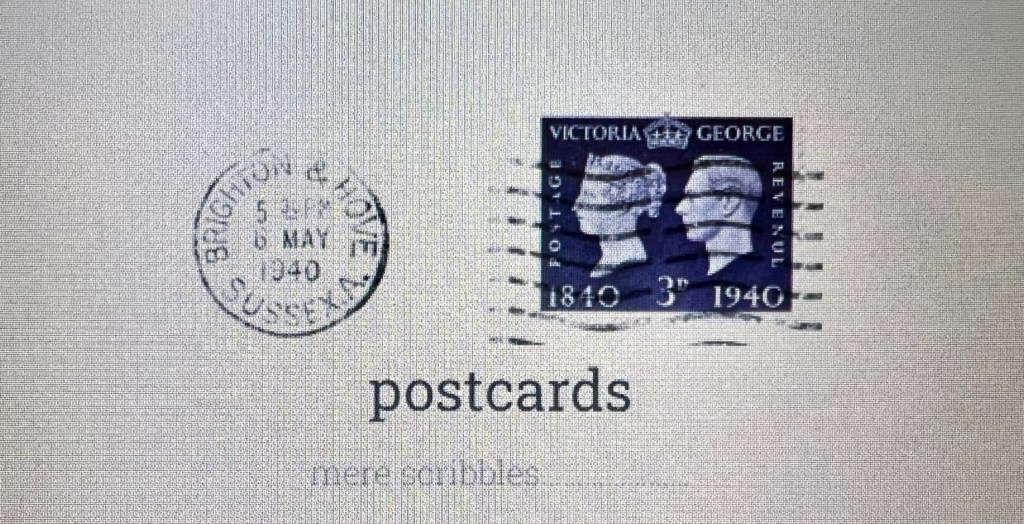
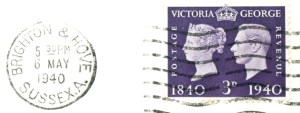
….. and he also found a post office franking for Brighton & Hove dated May 1940. (Note 1)

Seems a long time ago now and it is! Over eight years in fact. During the first UK Lockdown for the Covid pandemic, March 2020, I increased the frequency from two a month to one a week so this is my three hundredth, each about 1000 words. It’s not easy to group them into any sort of categories but I will try to, as it might make the back catalogue less daunting for my newer readers.

Places we’ve been to in Brazil

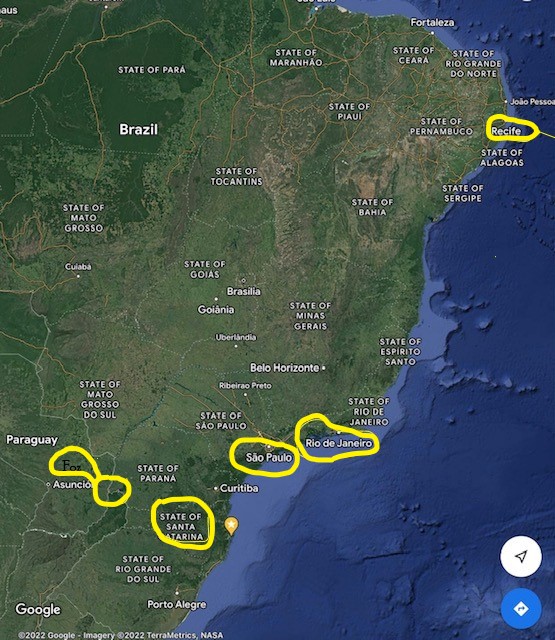
The series of postcard scribbles started in Rio de Janeiro in Brazil, Celina’s home city and that of her family. Brazil is enormous, some 4300 kms both north to south and east to west at its widest part. We have travelled north to Recife where my great grandfather Richard Sidney Corbett was born in 1850 (34) and south to Brazil’s Santa Catarina, one state away from the border with Uruguay (63). We visited the waterfalls at Foz that puts Niagara in the US to shame and gives Victoria Falls a good run for its money (51) and we spent some time in the world’s biggest flattest wetlands, some 800kms north to south and 500kms east to west, Pantanal (17 and 20).

Our Alaska journey in 2015

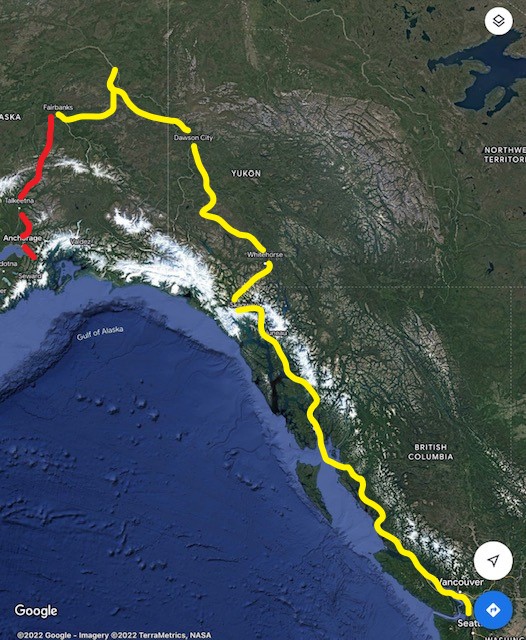
 In 2015 we followed in the footsteps of another of my great-grandfathers, George Nation, and his route up from Seattle into Alaska, to Dawson City and eventually Eagle, population 52, in 1900, 1901 and 1902. Postcards 44 & 45 covered this plus PC 46 included a few days in San Francisco.

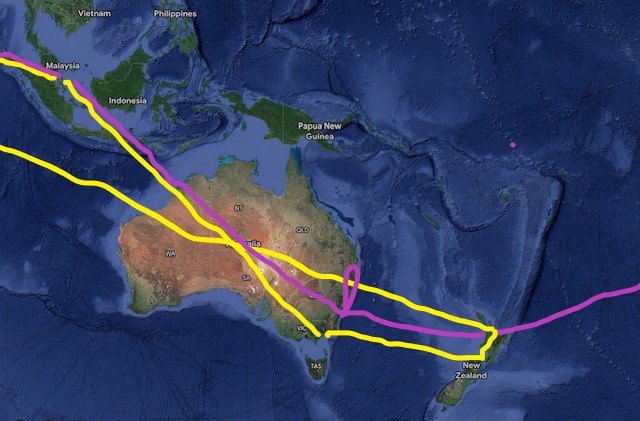
One year we flew eastwards, visiting Australia, Auckland, and The Coromandel Peninsula in New Zealand, before crossing the Pacific to Santiago in Chile (88 & 89).  We returned to South East Asia and The Antipodes in 2019, just before Covid locked down the globe! (168, 169 and 170)

There and back or straight through!!

In PC 37, I described visiting the Rocha Miranda family home in Friburgo, Brazil. Closer to home in Hove, in PC 58, I scribbled about returning to my late parents’ home in Balcombe, 20 miles north of Brighton. The search for family connections saw us fly to Limerick, to look for the home of Sarah Fosbery, a great-great-grandmother (127 from June 2018).

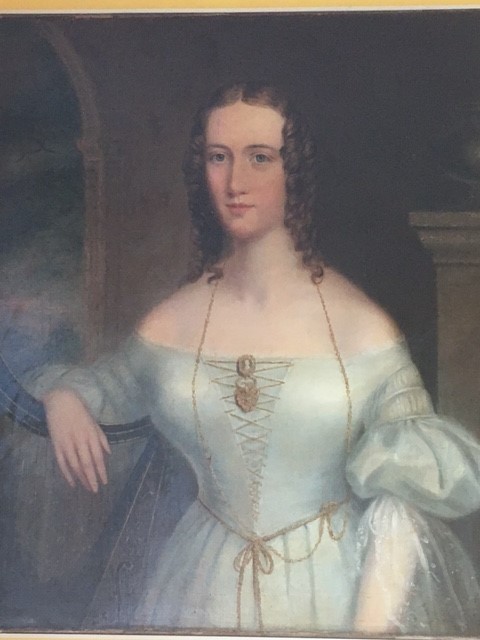
Sarah Fosbery

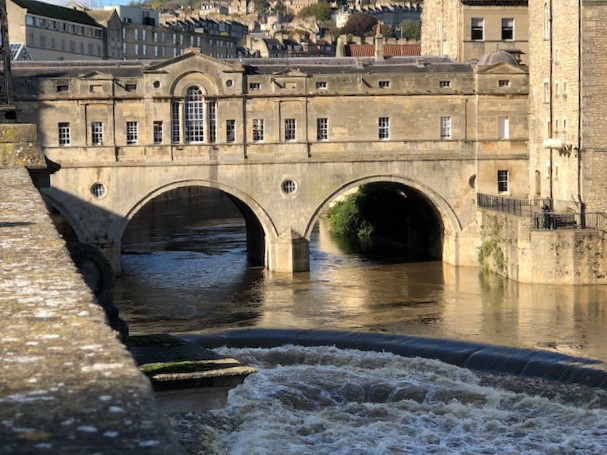
In 2019 we spent a couple of nights in the city of my birth, Bath (164 & 165).

Portugal has featured a great deal, ever since our first short break in April 2016, visiting Celina’s brother and family who were looking for somewhere to live (87). Subsequent postcards, 107, 112, 130, 245 for example, have covered Estoril and the Lisbon littoral. In 2018 we took the ferry from Portsmouth to Santander on the north Spanish coast and drove west and then south into Portugal. Sicily featured in PC 134 entitled ‘The Largest Mediterranean Island’.

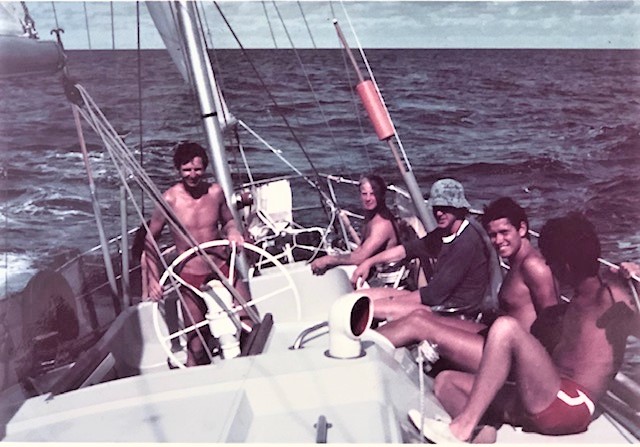
My love of offshore sailing is reflected in a number of reminisces; Sailing in The Baltic (106), racing across The Atlantic (116) and Kiel to Oslo (229).

Somewhere in the middle of the North Atlantic 1976

Times when it’s been a little hairy are covered in Off Arromanches (209/211), Almost a Disaster (215) and Knockdown (249), supplemented by Ropes, Warps & Sheets (231).

The current focus on health and fitness has featured quite a lot in these three hundred postcards. Some have been specific like My Thumb (52), Molars & Wisdom (64 & 66), Sight & Eyes (94), Up My Nose (190, One’s Heart (280) and Hot Yoga Thoughts (84 & 93). More general ones have covered Bacteria & Bloating (28), Loo Paper (47) and The Loo (54), Male Waistlines (55) and Am I Obese? (233), The Common Cold (148) and Montefiore (my back operation) (99).

Some have had a very serious element, like What’s Going On (21) which looked at the ugly war against ISIS. That was eight years ago and now we have the Ukrainian War to be extremely concerned about: my PC 276 was about their cultural side of life – ‘Picture at an Exhibition’ with the overtones from Tchaikovsky’s 1812 Overture and Napoleon’s retreat from the gates of Moscow. Collectively PCs 263, 269 and 278 raise the issues of refugees, of migrants, of freedom and of hope.  In February 2018 I wrote about ‘Ancient and Modern Slavery’ in PC 117.

I looked at ‘Alcohol and Other Drugs’ in PC 15 in 2014, and followed it with ‘Alcohol and The British Issue’ in PC 257 seven years later. Earlier this month I scribbled ‘Judge Not’ (298) about the “the most socially acceptable drug”. The issue of what people do with their cigarette butts is the subject of PC 234 ‘No Buts ….. No Butts’. Surrounded by the ‘Carwash’ corruption investigation in Brazil at the time, I looked at the UK’s record of being squeaky clean, or not, in Money & Corruption PC 36. Two incidents, the Grenfell Tower fire when 72 people died and the Post Office scandal when over 700 were wrongly convicted, were the focus of ‘Generosity in Government’, PC 235 of June 2021.

And finally there are over two hundred and thirty others, covering topics as diverse as our language, English and others, the written word and spelling, Christmas, Boxing Day and Easter, manners and etiquette, guns in America, health, safety and customer services, chickens, pigs, cars and driving, pockets, the Truth, bread and toast, modern complexity and so on and so forth.

The late Queen’s coffin moved from Buckingham Palace to Westminster Hall on 14th September 2022

The penultimate one of these 300 postcards was written the day after Queen Elizabeth II died. It feels today as though a page has been turned, a chapter finished, the book closed. Satisfaction! Next week, after her funeral on Monday, the start of a new book, a new chapter and the first of another hundred postcards!

Richard 16th September 2022

www.postcardscribbles.co.uk

Note 1 Interesting stamp and frank. Celebrating 100 years 1840-1940 with portraits of Victoria and George VI, a postcard (maybe!) posted in Brighton & Hove on 6th May 1940 at 5:30. We were at war with Nazi Germany and within twenty days started the evacuation of the BEF from the beaches of Dunkirk.

PC 299 Our Nation Pauses

It’s Friday and today I post my weekly efforts, my scribbles about this and that, some topical, some simple observations or commentary about the life we live, the life we’ve had and the potential life to come. I don’t think there’s anything very intellectual about these posts but I hope that some part of them will encourage my readers to spend five minutes every week, pausing and being still.

This week’s post had been written, edited and proof-read and this afternoon I would have pressed the ‘send’ button. It was an update from Sami, my friend from The Hope Café, who’s gone to India to check out his family roots whilst awaiting the conclusion of the Post Office enquiry and subsequent allocation of compensation. Then yesterday late afternoon, news that our Queen had died pinged onto our news apps. Long gone are the days when the transmission of news relied on wind or horse power.

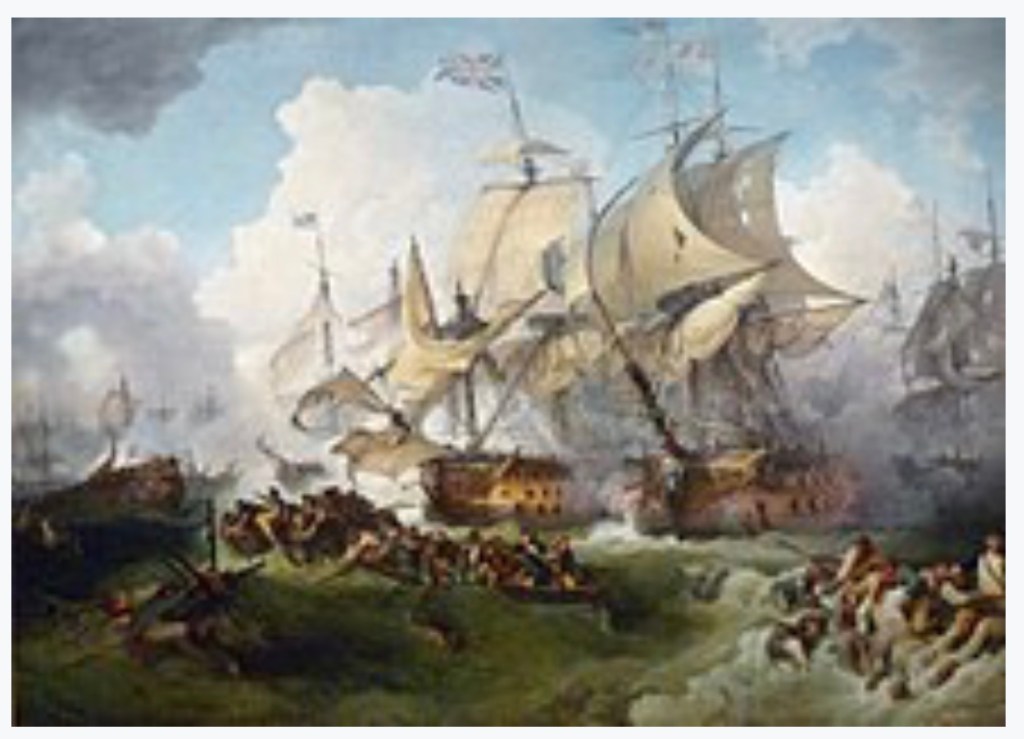
My step-father’s birthday was on June 1st and he always reminded those who would listen that the date was known as ‘The Glorious First of June’. Why? Well in the C18th the West Indies were key to the strategic aims of France. In answer to appeals from the French planters, British forces occupied the ports of Haiti in1794, and soon held all the French islands except Guadeloupe.

A French convoy on its way to the West Indies was engaged by Admiral Howe 300 miles west of Brest and a quarter of its fighting strength was destroyed; his signal to the Admiralty started: ‘On this glorious first of June, …..’. The signal was entrusted to a midshipman on a fast frigate that made landfall at Plymouth and then conveyed over the 220 miles to The Admiralty in London by horseback; even with fresh horses maybe some days.

Today news is instant; sometimes it seems to be transmitted before it’s happened. This morning the press is replete with commentary about Queen Elizabeth II; professional journalists and social observers compete with personal outpourings on television, in the newspapers, on Facebook and on other social media sites.

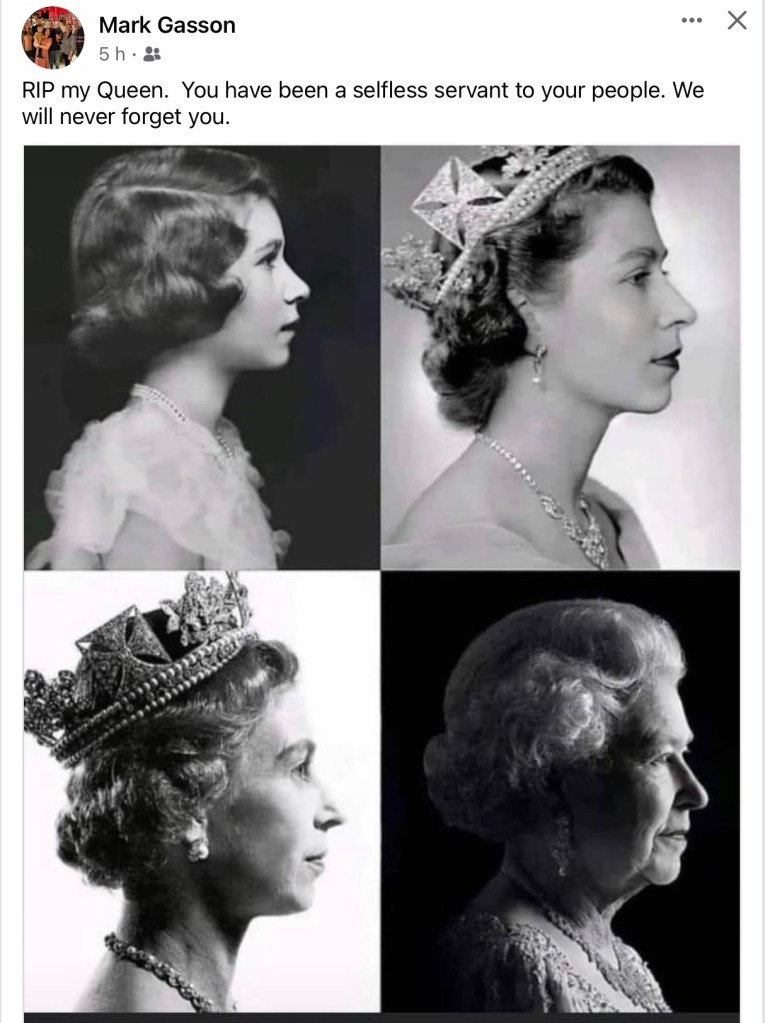
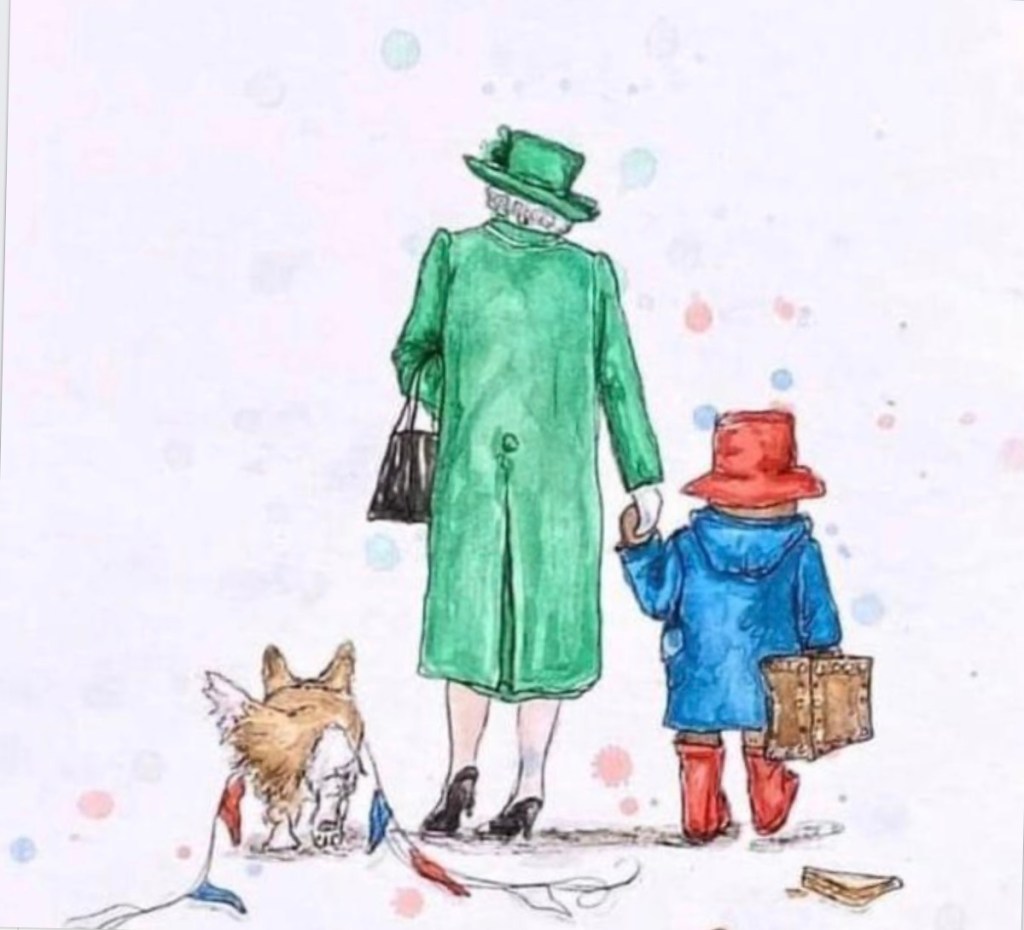
A ex-client turned friend, Mark Gasson, posted this on Facebook this morning

Max Hastings, writing in today’s Times, summed up his column of reflections so: “She conferred a grace, charm, and stature on her reign that caught the imagination even of tens of millions of republicans. Our debt to her is beyond any power of payment, save by doing justice to her memory. We shall soon join in saying ‘Long Live The King’. But first we may allow ourselves precious moments to bid farewell and give thanks for Elizabeth II. For seven decades, God indeed saved the Queen.”

Gerald Baker, again from The Times: “It will rank as one of the larger ironies of the era of Elizabeth II that even as the English Queen reigned over a dominion of ever-diminishing significance, she became a figure of ever increasing global reverence. Immediate reaction of her death attested to her status as the best-known and probably most respected woman in the world. ‘I remember her as a friend of France’ says President Macron, ‘Her wisdom was truly unique’ says Micheál Martin the Irish Taoiseach, ‘An irreparable loss’ says President Zelensky, ‘Pained by her demise’ says Narendra Modi the Indian Prime Minister. 

There is a lovely story doing the rounds on various radio stations and social media which, although not verbatim, I recount here, as it sums up the way this human being lived her life. One summer The Queen was enjoying a picnic somewhere in the grounds of Balmoral, her 50,000 acre Scottish estate, when a couple of American tourists on a walking holiday saw her and her equerry Dick. They didn’t recognise the Queen but asked: “Where do you live?” “Oh! I live in London but I have a holiday home over that hill.” She said, pointing in the general direction of the huge stately home behind some woods. “How often to you get up here?” “Well” she said, “I have been coming here since I was a child so over 80 years.” “So you must have met the Queen of England?” “Well, I haven’t but Dick here has!” So they asked Dick what the Queen was like. “She can be very cantankerous at times but has a great sense of humour.” And before you could say boo to a goose, they had got either side of Dick, given the camera to the Queen and asked her to take a photograph. Then they swapped places so the Americans left with some photographs to show their family back in the States. As they left, the Queen smiled and said: “I’d love to be a fly on the wall when they show the photographs!”

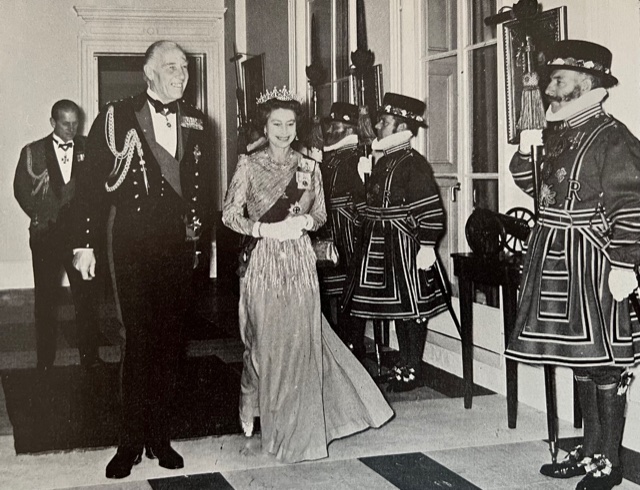
I have been lucky enough to have met the Queen informally, to ‘have a chat’ and scribbled about that experience in ‘I had Dinner with Her Majesty’ in PC 289 of July this year, the month of her Platinum Jubilee. Those in the last few days of their life often have a sense of quickening events. One of our Prime Ministers, Harold MacMillan, is reported to have had his normal evening whisky, put the glass on the table and murmured: “I think that’s enough” … and died. Knowing the late Queen’s impish sense of humour, I wonder whether she had simply waited to say goodbye to Boris, welcomed the new Prime Minister, Liz Truss and then, duty done, decided it was time to go?

In 2016 Celina’s father died. I had only known him for four years but come to love him deeply. In PC 60, ‘Goodbye … but never forgotten’ I summed up my thoughts about him. “The man I grieve in this piece was an enormously loved, talented individual who used his intellect to further our understanding of our brains and how they function. He was a simple man of faith or maybe a man of simple, deeply held faith, and if anyone was prepared for what might follow this earthy life, he was.

I sense this last sentence could apply equally well to Elizabeth II (with some pronoun adjustments!).

Richard 9th September 2022

http://www.postcardscribbles.co.uk

PC 298 Judge not

Instant judgements? We all make them and with the ever increasing polarisation of western societies they get more common; “quick to judge, slow to understand”. Some people are very quick to judge and make decisions for themselves about situations they know absolutely nothing about. For those of you on any form of social media, one person’s story can be attacked from left and right, from above and below and still the writers often know little about the real situation.

Mind you these days it seems one person’s ‘truth’ is only their perception of what really happened and may not bear any relation to what did happen!! Sometimes you read of a critic whose written a vicious review of a book and then it materialises they haven’t read it. You might think I am a little sensitive about the following example – but judge for yourselves!

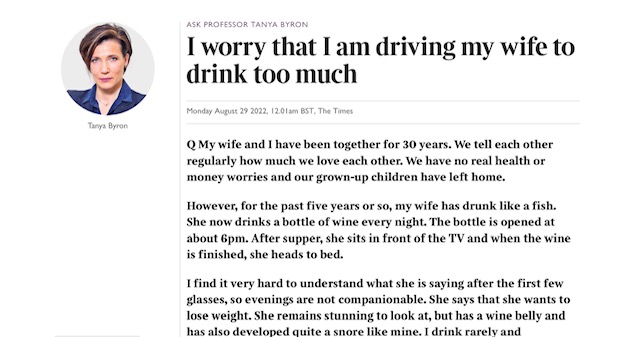
Professor Tanya Byron, a British psychologist, writer and media personality best known for her work as a child therapist, has an advice column in The Times. A husband asked for help to address his wife’s drinking problem, as he saw it.

I suspect we all hold to the archetypal view that it’s always the male of the species that has a drink problem, but the figures suggest it’s women, particularly after middle-age, who suffer a much greater risk of alcohol-associated bodily damage through chronic alcohol abuse. She wrote:

Alcohol, the most socially acceptable drug, is considered the world’s most dangerous drug. A recent panel of British academics and practitioners ranked the harm caused by all legal and illegal drugs (for example harms that are physical, psychological, social, health-related, financial, relationship and family related), and found that the harm alcohol causes exceeds the dangers of heroin and crack cocaine when the overall danger/harm to the user and others is taken into account.”

“…..the most socially acceptable drug ……” – so if you don’t partake you’re considered odd, not a ‘team-player’, boring, not interesting? Then that lovely quote from Ernest Hemingway comes to mind: “I drink to make other people more interesting.”. Paddling a solo canoe upstream is harder work than letting the current take you ….. so when you do, you become a little sensitive, maybe over-sensitive, to how others behave towards you.

I never know from where an idea for a postcard may come although I often add to my ‘Notes for Future PCs’ folder little bits and snippets. The following example about making quick judgments just fell into my lap a few days ago and I thought it worthy of expounding.

Alberto had been involved at a senior level in Rio de Janeiro in the large Brazilian brewing company Brahma, founded in 1888. It’s now owned by global brewing giant Anheuser-Brusch InBev, whose 500 brands, including Budweiser, Corona and Stella Artois, are familiar to beer drinkers the world over. He and other family members, on the first day of a three week European trip, dropped in for a drink before going on to supper locally. Everyone enjoyed a glass of champagne and I tucked into a Sagres 00, a likeable non-alcoholic local beer. At some stage it was pointed out to Alberto that I was drinking a non-alcoholic beer.

“You don’t know what you’re missing!” he cried, raising his glass.    

Well of course I knew what alcohol, particularly a glass of champagne, tasted like, what it chemically does to the body. I also knew I didn’t need it to feel fun and enjoy myself, knew I wasn’t missing it. He knew nothing about me; I could have been a recovering alcoholic, I could have had parents who were alcoholics, a friend could have been killed by a drunken driver. But it’s the arrogance of the statement, not knowing anything about the person that he was talking to, that has made me scribble this. The instant judgment is often so incorrect!

Writing about this recent event caused an old memory to rise from the murky deaths. Somewhen (Note 1) in the spring of 2014 we had a guest teacher from the USA for our Wednesday 1000 yoga class in Portslade, someone who had run his own studio in New York. It’s always good to have another teacher, as it’s easy to get so used to the mannerisms and style of one that you can end up in a rut! God forbid! I remember him as it was six months after my triple heart bypass operation …… and we are encouraged to tell the teacher if you have any aches, physical limitations, are pregnant if appropriate, breathing issues and so on which can affect the way you attempt a posture. So before class I found Otto and told him I had had a heart bypass, that I was fine but was taking it sensibly.

“You need to change your diet!” was his only response.

There are many reasons for needing a heart bypass, and one’s diet may be one of them. Actually I thought my diet had been relatively healthy, plenty of fruit and vegetables, not a lot of meat, plenty of fish and nuts, so I was rocked back on my heels a little by his comment. How could he make any judgment about me, in any way, knowing nothing about me? I might have expected him to ask: “Oh! I am sorry the hear that.” “How long ago?” “Are you back to full health?” “I’ll keep an eye on you during class.” …… didn’t feel he was very empathetic!

Later during class I realised he had a very sexist manner and decided he had more issues that worrying about my diet!  But maybe I was being quick to judge?

Richard 2nd September 2022

www.postcardscribbles.co.uk

PS According to the Myers Briggs Type Indicator, people with judging preference want things neat, orderly and established, so more likely to judge quickly! Those with a perceiving preference want things to be spontaneous and flexible – ‘let’s find out more’!

Note 1 Somewhen is a delightful informal word meaning ‘at some time’ that was first recorded in the C13th but then dropped out of favour until the 1800s. Best articulated with a County of Sussex dialect!