My step father, known by me throughout our thirty-eight-year relationship as Uncle Philip, died in November 1993. He came from a traditional Scottish family, and his values were very much shaped by a strict upbringing, typical of the age, and coloured by wartime experience. Indeed the family motto was ‘Cura et Industria’ (Care and industry) and their crest showed a cornucopia of goodies – suggesting that through hard work comes abundance. He was careful with money and generous of spirit. Above all he was an engineer, a mechanical one at that. He loved technology and things mechanical, always wanting to understand how something worked.

The other evening I imagined having a conversation with him, about life in May 2017! The thought came to my head as I used some grease from a green Duckham’s tin to ease the hinge of a metal gate to stop it squeaking. Uncle Philip had had this very tin ….. using the contents to fill a grease gun for the nipples on his car. I am not a mechanical engineer so I can’t tell you where exactly these said nipples were but ……! He had only two cars in the time I knew him, an old black Riley Pathfinder and then a Rover 3500. Both he cherished and serviced himself.

“You wouldn’t know how to service a car today, Uncle Philip” I said rather confrontationally.
“Oh! Why’s that?” he said, immediately bristling with indignation!
“You raise the bonnet and there’s a large cover – and very little else. All computer-controlled and very efficient. Not sure there is even a distributor or carburettor!! Do you remember how you used to check the spark gaps with a feeler gauge …… pick all the gravel out of the tread of the ‘Crossply’ tyres, to ensure they lasted longer?”
“So you’re saying I would not recognise how cars have developed in the last 30 years or so? What else would I be surprised at?”
(Ed: What follows are some of the things that pop in to my head. It’s only a start!)
“First and foremost, the development of the ‘internet’ – the world wide web (www)”
“And what, pray, is the Internet?”
“The Internet was originally a military back-up plan linking super computers across the United States in the 1960s. In the early 1990s CERN proposed a global web concept and by the middle of that decade the public began to grasp its potential. Today its tentacles reach into every aspect of human activity.”
“Such as?”
“Communications! There has been such an exponential growth in their development that it’s hard to keep up, unless you’re under 25 and working for a technology company.”
“A what? A ‘technology’ company?”
“They are the new Masters of the Universe! In the latter years of your life you remember the development of the mobile telephone? Looked like a brick which you charged with a bigger brick.”
“Yes! You had a ‘Rabbit’ that only worked if you were within 100m of a rebroadcast mast.”
“Yep! Well remembered. That didn’t last long (20 months). But look at this, my ‘smart’ phone through which I can make telephone calls, either through a local mast or through the internet (and that’s free!) ……. take photographs as it has a camera…”
“Hang on! You have a camera in your phone? That sounds amazing? But how do you see the photographs. It was always so expensive to print them.”
“It’s all in the digital revolution. You can define anything with a series of ones and zeros as in ‘100110111100001001’ – and this has simply turned life upside down. So I can see them on my personal computer, which incidentally is smaller but more powerful than ever. If I want to, I can load them onto a web-based site and print them off in an album, individually, however I want them.”
“A ‘web-based’ site? One of those thingamajigs on the internet?”
“Absolutely! I can use my smart phone as a clock/alarm/stopwatch …. I can use it to text people.”
“This phraseology is all so alien to me. Text?” he said, peering over his half-moon glasses.
“Instead of talking to people, I can write to them electronically, either in the form of ‘electronic mail’, shortened to email, which started becoming popular about 2 years after you left us, or, if it’s a short message, by typing it out on my ‘phone’ in the form of a text. The wide availability of hand-held devices, be they a telephone or small lightweight ‘Laptop’ computer, has ensured the success of this new medium. This is all part of social media, a completely new industry with odd names like Face Book, Instagram, Snapchat, WhatsApp, that ensures no one talks face-to-face and encourages the rise of self-obsession. I joke!”
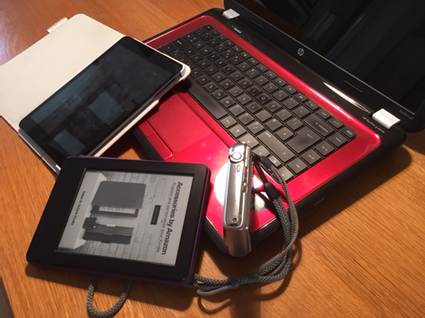
Digital Devices
“You’d also be surprised at the development of the devices for seeing video. You will remember how TV size was defined by the Cathode Ray Tube; they got so big the set was almost as deep as it was wide. Now an extremely slim TV monitor can be made with solid- state electronics and the development of pixel technology. A pixel is the smallest element of an image that can be individually processed in a digital display – be it a photograph or video system.” (Note 1)
“You remember that drawer in the hall table where you kept your Ordinance Survey Maps? Actually these days you can get any map on your phone and the Global Positioning System GPS will even tell you exactly where you are, to an accuracy of 5 metres or so.”
“My brain is being overloaded. Quickly, before I fry. What else?”
“Cursive writing (see PCs 56 & 57) is slightly passé. Reading anything, be it a book or a newspaper, can be via an electronic device although, unless you’re travelling, most people seem to prefer the old-fashioned paper book. Learning is similarly available through the internet. And the internet has freed those chained to their office desk; they can work anywhere, provided they can get an internet connection. Your electronic ‘library’ for research purposes is, in the main, provided by a company called ‘Google’; so it’s part of our language ‘to google it’, meaning to go online to find the answer through the Google search engine.”
“Search Engine? Oh! Don’t bother!”
“And the most exciting developments are going to be, I think, in the area of nanotechnology and the use of Graphene. Meanwhile everyone still moans about the weather and politicians of every persuasion, no one has solved the 69 year-old Israel-Palestine problem, and extreme Islam is the butt of blame for most of the world’s woes.”
“The world’s a very different place it seems, but it was ever thus! My father would have said the same; different developments, different times. Thanks for bringing me up to date! Now I must go and tell St Peter all about it, although he probably knows as he seems to have eyes and ears everywhere!”
Richard 7th May 2017
Note 1 A pixel can be turned on (ie illuminated) and off (darkened) on a computer monitor. Resolution depends on the number of pixels a monitor can show. They have developed from 640 x 480 pixels per inch (PPI), through 1073 x 768 PPI until today’s 1000 x 1000 PPI. Colour depends on how much memory has been assigned to each pixel. For instance, two-bit memory pixels can show 8 colours, whereas eight-bit pixels can show 256 colours.