PC 161 The Atlantic – a Tall Ships’ Race

Way back in 1975, on a cool autumnal evening in Dempsey Barracks, Sennelager in Germany, I was sitting in my room in the Officers Mess of 39 Medium Regiment Royal Artillery, thinking how the last training exercise had gone. The mess orderly knocked; I had a telephone call, someone called Major Mike May. Hard to believe these days, when communication devices are personal and in your face, or should that be at your ear (?), but the Mess’ telephone was housed in a little cubicle off the main ground floor corridor. Outgoing calls were made via an exchange operator! It was a somewhat airless and dimly lit space, but doubtless privy to countless intimate conversations over the decades. I had sailed with Mike May a few times and this was really our only connection; so I was expecting some sailing-related question, but not: “Would you like to navigate an Army entry in the STA Race next year?”
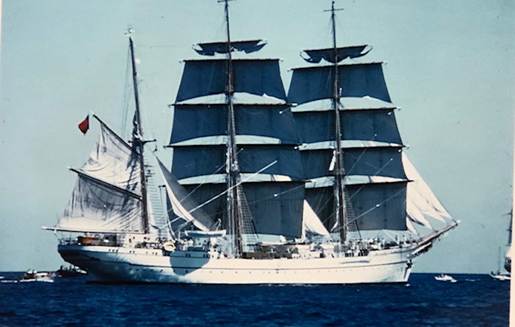
The STA (Sail Training Association) was an umbrella organisation for offshore sailing in the UK, but more importantly organised an annual international race for square riggers and sailing ships. (See note 1) I had taken part in its 1969 race from Portsmouth to Skagen in Denmark, so was familiar with its ethos of encouraging youngsters to develop their character through sailing. Additionally in 1974 I had had a fortnight sailing as a Watch Officer on the TS Malcolm Miller, a three-masted schooner. The 1976 race was from Portsmouth, England to Newport, Rhode Island, USA via Tenerife, in The Canaries, and Bermuda. These four legs would be sailed by different crews; we were allotted the Tenerife to Bermuda leg, a distance of just under 3000 nautical miles. Bermuda, an island lying some 600 miles east of the USA state of North Carolina, is 22 miles long but only one mile wide!

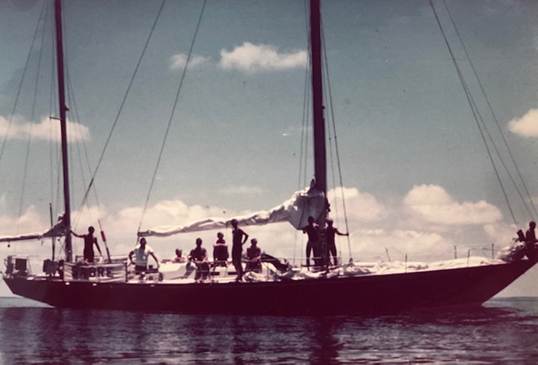
After some crew training in The Baltic we, Mike May as Skipper, me as Navigator and ten other army personnel, flew to Santa Cruz de Tenerife on 21st May 1976 and took over the Nicholson 55ft yacht HMY Sabre.
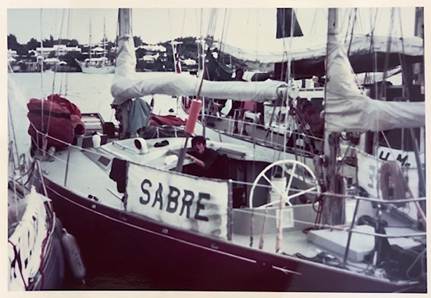
Two days later the race to Bermuda started; there must have been about 50 vessels, from huge ‘tall ships’ to lesser mortals like us. Offshore racing is strange; you have a crowded, manic surge across the start line, the skippers set their course and off you go. Most modern yachts can sail just below 40 deg to the wind, the tall ships probably only manage 60 deg; but their speed was much superior to ours, so their passage quite different! I don’t think we saw any other competitors after that first night, such is the vastness of our oceans! It’s a long time ago (!) but I think we organised a watch system of 4 hours on/4 hours off with a ‘dog watch’ to change the routine …… for three weeks.
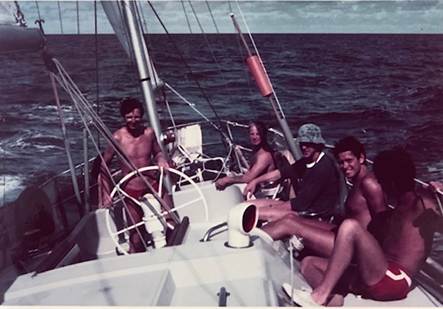
So ….. days of watch and sail changing, attempting to squeeze another knot out of the yacht and our inexorable progress towards Bermuda. Ripped sails needed mending, gear needed maintaining, bread needed making – or should that be kneading? And with twelve people in a small confined space, the crew needed managing!
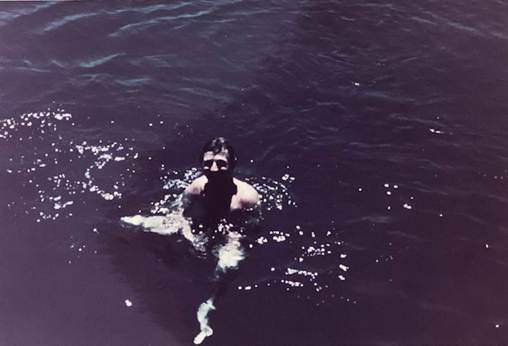
The trade winds are the prevailing pattern of winds found in the tropics, from the east towards the west. Tenerife is some five degrees north of the Tropic of Cancer so we were able to take advantage of these favourable winds, flying the large spinnaker sail almost for two weeks, before a final few days of head winds and heavy seas. Somewhere in the middle of the Atlantic we were becalmed and this gave us all an opportunity to have a swim, although prudence ensured only one crewman was in the sea at any time, the rest maintaining a lookout for sharks!
…….. and me! (Not thinking how deep the water was!)
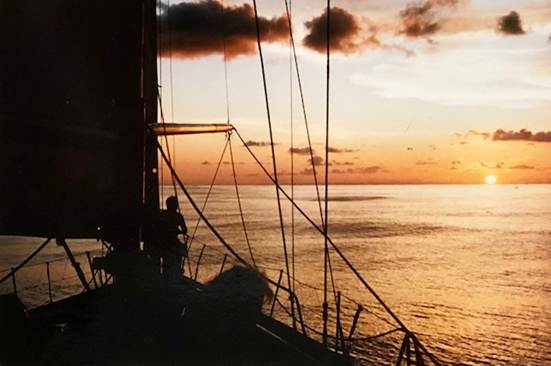
Fresh water was rationed to 1.5 litres per person per day – although we had an extra splash in a whisky at drinks time. The eventual lack of fresh food and the constant exposure to salt water produced some skin issues but otherwise the planned menus worked well.  Sometimes the nights seemed very long …….
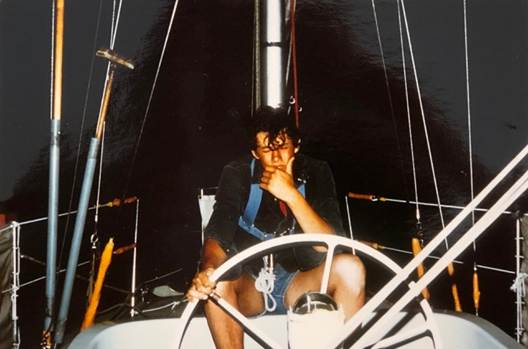
…… and at other times the conditions required much concentration …….
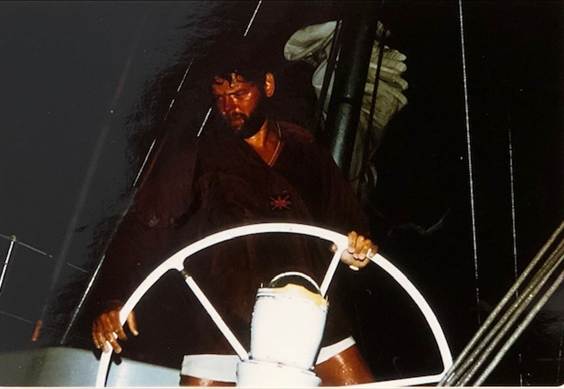
We checked in with the Race Controllers every day by two-way radio, giving our position and listening to those of the yachts we saw as our competitors! Into our final week and we had head winds which gave us more movement and surprisingly some seasickness!
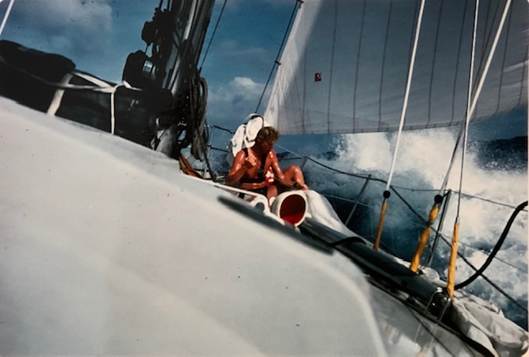
No two yachts were the same and there was a handicap system. We navigated by sextant with sun and moon shots, converting our data by way of navigational tables and a Hewlett-Packard calculator the size of a house brick that had some computing ability, to a position on the chart ……. and were very pleased to find the tiny island of Bermuda right on the bow on the 10th June.
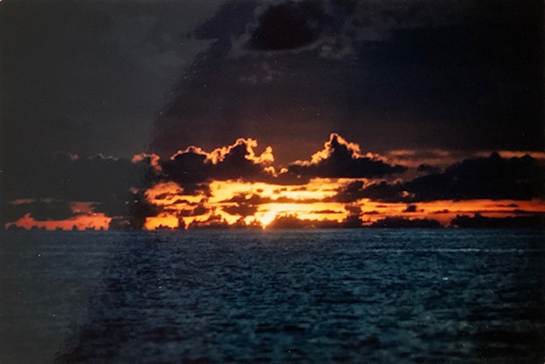
We had arrived in Bermuda at the beginning of the hurricane season, greeted by cloudy and extremely humid weather. The Tall Ships gradually filled up the harbours and small bays and celebrations were numerous and colourful; thousands of young people enjoying a tremendous achievement, crossing one of the great oceans of the world. And if you’ve never tried Planter’s Punch, do so, but do it in the environment for which it was created; doing so back in Germany some weeks later it wasn’t quite the same! But we had done well and somehow managed to win some trophy.

Richard 19th September 2019

PS I even managed to catch up with an ex-school friend who lived there.

Note 1. Founded in 1956, the Sail Training Association (STA) became the Tall Ships Youth Trust. The current Tall Ships’ Races are organised by the Portsmouth-based Sail Training International.
PC 211 Off Arromanches (continued …. see PC 209)

Asking Kevin, both mate and the yacht’s mate and the most competent of my crew, to take the wheel I headed below. Sure enough there was about two inches of sea water washing around; lifting a board confirmed the bilges were full and it wasn’t simply water off crew oilskins. (Note 1). My heart started to beat faster as the crew expected me to sort it out!

I turned on the electric bilge pump; nothing happened. I shouted to John in the cockpit to find the manual pump, to make sure the tube was out of the locker and to start pumping. My mind began to fill with a thousand things I should do …… and they were all ‘NOW’! Where’s the pump? Saucepans please! Put a position on the chart, note in the log. Where are the flares? Is the life raft easily ready? What about life jackets? I had never felt the necessity of always wearing a life jacket on a yacht – but sense these days with smaller less-bulky ones available that might be an out-dated practice. But I knew down over the lee rail was the coast of Arromanches, with its rocky shallow foreshore extending far from the beach and we were on a falling tide. (Note 2) “Oh! Shit! The club’s flagship might go aground! Explain that to the Committee!” Then at last the first and only important question: “Why was there water inside?”

The crew formed a saucepan chain (you know what I mean!) and bailing began. Waves were breaking over the bow and it was unpleasant below and on deck. I needed to get the yacht in a more stable state so took the helm, brought the bow through the wind without changing the jib sheets and hove to. Wonderful! Suddenly the movements lessened and there was less noise.

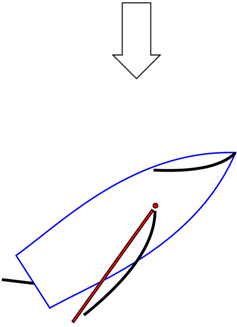
Rudder tries to turn the yacht towards the wind; wind on the foresail resists

I hope none of you have had to heave to in an emergency; I certainly hadn’t before but had demonstrated the technique to those learning to sail. I had likened the sails to two hands around a bar of soap. Squeeze – tighten the sails and the wind has to accelerate through the narrower slot – the soap and it shoots out – and the boat moves forward. When you take the bow through the direction of the wind, and leave the foresail untouched, the mainsail and rudder try to move the boat forward and the headsail resists. The yacht simply sits, slightly head to wind, and if the sail areas are well balanced, hardly moves.

I have sailed on many wooden yachts that let water in, as the planking opened a millimetre or two beating hard to wind. The 30 sqm and 50 sqm yachts at the British Kiel Yacht Club (see PC 106) were particularly wet below and it was essential to have all your spare clothes and sleeping bag wrapped in black rubbish bags to keep them dry! But St Barbara III’s hull was made of GRP (Glass Reinforced Plastic) – God help us if we had somehow cracked the hull on some high bounce as we left the harbour!

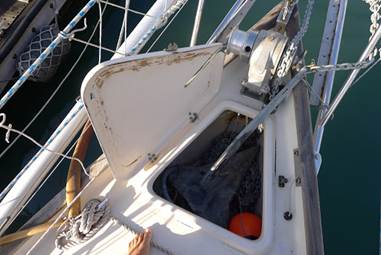
Dismissing this nasty idea, my thoughts then turned to the anchor stowage. A more stable yacht meant less water was breaking over the bow ….. and finding its way below! I knew from experience that if the Kedge Anchor was not exactly positioned in its locker, with even a centimetre proud, the hatch cover would not fit and lock properly and water would seep in, and in rough conditions flood in. Turning on the foredeck lights, I took Hew with me and, clipping on at each stage, we made our way up to the bow.

Generic ‘anchor stowage’

Sure enough, we could make out the anchor locker lid was not flush with the deck. In their haste and in the pouring rain, coping with a pitching deck as we motored out through the harbour entrance, the foredeck crew hadn’t got the anchor properly stowed. It took Hew and I about 5 minutes to get it fitted properly and, as we made our way back to the cockpit, we hoped that the level of water on board would begin to reduce. After ten minutes that was noticeable and there was much relief all around.

I was a bit of a stickler for writing up both the daily log and the journal so, as we set a revised course for The Solent and Gosport, wrote up both whilst the emotion was running! Somewhere in the archives of the Royal Artillery Yacht Club are that log and the journal entries.

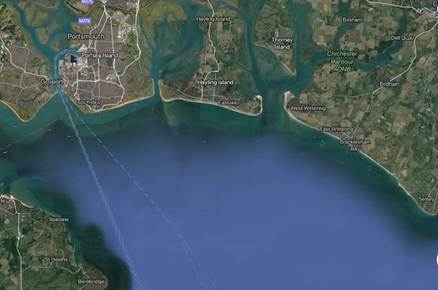
Google Earth showing The Solent, with the Isle of Wight on the bottom left and the entrance to Portsmouth top left

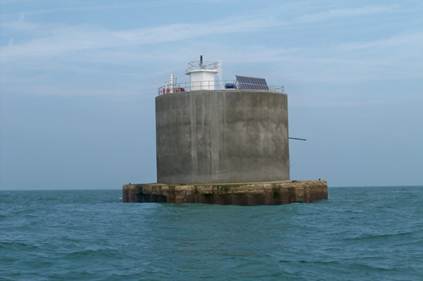
As is often the case when sailing, conditions can change quite rapidly. From our rough start from Trouville in a Force 7, the wind had gradually decreased as we crossed The Channel. We shook the rolls out of the mainsail and changed up to the No 1 Jib.  Abeam of the Nab Tower, the wind dropped completely, the sea strangely calm and the last few miles were made under engine. 

The Nab Tower at the entrance to The Solent

It was quite a relief to tie up alongside the pontoon in the Gosport Marina mid-afternoon and switch off – in every sense!

Richard New Year’s Day 2021

PS A Very Happy New Year to all my readers

Note 1 Gallows Humour is often part of a crisis and this was no exception!  I was reminded of part of Tales of Old Dartmoor, a radio sketch from The Goon Show (February 1956). To cut to the chase (It’s all on You Tube so if you have never listened to it, do so!) Dartmoor prison had somehow become HMS Dartmoor, a floating prison ship (!), and the crew were looking for the ‘treasure of the Count of Monte Cristo’. Rumour had it it lay under the floor of Cell 626. They lifted a flagstone.

“Ah! Look! Water.”

 “Salt Water!”

 “Look! There’s more of it! It’s coming in.”

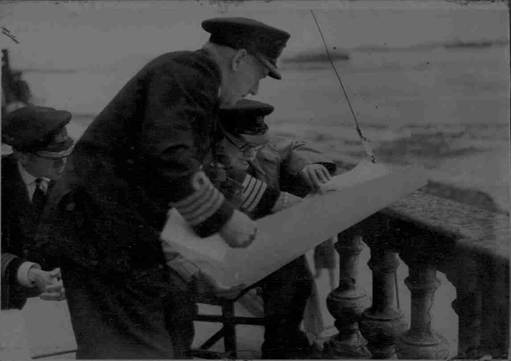
Note 2. After reading PC 209 Jonathan sent me this photograph of his great uncle Harold Hickling briefing Churchill at the Mulbery Harbours off Arromanches. June 1944