“You told me of your sister’s copyright infringement fine whilst at university, Duncan ….. (see PC 496) ….”
“Yes! So, what’s your sorry story?
“A sorry story indeed! I don’t think I am not alone in downloading images from the internet to share with chums, something you see interesting, beautiful, explanatory? ‘To share with chums’ ….. so not public! And you probably don’t worry about the original image’s ‘copyright’? Although if you do it to illustrate, for instance, a non-commercial newsletter, for a limited but public readership, you enter a minefield.”
“When I started The Hope Café I did search for suitable images for the promotional material …. and indeed for the posters for the walls, although I always imagined the original copyright was covered. Thankfully I didn’t need anything for your gifted triptych!”
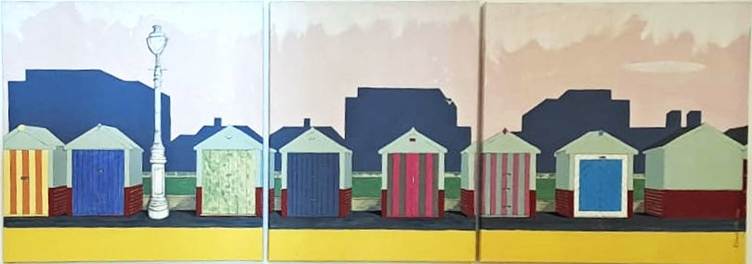
A present to The Hope Café
“My first postcards were emailed to a very small group. Then I created my www.postcardscribbles.co.uk public site and started embedding the odd photograph to make them more interesting. Finding the right photograph was fun, often through Google. Some of my postcards have covered the Post Office scandal; meeting Sami, the ex-PO submanager made bankrupt by the fines imposed on him, here in The Hope Café gave a personal dimension to the story and in one PC I used a photo of Sir Alan Bates and in another one of Betty Brown OBE; both photographs taken off the internet.
Then, out of the blue, I receive this from one of the media giants: “To whom it may concern, We are contacting you regarding the use of our imagery on your website postcardscribbles.co.uk. We don’t have any record of our content being licensed for this use. …….. If you don’t have a licence, your use of our images would constitute an infringement of our copyright … note that removal alone does not resolve the matter.”
“Wow! I bet you gulped hard at that – and started sweating?
“Did I ever! The bottom line was …… ‘We, Mega Media company, own the copyright and you should pay over £1400 to avoid an immediate fine of £5000’ ….. something like that! I paid ….. and had a sleepless night …. then I got another fine ….. and I began thinking it was a scam! I contacted my bank’s fraud hotline and explained. They gave me the bonafide Mega Media Customer Services email and telephone number and soon I am having an email exchange with their ‘Copyright Enforcement Specialist’ Adam; sounded very Big Brother!”
“Didn’t you know any lawyer who could give you advice?”
“It’s a very specialist area and not one three friends who are lawyers are familiar with. But another friend, bless her, asked Chat GPT, who she calls ‘Gerald’ (!) …… I will summarise what it wrote:
‘This is a common trap for non-commercial newsletters. I’m not a lawyer, (!!) so treat this as general info. For years, rights holders rarely chased individuals for non-commercial use. That changed around 2015-2018 when automated systems made it cheap to send thousands of letters. Software generates a letter claiming, “unauthorised use” and demanding a “settlement fee” that’s much higher than a normal license. They rely on fear.’
“Well, it’s right there! Exactly how you acted, out of fear! The huge advances in AI make it a doddle to scan billions of pages worldwide in seconds. What else?”
“Gerald went on:
‘The bottom line was: ‘If he copied/pasted an image from Google and used it without a license, that’s infringement under the UK Copyright, Designs and Patents Act 1988. Copyright infringement is “strict liability” – intent and profit don’t matter. If it went to court, a judge would look at what a license would have cost. For a non-commercial newsletter to 450 people, a single image license is typically £20-£150, not thousands.
“Did Gerald suggest what you should do?”
“One of the positives about AI is that it often does. In my case Gerald said:
Step 1: Stop doing it and don’t ignore the email.
Step 2: Check who’s demanding money. (Scams exist too)
Step 3: Don’t pay the “penalty” amount as-is – the first demand is usually inflated.
Step 4: Respond with a “mitigation” letter. This often gets it settled for £100-£300 per image.
If I needed photographs for a future postcard, I should look at public domain images in Wikimedia Commons, or on Royalty-free sites like Unsplash, Pexels, Pixabay, which are all free for editorial use.”
I squirmed and wrote an obsequious email, which went something like:
‘Since 2014 I have written a weekly electronic postcard and post them on WordPress. I have a hundred or so regular readers (actually a few hundred!!) and topics have covered my own career, sailing, travel, observations about life and current affairs. As a member of the older generation, it’s good to keep my brain active ….. I make no money from these literary efforts. Suddenly I am charged over £1400 for using two photographs. Not sure where this will come from but there was a threat of an immediate £5000 fine so paid up. Can I appeal? Is it fair? On what basis are the charges made? Advice please?”
In amongst the reply I was asked for a printout of my ‘Profit & Loss’ account!! I got a reduction and removed my old postcards.”
“What if someone wants to read one from your back catalogue of almost 500, as often you refer to an old one in a new postcard?”
“They would need to ask me by email. When all’s said and done, Duncan, the individuals who produced the photograph, the artwork, in the first place need to earn a crust.”
“But for you, Richard, David & Goliath or Sledgehammers & Nuts come to mind!!”
Richard 26th June 2026
Hove
http://www.postcardscribbles.co.uk
PS On Tuesday it was announced that Getty Images, one of the world’s largest photography agencies, has signed a multi-year licensing agreement with OpenAI, months after it lost a high-profile copyright infringement claim against another artificial intelligence developer. The deal will mean images from its library will appear within ChatGPT’s search display, bringing more visual features into the chatbot.

