PC 488 Hope – WhatsApp with Sami

This week we’ve been in the capital of Argentina, Buenos Aires and we flew back to Rio de Janeiro today. I will obviously devote next week’s postcard to our time in ‘BA’, the city founded in 1536 by Pedro de Mendoza, who named the fort and port settlement after ‘Nuestra Señora Santa Maria del Buen Aire’, a patroness of sailors, venerated by Spanish sailors to ensure safe voyages. The translation means ‘fair winds’ or ‘good air’. Yesterday I managed a video WhatsApp call with Sami, who was sitting in the Hope Café in Hove; there is a four-hour time difference.

“Hey! Richard! Good to see you! You’ve already caught the sun, but that nose of yours is always red, as opposed to suntanned!!”

“Funny! I have lived with this nose for a long time and yes, it never goes brown. Used to peel a great deal when sailing, salt water and sun always detrimental to the skin! Just have to live with it or walk around with it covered in zinc ointment; not a good look. (See alsoPC 190 ‘Up My Nose!’ August 2020.)”

“Talking of noses, did you see that article in the Times about our concept of pain, and the illustration of a nail up someone’s nose?”

“Remind me?”

“According to the psychologist Rachel Zoffness (Note 1), pain ‘is rooted in a mix of biological, psychological and social factors. This biopsychosocial model views symptoms as more than the mere sum of damaged tissue’.”

“We’ve all suffered pain, often so excruciating one needs a  strong pain killer. I remember before my L4/L5 microdiscectomy on my back I was offered gabapentin. I took one, felt awful and never took another. You mentioned a nail up someone’s nose? Do you have a photo?”

“The Times article had one of the X-ray of Patrick Lawler’s skull. A labourer in Colorado, Lawler had inadvertently banged himself in the face with a nail gun. He thought nothing of it but 6 days later had a vague toothache. The dentist’s X-ray showed a 10cm nail up his nostril, buried in his brain. Zoffness contrasted this story with one of a builder in the UK in 1995, who’d stepped on a 15cm nail that had gone all the way through his boot and out the top. He was in such pain the hospital sedated him with fentanyl and midazolam. Yet when they cut away his boot, the doctors found the nail hadn’t touched his foot at all.”

“Ah! He automatically thought when he saw the tip of the nail that it had gone through his foot and this triggered an automatic psychological pain response. Wow! I always told my clients that we can only focused on one thing at once and illustrated this by saying: ‘If you stub your toe, your toe hurts. You bend down to rub your toe and bang you head on a table; what hurts? Your head!’”

“What’s that T-shirt you’re wearing? What does it say?”

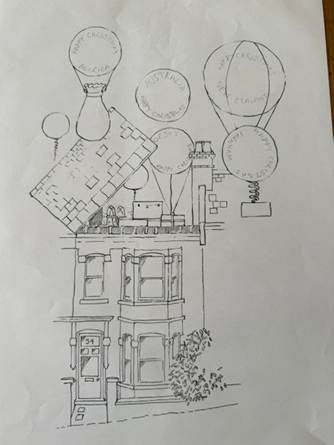
“It says: “Teachers – The Original Influencers” and it was seen in a school in Zimbabwe by Benedicte Deutsch. Benedicte is a wonderful example of doing something you think you could. She was over 50 when she decided to become a Paramedic here in Sussex. She needed to do a year upgrading some of her French qualifications, then a three-year degree before she could put on the green uniform. She’s been assisting people in stressful situations in Worthing ever since, but last summer she spent three weeks volunteering in Africa. Hence the T-shirt.

“Is what you’re wearing from Zimbabwe?”

“No! She told me about it; I thought it would be fun to sketch it out and have one printed off, especially as my daughter’s been teaching for decades. Incidentally Sami, Brighton & Hove is such a diverse city, isn’t it? Just love living here.”

“And you’re making this statement because ….

“We use the bus most weekdays to go to yoga and regularly see a couple of chaps who clearly live in a different world, inside their heads. Often we see one, but the other morning saw both. They are amiable, non-offensive and live in a very musical world, often singing the lyrics to some well-known song quietly to themselves, over and over again …. not afraid of eye contact, always polite and say ‘good morning’ then retreat, back into their head. I sometimes wonder whether I should miss my 1000 class and stay on the bus, to understand what their day will be like, where they will go, who they will meet. Maybe they go to the same place ……”

“Didn’t I read somewhere, and given your military background you could confirm this, that a senior officer wrote in one of his subordinate’s annual Confidential Report: ‘His soldiers follow him, but only out of curiosity.’? Maybe your own curiosity will dictate missing yoga one morning.”

“Maybe it will Sami. You and Lisa got a holiday planned this summer?”

“Huh! We were planning a couple of weeks in May in Dubai. Never seen the place, have friends who live there and love it. However ……”

“You going to mention the conflict with Iran?”

“We’ve booked to go to Sicily instead. A little safer, although everyone else seems to have the same idea and it’s getting quite booked up, although we’re going before the schools close, so it’ll be OK!”

“And before I end the call, Sami, must tell you that the most exciting piece of mail I got just before we left Hove was a letter from HMG’s Department for Work & Pensions, informing me of ‘the general increase in benefits’ I will receive in the new Tax Year. In the small print at the bottom, I was delighted to read that I would also have an extra 25pence per week from my 80th Birthday.”

“Lucky you. The generosity of The State! See you next month. Safe travels.”

“Indeed!”

Richard 25th April 2026

Rio de Janeiro, Brazil

www.postcardscribbles.co.uk

Note 1 ‘Tell where it hurts: The Science of Pain and how to heal’ by Rachel Zoffness

PC 485 Live more? Live less?

There is something rather dictatorial about the title of this week’s postcard, but it was prompted by one of the doctors at The Hove Practice on Church Road, Dr Ellie Deane-Bowers. We were chatting about the after-effects of major surgery, and I recounted my conversation with Professor Hugh Perry, Emeritus Professor of Experimental Neuropathology at the University of Southampton, who had worked with Celina’s father in Rio de Janeiro. We had lunch with him and his wife Jess in May 2024 (See PC 388 Lymington) and, having never met me before, he asked for my ‘potted history’; where I was born, what I had done etc.

I was born in Bath (blah blah) ……. In 2013 I had a triple heart bypass …..”. Hugh took a step backwards and looked at me anew. It seems that most people, 85% (?), become rather risk-averse, withdrawn from full-on activities, after major surgery. I had met a few of them in the Moulsecomb Leisure Centre on the east side of Brighton, where I went for a series of rehabilitation sessions after my bypass. “Hey! Take it easy; you’re sweating” said one of my fellow participants! He clearly was in that 85% category. There was no reason from a physical point of view to take it easy; as Jonathan Hyde my heart surgeon said: ‘good for 30 years’. So, it’s purely mental, the development of habits that restrict, that close one down, that make you live less than you’re physically capable of.

I asked a fellow yogi, Ian, his take on why we stop attempting something. “Fear!” was his immediate response and he promised to expand this idea when I asked: “Fear of what?”

Rather reflected what Marianne Williamson had written (See PC 205 First Steps): “Our deepest fear is not that we are inadequate. Our deepest fear is that we are powerful beyond measure. ….. And as we let our own light shine, we unconsciously give other people permission to do the same. As we are liberated from our own fear, our presence automatically liberates others.”

Marianne suggests we fear our own power, our own innate ability to do something if we wish to. Certainly, the fear of failure is a possibility. We all know the apocryphal story of Thomas Edison who tried 99 times to make a light bulb filament burn brightly, before the 100th attempt that worked. Another American, George Washington, claimed ‘Ninety-nine percent of all failures come from people who have a habit of making excuses,’ so the failure is self-inflicted through lack of accountability rather than lack of ability.

How do you know you can’t do something unless you try it? Four years ago, I wrote a postcard titled ‘Why You Should Try Something Different …. Ceroc?’ (PC 192 from August 2020). Maybe we don’t try things, in this case Ceroc, aka Modern Jive, because we’re worried what others will think?

The late Ken Robinson’s life’s work (PC 195) was to encourage individuals to find the one element that makes them tick, makes them want to get up and grab life, to live more. Please, if you haven’t already, read his book ‘The Element’. Isn’t everyone capable of being a writer, a musician, businessperson, sportsperson, or doing any of the myriad of things humans do? Some will be more successful at something than others – so we need to find our own personal element or elements.  

Of course, someone might have been so traumatised by some experience that they carry that burden, that trauma with them every day, every week; the trauma acts as an anchor and prevents present and future action. The suggestion in Timeline Therapy is that we attach emotions of fear, sadness, anger and guilt to past events and that we wear these emotions in the present. There was a good line in some TV drama: “Whatever darkness you’re hiding, it’s written all over your face.” So, to ‘live more’ we need, through therapy, to detach these unwanted emotions from our past. Makes sense, I think; no one really wants to ‘live less’, surely?

I was talking to a clinical psychologist the other day; at some point in the conversation, I told him of the sudden death of a friend’s sister at the age of 59. Incidentally this tragedy had reminded me of Victoria, the sister of a good friend, who had died aged just 60 (See PC 22 Life is Uncertain).  It’s always interesting to hear people’s reactions, but I was shocked by his: “Illness and death stalk us always”. Maybe it’s true but it’s so morbid, would not be my immediate response to someone’s personal tragedy.

A recent Times article about lust and libido by Jean-Claude Chalmet, a psychotherapist, raised many interesting issues, but one particularly relevant for this postcard. Under a sub-title ‘….. but do look after yourself and your body’, he writes: “I notice among my clients, and particularly in men, that if they let themselves go physically, they also let go of their needs and desires. It’s often because there’s been a realisation in midlife that they haven’t lived, they’ve merely existed. They’ve had an unfulfilling career, a marriage that has become operational (sic). Now, learning to live looks arduous and disinterest becomes their armour because they think it’s too late. This bitterness and ‘beer belly’ combination kills libido in a couple.” The message is clear; stop existing, start living.

Ian again: “Is fear the biggest inhibitor or the biggest motivator? If something scares the living daylights out of you, if you’re brave enough to pursue it, it can give you the biggest reward and often the biggest opportunity to develop as a person.” There will always be uncertainty in life, whether it’s moving up to a new school, finding your feet in university, earning money and growing as a person, developing relationships, parenting, coping with the loss of loved ones, whatever, that’s a given.

And Ian reminded me that we are born with only two innate hard-wired fears designed for survival, the fear of falling and the fear of loud noise. These instinctive responses instantly trigger the fight-or-flight mechanism!

I will continue these themes in a future postcard.

Richard 3rd April 2026

Hove

http://www.postcardscribbles.co.uk

PC 480 More Hope News

Mo and I sit down with our individual coffees for a catch up; it’s been a while and I feel sure there’s much to chat about.

“You know my mother’s in Southwick, Richard, in one of those retirement places which offers everything those of a certain age need, without taking away anyone’s individuality?

“Yes; She’s got her own flat, hasn’t she? Am I right, she has become obsessed with the Assisted Dying Bill?”

“I suppose it’s bound to be on everyone’s lips, with the worriers wondering whether their offspring will use it to hasten their departure and those more sanguine thinking it’s needed for those with life-limiting conditions. The ‘Terminally Ill Adults (End of Life) Bill’, as it’s officially called, is currently at the Committee stage in the House of Lords. (See PS) But we had a bit of a scare last month; her doctor found she’d developed an infection that had created more fluid than normal around her heart. It’s called Pericardial Effusion and the fluid squeezes the heart muscle, so it needs to be drained, slowly.”

“All good now?”

“Yes. Just needs to take some antibiotics for a couple of weeks to clear the infection.”

“Hearts seem to be on everyone’s lips. You’ll remember before Christmas, a yoga chum’s sister, aged 59, had gone to bed early and her husband had found her dead before midnight? Well, our masseuse had a very good friend who had a fatal heart attack last month at 62, then last week her nephew had a heart attack, went into a coma and was allowed to die; he was 39! Now news of your mother, although pleased her heart issue was easily dealt with.”

“God, that sounds awful. I guess the message is, if in doubt about any ache or pain around your heart, go and get it checked – NOW! And how’s your daughter, Richard?”

“Half term last week and I suspect that was a real relief; a hard first half. In addition to her full-on teaching role and head of year, personally she’d become somewhat deficient in iron, a vital chemical for our bodies to function at 100%. She had to have two iron infusions, a fortnight apart ….. and suffered a rather swollen tongue for a few hours afterwards. A little investigation says this is a common reaction.”

“If it had been me, I would have panicked!!”

“For me, it brought back a memory from a different era when, during the long summer holidays, my brother and I found ourselves playing cricket near home in Balcombe. My own cricket experience was from a preparatory school when, despite being hopeless at either batting, bowling or fielding, so every aspect of the game (!) I realised the team needed someone to keep score. And there was the added attraction of the after-match cream teas!

Two scratch teams came together using the pitch of a local school. Apart from the fact it was a glorious summer’s day, I remember little of the cricket. But during the tea, I hadn’t realised a bee had landed on the cream éclair I was about to stuff into my mouth. The last action of its short life was to sting my tongue. One’s body reacts to certain chemicals quickly and my tongue rapidly grew in size! Someone recognised this as a Medical Emergency and called an ambulance. I obviously survived …… but the memory of that jab of its barbed stinger into my tongue remains to this day.” 

“You wrote in your last postcard about The Hope Café (PC 475 New Year in The Hope 23 January) that you were curious the Waitrose produce-picker had chosen Pomegranate seeds as a substitute for an order of Red Currents. I read that the recent storms in Southern Europe and North Africa have created a potential dearth in the UK of soft fruit like raspberries (Note 1), strawberries, blackberries, and blue berries. We have got used to being able to buy them all the year around, haven’t we – even if we accept that the blueberries in winter come from Peru!”

“Whenever I hear about berries I remember the delightful story about the colour of the mulberry.”

“The colour of the mulberry?”

“I wrote about it in PC 242 ‘What is This Thing Called Love? (1)’ (August 2021). In summary Thisbe has found her lover Pyramus’ body next to a white Mulberry bush, covered in his blood. Her heart broken, Thisbe kills herself with the same sword that Pyramus had used. The gods are so moved that the colour of the Mulberry fruit is forever changed to blood red!”

“Ah! That’s such a nice story! I think, like you Richard, I generally have the radio station Classic FM murmuring on in the background at home. A commercial station, its revenue comes from advertising. Having read PC 478 Eating Habits (13 February 2026) I have become a little more aware of what I am eating! Recently Classic FM was broadcasting an advertisement for Nestle’s Shredded Wheat.

 The voiceover says: “I’ve been asked to read out the ingredients.” Of course, these days we are led to expect lots of ‘E’ numbers, flavourings and colourings, so it is a pleasant surprise when she continues: “Whole grain wheat.” Then there’s a pause and she comes on again: “That’s it, whole grain wheat. Nothing else.”

And that’s what the box shows ……. plus the disclaimer about nuts (!), although it this case Peanuts seem to be in a category of their own (?)”

“You mentioning Classic FM reminds me! A couple of weeks ago I was scanning The Times at breakfast. Having learned to play the trumpet at school I was attracted to the obituary of John Wallace CBE, whose career as a trumpeter took him all over the world with his renowned brass group The Wallace Collection, which he’d formed in 1986. In a lovely twist, as I was reading of his career, Classic FM was broadcasting Haydn’s famous Trumpet Concerto in E flat, the Andante movement of which I played for my audition for the National Youth Orchestra. (See PPS)”

“Need to rush, Richard. Lovely to chat ….. see yer!”

Richard 27th February 2026

Hove

www.postcardscribbles.co.uk

PS Yesterday the Government of Jersey passed its own ‘Assisted Dying Bill’ and that will need Royal Assent; probable within 18 months. The Isle of Man’s bill is still awaiting Royal Assent. It’s likely that England & Wales’s own Assisted Dying Bill will fail due to lack of time. It is a Private Member’s Bill so does not have the Government’s support.

PPS Wasn’t successful! I could play something I had practised but the sight-reading test was a nightmare.

Note 1 To make the point, in this morning’s Waitrose online order, Raspberries have been substituted by …… Strawberries!!