In my postcard ‘Five days in May’ (PC 484 March 2026) about my time as Battery Commander of 43 Air Defence Battery (Lloyd’s Company) Royal Artillery, I mentioned that my stepfather, Philip Thomson-Walker, had spent just over two months of 1945 in the Malayan jungle as part of Force 136. As I scribbled the note (Note 1), I thought it could become a stand-alone postcard, about Force 136. So here it is; actually, the first of two!
My divorced mother met Philip skiing in St Moritz in 1954 and one weekend he came to stay in the old servants’ quarters where we lived, on the top floor of No 15 Royal Crescent in Bath. As an eight-year-old I remember his pyjamas were made from an old camouflage silk parachute. They married and moved to Balcombe, some twenty miles north of Brighton, in 1955.
Like many of his generation he didn’t talk about the recent World War and his part in it, although the occasional nightmare and his bad back, injured in some hard parachute landing, were no doubt personal reminders, but somehow I knew he’d been part of Force 136, whatever that was! He died in 1993 aged 81. In 2002, some months before my mother died, I wrote to the SOE (Special Operations Executive (note 2)) Advisor in the Foreign & Commonwealth Office, at that time in the Old Admiralty Building on Whitehall. My enquiry was extremely timely, as nine days afterwards the office was officially closed, but Duncan Stuart (an SOE Advisor) came up with most of the information I needed to fill in the enormous blanks in my knowledge of ‘Uncle’ Philip’s wartime experiences.
He graduated from Clare College, Cambridge with a MA in Mechanical Sciences in 1934. On 2nd September 1939, the day before war was declared, he was granted an emergency commission in the Royal Engineers. Three years later he was posted to the Special Operations Executive where he used his technical knowledge to enhance SOE’s equipment and operational capability. In September 1944 he joined Force 133 which had responsibilities for operations in The Balkans. The Military Mission to Jugoslavia (sic) was set up to support the partisans led by Josip Tito, who would become President of Yugoslavia.
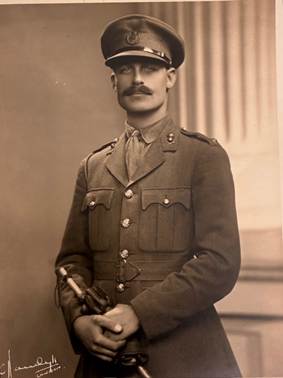
Second Lieutenant Royal Engineers September 1939 (aged 29)
Based on the island of Vis, opposite Split on the now Croatian coast, Tito’s partisans were assisted by the author Sir Fitzroy Maclean (See PC 391 Tales of Croatia June 2024). The latter was allowed to purchase a house in Korčula, not normally allowed for a foreigner.
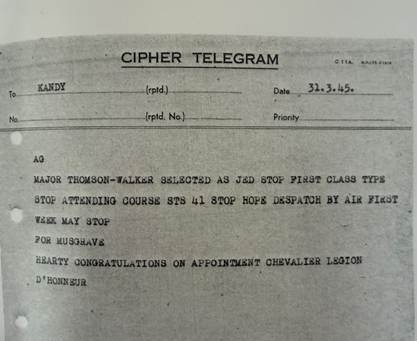
In February 1945 Philip attended a JEDBURGH course in Market Harborough. JEDBURGHs were originally 3-man parachute teams first used for post-D-Day operations, to liaise with and to reinforce resistance groups in France. The three men were of British, French and American nationalities, one the leader, another the deputy and the third the radio operator. By now an acting Major, Philip was posted (see photograph) to Malaya as Patrol Leading Officer in Force 136.
Malaya had been overrun in December 1941 by the Japanese Army, which also took Singapore the following February. Before Philip joined, a Force 136 officer, Captain Freddie Spencer Chapman, had succeeded in carrying out offensive operations against the occupying Japanese for over three years, with the aid of fighters from the Chinese Communist guerillas. For more than a year and a half, he and two other members of Force 136, John Davis and Richard Broome, had lived in jungle camps with Chinese Communist guerrillas, traveling long distances through dense and difficult jungle, while often suffering high fevers caused by malaria, beri-beri, black-water fever, tick typhus and pneumonia. Somehow, they had survived. In his book ‘The Jungle is Neutral’ (1950) Chapman attributed his survival to the ‘basic rule that the jungle is neutral, that one should view the surroundings as neither good nor bad’.
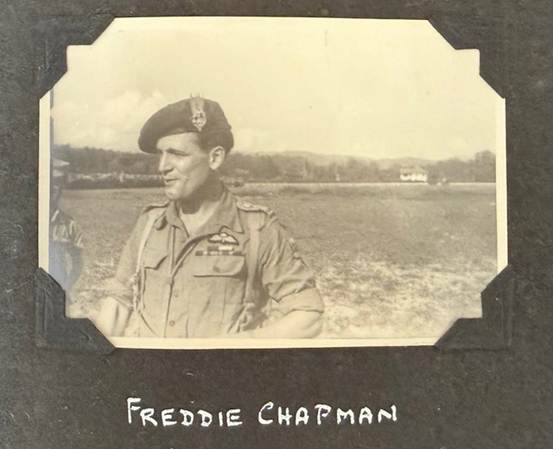
A photograph of Freddie Chapman from Philip’s album
Although the top command of Force 136 were British officers and civilians, most of those it trained and employed as agents were indigenous to the regions in which they operated. Burmese, Indians and Chinese were trained as agents for missions in Burma, for example. British and other European officers and NCOs went behind the lines to train resistance movements. Former colonial officials and men who had worked in these countries for various companies knew the local languages, the peoples and the land and so became invaluable to SOE.
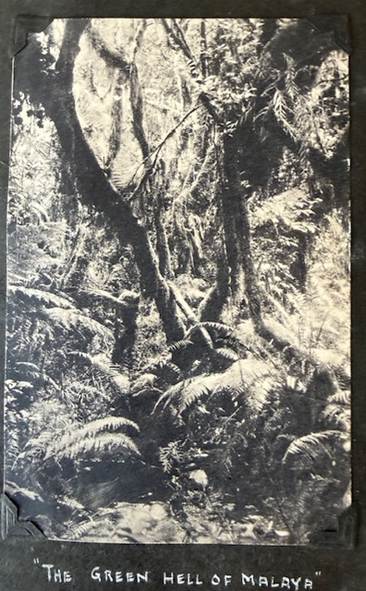
Philip’s black & white photograph of the ‘green hell of Malaya’. It was into this inhospitable landscape that Philip parachuted on 10th July 1945.
A year after the end of the war, Philip was made a Member of the British Empire (MBE). His citation gives an indication of what he did in Malaya:
“Major Thomson-Walker dropped into Selangor on 10th July 1945 to take command of a patrol established by Flight Lieutenant Robertson. His organisation and planned dispositions for offensive action were exemplary, and his ability and attention to detail under the rough and ready conditions of jungle life were exceptional. In covering the main North-South railway from Kuala Lumpur to Ipoh, he provided much pre-surrender intelligence on enemy troop movements, the value of which was enhanced by the fact that it was received from an area directly inland from the invasion beaches. As an organiser in Selangor, Major Thomson-Walker was outstanding amongst the Force 136 Liaison Officers, and the quality of his work is reflected in the praise accorded to his patrol on the occasion of an inspection in Klang on 11 September 1945 by the Supreme Allied Commander.”
Philip’s photograph album is full of grainy black & white photographs from his time in Force 136. First up, an indication that he didn’t land where he should have done.
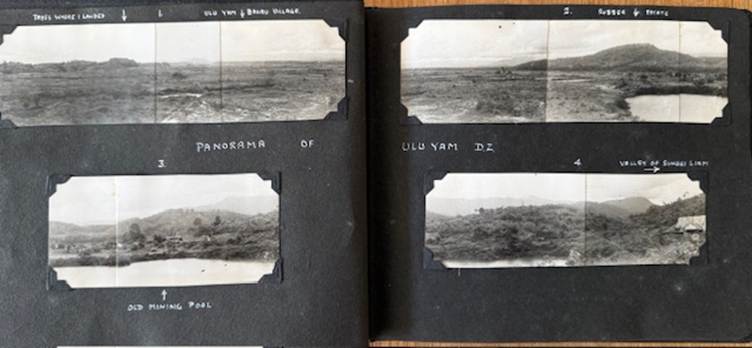
To be continued …….
Richard 29th May 2026
Hove
Note 1 On a trip to Belize I spent one night in the jungle: “Night comes early, and it was noisy, wet, extremely humid and hot.”
Note 2 The Special Operations Executive was raised in July 1940 on the orders of the Prime Minister Winston Churchill; its sole aim was to “set Europe ablaze”. It operated behind enemy lines to conduct espionage, sabotage, and reconnaissance, while aiding local resistance movements against Axis powers.
Often referred to as Churchill’s “underground army,” the SOE’s unconventional warfare tactics and operatives profoundly impacted the war through a variety of dangerous, covert operations.

